

Turkey, whole, dark meat, cooked, roasted
Whole food · Poultry Products
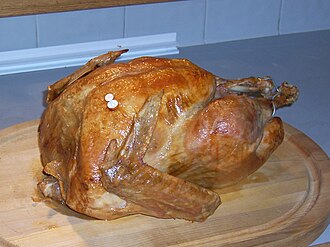
Photo: Wikipedia
Roasted whole dark meat turkey is the succulent, richly flavored heart of the holiday bird, prized for its moist, tender texture and deep, savory taste. Its dark meat, from the legs and thighs, boasts a higher fat content than white meat, which keeps it juicy and flavorful even when cooked to well-done. Nutritionally, it's a powerhouse of protein, offering a substantial 27.71 grams per 100-gram serving with virtually no carbohydrates.
Calorie split: 67% protein · 0% carbs · 33% fat
↓ Full nutrition💚 Why it's loved
People adore its comforting, savory flavor and forgiving, moist texture that stands up well to roasting and braising. It's the centerpiece of festive meals, especially Thanksgiving in the U.S., symbolizing tradition and communal feasting.
⚠️ Watch-outs & how to enjoy it better
Dark meat has a higher fat and calorie content than white meat, which some may limit. To counteract this, practice portion control and pair it with fiber-rich vegetables like roasted Brussels sprouts or a green salad to balance the meal. Also, ensure it's cooked to a safe internal temperature (165°F/74°C) to avoid foodborne illness.
Key benefits
- Excellent source of high-quality, complete protein for muscle maintenance.
- Naturally zero-carb, making it suitable for ketogenic and low-carb diets.
- Rich in minerals like selenium and phosphorus.
- Provides B vitamins, particularly niacin and B6, for energy metabolism.
- Contains more iron and zinc than turkey breast.
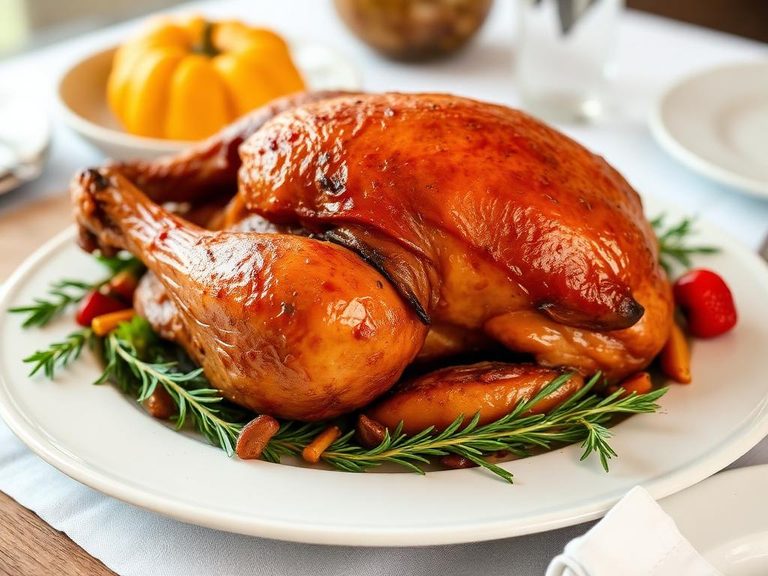
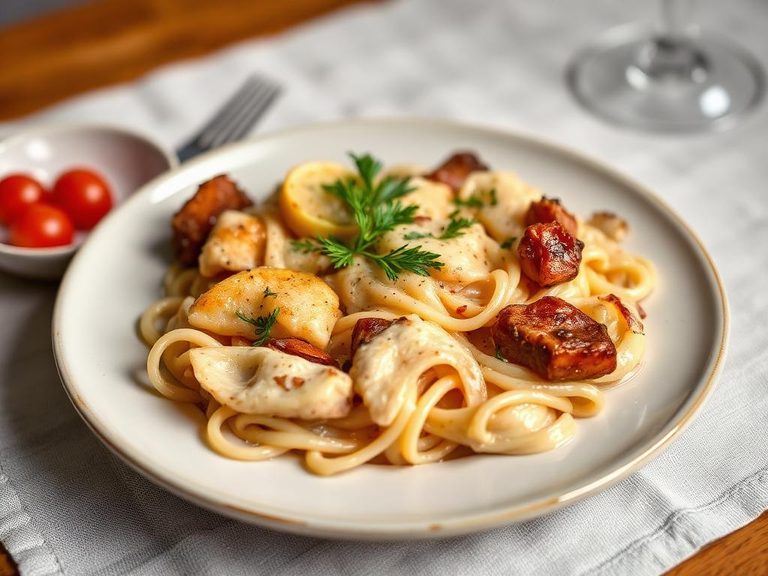
🍽️ Popular dishes




🌍 Where it's eaten
💡 Did you know?
A single roasted turkey leg can contain over 50% of the daily recommended intake for niacin (vitamin B3), a nutrient crucial for converting food into usable energy.
Full nutrition (USDA data · scales with serving)
| Water | 65.2 g |
| Energy | 173 kcal |
| Energy | 723 kj |
| Protein | 27.7 g |
| Total lipid (fat) | 6.0 g |
| Ash | 1.1 g |
| Carbohydrate, by difference | 0.00 g |
| Fiber, total dietary | 0.00 g |
| Total Sugars | 0.00 g |
| Calcium, Ca | 17.0 mg |
| Iron, Fe | 1.4 mg |
| Magnesium, Mg | 27.0 mg |
| Phosphorus, P | 212 mg |
| Potassium, K | 227 mg |
| Sodium, Na | 104 mg |
| Zinc, Zn | 3.5 mg |
| Copper, Cu | 0.13 mg |
| Manganese, Mn | 0.02 mg |
| Selenium, Se | 31.4 ug |
| Vitamin C, total ascorbic acid | 0.00 mg |
| Thiamin | 0.06 mg |
| Riboflavin | 0.38 mg |
| Niacin | 6.7 mg |
| Pantothenic acid | 1.0 mg |
| Vitamin B-6 | 0.44 mg |
| Folate, total | 9.0 ug |
| Folic acid | 0.00 ug |
| Folate, food | 9.0 ug |
| Folate, DFE | 9.0 ug |
| Choline, total | 95.8 mg |
| Vitamin B-12 | 1.6 ug |
| Vitamin B-12, added | 0.00 ug |
| Vitamin A, RAE | 5.0 ug |
| Retinol | 5.0 ug |
| Carotene, beta | 0.00 ug |
| Carotene, alpha | 0.00 ug |
| Cryptoxanthin, beta | 0.00 ug |
| Vitamin A, IU | 18.0 iu |
| Lycopene | 0.00 ug |
| Lutein + zeaxanthin | 0.00 ug |
| Vitamin E (alpha-tocopherol) | 0.07 mg |
| Vitamin E, added | 0.00 mg |
| Tocopherol, beta | 0.00 mg |
| Tocopherol, gamma | 0.04 mg |
| Tocopherol, delta | 0.03 mg |
| Tocotrienol, alpha | 0.00 mg |
| Tocotrienol, beta | 0.00 mg |
| Tocotrienol, gamma | 0.05 mg |
| Tocotrienol, delta | 0.00 mg |
| Vitamin D (D2 + D3), International Units | 10.0 iu |
| Vitamin D (D2 + D3) | 0.30 ug |
| Vitamin D3 (cholecalciferol) | 0.30 ug |
| Vitamin K (phylloquinone) | 0.00 ug |
| Vitamin K (Dihydrophylloquinone) | 0.00 ug |
| Alcohol, ethyl | 0.00 g |
| Caffeine | 0.00 mg |
| Theobromine | 0.00 mg |
Fat & fatty acid profile (per 100g)
| Fatty acids, total saturated | 1.8 g |
| SFA 4:0 | 0.00 g |
| SFA 6:0 | 0.00 g |
| SFA 8:0 | 0.00 g |
| SFA 10:0 | 0.01 g |
| SFA 12:0 | 0.02 g |
| SFA 14:0 | 0.06 g |
| SFA 15:0 | 0.01 g |
| SFA 16:0 | 1.2 g |
| SFA 17:0 | 0.02 g |
| SFA 18:0 | 0.51 g |
| SFA 20:0 | 0.01 g |
| SFA 22:0 | 0.00 g |
| SFA 24:0 | 0.00 g |
| Fatty acids, total monounsaturated | 2.1 g |
| MUFA 14:1 | 0.01 g |
| MUFA 15:1 | 0.00 g |
| MUFA 16:1 | 0.19 g |
| MUFA 16:1 c | 0.18 g |
| MUFA 17:1 | 0.01 g |
| MUFA 18:1 | 1.8 g |
| MUFA 18:1 c | 1.8 g |
| MUFA 20:1 | 0.03 g |
| MUFA 22:1 | 0.00 g |
| MUFA 22:1 c | 0.00 g |
| MUFA 24:1 c | 0.00 g |
| Fatty acids, total polyunsaturated | 1.7 g |
| PUFA 18:2 | 1.4 g |
| PUFA 18:2 n-6 c,c | 1.4 g |
| PUFA 18:2 CLAs | 0.01 g |
| PUFA 18:3 | 0.07 g |
| PUFA 18:3 n-3 c,c,c (ALA) | 0.07 g |
| PUFA 18:3 n-6 c,c,c | 0.00 g |
| PUFA 18:4 | 0.00 g |
| PUFA 20:2 n-6 c,c | 0.01 g |
| PUFA 20:3 | 0.01 g |
| PUFA 20:3 n-3 | 0.00 g |
| PUFA 20:3 n-6 | 0.01 g |
| PUFA 20:4 | 0.09 g |
| PUFA 20:5 n-3 (EPA) | 0.01 g |
| PUFA 22:4 | 0.02 g |
| PUFA 22:5 n-3 (DPA) | 0.01 g |
| PUFA 22:6 n-3 (DHA) | 0.01 g |
| Fatty acids, total trans | 0.08 g |
| Fatty acids, total trans-monoenoic | 0.07 g |
| TFA 16:1 t | 0.00 g |
| TFA 18:1 t | 0.06 g |
| TFA 22:1 t | 0.00 g |
| TFA 18:2 t not further defined | 0.01 g |
| Fatty acids, total trans-polyenoic | 0.01 g |
| Cholesterol | 128 mg |
Amino acid profile (per 100g)
| Tryptophan | 0.29 g |
| Threonine | 1.0 g |
| Isoleucine | 0.79 g |
| Leucine | 1.9 g |
| Lysine | 2.3 g |
| Methionine | 0.72 g |
| Cystine | 0.26 g |
| Phenylalanine | 0.89 g |
| Tyrosine | 0.82 g |
| Valine | 0.89 g |
| Arginine | 1.6 g |
| Histidine | 0.75 g |
| Alanine | 1.5 g |
| Aspartic acid | 2.2 g |
| Glutamic acid | 3.8 g |
| Glycine | 1.2 g |
| Proline | 1.5 g |
| Serine | 1.1 g |
FAQ
Why is dark meat turkey more flavorful than white meat?
Dark meat comes from muscles used for walking and standing, which contain more myoglobin (an oxygen-storing protein) and fat. This results in a richer, more robust flavor and a moister texture.
How do I keep roasted dark meat turkey from drying out?
The key is not to overcook it. Use a meat thermometer and pull it out at 165°F (74°C). Letting it rest for 20-30 minutes after roasting allows juices to redistribute throughout the meat.
Is the fat in turkey dark meat healthy?
Turkey fat is primarily monounsaturated fat, similar to that found in olive oil. While it should be consumed in moderation as part of a balanced diet, it's a source of healthier unsaturated fats compared to saturated fats.
Nutrient density (calculated · NRF9.3)
Nutrient Rich Foods index: beneficial nutrients (protein, fiber, vitamins, minerals) minus saturated fat, added sugar & sodium, per 100 kcal.
NRF9.3 index — Fulgoni, Keast & Drewnowski, 2009. Computed from USDA nutrients.
Weight-loss friendliness (composite index)
Energy density 1.73 kcal/g · 64% calories from protein · 0.0 g fiber · 0.0 g sugar per 100 g.
Composite of energy density (Rolls et al., 1999), protein & fiber satiety, minus sugar. A calculated heuristic — ranks satiety-per-calorie, not a clinical measure.
Dietary load (calculated from USDA values)
Potential renal acid load. Positive = acid-forming, negative = alkaline-forming.
Sodium-to-potassium ratio: 0.46 (lower is better — aim for ≤ 1)
Sodium:potassium per WHO potassium guidance. Computed from USDA nutrients.