

Turkey, retail parts, wing, meat and skin, cooked, roasted
Whole food · Poultry Products

Photo: Wikipedia
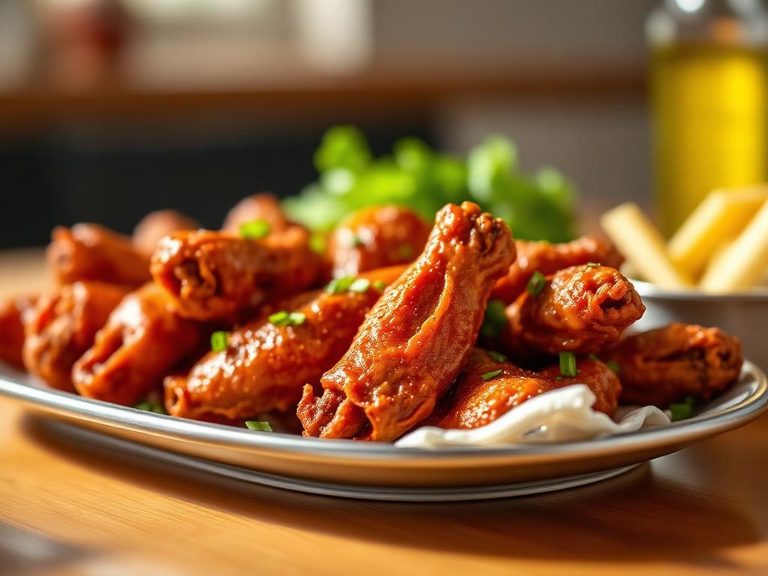
This is the rich, savory meat from a turkey wing, roasted with its skin intact, delivering a deeply satisfying, succulent bite. The texture is tender yet substantial, with the skin adding a crispy, fatty layer that amplifies the flavor. Nutritionally, it's a powerhouse of protein with virtually no carbohydrates.
Calorie split: 49% protein · 0% carbs · 51% fat
↓ Full nutrition💚 Why it's loved
People adore it for the perfect contrast between the juicy, flavorful meat and the crispy, salty skin, especially when roasted to perfection. It's a beloved centerpiece for festive meals and a versatile protein that stands up to bold seasonings and sauces.
⚠️ Watch-outs & how to enjoy it better
The skin and dark meat are relatively high in saturated fat and calories, which may concern those monitoring fat intake. To enjoy it healthily, practice portion control, remove the skin if needed, and pair it with fiber-rich vegetables or a fresh salad to balance the meal.
Key benefits
- Excellent source of complete protein for muscle maintenance and repair.
- Provides essential B vitamins like niacin and B6 for energy metabolism.
- Contains minerals such as selenium and phosphorus for immune and bone health.
- The skin offers dietary fat, which aids in the absorption of fat-soluble vitamins.
🍽️ Popular dishes



🌍 Where it's eaten
💡 Did you know?
A single turkey wing can weigh nearly a pound, making it a substantial portion that's often shared or considered a meal in itself.
Full nutrition (USDA data · scales with serving)
| Water | 57.3 g |
| Energy | 235 kcal |
| Energy | 983 kj |
| Protein | 28.7 g |
| Total lipid (fat) | 13.3 g |
| Ash | 1.1 g |
| Carbohydrate, by difference | 0.13 g |
| Fiber, total dietary | 0.00 g |
| Total Sugars | 0.00 g |
| Calcium, Ca | 14.0 mg |
| Iron, Fe | 1.0 mg |
| Magnesium, Mg | 24.0 mg |
| Phosphorus, P | 192 mg |
| Potassium, K | 215 mg |
| Sodium, Na | 106 mg |
| Zinc, Zn | 3.0 mg |
| Copper, Cu | 0.07 mg |
| Manganese, Mn | 0.01 mg |
| Selenium, Se | 28.4 ug |
| Vitamin C, total ascorbic acid | 0.00 mg |
| Thiamin | 0.04 mg |
| Riboflavin | 0.20 mg |
| Niacin | 8.9 mg |
| Pantothenic acid | 0.78 mg |
| Vitamin B-6 | 0.59 mg |
| Folate, total | 9.0 ug |
| Folic acid | 0.00 ug |
| Folate, food | 9.0 ug |
| Folate, DFE | 9.0 ug |
| Choline, total | 77.1 mg |
| Betaine | 3.4 mg |
| Vitamin B-12 | 1.4 ug |
| Vitamin B-12, added | 0.00 ug |
| Vitamin A, RAE | 24.0 ug |
| Retinol | 24.0 ug |
| Carotene, beta | 0.00 ug |
| Carotene, alpha | 0.00 ug |
| Cryptoxanthin, beta | 0.00 ug |
| Vitamin A, IU | 80.0 iu |
| Lycopene | 0.00 ug |
| Lutein + zeaxanthin | 0.00 ug |
| Vitamin E (alpha-tocopherol) | 0.17 mg |
| Vitamin E, added | 0.00 mg |
| Tocopherol, beta | 0.00 mg |
| Tocopherol, gamma | 0.02 mg |
| Tocopherol, delta | 0.00 mg |
| Tocotrienol, alpha | 0.00 mg |
| Tocotrienol, beta | 0.00 mg |
| Tocotrienol, gamma | 0.02 mg |
| Tocotrienol, delta | 0.00 mg |
| Vitamin D (D2 + D3), International Units | 34.0 iu |
| Vitamin D (D2 + D3) | 0.80 ug |
| Vitamin D3 (cholecalciferol) | 0.80 ug |
| Vitamin K (phylloquinone) | 0.00 ug |
| Alcohol, ethyl | 0.00 g |
| Caffeine | 0.00 mg |
| Theobromine | 0.00 mg |
Fat & fatty acid profile (per 100g)
| Fatty acids, total saturated | 3.7 g |
| SFA 4:0 | 0.00 g |
| SFA 6:0 | 0.00 g |
| SFA 8:0 | 0.00 g |
| SFA 10:0 | 0.01 g |
| SFA 12:0 | 0.04 g |
| SFA 14:0 | 0.13 g |
| SFA 15:0 | 0.02 g |
| SFA 16:0 | 2.5 g |
| SFA 17:0 | 0.04 g |
| SFA 18:0 | 0.89 g |
| SFA 20:0 | 0.01 g |
| SFA 22:0 | 0.01 g |
| SFA 24:0 | 0.01 g |
| Fatty acids, total monounsaturated | 4.8 g |
| MUFA 14:1 | 0.02 g |
| MUFA 15:1 | 0.00 g |
| MUFA 16:1 | 0.50 g |
| MUFA 16:1 c | 0.49 g |
| MUFA 17:1 | 0.02 g |
| MUFA 18:1 | 4.2 g |
| MUFA 18:1 c | 4.0 g |
| MUFA 20:1 | 0.06 g |
| MUFA 22:1 | 0.01 g |
| MUFA 22:1 c | 0.00 g |
| MUFA 24:1 c | 0.00 g |
| Fatty acids, total polyunsaturated | 3.8 g |
| PUFA 18:2 | 3.4 g |
| PUFA 18:2 n-6 c,c | 3.4 g |
| PUFA 18:2 CLAs | 0.02 g |
| PUFA 18:3 | 0.21 g |
| PUFA 18:3 n-3 c,c,c (ALA) | 0.20 g |
| PUFA 18:3 n-6 c,c,c | 0.01 g |
| PUFA 18:4 | 0.00 g |
| PUFA 20:2 n-6 c,c | 0.02 g |
| PUFA 20:3 | 0.02 g |
| PUFA 20:3 n-3 | 0.00 g |
| PUFA 20:3 n-6 | 0.01 g |
| PUFA 20:4 | 0.11 g |
| PUFA 20:5 n-3 (EPA) | 0.01 g |
| PUFA 22:4 | 0.03 g |
| PUFA 22:5 n-3 (DPA) | 0.01 g |
| PUFA 22:6 n-3 (DHA) | 0.01 g |
| Fatty acids, total trans | 0.17 g |
| Fatty acids, total trans-monoenoic | 0.14 g |
| TFA 16:1 t | 0.01 g |
| TFA 18:1 t | 0.12 g |
| TFA 22:1 t | 0.00 g |
| TFA 18:2 t not further defined | 0.04 g |
| Fatty acids, total trans-polyenoic | 0.04 g |
| Cholesterol | 115 mg |
Amino acid profile (per 100g)
| Tryptophan | 0.31 g |
| Threonine | 1.1 g |
| Isoleucine | 0.94 g |
| Leucine | 2.2 g |
| Lysine | 2.7 g |
| Methionine | 0.74 g |
| Cystine | 0.26 g |
| Phenylalanine | 0.98 g |
| Tyrosine | 0.89 g |
| Valine | 1.0 g |
| Arginine | 1.8 g |
| Histidine | 0.80 g |
| Alanine | 1.8 g |
| Aspartic acid | 2.5 g |
| Glutamic acid | 4.1 g |
| Glycine | 1.8 g |
| Proline | 1.6 g |
| Serine | 1.2 g |
FAQ
Is turkey wing meat considered white or dark meat?
Turkey wings contain both. The breast portion on the wing is white meat, while the drumette and other attached muscles are dark meat, which is richer in fat and flavor.
How does the nutrition compare to chicken wings?
Turkey wings are generally larger and have a higher protein-to-fat ratio than chicken wings, though the skin-on versions of both are high in fat. Per 100g, roasted turkey wing meat is slightly leaner than roasted chicken wing meat.
What's the best way to keep the skin crispy?
Pat the wings completely dry before seasoning, roast at a high temperature (around 400°F/200°C), and avoid covering with foil during cooking. You can also start with a dry brine to draw out moisture.
Nutrient density (calculated · NRF9.3)
Nutrient Rich Foods index: beneficial nutrients (protein, fiber, vitamins, minerals) minus saturated fat, added sugar & sodium, per 100 kcal.
NRF9.3 index — Fulgoni, Keast & Drewnowski, 2009. Computed from USDA nutrients.
Weight-loss friendliness (composite index)
Energy density 2.35 kcal/g · 49% calories from protein · 0.0 g fiber · 0.0 g sugar per 100 g.
Composite of energy density (Rolls et al., 1999), protein & fiber satiety, minus sugar. A calculated heuristic — ranks satiety-per-calorie, not a clinical measure.
Dietary load (calculated from USDA values)
Potential renal acid load. Positive = acid-forming, negative = alkaline-forming.
Sodium-to-potassium ratio: 0.49 (lower is better — aim for ≤ 1)
Sodium:potassium per WHO potassium guidance. Computed from USDA nutrients.