

Sweet Potatoes, french fried, frozen as packaged, salt added in processing
Whole food · Vegetables and Vegetable Products

Photo: Wikipedia
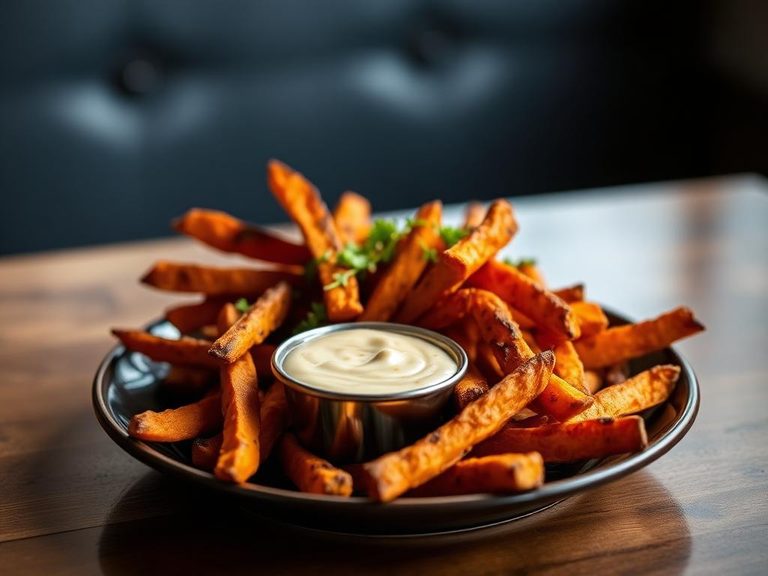
These are pre-cut, frozen sweet potato fries, typically blanched and lightly oiled before freezing, ready to be baked or fried until golden and crisp. They offer a satisfying crunch on the outside with a soft, sweet interior, balancing earthy notes with a hint of caramelization. Nutritionally, they provide a solid source of fiber (5.7g per 100g) and beta-carotene, though the added salt and processing mean they are more of an indulgent side than a health food staple.
Calorie split: 4% protein · 62% carbs · 35% fat
↓ Full nutrition💚 Why it's loved
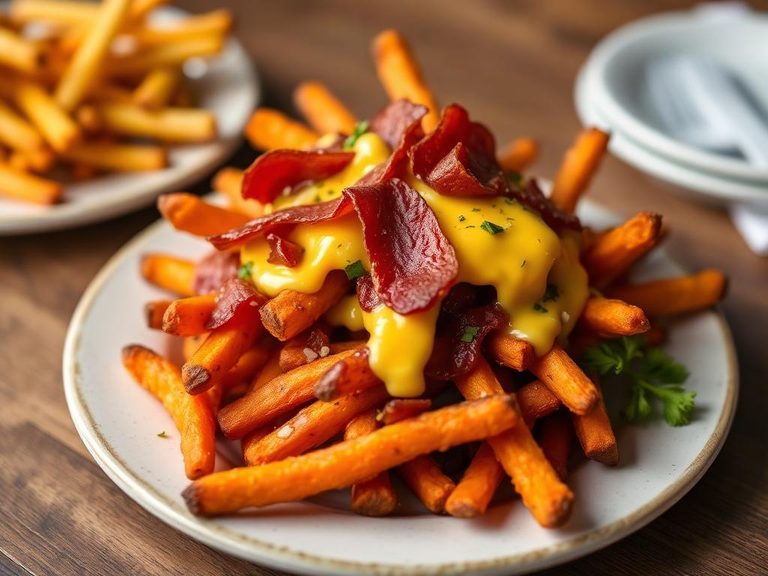
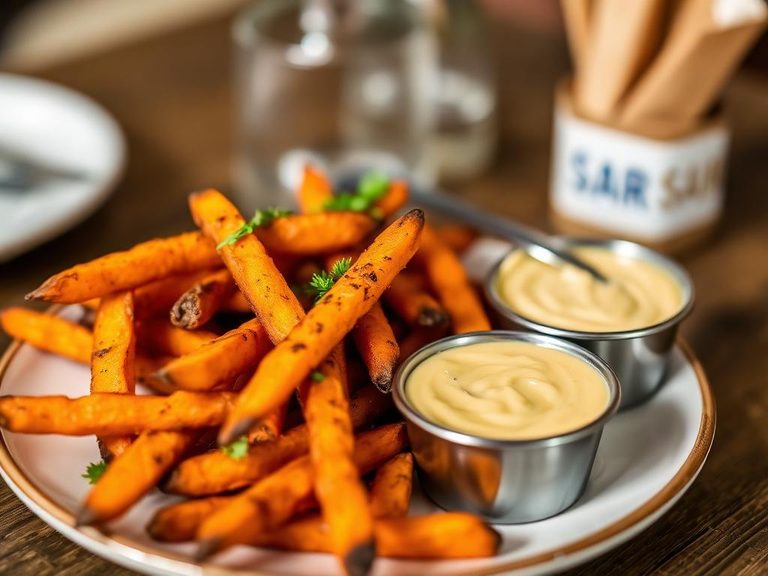
People adore them for their perfect balance of sweet and savory, with a crispy exterior that gives way to a creamy, tender inside. They're a beloved comfort food that pairs effortlessly with burgers, sandwiches, or as a standalone snack with dipping sauces.
⚠️ Watch-outs & how to enjoy it better
The added salt (often 200-300mg per serving) and the potential for blood sugar spikes from the 12.9g sugar content can be concerns for those watching sodium or glucose levels. To counteract this, pair them with a protein-rich dip like Greek yogurt or hummus, practice portion control (stick to 100g), and avoid adding extra salt during cooking.
Key benefits
- Good source of dietary fiber (5.7g/100g) for digestive health
- Rich in beta-carotene, which the body converts to vitamin A
- Convenient and quick to prepare from frozen
- Provides complex carbohydrates for sustained energy
- Naturally sweet flavor reduces need for added sugars
🍽️ Popular dishes
🌍 Where it's eaten
💡 Did you know?
Sweet potatoes are not actually related to regular potatoes—they belong to the morning glory family (Convolvulaceae), while potatoes are in the nightshade family (Solanaceae).
Full nutrition (USDA data · scales with serving)
| Water | 52.0 g |
| Energy | 182 kcal |
| Energy | 762 kj |
| Protein | 2.2 g |
| Total lipid (fat) | 8.9 g |
| Ash | 1.4 g |
| Carbohydrate, by difference | 35.6 g |
| Fiber, total dietary | 5.7 g |
| Total Sugars | 12.9 g |
| Sucrose | 5.4 g |
| Glucose | 0.81 g |
| Fructose | 0.57 g |
| Lactose | 0.00 g |
| Maltose | 6.1 g |
| Galactose | 0.00 g |
| Starch | 13.2 g |
| Calcium, Ca | 52.0 mg |
| Iron, Fe | 0.77 mg |
| Magnesium, Mg | 26.0 mg |
| Phosphorus, P | 59.0 mg |
| Potassium, K | 409 mg |
| Sodium, Na | 146 mg |
| Zinc, Zn | 0.38 mg |
| Copper, Cu | 0.18 mg |
| Manganese, Mn | 0.48 mg |
| Selenium, Se | 0.40 ug |
| Vitamin C, total ascorbic acid | 7.5 mg |
| Thiamin | 0.09 mg |
| Riboflavin | 0.09 mg |
| Niacin | 0.70 mg |
| Pantothenic acid | 0.46 mg |
| Vitamin B-6 | 0.18 mg |
| Folate, total | 32.0 ug |
| Folic acid | 0.00 ug |
| Folate, food | 32.0 ug |
| Folate, DFE | 32.0 ug |
| Choline, total | 26.0 mg |
| Vitamin B-12 | 0.00 ug |
| Vitamin B-12, added | 0.00 ug |
| Vitamin A, RAE | 434 ug |
| Retinol | 0.00 ug |
| Carotene, beta | 5204 ug |
| Carotene, alpha | 0.00 ug |
| Cryptoxanthin, beta | 0.00 ug |
| Vitamin A, IU | 8674 iu |
| Lycopene | 0.00 ug |
| Lutein + zeaxanthin | 8.0 ug |
| Vitamin E (alpha-tocopherol) | 1.5 mg |
| Vitamin E, added | 0.00 mg |
| Tocopherol, beta | 0.00 mg |
| Tocopherol, gamma | 1.0 mg |
| Tocopherol, delta | 0.19 mg |
| Tocotrienol, alpha | 0.00 mg |
| Tocotrienol, beta | 0.00 mg |
| Tocotrienol, gamma | 0.00 mg |
| Tocotrienol, delta | 0.00 mg |
| Vitamin D (D2 + D3), International Units | 0.00 iu |
| Vitamin D (D2 + D3) | 0.00 ug |
| Vitamin K (phylloquinone) | 4.6 ug |
| Alcohol, ethyl | 0.00 g |
| Caffeine | 0.00 mg |
| Theobromine | 0.00 mg |
Fat & fatty acid profile (per 100g)
| Fatty acids, total saturated | 1.2 g |
| SFA 4:0 | 0.00 g |
| SFA 6:0 | 0.00 g |
| SFA 8:0 | 0.01 g |
| SFA 10:0 | 0.01 g |
| SFA 12:0 | 0.00 g |
| SFA 14:0 | 0.02 g |
| SFA 15:0 | 0.00 g |
| SFA 16:0 | 0.81 g |
| SFA 17:0 | 0.01 g |
| SFA 18:0 | 0.23 g |
| SFA 20:0 | 0.03 g |
| SFA 22:0 | 0.03 g |
| SFA 24:0 | 0.01 g |
| Fatty acids, total monounsaturated | 3.7 g |
| MUFA 14:1 | 0.00 g |
| MUFA 15:1 | 0.00 g |
| MUFA 16:1 | 0.02 g |
| MUFA 16:1 c | 0.02 g |
| MUFA 17:1 | 0.00 g |
| MUFA 18:1 | 3.6 g |
| MUFA 18:1 c | 3.6 g |
| MUFA 20:1 | 0.07 g |
| MUFA 22:1 | 0.01 g |
| MUFA 22:1 c | 0.00 g |
| MUFA 24:1 c | 0.00 g |
| Fatty acids, total polyunsaturated | 2.9 g |
| PUFA 18:2 | 2.5 g |
| PUFA 18:2 n-6 c,c | 2.5 g |
| PUFA 18:2 CLAs | 0.02 g |
| PUFA 18:3 | 0.33 g |
| PUFA 18:3 n-3 c,c,c (ALA) | 0.30 g |
| PUFA 18:3 n-6 c,c,c | 0.02 g |
| PUFA 18:3i | 0.00 g |
| PUFA 18:4 | 0.00 g |
| PUFA 20:2 n-6 c,c | 0.00 g |
| PUFA 20:3 | 0.00 g |
| PUFA 20:3 n-3 | 0.00 g |
| PUFA 20:3 n-6 | 0.00 g |
| PUFA 20:4 | 0.00 g |
| PUFA 20:5 n-3 (EPA) | 0.00 g |
| PUFA 22:4 | 0.00 g |
| PUFA 22:5 n-3 (DPA) | 0.00 g |
| PUFA 22:6 n-3 (DHA) | 0.00 g |
| Fatty acids, total trans | 0.04 g |
| Fatty acids, total trans-monoenoic | 0.02 g |
| TFA 16:1 t | 0.00 g |
| TFA 18:1 t | 0.02 g |
| TFA 22:1 t | 0.00 g |
| TFA 18:2 t not further defined | 0.02 g |
| Fatty acids, total trans-polyenoic | 0.02 g |
| Cholesterol | 0.00 mg |
Amino acid profile (per 100g)
Estimated from Babyfood, vegetables, sweet potatoes strained — USDA does not publish this profile for Sweet Potatoes.
| Tryptophan | 0.02 g |
| Threonine | 0.05 g |
| Isoleucine | 0.05 g |
| Leucine | 0.08 g |
| Lysine | 0.04 g |
| Methionine | 0.02 g |
| Cystine | 0.01 g |
| Phenylalanine | 0.06 g |
| Tyrosine | 0.04 g |
| Valine | 0.07 g |
| Arginine | 0.05 g |
| Histidine | 0.03 g |
| Alanine | 0.06 g |
| Aspartic acid | 0.20 g |
| Glutamic acid | 0.12 g |
| Glycine | 0.05 g |
| Proline | 0.06 g |
| Serine | 0.05 g |
FAQ
Are frozen sweet potato fries healthier than regular frozen french fries?
Generally, yes. Sweet potato fries contain more fiber, vitamin A, and antioxidants than regular potato fries, though both are still processed and can be high in fat and sodium depending on preparation.
How do I get crispy sweet potato fries from frozen?
Preheat your oven to 425°F (220°C), spread fries in a single layer on a baking sheet, and bake for 20-25 minutes, flipping halfway. For extra crispness, you can lightly coat them with cornstarch before baking.
Can I eat sweet potato fries if I'm watching my blood sugar?
You can, but in moderation. The 12.9g of sugar per 100g can cause blood sugar spikes. Pair them with protein (like grilled chicken) or healthy fats (like avocado) to slow glucose absorption, and stick to smaller portions.
Nutrient density (calculated · NRF9.3)
Nutrient Rich Foods index: beneficial nutrients (protein, fiber, vitamins, minerals) minus saturated fat, added sugar & sodium, per 100 kcal.
NRF9.3 index — Fulgoni, Keast & Drewnowski, 2009. Computed from USDA nutrients.
Weight-loss friendliness (composite index)
Energy density 1.82 kcal/g · 5% calories from protein · 5.7 g fiber · 12.9 g sugar per 100 g.
Composite of energy density (Rolls et al., 1999), protein & fiber satiety, minus sugar. A calculated heuristic — ranks satiety-per-calorie, not a clinical measure.
Dietary load (calculated from USDA values)
Potential renal acid load. Positive = acid-forming, negative = alkaline-forming.
Sodium-to-potassium ratio: 0.36 (lower is better — aim for ≤ 1)
Sodium:potassium per WHO potassium guidance. Computed from USDA nutrients.