

Restaurant, Chinese, general tso's chicken
Whole food · Restaurant Foods
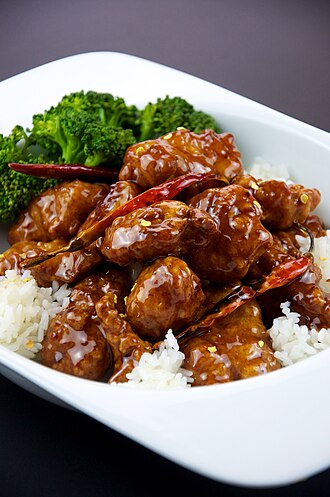
Photo: Wikipedia
General Tso's chicken is a popular Chinese-American dish featuring bite-sized, deep-fried chicken pieces coated in a glossy, sweet-and-spicy sauce. The texture is a satisfying contrast of crispy coating and tender meat, while the flavor profile balances tangy, savory, and mildly hot notes. Nutritionally, it is a calorie-dense dish, with a significant portion of its energy coming from fat and sugar.
Calorie split: 18% protein · 33% carbs · 50% fat
↓ Full nutrition💚 Why it's loved
People love it for its addictive sweet-spicy-tangy flavor profile and the satisfying crunch of the fried chicken. It's a staple of Chinese-American takeout, offering a bold and comforting taste experience that pairs well with steamed rice.
⚠️ Watch-outs & how to enjoy it better
The dish is high in calories, sodium, and added sugar, which can contribute to blood-sugar spikes and is a concern for those monitoring sodium or sugar intake. To counteract this, opt for a smaller portion, pair it with a large serving of steamed vegetables or plain rice to dilute the sauce, and consider asking for the sauce on the side to control the amount used.
Key benefits
- Provides a good source of protein from the chicken.
- Contains carbohydrates for quick energy.
- Often includes garlic and ginger, which have antioxidant properties.
- The sauce can stimulate appetite with its bold flavors.
🍽️ Popular dishes
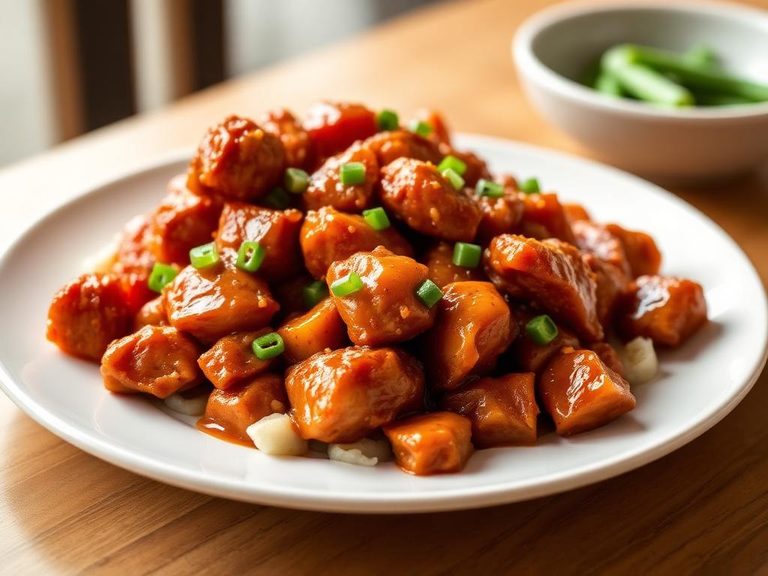
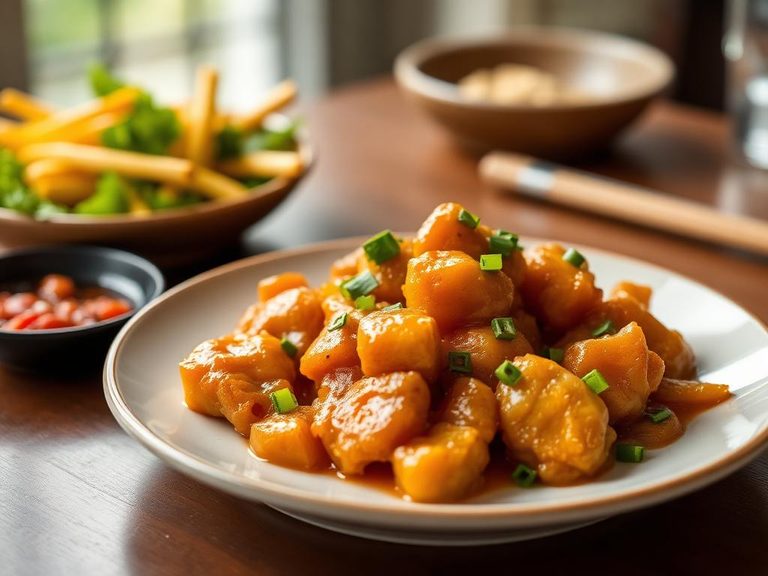
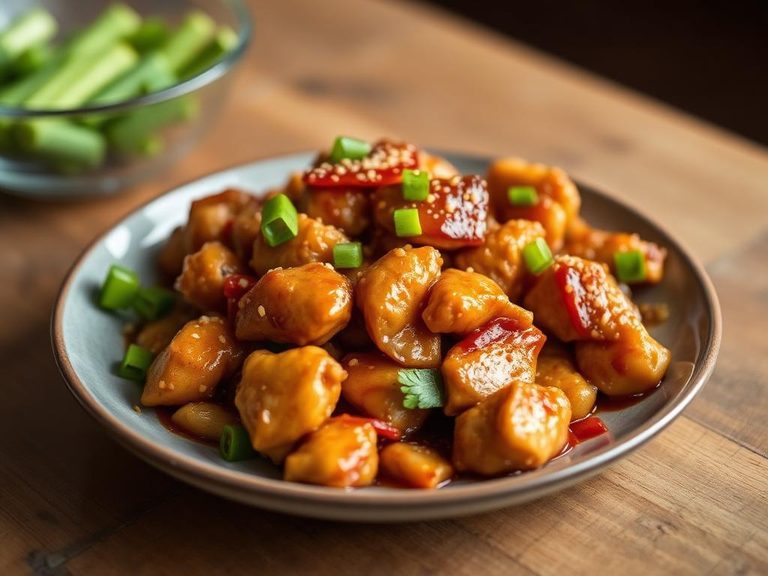
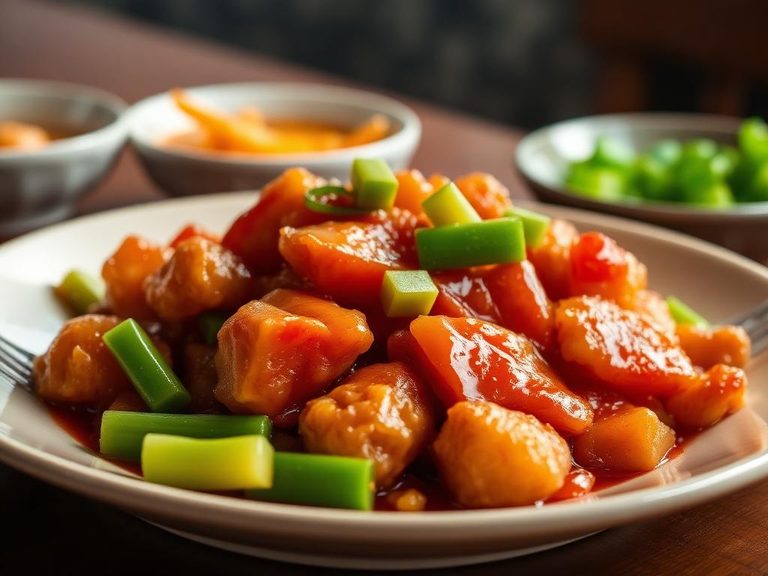
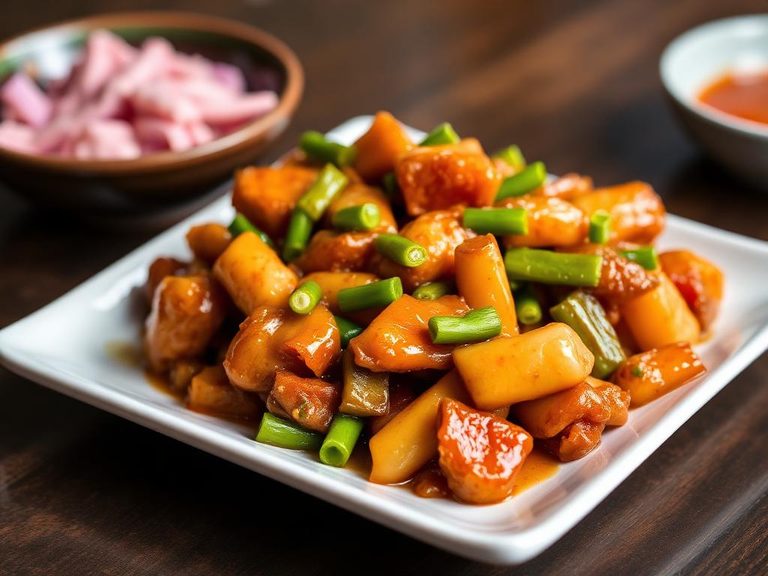
🌍 Where it's eaten
💡 Did you know?
Despite its name, the dish is not widely known in China and is believed to have been created in Taiwan or New York City in the 1970s, named after a Hunanese military leader from the Qing dynasty.
Full nutrition (USDA data · scales with serving)
| Water | 45.1 g |
| Energy | 295 kcal |
| Energy | 1233 kj |
| Protein | 12.9 g |
| Total lipid (fat) | 16.4 g |
| Ash | 1.6 g |
| Carbohydrate, by difference | 24.0 g |
| Fiber, total dietary | 0.90 g |
| Total Sugars | 11.6 g |
| Sucrose | 10.5 g |
| Glucose | 0.62 g |
| Fructose | 0.51 g |
| Lactose | 0.00 g |
| Maltose | 0.00 g |
| Galactose | 0.00 g |
| Starch | 11.8 g |
| Calcium, Ca | 12.0 mg |
| Iron, Fe | 1.2 mg |
| Magnesium, Mg | 18.0 mg |
| Phosphorus, P | 127 mg |
| Potassium, K | 201 mg |
| Sodium, Na | 435 mg |
| Zinc, Zn | 1.3 mg |
| Copper, Cu | 0.05 mg |
| Manganese, Mn | 0.07 mg |
| Selenium, Se | 14.4 ug |
| Vitamin C, total ascorbic acid | 1.6 mg |
| Thiamin | 0.03 mg |
| Riboflavin | 0.12 mg |
| Niacin | 2.9 mg |
| Pantothenic acid | 0.62 mg |
| Vitamin B-6 | 0.20 mg |
| Folate, total | 11.0 ug |
| Folic acid | 5.0 ug |
| Folate, food | 6.0 ug |
| Folate, DFE | 15.0 ug |
| Choline, total | 41.5 mg |
| Betaine | 5.5 mg |
| Vitamin B-12 | 0.22 ug |
| Vitamin B-12, added | 0.00 ug |
| Vitamin A, RAE | 11.0 ug |
| Retinol | 7.0 ug |
| Carotene, beta | 37.0 ug |
| Carotene, alpha | 2.0 ug |
| Cryptoxanthin, beta | 9.0 ug |
| Vitamin A, IU | 94.0 iu |
| Lycopene | 20.0 ug |
| Lutein + zeaxanthin | 99.0 ug |
| Vitamin E (alpha-tocopherol) | 1.2 mg |
| Vitamin E, added | 0.00 mg |
| Tocopherol, beta | 0.15 mg |
| Tocopherol, gamma | 6.1 mg |
| Tocopherol, delta | 2.8 mg |
| Tocotrienol, alpha | 0.02 mg |
| Tocotrienol, beta | 0.00 mg |
| Tocotrienol, gamma | 0.02 mg |
| Tocotrienol, delta | 0.00 mg |
| Vitamin D (D2 + D3), International Units | 6.0 iu |
| Vitamin D (D2 + D3) | 0.20 ug |
| Vitamin D3 (cholecalciferol) | 0.20 ug |
| Vitamin K (phylloquinone) | 38.2 ug |
| Vitamin K (Menaquinone-4) | 7.2 ug |
| Alcohol, ethyl | 0.00 g |
| Caffeine | 0.00 mg |
| Theobromine | 0.00 mg |
Fat & fatty acid profile (per 100g)
| Fatty acids, total saturated | 2.8 g |
| SFA 4:0 | 0.01 g |
| SFA 6:0 | 0.00 g |
| SFA 8:0 | 0.01 g |
| SFA 10:0 | 0.00 g |
| SFA 12:0 | 0.00 g |
| SFA 14:0 | 0.03 g |
| SFA 15:0 | 0.01 g |
| SFA 16:0 | 1.9 g |
| SFA 17:0 | 0.02 g |
| SFA 18:0 | 0.68 g |
| SFA 20:0 | 0.04 g |
| SFA 22:0 | 0.04 g |
| SFA 24:0 | 0.01 g |
| Fatty acids, total monounsaturated | 3.9 g |
| MUFA 14:1 | 0.01 g |
| MUFA 15:1 | 0.00 g |
| MUFA 16:1 | 0.19 g |
| MUFA 16:1 c | 0.18 g |
| MUFA 17:1 | 0.01 g |
| MUFA 18:1 | 3.6 g |
| MUFA 18:1 c | 3.6 g |
| MUFA 20:1 | 0.07 g |
| MUFA 22:1 | 0.01 g |
| MUFA 22:1 c | 0.00 g |
| MUFA 24:1 c | 0.00 g |
| Fatty acids, total polyunsaturated | 7.5 g |
| PUFA 18:2 | 6.5 g |
| PUFA 18:2 n-6 c,c | 6.5 g |
| PUFA 18:2 CLAs | 0.02 g |
| PUFA 18:3 | 0.84 g |
| PUFA 18:3 n-3 c,c,c (ALA) | 0.84 g |
| PUFA 18:3 n-6 c,c,c | 0.01 g |
| PUFA 18:4 | 0.00 g |
| PUFA 20:2 n-6 c,c | 0.01 g |
| PUFA 20:3 | 0.01 g |
| PUFA 20:3 n-3 | 0.00 g |
| PUFA 20:3 n-6 | 0.01 g |
| PUFA 20:4 | 0.06 g |
| PUFA 20:5 n-3 (EPA) | 0.01 g |
| PUFA 22:4 | 0.01 g |
| PUFA 22:5 n-3 (DPA) | 0.01 g |
| PUFA 22:6 n-3 (DHA) | 0.01 g |
| Fatty acids, total trans | 0.09 g |
| Fatty acids, total trans-monoenoic | 0.03 g |
| TFA 16:1 t | 0.00 g |
| TFA 18:1 t | 0.03 g |
| TFA 22:1 t | 0.00 g |
| TFA 18:2 t not further defined | 0.06 g |
| Fatty acids, total trans-polyenoic | 0.06 g |
| Cholesterol | 53.0 mg |
Amino acid profile (per 100g)
| Tryptophan | 0.14 g |
| Threonine | 0.55 g |
| Isoleucine | 0.56 g |
| Leucine | 1.0 g |
| Lysine | 1.1 g |
| Methionine | 0.33 g |
| Cystine | 0.14 g |
| Phenylalanine | 0.56 g |
| Tyrosine | 0.39 g |
| Valine | 0.61 g |
| Arginine | 0.69 g |
| Histidine | 0.33 g |
| Alanine | 0.75 g |
| Aspartic acid | 1.2 g |
| Glutamic acid | 2.4 g |
| Glycine | 0.61 g |
| Proline | 0.49 g |
| Serine | 0.53 g |
FAQ
Is General Tso's chicken authentic Chinese food?
It is primarily a Chinese-American invention, though its roots may trace to Hunan cuisine or a Taiwanese chef. It is not a common dish in mainland China.
How can I make General Tso's chicken healthier at home?
You can bake or air-fry the chicken instead of deep-frying, use less sugar in the sauce, and increase the ratio of vegetables like broccoli or bell peppers in the dish.
What is the difference between General Tso's and Orange Chicken?
General Tso's typically has a darker, spicier, and more savory sauce, while Orange Chicken features a lighter, citrus-forward, and sweeter glaze.
Nutrient density (calculated · NRF9.3)
Nutrient Rich Foods index: beneficial nutrients (protein, fiber, vitamins, minerals) minus saturated fat, added sugar & sodium, per 100 kcal.
NRF9.3 index — Fulgoni, Keast & Drewnowski, 2009. Computed from USDA nutrients.
Weight-loss friendliness (composite index)
Energy density 2.95 kcal/g · 17% calories from protein · 0.9 g fiber · 11.6 g sugar per 100 g.
Composite of energy density (Rolls et al., 1999), protein & fiber satiety, minus sugar. A calculated heuristic — ranks satiety-per-calorie, not a clinical measure.
Dietary load (calculated from USDA values)
Potential renal acid load. Positive = acid-forming, negative = alkaline-forming.
Sodium-to-potassium ratio: 2.16 (lower is better — aim for ≤ 1)
Sodium:potassium per WHO potassium guidance. Computed from USDA nutrients.