

Pork, cured, ham with natural juices, spiral slice, boneless, separable lean and fat, unheated
Whole food · Pork Products
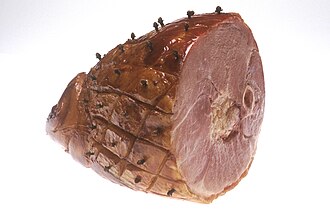
Photo: Wikipedia
This is a pre-cooked, boneless ham that has been spiral-sliced for easy serving, retaining its natural juices for moisture and flavor. It offers a tender, slightly chewy texture with a classic sweet-savory, smoky profile. Nutritionally, it's a high-protein, low-carb option, providing nearly 19 grams of protein per 100-gram serving.
Calorie split: 57% protein · 4% carbs · 39% fat
↓ Full nutrition💚 Why it's loved
People love it for its deeply satisfying, savory-sweet flavor and the convenience of perfectly pre-sliced meat that's ready for a quick meal or sandwich. It's a centerpiece of holiday tables and comfort food, evoking a sense of tradition and celebration.
⚠️ Watch-outs & how to enjoy it better
The primary concern is its high sodium content, which can be problematic for those monitoring blood pressure or fluid retention. To counteract this, pair it with potassium-rich foods like steamed broccoli, spinach, or a side of unsalted beans to help balance sodium levels. Also, be mindful of portion sizes, as the added sugars in the cure can contribute to excess calorie intake.
Key benefits
- Excellent source of high-quality protein
- Very low in carbohydrates and sugar
- Provides essential B vitamins, especially thiamin and niacin
- Contains minerals like phosphorus, zinc, and selenium
- Convenient, ready-to-eat protein source
🍽️ Popular dishes


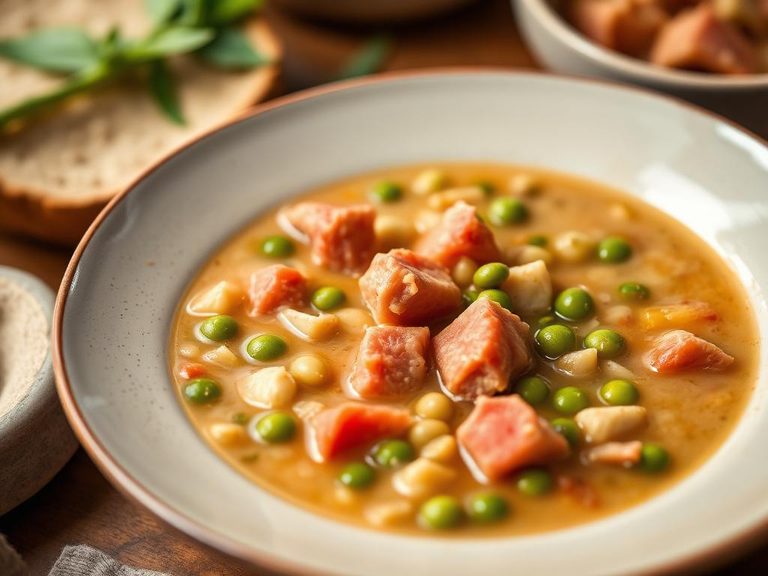
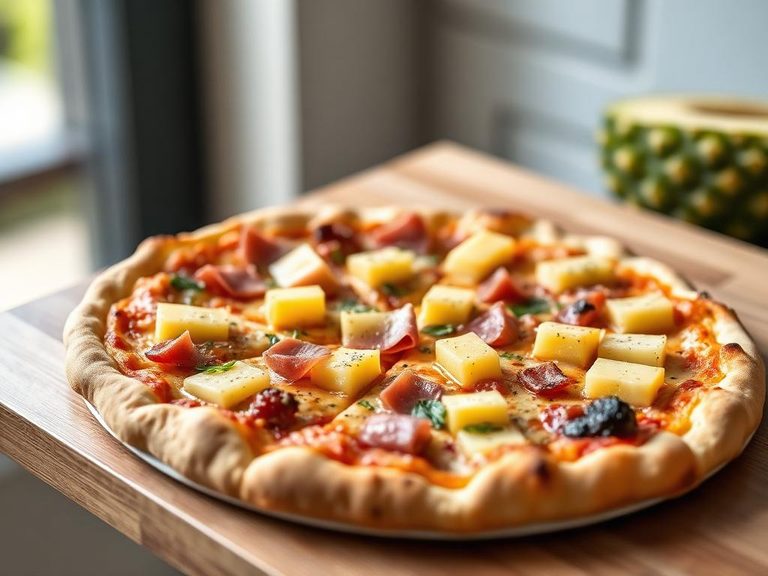

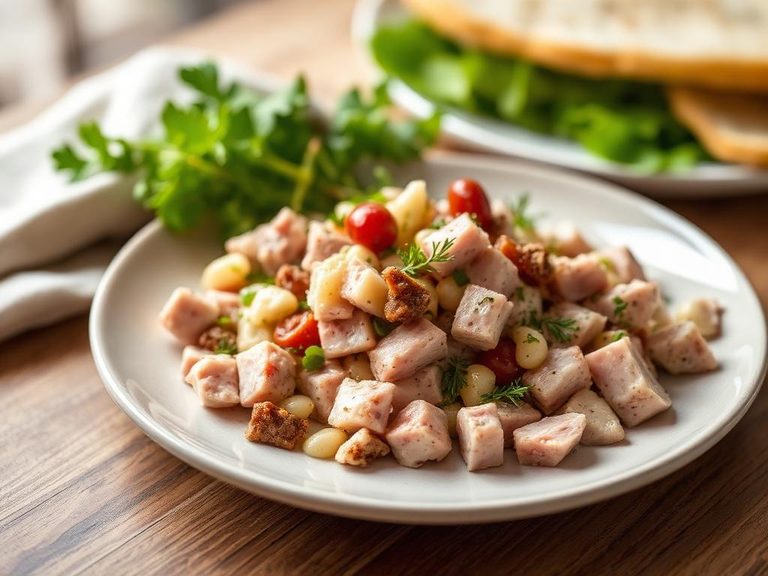
🌍 Where it's eaten
💡 Did you know?
The tradition of spiral-slicing ham was popularized in the 1950s by a company called City Meat Market in Gadsden, Alabama, using a machine that could carve a whole ham into uniform slices in about a minute.
Full nutrition (USDA data · scales with serving)
| Water | 70.6 g |
| Energy | 129 kcal |
| Energy | 541 kj |
| Protein | 18.7 g |
| Total lipid (fat) | 5.8 g |
| Ash | 4.3 g |
| Carbohydrate, by difference | 1.2 g |
| Fiber, total dietary | 0.00 g |
| Total Sugars | 1.2 g |
| Sucrose | 0.74 g |
| Glucose | 0.44 g |
| Fructose | 0.00 g |
| Lactose | 0.00 g |
| Maltose | 0.00 g |
| Galactose | 0.00 g |
| Calcium, Ca | 4.0 mg |
| Iron, Fe | 0.75 mg |
| Magnesium, Mg | 19.0 mg |
| Phosphorus, P | 276 mg |
| Potassium, K | 310 mg |
| Sodium, Na | 881 mg |
| Zinc, Zn | 1.6 mg |
| Copper, Cu | 0.17 mg |
| Manganese, Mn | 0.00 mg |
| Selenium, Se | 36.8 ug |
| Vitamin C, total ascorbic acid | 0.00 mg |
| Thiamin | 0.39 mg |
| Riboflavin | 0.19 mg |
| Niacin | 5.6 mg |
| Pantothenic acid | 0.02 mg |
| Vitamin B-6 | 0.36 mg |
| Folate, total | 1.0 ug |
| Folic acid | 0.00 ug |
| Folate, food | 1.0 ug |
| Folate, DFE | 1.0 ug |
| Choline, total | 75.8 mg |
| Betaine | 3.3 mg |
| Vitamin B-12 | 0.43 ug |
| Vitamin B-12, added | 0.00 ug |
| Vitamin A, RAE | 12.0 ug |
| Retinol | 12.0 ug |
| Carotene, beta | 0.00 ug |
| Carotene, alpha | 0.00 ug |
| Cryptoxanthin, beta | 0.00 ug |
| Vitamin A, IU | 39.0 iu |
| Lycopene | 0.00 ug |
| Lutein + zeaxanthin | 0.00 ug |
| Vitamin E (alpha-tocopherol) | 0.20 mg |
| Vitamin E, added | 0.00 mg |
| Tocopherol, beta | 0.00 mg |
| Tocopherol, gamma | 0.03 mg |
| Tocopherol, delta | 0.00 mg |
| Tocotrienol, alpha | 0.01 mg |
| Tocotrienol, beta | 0.00 mg |
| Tocotrienol, gamma | 0.01 mg |
| Tocotrienol, delta | 0.00 mg |
| Vitamin D (D2 + D3), International Units | 27.0 iu |
| Vitamin D (D2 + D3) | 0.70 ug |
| Vitamin D3 (cholecalciferol) | 0.70 ug |
| Vitamin K (phylloquinone) | 0.00 ug |
| Vitamin K (Dihydrophylloquinone) | 0.00 ug |
| Vitamin K (Menaquinone-4) | 0.00 ug |
| Alcohol, ethyl | 0.00 g |
| Caffeine | 0.00 mg |
| Theobromine | 0.00 mg |
Fat & fatty acid profile (per 100g)
| Fatty acids, total saturated | 1.8 g |
| SFA 4:0 | 0.00 g |
| SFA 6:0 | 0.00 g |
| SFA 8:0 | 0.00 g |
| SFA 10:0 | 0.00 g |
| SFA 12:0 | 0.00 g |
| SFA 14:0 | 0.06 g |
| SFA 15:0 | 0.00 g |
| SFA 16:0 | 1.1 g |
| SFA 17:0 | 0.01 g |
| SFA 18:0 | 0.58 g |
| SFA 20:0 | 0.01 g |
| SFA 22:0 | 0.02 g |
| Fatty acids, total monounsaturated | 2.5 g |
| MUFA 14:1 | 0.00 g |
| MUFA 15:1 | 0.00 g |
| MUFA 16:1 | 0.14 g |
| MUFA 17:1 | 0.00 g |
| MUFA 18:1 | 2.3 g |
| MUFA 18:1 c | 2.3 g |
| MUFA 20:1 | 0.04 g |
| MUFA 22:1 | 0.00 g |
| Fatty acids, total polyunsaturated | 0.90 g |
| PUFA 18:2 | 0.72 g |
| PUFA 18:2 n-6 c,c | 0.70 g |
| PUFA 18:3 | 0.03 g |
| PUFA 18:3 n-3 c,c,c (ALA) | 0.03 g |
| PUFA 18:3 n-6 c,c,c | 0.00 g |
| PUFA 18:4 | 0.00 g |
| PUFA 20:2 n-6 c,c | 0.03 g |
| PUFA 20:3 | 0.00 g |
| PUFA 20:4 | 0.13 g |
| PUFA 20:5 n-3 (EPA) | 0.00 g |
| PUFA 22:5 n-3 (DPA) | 0.00 g |
| PUFA 22:6 n-3 (DHA) | 0.00 g |
| Fatty acids, total trans | 0.04 g |
| Fatty acids, total trans-monoenoic | 0.02 g |
| TFA 18:1 t | 0.02 g |
| TFA 18:2 t,t | 0.02 g |
| Fatty acids, total trans-polyenoic | 0.02 g |
| Cholesterol | 57.0 mg |
Amino acid profile (per 100g)
| Tryptophan | 0.17 g |
| Threonine | 0.83 g |
| Isoleucine | 0.84 g |
| Leucine | 1.5 g |
| Lysine | 1.6 g |
| Methionine | 0.45 g |
| Cystine | 0.21 g |
| Phenylalanine | 0.74 g |
| Tyrosine | 0.60 g |
| Valine | 0.94 g |
| Arginine | 1.2 g |
| Histidine | 0.81 g |
| Alanine | 1.1 g |
| Aspartic acid | 1.6 g |
| Glutamic acid | 2.7 g |
| Glycine | 0.98 g |
| Proline | 0.80 g |
| Serine | 0.73 g |
| Hydroxyproline | 0.13 g |
FAQ
Is this ham fully cooked and safe to eat cold?
Yes, this type of ham is fully cooked during processing. It is safe to eat cold directly from the package, though many prefer to reheat it gently to enhance flavor and texture.
How should I store leftover sliced ham?
Store leftovers in an airtight container in the refrigerator for 3-5 days. For longer storage, wrap portions tightly in plastic wrap and foil, or use a freezer bag, and freeze for up to 1-2 months.
What's the best way to reheat it without drying it out?
Reheat slices in a skillet over medium-low heat with a splash of water or pineapple juice, covered, until warmed through. Alternatively, place slices in a baking dish, add a little broth, cover with foil, and warm in a 325°F (165°C) oven for about 10-15 minutes.
Nutrient density (calculated · NRF9.3)
Nutrient Rich Foods index: beneficial nutrients (protein, fiber, vitamins, minerals) minus saturated fat, added sugar & sodium, per 100 kcal.
NRF9.3 index — Fulgoni, Keast & Drewnowski, 2009. Computed from USDA nutrients.
Weight-loss friendliness (composite index)
Energy density 1.29 kcal/g · 58% calories from protein · 0.0 g fiber · 1.2 g sugar per 100 g.
Composite of energy density (Rolls et al., 1999), protein & fiber satiety, minus sugar. A calculated heuristic — ranks satiety-per-calorie, not a clinical measure.
Dietary load (calculated from USDA values)
Potential renal acid load. Positive = acid-forming, negative = alkaline-forming.
Sodium-to-potassium ratio: 2.84 (lower is better — aim for ≤ 1)
Sodium:potassium per WHO potassium guidance. Computed from USDA nutrients.