

Pork, cured, ham and water product, slice, boneless, separable lean only, heated, pan-broil
Whole food · Pork Products
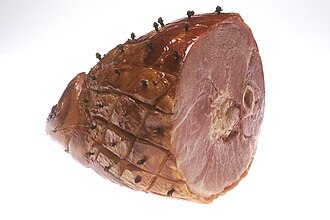
Photo: Wikipedia
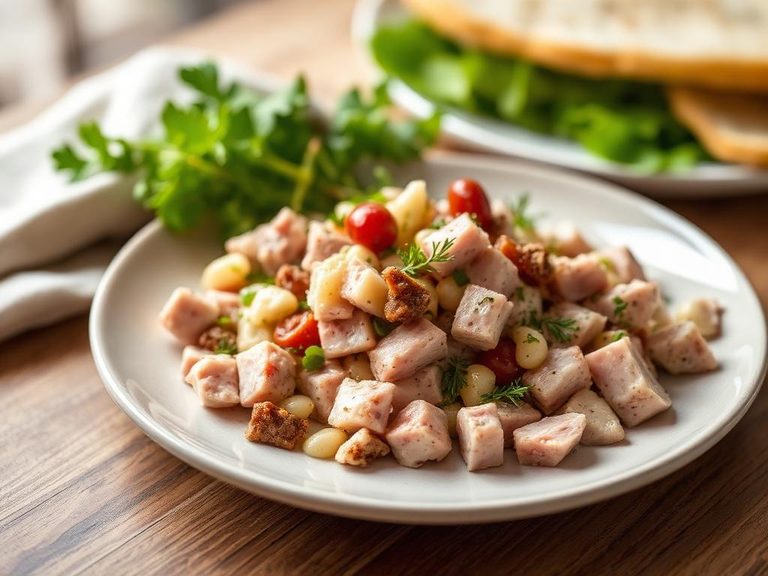
This is a lean, pan-broiled slice of boneless cured ham, a staple of quick, savory meals. Its texture is tender yet firm, with a salty, smoky flavor profile that intensifies with a golden sear. Nutritionally, it's a high-protein, low-fat option, providing 15 grams of protein per 100g with minimal fat and carbohydrates.
Calorie split: 48% protein · 15% carbs · 37% fat
↓ Full nutrition💚 Why it's loved
People love it for its savory, salty depth and satisfying texture that crisps up beautifully when pan-broiled. It's incredibly versatile, fitting seamlessly into breakfasts, sandwiches, salads, and dinner plates across many cultures.
⚠️ Watch-outs & how to enjoy it better
The primary concern is its high sodium content from the curing process, which can be problematic for those managing blood pressure. To counteract this, pair it with potassium-rich foods like leafy greens or avocado, and practice portion control by using it as a flavor accent rather than the main protein. Additionally, the added sugars (4.69g/100g) can cause a minor blood-sugar spike; balancing it with fiber and healthy fats helps mitigate this.
Key benefits
- High in complete protein for muscle maintenance.
- Low in total fat and saturated fat.
- Good source of B vitamins like thiamine and niacin.
- Convenient, pre-cooked protein source for quick meals.
- Provides minerals like phosphorus and selenium.
🍽️ Popular dishes
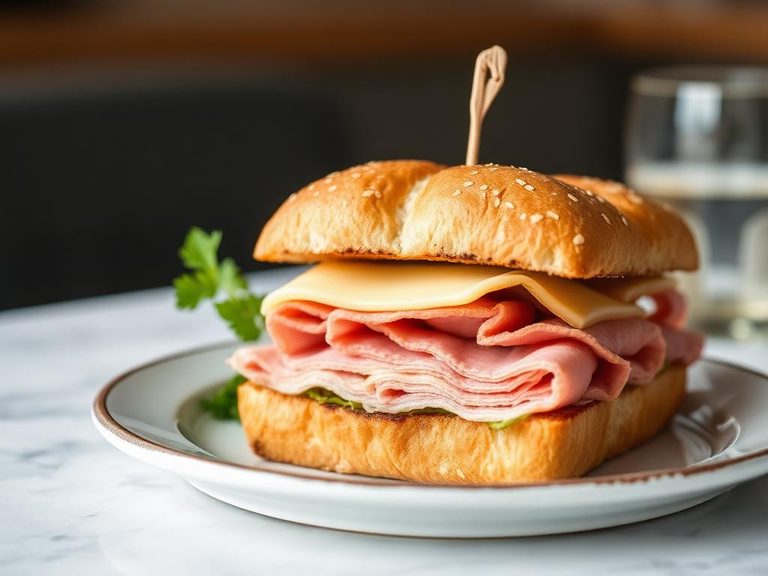

🌍 Where it's eaten
💡 Did you know?
The term 'ham' comes from the Old English 'hamm,' meaning the hollow or bend of the knee, referring to the cut of meat from the leg of a pig.
Full nutrition (USDA data · scales with serving)
| Water | 71.2 g |
| Energy | 123 kcal |
| Energy | 516 kj |
| Protein | 15.1 g |
| Total lipid (fat) | 5.1 g |
| Ash | 4.3 g |
| Carbohydrate, by difference | 4.7 g |
| Fiber, total dietary | 0.00 g |
| Total Sugars | 4.7 g |
| Sucrose | 0.00 g |
| Glucose | 4.0 g |
| Fructose | 0.48 g |
| Lactose | 0.00 g |
| Maltose | 0.17 g |
| Galactose | 0.00 g |
| Calcium, Ca | 8.0 mg |
| Iron, Fe | 0.74 mg |
| Magnesium, Mg | 17.0 mg |
| Phosphorus, P | 240 mg |
| Potassium, K | 272 mg |
| Sodium, Na | 1390 mg |
| Zinc, Zn | 1.6 mg |
| Copper, Cu | 0.09 mg |
| Manganese, Mn | 0.04 mg |
| Selenium, Se | 32.6 ug |
| Vitamin C, total ascorbic acid | 0.00 mg |
| Thiamin | 0.31 mg |
| Riboflavin | 0.14 mg |
| Niacin | 4.3 mg |
| Pantothenic acid | 0.69 mg |
| Vitamin B-6 | 0.34 mg |
| Folate, total | 3.0 ug |
| Folic acid | 0.00 ug |
| Folate, food | 3.0 ug |
| Folate, DFE | 3.0 ug |
| Choline, total | 64.6 mg |
| Betaine | 4.5 mg |
| Vitamin B-12 | 0.44 ug |
| Vitamin B-12, added | 0.00 ug |
| Vitamin A, RAE | 13.0 ug |
| Retinol | 13.0 ug |
| Carotene, beta | 0.00 ug |
| Carotene, alpha | 0.00 ug |
| Cryptoxanthin, beta | 0.00 ug |
| Vitamin A, IU | 44.0 iu |
| Lycopene | 0.00 ug |
| Lutein + zeaxanthin | 0.00 ug |
| Vitamin E (alpha-tocopherol) | 0.12 mg |
| Vitamin E, added | 0.00 mg |
| Tocopherol, beta | 0.00 mg |
| Tocopherol, gamma | 0.03 mg |
| Tocopherol, delta | 0.00 mg |
| Tocotrienol, alpha | 0.03 mg |
| Tocotrienol, beta | 0.00 mg |
| Tocotrienol, gamma | 0.00 mg |
| Tocotrienol, delta | 0.00 mg |
| Vitamin D (D2 + D3), International Units | 34.0 iu |
| Vitamin D (D2 + D3) | 0.90 ug |
| Vitamin D3 (cholecalciferol) | 0.90 ug |
| Vitamin K (phylloquinone) | 0.00 ug |
| Vitamin K (Dihydrophylloquinone) | 0.00 ug |
| Vitamin K (Menaquinone-4) | 4.5 ug |
| Alcohol, ethyl | 0.00 g |
| Caffeine | 0.00 mg |
| Theobromine | 0.00 mg |
Fat & fatty acid profile (per 100g)
| Fatty acids, total saturated | 1.5 g |
| SFA 4:0 | 0.00 g |
| SFA 6:0 | 0.00 g |
| SFA 8:0 | 0.00 g |
| SFA 10:0 | 0.00 g |
| SFA 12:0 | 0.00 g |
| SFA 14:0 | 0.06 g |
| SFA 15:0 | 0.00 g |
| SFA 16:0 | 0.97 g |
| SFA 17:0 | 0.01 g |
| SFA 18:0 | 0.47 g |
| SFA 20:0 | 0.00 g |
| SFA 22:0 | 0.01 g |
| Fatty acids, total monounsaturated | 2.1 g |
| MUFA 14:1 | 0.00 g |
| MUFA 15:1 | 0.00 g |
| MUFA 16:1 | 0.12 g |
| MUFA 17:1 | 0.00 g |
| MUFA 18:1 | 2.0 g |
| MUFA 18:1 c | 1.9 g |
| MUFA 20:1 | 0.04 g |
| MUFA 22:1 | 0.00 g |
| Fatty acids, total polyunsaturated | 0.69 g |
| PUFA 18:2 | 0.59 g |
| PUFA 18:2 n-6 c,c | 0.58 g |
| PUFA 18:3 | 0.02 g |
| PUFA 18:3 n-3 c,c,c (ALA) | 0.02 g |
| PUFA 18:3 n-6 c,c,c | 0.00 g |
| PUFA 18:4 | 0.00 g |
| PUFA 20:2 n-6 c,c | 0.02 g |
| PUFA 20:3 | 0.00 g |
| PUFA 20:4 | 0.05 g |
| PUFA 20:5 n-3 (EPA) | 0.00 g |
| PUFA 22:5 n-3 (DPA) | 0.00 g |
| PUFA 22:6 n-3 (DHA) | 0.00 g |
| Fatty acids, total trans | 0.04 g |
| Fatty acids, total trans-monoenoic | 0.02 g |
| TFA 18:1 t | 0.02 g |
| TFA 18:2 t,t | 0.01 g |
| Fatty acids, total trans-polyenoic | 0.01 g |
| Cholesterol | 45.0 mg |
Amino acid profile (per 100g)
| Tryptophan | 0.14 g |
| Threonine | 0.68 g |
| Isoleucine | 0.68 g |
| Leucine | 1.2 g |
| Lysine | 1.3 g |
| Methionine | 0.36 g |
| Cystine | 0.17 g |
| Phenylalanine | 0.60 g |
| Tyrosine | 0.49 g |
| Valine | 0.76 g |
| Arginine | 0.97 g |
| Histidine | 0.66 g |
| Alanine | 0.89 g |
| Aspartic acid | 1.3 g |
| Glutamic acid | 2.2 g |
| Glycine | 0.79 g |
| Proline | 0.65 g |
| Serine | 0.59 g |
| Hydroxyproline | 0.10 g |
FAQ
Is this ham product considered a processed meat?
Yes, as a cured and sliced product, it is classified as processed meat. It's often recommended to consume it in moderation as part of a balanced diet.
How does pan-broiling affect its nutritional profile?
Pan-broiling with minimal added fat keeps the calorie and fat content low. It can slightly reduce the sodium content through rendering, but the primary benefit is creating a flavorful, crispy texture without deep-frying.
What's the difference between this and 'ham and water product'?
The 'and water product' designation means water has been added during processing, often to increase yield and moisture. This specific product is a lean, boneless slice that has been heated, making it ready to eat.
Nutrient density (calculated · NRF9.3)
Nutrient Rich Foods index: beneficial nutrients (protein, fiber, vitamins, minerals) minus saturated fat, added sugar & sodium, per 100 kcal.
NRF9.3 index — Fulgoni, Keast & Drewnowski, 2009. Computed from USDA nutrients.
Weight-loss friendliness (composite index)
Energy density 1.23 kcal/g · 49% calories from protein · 0.0 g fiber · 4.7 g sugar per 100 g.
Composite of energy density (Rolls et al., 1999), protein & fiber satiety, minus sugar. A calculated heuristic — ranks satiety-per-calorie, not a clinical measure.
Dietary load (calculated from USDA values)
Potential renal acid load. Positive = acid-forming, negative = alkaline-forming.
Sodium-to-potassium ratio: 5.11 (lower is better — aim for ≤ 1)
Sodium:potassium per WHO potassium guidance. Computed from USDA nutrients.