

Pork, cured, feet, pickled
Whole food · Pork Products
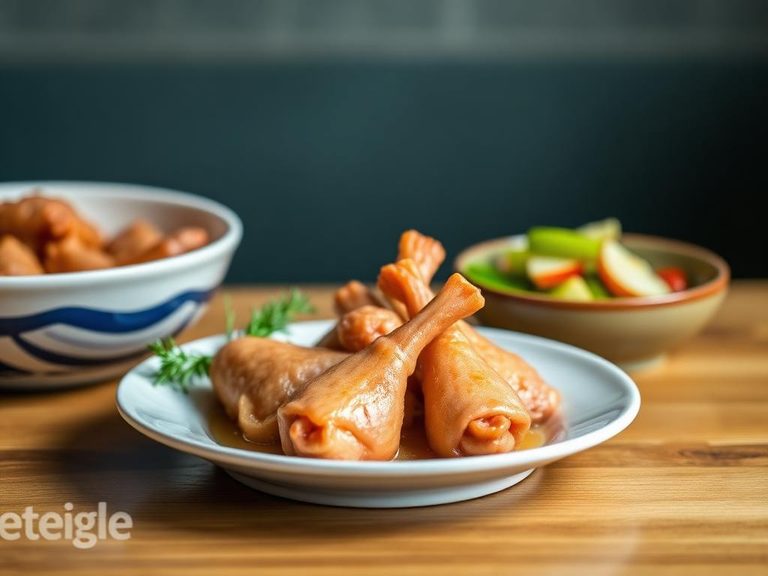
Pickled pork feet are a savory, tangy delicacy made by curing and preserving pork trotters in a brine or vinegar-based solution. The texture is uniquely gelatinous and tender, with a firm, snappy bite from the skin and a rich, melt-in-your-mouth quality from the collagen-rich connective tissue. Nutritionally, it is a high-protein, high-fat food with virtually zero carbohydrates, making it a dense source of energy and amino acids.
Calorie split: 34% protein · 0% carbs · 66% fat
↓ Full nutrition💚 Why it's loved
People love pickled pork feet for their intense, savory-sour flavor and the satisfying, chewy-yet-tender texture that releases rich, umami juices. It's a beloved snack and appetizer in many cultures, often enjoyed cold with drinks, showcasing a perfect balance of tang from the pickling brine and deep pork savoriness.
⚠️ Watch-outs & how to enjoy it better
The high sodium content from the curing and pickling brine can be a concern for those monitoring salt intake, and the high fat content may not suit very low-fat diets. To counteract this, consume it in moderation as part of a balanced meal, pair it with low-sodium, fiber-rich vegetables, and drink plenty of water to help manage sodium levels.
Key benefits
- Excellent source of high-quality protein for muscle maintenance.
- Rich in collagen, which may support skin, joint, and connective tissue health.
- Very low in carbohydrates and sugar, suitable for low-carb or ketogenic diets.
- Provides essential minerals like iron and zinc from the pork.
- The pickling process can introduce probiotics if naturally fermented.
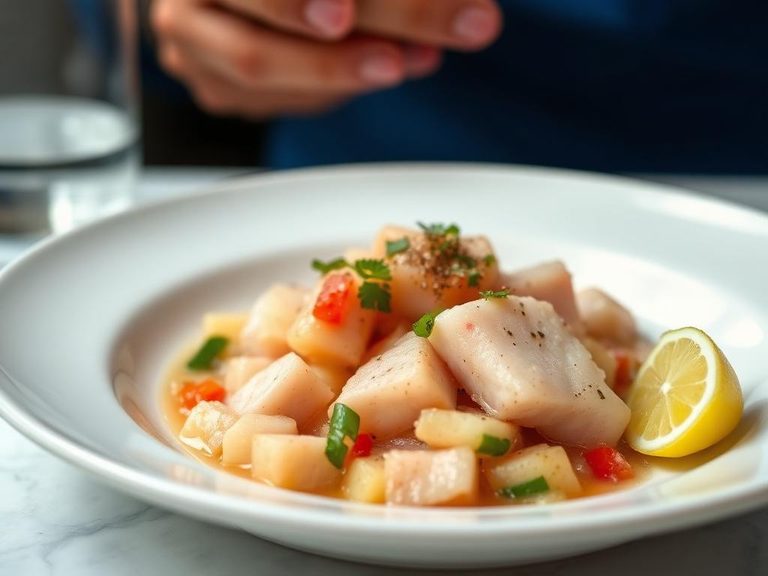
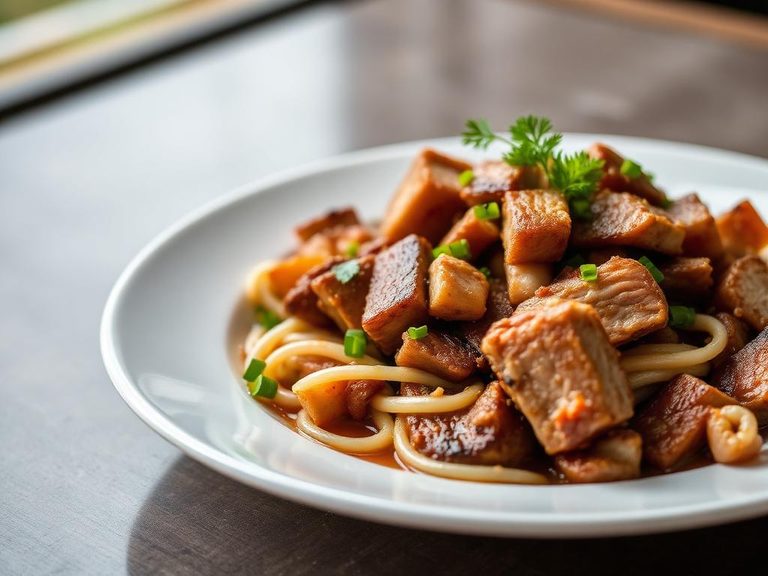
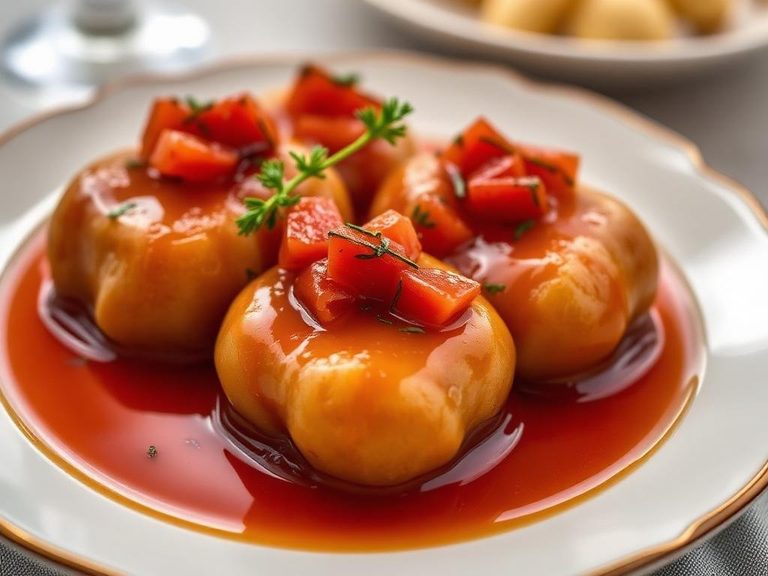
🍽️ Popular dishes

🌍 Where it's eaten
💡 Did you know?
The gelatin in pickled pork feet is derived from collagen, which, when cooled, forms a natural, jiggly aspic that can solidify the pickling liquid around the meat.
Full nutrition (USDA data · scales with serving)
| Water | 75.0 g |
| Energy | 140 kcal |
| Energy | 586 kj |
| Protein | 11.6 g |
| Total lipid (fat) | 10.0 g |
| Ash | 3.4 g |
| Carbohydrate, by difference | 0.01 g |
| Fiber, total dietary | 0.00 g |
| Total Sugars | 0.00 g |
| Sucrose | 0.00 g |
| Glucose | 0.00 g |
| Fructose | 0.00 g |
| Lactose | 0.00 g |
| Maltose | 0.00 g |
| Galactose | 0.00 g |
| Calcium, Ca | 32.0 mg |
| Iron, Fe | 0.31 mg |
| Magnesium, Mg | 11.0 mg |
| Phosphorus, P | 87.0 mg |
| Potassium, K | 13.0 mg |
| Sodium, Na | 946 mg |
| Zinc, Zn | 0.20 mg |
| Copper, Cu | 0.04 mg |
| Manganese, Mn | 0.02 mg |
| Selenium, Se | 15.8 ug |
| Vitamin C, total ascorbic acid | 0.00 mg |
| Thiamin | 0.01 mg |
| Riboflavin | 0.01 mg |
| Niacin | 0.22 mg |
| Pantothenic acid | 0.26 mg |
| Vitamin B-6 | 0.01 mg |
| Folate, total | 1.0 ug |
| Folic acid | 0.00 ug |
| Folate, food | 1.0 ug |
| Folate, DFE | 1.0 ug |
| Choline, total | 44.5 mg |
| Betaine | 2.9 mg |
| Vitamin B-12 | 0.21 ug |
| Vitamin B-12, added | 0.00 ug |
| Vitamin A, RAE | 11.0 ug |
| Retinol | 11.0 ug |
| Carotene, beta | 0.00 ug |
| Carotene, alpha | 0.00 ug |
| Cryptoxanthin, beta | 0.00 ug |
| Vitamin A, IU | 37.0 iu |
| Lycopene | 0.00 ug |
| Lutein + zeaxanthin | 0.00 ug |
| Vitamin E (alpha-tocopherol) | 0.21 mg |
| Vitamin E, added | 0.00 mg |
| Tocopherol, beta | 0.02 mg |
| Tocopherol, gamma | 0.02 mg |
| Tocopherol, delta | 0.01 mg |
| Tocotrienol, alpha | 0.03 mg |
| Tocotrienol, beta | 0.00 mg |
| Tocotrienol, gamma | 0.00 mg |
| Tocotrienol, delta | 0.00 mg |
| Vitamin D (D2 + D3), International Units | 16.0 iu |
| Vitamin D (D2 + D3) | 0.40 ug |
| Vitamin D3 (cholecalciferol) | 0.40 ug |
| Vitamin K (phylloquinone) | 0.00 ug |
| Vitamin K (Dihydrophylloquinone) | 0.00 ug |
| Vitamin K (Menaquinone-4) | 10.4 ug |
| Alcohol, ethyl | 0.00 g |
| Caffeine | 0.00 mg |
| Theobromine | 0.00 mg |
Fat & fatty acid profile (per 100g)
| Fatty acids, total saturated | 2.9 g |
| SFA 4:0 | 0.00 g |
| SFA 6:0 | 0.00 g |
| SFA 8:0 | 0.00 g |
| SFA 10:0 | 0.00 g |
| SFA 12:0 | 0.00 g |
| SFA 14:0 | 0.12 g |
| SFA 15:0 | 0.00 g |
| SFA 16:0 | 2.1 g |
| SFA 17:0 | 0.02 g |
| SFA 18:0 | 0.70 g |
| SFA 20:0 | 0.01 g |
| SFA 22:0 | 0.01 g |
| Fatty acids, total monounsaturated | 5.7 g |
| MUFA 14:1 | 0.00 g |
| MUFA 15:1 | 0.00 g |
| MUFA 16:1 | 0.39 g |
| MUFA 17:1 | 0.00 g |
| MUFA 18:1 | 5.2 g |
| MUFA 18:1 c | 5.2 g |
| MUFA 20:1 | 0.10 g |
| MUFA 22:1 | 0.00 g |
| Fatty acids, total polyunsaturated | 0.78 g |
| PUFA 18:2 | 0.67 g |
| PUFA 18:2 n-6 c,c | 0.64 g |
| PUFA 18:3 | 0.03 g |
| PUFA 18:3 n-3 c,c,c (ALA) | 0.03 g |
| PUFA 18:3 n-6 c,c,c | 0.00 g |
| PUFA 18:4 | 0.00 g |
| PUFA 20:2 n-6 c,c | 0.04 g |
| PUFA 20:3 | 0.00 g |
| PUFA 20:4 | 0.05 g |
| PUFA 20:5 n-3 (EPA) | 0.00 g |
| PUFA 22:5 n-3 (DPA) | 0.00 g |
| PUFA 22:6 n-3 (DHA) | 0.00 g |
| Fatty acids, total trans | 0.07 g |
| Fatty acids, total trans-monoenoic | 0.04 g |
| TFA 18:1 t | 0.04 g |
| TFA 18:2 t,t | 0.03 g |
| Fatty acids, total trans-polyenoic | 0.03 g |
| Cholesterol | 83.0 mg |
| Phytosterols | 0.00 mg |
Amino acid profile (per 100g)
| Tryptophan | 0.02 g |
| Threonine | 0.31 g |
| Isoleucine | 0.20 g |
| Leucine | 0.51 g |
| Lysine | 0.50 g |
| Methionine | 0.13 g |
| Cystine | 0.10 g |
| Phenylalanine | 0.34 g |
| Tyrosine | 0.19 g |
| Valine | 0.29 g |
| Arginine | 0.87 g |
| Histidine | 0.13 g |
| Alanine | 0.95 g |
| Aspartic acid | 0.84 g |
| Glutamic acid | 1.3 g |
| Glycine | 2.0 g |
| Proline | 1.2 g |
| Serine | 0.47 g |
FAQ
Are pickled pork feet the same as head cheese?
No. While both are cold cuts set in aspic (gelatin), pickled pork feet are specifically made from the trotters (feet), whereas head cheese is a terrine made from various parts of the pig's head, like the cheeks, tongue, and sometimes feet.
How should I store opened pickled pork feet?
Once opened, keep them submerged in their brine in a sealed container in the refrigerator. They will typically last for 1-2 weeks. Freezing is not recommended as it can drastically alter the texture.
Can I eat the pickling liquid?
Yes, the brine is edible and often used as a tangy dressing or sauce. However, be mindful of its high salt content.
Nutrient density (calculated · NRF9.3)
Nutrient Rich Foods index: beneficial nutrients (protein, fiber, vitamins, minerals) minus saturated fat, added sugar & sodium, per 100 kcal.
NRF9.3 index — Fulgoni, Keast & Drewnowski, 2009. Computed from USDA nutrients.
Weight-loss friendliness (composite index)
Energy density 1.40 kcal/g · 33% calories from protein · 0.0 g fiber · 0.0 g sugar per 100 g.
Composite of energy density (Rolls et al., 1999), protein & fiber satiety, minus sugar. A calculated heuristic — ranks satiety-per-calorie, not a clinical measure.
Dietary load (calculated from USDA values)
Potential renal acid load. Positive = acid-forming, negative = alkaline-forming.
Sodium-to-potassium ratio: 72.77 (lower is better — aim for ≤ 1)
Sodium:potassium per WHO potassium guidance. Computed from USDA nutrients.