

OLIVE GARDEN, lasagna classico
Whole food · Restaurant Foods

Photo: Wikipedia
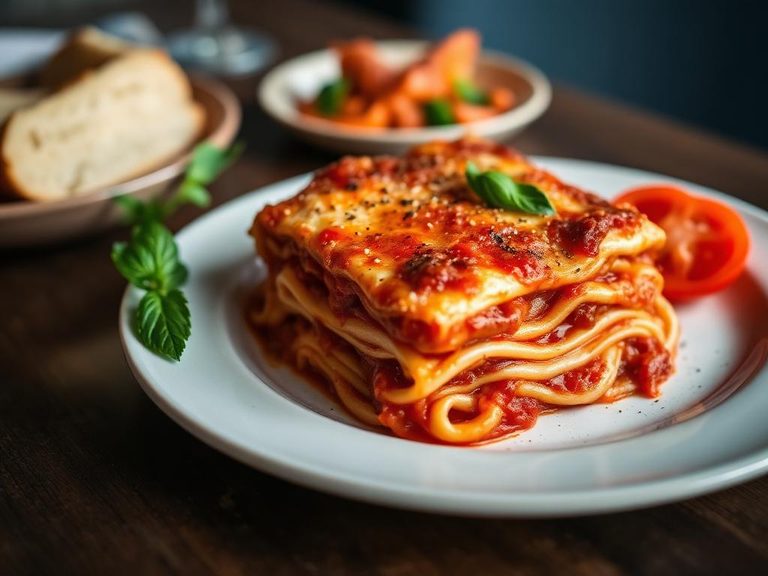
Olive Garden's Lasagna Classico is a rich, layered pasta dish featuring sheets of pasta, seasoned beef, Italian sausage, a creamy ricotta and mozzarella blend, and a savory marinara sauce. Each bite offers a satisfying contrast between the tender pasta, hearty meat, and gooey, melted cheese. Nutritionally, it's a substantial source of protein and fat, providing a dense, energy-rich meal.
Calorie split: 25% protein · 22% carbs · 53% fat
↓ Full nutrition💚 Why it's loved
People love it for its comforting, layered flavors and the hearty, filling combination of meat, cheese, and sauce. It's a classic Italian-American comfort food that evokes a sense of tradition and indulgence.
⚠️ Watch-outs & how to enjoy it better
The dish is high in saturated fat and sodium, which can be a concern for heart health. To counteract this, consider sharing a portion, pairing it with a large side salad or steamed vegetables to increase fiber and volume without excess calories, and drinking water instead of sugary beverages.
Key benefits
- High in protein for muscle maintenance
- Contains calcium from cheese for bone health
- Provides iron from the meat filling
- Offers a satisfying, energy-dense meal
🍽️ Popular dishes
🌍 Where it's eaten
💡 Did you know?
The word 'lasagna' likely derives from the Greek 'lasanon,' meaning a large pot or cauldron used for cooking the layered pasta dish.
Full nutrition (USDA data · scales with serving)
| Water | 65.3 g |
| Energy | 184 kcal |
| Energy | 770 kj |
| Protein | 11.3 g |
| Total lipid (fat) | 10.8 g |
| Ash | 2.3 g |
| Carbohydrate, by difference | 10.3 g |
| Fiber, total dietary | 1.6 g |
| Total Sugars | 3.5 g |
| Sucrose | 0.00 g |
| Glucose | 1.0 g |
| Fructose | 1.1 g |
| Lactose | 1.2 g |
| Maltose | 0.00 g |
| Galactose | 0.18 g |
| Starch | 4.8 g |
| Calcium, Ca | 211 mg |
| Iron, Fe | 0.75 mg |
| Magnesium, Mg | 22.0 mg |
| Phosphorus, P | 183 mg |
| Potassium, K | 258 mg |
| Sodium, Na | 450 mg |
| Zinc, Zn | 1.3 mg |
| Copper, Cu | 0.06 mg |
| Manganese, Mn | 0.11 mg |
| Selenium, Se | 15.2 ug |
| Vitamin C, total ascorbic acid | 0.70 mg |
| Thiamin | 0.16 mg |
| Riboflavin | 0.27 mg |
| Niacin | 1.9 mg |
| Pantothenic acid | 0.52 mg |
| Folate, total | 35.0 ug |
| Choline, total | 33.5 mg |
| Betaine | 594 mg |
| Vitamin B-12 | 0.55 ug |
| Vitamin A, RAE | 60.0 ug |
| Retinol | 48.0 ug |
| Carotene, beta | 153 ug |
| Carotene, alpha | 0.00 ug |
| Cryptoxanthin, beta | 0.00 ug |
| Vitamin A, IU | 414 iu |
| Lycopene | 2177 ug |
| Lutein + zeaxanthin | 105 ug |
| Vitamin E (alpha-tocopherol) | 0.86 mg |
| Tocopherol, beta | 0.00 mg |
| Tocopherol, gamma | 0.20 mg |
| Tocopherol, delta | 0.01 mg |
| Tocotrienol, alpha | 0.01 mg |
| Tocotrienol, beta | 0.04 mg |
| Tocotrienol, gamma | 0.00 mg |
| Tocotrienol, delta | 0.00 mg |
| Vitamin K (phylloquinone) | 6.8 ug |
| Vitamin K (Dihydrophylloquinone) | 0.30 ug |
| Vitamin K (Menaquinone-4) | 3.2 ug |
Fat & fatty acid profile (per 100g)
| Fatty acids, total saturated | 5.3 g |
| SFA 4:0 | 0.14 g |
| SFA 6:0 | 0.11 g |
| SFA 8:0 | 0.07 g |
| SFA 10:0 | 0.19 g |
| SFA 12:0 | 0.21 g |
| SFA 14:0 | 0.75 g |
| SFA 15:0 | 0.08 g |
| SFA 16:0 | 2.6 g |
| SFA 17:0 | 0.07 g |
| SFA 18:0 | 1.1 g |
| SFA 20:0 | 0.02 g |
| SFA 22:0 | 0.01 g |
| SFA 24:0 | 0.01 g |
| Fatty acids, total monounsaturated | 3.2 g |
| MUFA 14:1 | 0.08 g |
| MUFA 15:1 | 0.00 g |
| MUFA 16:1 | 0.19 g |
| MUFA 16:1 c | 0.16 g |
| MUFA 17:1 | 0.03 g |
| MUFA 18:1 | 2.9 g |
| MUFA 18:1 c | 2.6 g |
| MUFA 20:1 | 0.03 g |
| MUFA 22:1 | 0.00 g |
| MUFA 22:1 c | 0.00 g |
| MUFA 24:1 c | 0.00 g |
| Fatty acids, total polyunsaturated | 0.79 g |
| PUFA 18:2 | 0.66 g |
| PUFA 18:2 n-6 c,c | 0.55 g |
| PUFA 18:2 CLAs | 0.04 g |
| PUFA 18:3 | 0.06 g |
| PUFA 18:3 n-3 c,c,c (ALA) | 0.06 g |
| PUFA 18:3 n-6 c,c,c | 0.00 g |
| PUFA 18:3i | 0.00 g |
| PUFA 18:4 | 0.00 g |
| PUFA 20:2 n-6 c,c | 0.01 g |
| PUFA 20:3 | 0.01 g |
| PUFA 20:3 n-3 | 0.00 g |
| PUFA 20:3 n-6 | 0.01 g |
| PUFA 20:4 | 0.03 g |
| PUFA 20:5 n-3 (EPA) | 0.00 g |
| PUFA 22:4 | 0.01 g |
| PUFA 22:5 n-3 (DPA) | 0.01 g |
| PUFA 22:6 n-3 (DHA) | 0.00 g |
| Fatty acids, total trans | 0.34 g |
| Fatty acids, total trans-monoenoic | 0.27 g |
| TFA 16:1 t | 0.03 g |
| TFA 18:1 t | 0.23 g |
| TFA 22:1 t | 0.00 g |
| TFA 18:2 t not further defined | 0.07 g |
| Fatty acids, total trans-polyenoic | 0.07 g |
| Cholesterol | 40.0 mg |
Amino acid profile (per 100g)
| Tryptophan | 0.13 g |
| Threonine | 0.39 g |
| Isoleucine | 0.43 g |
| Leucine | 0.90 g |
| Lysine | 0.84 g |
| Methionine | 0.25 g |
| Cystine | 0.12 g |
| Phenylalanine | 0.50 g |
| Tyrosine | 0.35 g |
| Valine | 0.48 g |
| Arginine | 0.46 g |
| Histidine | 0.28 g |
| Alanine | 0.43 g |
| Aspartic acid | 0.80 g |
| Glutamic acid | 2.0 g |
| Glycine | 0.37 g |
| Proline | 1.1 g |
| Serine | 0.51 g |
| Hydroxyproline | 0.09 g |
FAQ
Is Olive Garden's lasagna made with fresh pasta?
No, like most restaurant lasagnas, it uses pre-made, dried pasta sheets for consistency and efficiency in a high-volume kitchen.
Can I make a lighter version at home?
Yes, you can use whole-wheat pasta, lean ground turkey, low-fat ricotta, and a vegetable-packed marinara to reduce calories and fat while increasing fiber.
Why is restaurant lasagna often higher in calories than homemade?
Restaurants typically use more cheese and fat for richer flavor and texture, and portion sizes are often larger than standard home servings.
Nutrient density (calculated · NRF9.3)
Nutrient Rich Foods index: beneficial nutrients (protein, fiber, vitamins, minerals) minus saturated fat, added sugar & sodium, per 100 kcal.
NRF9.3 index — Fulgoni, Keast & Drewnowski, 2009. Computed from USDA nutrients.
Weight-loss friendliness (composite index)
Energy density 1.84 kcal/g · 25% calories from protein · 1.6 g fiber · 3.5 g sugar per 100 g.
Composite of energy density (Rolls et al., 1999), protein & fiber satiety, minus sugar. A calculated heuristic — ranks satiety-per-calorie, not a clinical measure.
Dietary load (calculated from USDA values)
Potential renal acid load. Positive = acid-forming, negative = alkaline-forming.
Sodium-to-potassium ratio: 1.74 (lower is better — aim for ≤ 1)
Sodium:potassium per WHO potassium guidance. Computed from USDA nutrients.