

Fast food, biscuit
Whole food · Fast Foods
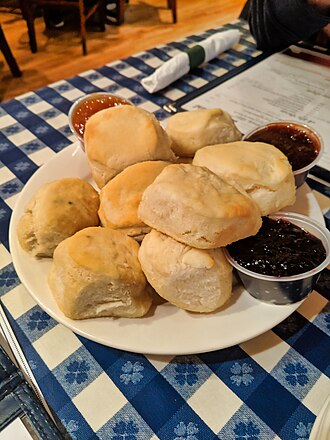
Photo: Wikipedia
A classic American fast-food biscuit is a flaky, buttery quick bread, typically made with flour, shortening, and buttermilk. It offers a rich, savory flavor with a tender, crumbly texture that is often enhanced by a salty, buttery finish. Nutritionally, it is a dense source of carbohydrates and fat, providing a quick energy boost but with relatively low protein and fiber.
Calorie split: 8% protein · 46% carbs · 46% fat
↓ Full nutrition💚 Why it's loved
People love it for its buttery, savory flavor and the satisfying, flaky texture that pairs perfectly with gravy, honey, or jam. It's a cultural staple in the American South, often associated with comfort food and breakfast traditions.
⚠️ Watch-outs & how to enjoy it better
The high fat and carbohydrate content can lead to blood-sugar spikes and contribute to weight gain if consumed frequently. To counteract this, pair it with protein (like eggs or sausage) and fiber-rich vegetables to slow digestion, and practice portion control by enjoying it as an occasional treat rather than a daily staple.
Key benefits
- Provides a quick source of energy from carbohydrates.
- Contains some protein (7.08g per 100g) for muscle support.
- Can be a comforting, satisfying food in a meal.
- Offers a small amount of dietary fiber (2.5g per 100g).
🍽️ Popular dishes





🌍 Where it's eaten
💡 Did you know?
The word 'biscuit' comes from the Latin 'bis coctus,' meaning 'twice cooked,' referring to the original hard, dry biscuits used for long voyages.
Full nutrition (USDA data · scales with serving)
| Water | 27.9 g |
| Energy | 370 kcal |
| Energy | 1547 kj |
| Protein | 7.1 g |
| Total lipid (fat) | 18.9 g |
| Ash | 3.3 g |
| Carbohydrate, by difference | 42.8 g |
| Fiber, total dietary | 2.5 g |
| Total Sugars | 3.9 g |
| Sucrose | 1.6 g |
| Glucose | 0.00 g |
| Fructose | 0.00 g |
| Lactose | 1.8 g |
| Maltose | 0.52 g |
| Galactose | 0.00 g |
| Starch | 37.5 g |
| Calcium, Ca | 70.0 mg |
| Iron, Fe | 2.8 mg |
| Magnesium, Mg | 15.0 mg |
| Phosphorus, P | 474 mg |
| Potassium, K | 131 mg |
| Sodium, Na | 979 mg |
| Zinc, Zn | 0.50 mg |
| Copper, Cu | 0.08 mg |
| Manganese, Mn | 0.39 mg |
| Selenium, Se | 12.1 ug |
| Vitamin C, total ascorbic acid | 0.00 mg |
| Thiamin | 0.44 mg |
| Riboflavin | 0.30 mg |
| Niacin | 3.7 mg |
| Pantothenic acid | 0.41 mg |
| Vitamin B-6 | 0.06 mg |
| Folate, total | 84.0 ug |
| Folic acid | 53.0 ug |
| Folate, food | 31.0 ug |
| Folate, DFE | 121 ug |
| Choline, total | 0.80 mg |
| Vitamin B-12 | 0.00 ug |
| Vitamin B-12, added | 0.00 ug |
| Vitamin A, RAE | 18.0 ug |
| Retinol | 18.0 ug |
| Carotene, beta | 0.00 ug |
| Carotene, alpha | 0.00 ug |
| Cryptoxanthin, beta | 0.00 ug |
| Vitamin A, IU | 60.0 iu |
| Lycopene | 0.00 ug |
| Lutein + zeaxanthin | 0.00 ug |
| Vitamin E (alpha-tocopherol) | 0.47 mg |
| Vitamin E, added | 0.00 mg |
| Tocopherol, beta | 0.05 mg |
| Tocopherol, gamma | 1.6 mg |
| Tocopherol, delta | 0.51 mg |
| Tocotrienol, alpha | 0.07 mg |
| Tocotrienol, beta | 0.13 mg |
| Tocotrienol, gamma | 0.16 mg |
| Tocotrienol, delta | 0.02 mg |
| Vitamin D (D2 + D3), International Units | 0.00 iu |
| Vitamin D (D2 + D3) | 0.00 ug |
| Vitamin K (phylloquinone) | 4.5 ug |
| Alcohol, ethyl | 0.00 g |
| Caffeine | 0.00 mg |
| Theobromine | 0.00 mg |
Fat & fatty acid profile (per 100g)
| Fatty acids, total saturated | 11.8 g |
| SFA 4:0 | 0.00 g |
| SFA 6:0 | 0.03 g |
| SFA 8:0 | 0.37 g |
| SFA 10:0 | 0.30 g |
| SFA 12:0 | 3.2 g |
| SFA 14:0 | 1.0 g |
| SFA 15:0 | 0.00 g |
| SFA 16:0 | 3.8 g |
| SFA 17:0 | 0.01 g |
| SFA 18:0 | 3.0 g |
| SFA 20:0 | 0.06 g |
| SFA 22:0 | 0.02 g |
| SFA 24:0 | 0.01 g |
| Fatty acids, total monounsaturated | 2.5 g |
| MUFA 14:1 | 0.00 g |
| MUFA 15:1 | 0.00 g |
| MUFA 16:1 | 0.01 g |
| MUFA 16:1 c | 0.01 g |
| MUFA 17:1 | 0.00 g |
| MUFA 18:1 | 2.5 g |
| MUFA 18:1 c | 2.3 g |
| MUFA 20:1 | 0.02 g |
| MUFA 22:1 | 0.00 g |
| MUFA 22:1 c | 0.00 g |
| MUFA 24:1 c | 0.00 g |
| Fatty acids, total polyunsaturated | 2.2 g |
| PUFA 18:2 | 2.0 g |
| PUFA 18:2 n-6 c,c | 1.9 g |
| PUFA 18:2 CLAs | 0.01 g |
| PUFA 18:3 | 0.20 g |
| PUFA 18:3 n-3 c,c,c (ALA) | 0.20 g |
| PUFA 18:3 n-6 c,c,c | 0.01 g |
| PUFA 18:3i | 0.00 g |
| PUFA 18:4 | 0.00 g |
| PUFA 20:2 n-6 c,c | 0.00 g |
| PUFA 20:3 | 0.00 g |
| PUFA 20:3 n-3 | 0.00 g |
| PUFA 20:3 n-6 | 0.00 g |
| PUFA 20:4 | 0.00 g |
| PUFA 20:5 n-3 (EPA) | 0.00 g |
| PUFA 22:4 | 0.00 g |
| PUFA 22:5 n-3 (DPA) | 0.00 g |
| PUFA 22:6 n-3 (DHA) | 0.00 g |
| Fatty acids, total trans | 0.21 g |
| Fatty acids, total trans-monoenoic | 0.17 g |
| TFA 16:1 t | 0.00 g |
| TFA 18:1 t | 0.17 g |
| TFA 22:1 t | 0.00 g |
| TFA 18:2 t not further defined | 0.04 g |
| Fatty acids, total trans-polyenoic | 0.04 g |
| Cholesterol | 2.0 mg |
Amino acid profile (per 100g)
Estimated from Fast foods, nachos, with cheese — USDA does not publish this profile for Fast food.
| Tryptophan | 0.04 g |
| Threonine | 0.16 g |
| Isoleucine | 0.19 g |
| Leucine | 0.52 g |
| Lysine | 0.16 g |
| Methionine | 0.09 g |
| Phenylalanine | 0.23 g |
| Tyrosine | 0.14 g |
| Valine | 0.25 g |
| Arginine | 0.21 g |
| Histidine | 0.14 g |
| Alanine | 0.29 g |
| Aspartic acid | 0.34 g |
| Glutamic acid | 0.92 g |
| Glycine | 0.15 g |
| Proline | 0.53 g |
| Serine | 0.22 g |
| Hydroxyproline | 0.00 g |
FAQ
Is a fast-food biscuit healthy?
It's generally high in fat and carbs with low fiber, so it's best enjoyed in moderation as part of a balanced diet.
Can I make a healthier version at home?
Yes, you can use whole wheat flour, reduce butter or use healthier fats, and add ingredients like oats or seeds to boost fiber and nutrients.
What are common allergens in biscuits?
They often contain wheat (gluten), dairy (buttermilk), and sometimes soy or eggs, so check labels if you have allergies.
Nutrient density (calculated · NRF9.3)
Nutrient Rich Foods index: beneficial nutrients (protein, fiber, vitamins, minerals) minus saturated fat, added sugar & sodium, per 100 kcal.
NRF9.3 index — Fulgoni, Keast & Drewnowski, 2009. Computed from USDA nutrients.
Weight-loss friendliness (composite index)
Energy density 3.70 kcal/g · 8% calories from protein · 2.5 g fiber · 3.9 g sugar per 100 g.
Composite of energy density (Rolls et al., 1999), protein & fiber satiety, minus sugar. A calculated heuristic — ranks satiety-per-calorie, not a clinical measure.
Dietary load (calculated from USDA values)
Potential renal acid load. Positive = acid-forming, negative = alkaline-forming.
Sodium-to-potassium ratio: 7.47 (lower is better — aim for ≤ 1)
Sodium:potassium per WHO potassium guidance. Computed from USDA nutrients.