

Turkey, skin from whole, (light and dark), with added solution, roasted
Whole food · Poultry Products

Photo: Wikipedia
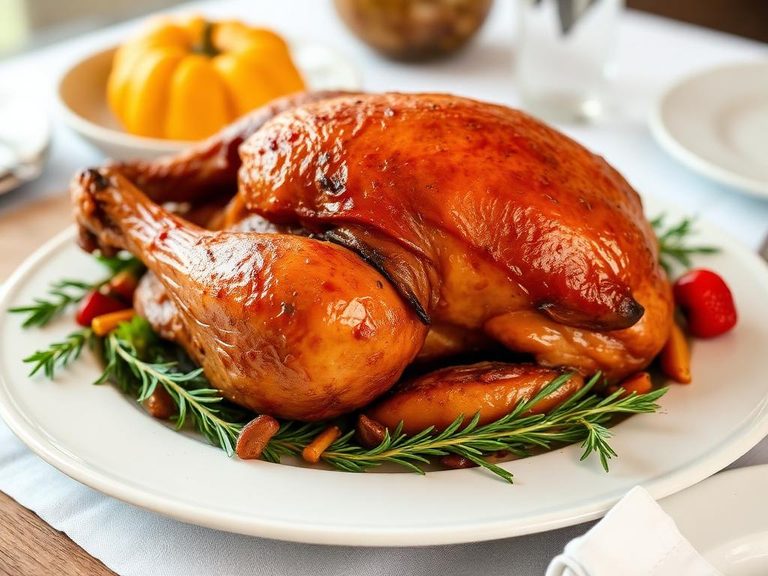
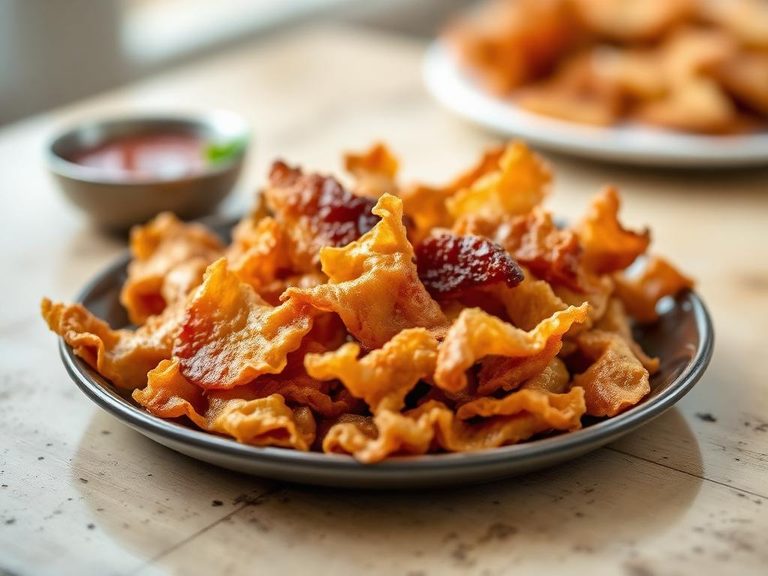
This is the flavorful, crispy skin from a whole roasted turkey, a prized delicacy that combines a shattering, savory crust with a rich, fatty mouthfeel. Nutritionally, it is a dense source of energy and fat, providing over 40 grams of fat per 100 grams with a significant protein content, but virtually no carbohydrates.
Calorie split: 20% protein · 0% carbs · 80% fat
↓ Full nutrition💚 Why it's loved
People love it for the irresistible contrast of textures—the crisp, rendered skin against the tender meat underneath—and its deep, savory, umami flavor that concentrates during roasting. It's a celebratory centerpiece, especially in holiday traditions, where the skin is often the most sought-after prize.
⚠️ Watch-outs & how to enjoy it better
The high fat and calorie density can be a concern for those monitoring intake, and the preparation often involves significant sodium. To counteract this, practice portion control, pair it with fiber-rich vegetables like roasted Brussels sprouts or a fresh salad, and ensure the rest of the meal is lower in added fats.
Key benefits
- Excellent source of high-quality protein.
- Provides a concentrated source of dietary fat for satiety.
- Rich in fat-soluble vitamins like Vitamin E.
- Contains minerals such as selenium and phosphorus.
- A flavorful, low-carb component for meal customization.
🍽️ Popular dishes

🌍 Where it's eaten
💡 Did you know?
In some culinary traditions, the turkey skin is carefully removed before roasting, seasoned separately, and then returned to the bird for the final stage of cooking to achieve maximum crispness without overcooking the meat.
Full nutrition (USDA data · scales with serving)
| Water | 36.9 g |
| Energy | 451 kcal |
| Energy | 1889 kj |
| Protein | 22.1 g |
| Total lipid (fat) | 40.3 g |
| Ash | 1.4 g |
| Carbohydrate, by difference | 0.00 g |
| Fiber, total dietary | 0.00 g |
| Total Sugars | 0.00 g |
| Calcium, Ca | 25.0 mg |
| Iron, Fe | 1.1 mg |
| Magnesium, Mg | 28.0 mg |
| Phosphorus, P | 244 mg |
| Potassium, K | 263 mg |
| Sodium, Na | 234 mg |
| Zinc, Zn | 1.6 mg |
| Copper, Cu | 0.07 mg |
| Manganese, Mn | 0.03 mg |
| Selenium, Se | 21.1 ug |
| Vitamin C, total ascorbic acid | 0.00 mg |
| Thiamin | 0.02 mg |
| Riboflavin | 0.23 mg |
| Niacin | 7.3 mg |
| Pantothenic acid | 0.92 mg |
| Vitamin B-6 | 0.29 mg |
| Folate, total | 7.0 ug |
| Folic acid | 0.00 ug |
| Folate, food | 7.0 ug |
| Folate, DFE | 7.0 ug |
| Choline, total | 73.8 mg |
| Betaine | 3.8 mg |
| Vitamin B-12 | 1.6 ug |
| Vitamin B-12, added | 0.00 ug |
| Vitamin A, RAE | 79.0 ug |
| Retinol | 79.0 ug |
| Carotene, beta | 0.00 ug |
| Carotene, alpha | 0.00 ug |
| Cryptoxanthin, beta | 0.00 ug |
| Vitamin A, IU | 262 iu |
| Lycopene | 0.00 ug |
| Lutein + zeaxanthin | 0.00 ug |
| Vitamin E (alpha-tocopherol) | 0.15 mg |
| Vitamin E, added | 0.00 mg |
| Tocopherol, beta | 0.00 mg |
| Tocopherol, gamma | 0.07 mg |
| Tocopherol, delta | 0.00 mg |
| Tocotrienol, alpha | 0.00 mg |
| Tocotrienol, beta | 0.00 mg |
| Tocotrienol, gamma | 0.08 mg |
| Tocotrienol, delta | 0.00 mg |
| Vitamin D (D2 + D3), International Units | 54.0 iu |
| Vitamin D (D2 + D3) | 1.4 ug |
| Vitamin D3 (cholecalciferol) | 1.4 ug |
| Vitamin K (phylloquinone) | 0.00 ug |
| Alcohol, ethyl | 0.00 g |
| Caffeine | 0.00 mg |
| Theobromine | 0.00 mg |
Fat & fatty acid profile (per 100g)
| Fatty acids, total saturated | 11.4 g |
| SFA 4:0 | 0.00 g |
| SFA 6:0 | 0.00 g |
| SFA 8:0 | 0.00 g |
| SFA 10:0 | 0.01 g |
| SFA 12:0 | 0.14 g |
| SFA 14:0 | 0.42 g |
| SFA 15:0 | 0.06 g |
| SFA 16:0 | 7.9 g |
| SFA 17:0 | 0.11 g |
| SFA 18:0 | 2.7 g |
| SFA 20:0 | 0.04 g |
| SFA 22:0 | 0.02 g |
| SFA 24:0 | 0.01 g |
| Fatty acids, total monounsaturated | 15.1 g |
| MUFA 14:1 | 0.06 g |
| MUFA 15:1 | 0.00 g |
| MUFA 16:1 | 1.5 g |
| MUFA 16:1 c | 1.5 g |
| MUFA 17:1 | 0.06 g |
| MUFA 18:1 | 13.2 g |
| MUFA 18:1 c | 12.8 g |
| MUFA 20:1 | 0.20 g |
| MUFA 22:1 | 0.01 g |
| MUFA 22:1 c | 0.01 g |
| MUFA 24:1 c | 0.00 g |
| Fatty acids, total polyunsaturated | 11.9 g |
| PUFA 18:2 | 10.8 g |
| PUFA 18:2 n-6 c,c | 10.6 g |
| PUFA 18:2 CLAs | 0.08 g |
| PUFA 18:3 | 0.68 g |
| PUFA 18:3 n-3 c,c,c (ALA) | 0.66 g |
| PUFA 18:3 n-6 c,c,c | 0.02 g |
| PUFA 18:4 | 0.00 g |
| PUFA 20:2 n-6 c,c | 0.06 g |
| PUFA 20:3 | 0.05 g |
| PUFA 20:3 n-3 | 0.01 g |
| PUFA 20:3 n-6 | 0.04 g |
| PUFA 20:4 | 0.19 g |
| PUFA 20:5 n-3 (EPA) | 0.01 g |
| PUFA 22:4 | 0.04 g |
| PUFA 22:5 n-3 (DPA) | 0.02 g |
| PUFA 22:6 n-3 (DHA) | 0.01 g |
| Fatty acids, total trans | 0.57 g |
| Fatty acids, total trans-monoenoic | 0.44 g |
| TFA 16:1 t | 0.03 g |
| TFA 18:1 t | 0.41 g |
| TFA 22:1 t | 0.00 g |
| TFA 18:2 t not further defined | 0.13 g |
| Fatty acids, total trans-polyenoic | 0.13 g |
| Cholesterol | 144 mg |
Amino acid profile (per 100g)
| Tryptophan | 0.11 g |
| Threonine | 0.50 g |
| Isoleucine | 0.43 g |
| Leucine | 1.0 g |
| Lysine | 1.2 g |
| Methionine | 0.37 g |
| Cystine | 0.17 g |
| Phenylalanine | 0.56 g |
| Tyrosine | 0.39 g |
| Valine | 0.61 g |
| Arginine | 1.4 g |
| Histidine | 0.37 g |
| Alanine | 1.5 g |
| Aspartic acid | 1.3 g |
| Glutamic acid | 2.2 g |
| Glycine | 2.9 g |
| Proline | 2.1 g |
| Serine | 0.72 g |
FAQ
How is the nutrition different from the turkey meat itself?
The skin is vastly higher in fat and calories. While the meat is lean protein (around 1-3g fat per 100g), the skin is over 40g fat per 100g, making it a very different nutritional component.
Can I make it crispier at home?
Yes. Pat the skin completely dry before seasoning, roast at a high temperature (425°F/220°C) initially, and avoid basting the skin directly with pan juices.
Is the 'added solution' in the description significant?
It typically refers to a brine or broth injected to enhance moisture and flavor. This can increase the sodium content, so it's something to note for those on a low-sodium diet.
Nutrient density (calculated · NRF9.3)
Nutrient Rich Foods index: beneficial nutrients (protein, fiber, vitamins, minerals) minus saturated fat, added sugar & sodium, per 100 kcal.
NRF9.3 index — Fulgoni, Keast & Drewnowski, 2009. Computed from USDA nutrients.
Weight-loss friendliness (composite index)
Energy density 4.51 kcal/g · 20% calories from protein · 0.0 g fiber · 0.0 g sugar per 100 g.
Composite of energy density (Rolls et al., 1999), protein & fiber satiety, minus sugar. A calculated heuristic — ranks satiety-per-calorie, not a clinical measure.
Dietary load (calculated from USDA values)
Potential renal acid load. Positive = acid-forming, negative = alkaline-forming.
Sodium-to-potassium ratio: 0.89 (lower is better — aim for ≤ 1)
Sodium:potassium per WHO potassium guidance. Computed from USDA nutrients.