

Snacks, popcorn, microwave, 94% fat free
Whole food · Snacks
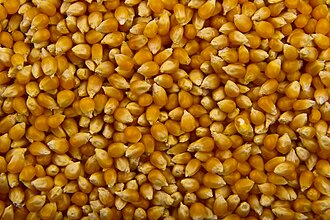
Photo: Wikipedia
Light, airy, and satisfyingly crunchy, this 94% fat-free microwave popcorn delivers a classic, savory snack experience with a fraction of the guilt. Its high-fiber, low-fat profile makes it a surprisingly nutrient-dense choice for a movie-night staple, offering a clean, corn-forward taste without heavy butter or oil.
Calorie split: 11% protein · 76% carbs · 14% fat
↓ Full nutrition💚 Why it's loved
People love it for its addictive, satisfying crunch and the ability to customize flavors—be it salty, cheesy, or spicy. It's a deeply ingrained part of cinema culture and a quick, portion-controlled comfort food.
⚠️ Watch-outs & how to enjoy it better
The primary concern is often hidden sodium in seasoning packets, which can contribute to high blood pressure. Additionally, the high-fiber content may cause digestive discomfort in some if consumed in large quantities. To counteract, choose low-sodium versions, drink plenty of water, and practice portion control by measuring a single serving (about 3-4 cups popped).
Key benefits
- Excellent source of dietary fiber (13.6g per 100g)
- Very low in fat (6.1g per 100g)
- Good source of plant-based protein (10.72g per 100g)
- Provides complex carbohydrates for sustained energy
- Low in sugar (0.65g per 100g)
🍽️ Popular dishes

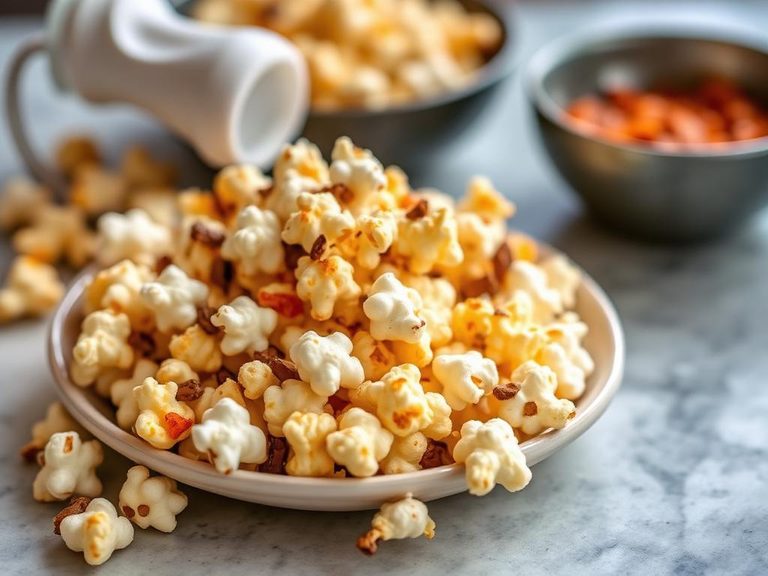
🌍 Where it's eaten
💡 Did you know?
Microwave popcorn bags contain a small, separate packet of oil and flavoring that is designed to melt and coat the kernels as they pop, creating the familiar buttery smell and taste.
Full nutrition (USDA data · scales with serving)
| Water | 4.2 g |
| Energy | 402 kcal |
| Energy | 1682 kj |
| Protein | 10.7 g |
| Total lipid (fat) | 6.1 g |
| Ash | 2.9 g |
| Carbohydrate, by difference | 76.0 g |
| Fiber, total dietary | 13.6 g |
| Total Sugars | 0.65 g |
| Sucrose | 0.65 g |
| Glucose | 0.00 g |
| Fructose | 0.00 g |
| Lactose | 0.00 g |
| Maltose | 0.00 g |
| Galactose | 0.00 g |
| Starch | 59.8 g |
| Calcium, Ca | 14.0 mg |
| Iron, Fe | 2.9 mg |
| Magnesium, Mg | 124 mg |
| Phosphorus, P | 304 mg |
| Potassium, K | 284 mg |
| Sodium, Na | 571 mg |
| Zinc, Zn | 2.8 mg |
| Copper, Cu | 0.26 mg |
| Manganese, Mn | 1.1 mg |
| Selenium, Se | 6.9 ug |
| Vitamin C, total ascorbic acid | 0.00 mg |
| Thiamin | 0.07 mg |
| Riboflavin | 0.15 mg |
| Niacin | 2.1 mg |
| Vitamin B-6 | 0.21 mg |
| Folate, total | 18.0 ug |
| Folic acid | 0.00 ug |
| Folate, food | 18.0 ug |
| Folate, DFE | 18.0 ug |
| Choline, total | 13.0 mg |
| Betaine | 0.30 mg |
| Vitamin B-12 | 0.00 ug |
| Vitamin B-12, added | 0.00 ug |
| Vitamin A, RAE | 13.0 ug |
| Retinol | 0.00 ug |
| Carotene, beta | 75.0 ug |
| Carotene, alpha | 7.0 ug |
| Cryptoxanthin, beta | 160 ug |
| Vitamin A, IU | 264 iu |
| Lycopene | 0.00 ug |
| Lutein + zeaxanthin | 1259 ug |
| Vitamin E (alpha-tocopherol) | 0.41 mg |
| Vitamin E, added | 0.00 mg |
| Tocopherol, beta | 0.02 mg |
| Tocopherol, gamma | 4.3 mg |
| Tocopherol, delta | 0.90 mg |
| Tocotrienol, alpha | 0.32 mg |
| Tocotrienol, beta | 0.00 mg |
| Tocotrienol, gamma | 0.37 mg |
| Tocotrienol, delta | 0.11 mg |
| Vitamin D (D2 + D3), International Units | 0.00 iu |
| Vitamin D (D2 + D3) | 0.00 ug |
| Vitamin K (phylloquinone) | 1.1 ug |
| Vitamin K (Dihydrophylloquinone) | 8.5 ug |
| Alcohol, ethyl | 0.00 g |
| Caffeine | 0.00 mg |
| Theobromine | 0.00 mg |
Fat & fatty acid profile (per 100g)
| Fatty acids, total saturated | 1.2 g |
| SFA 4:0 | 0.00 g |
| SFA 6:0 | 0.00 g |
| SFA 8:0 | 0.00 g |
| SFA 10:0 | 0.00 g |
| SFA 12:0 | 0.00 g |
| SFA 14:0 | 0.01 g |
| SFA 15:0 | 0.00 g |
| SFA 16:0 | 0.74 g |
| SFA 17:0 | 0.01 g |
| SFA 18:0 | 0.38 g |
| SFA 20:0 | 0.02 g |
| SFA 22:0 | 0.01 g |
| SFA 24:0 | 0.01 g |
| Fatty acids, total monounsaturated | 2.8 g |
| MUFA 14:1 | 0.00 g |
| MUFA 15:1 | 0.00 g |
| MUFA 16:1 | 0.01 g |
| MUFA 16:1 c | 0.01 g |
| MUFA 17:1 | 0.00 g |
| MUFA 18:1 | 2.7 g |
| MUFA 18:1 c | 1.9 g |
| MUFA 20:1 | 0.01 g |
| MUFA 22:1 | 0.00 g |
| MUFA 22:1 c | 0.00 g |
| MUFA 24:1 c | 0.00 g |
| Fatty acids, total polyunsaturated | 2.2 g |
| PUFA 18:2 | 2.2 g |
| PUFA 18:2 n-6 c,c | 2.1 g |
| PUFA 18:2 CLAs | 0.00 g |
| PUFA 18:3 | 0.06 g |
| PUFA 18:3 n-3 c,c,c (ALA) | 0.06 g |
| PUFA 18:3 n-6 c,c,c | 0.00 g |
| PUFA 18:4 | 0.00 g |
| PUFA 20:2 n-6 c,c | 0.00 g |
| PUFA 20:3 | 0.00 g |
| PUFA 20:3 n-3 | 0.00 g |
| PUFA 20:3 n-6 | 0.00 g |
| PUFA 20:4 | 0.00 g |
| PUFA 20:5 n-3 (EPA) | 0.00 g |
| PUFA 22:4 | 0.00 g |
| PUFA 22:5 n-3 (DPA) | 0.00 g |
| PUFA 22:6 n-3 (DHA) | 0.00 g |
| Fatty acids, total trans | 0.89 g |
| Fatty acids, total trans-monoenoic | 0.82 g |
| TFA 16:1 t | 0.00 g |
| TFA 18:1 t | 0.82 g |
| TFA 22:1 t | 0.00 g |
| TFA 18:2 t not further defined | 0.07 g |
| Fatty acids, total trans-polyenoic | 0.07 g |
| Cholesterol | 0.00 mg |
Amino acid profile (per 100g)
| Tryptophan | 0.08 g |
| Threonine | 0.37 g |
| Isoleucine | 0.39 g |
| Leucine | 1.5 g |
| Lysine | 0.35 g |
| Methionine | 0.20 g |
| Cystine | 0.18 g |
| Phenylalanine | 0.53 g |
| Tyrosine | 0.40 g |
| Valine | 0.52 g |
| Arginine | 0.31 g |
| Histidine | 0.24 g |
| Alanine | 0.80 g |
| Aspartic acid | 0.80 g |
| Glutamic acid | 2.1 g |
| Glycine | 0.34 g |
| Proline | 0.75 g |
| Serine | 0.50 g |
FAQ
Is this a healthy snack?
Compared to many snacks, it can be. It's high in fiber, low in fat and sugar, and provides whole-grain carbohydrates. The healthiness largely depends on the added sodium and any extra butter or oil you add.
Why is it called '94% fat free'?
This refers to the popped popcorn itself, not the added seasonings. The kernels are naturally very low in fat, and the microwave preparation for this variety minimizes added fats, resulting in a product with minimal total fat per serving.
How does the fiber content compare to other snacks?
It's exceptionally high. With 13.6g of fiber per 100g, it far exceeds most chips, crackers, or pretzels, making it a very filling snack that can support digestive health.
Nutrient density (calculated · NRF9.3)
Nutrient Rich Foods index: beneficial nutrients (protein, fiber, vitamins, minerals) minus saturated fat, added sugar & sodium, per 100 kcal.
NRF9.3 index — Fulgoni, Keast & Drewnowski, 2009. Computed from USDA nutrients.
Weight-loss friendliness (composite index)
Energy density 4.02 kcal/g · 11% calories from protein · 13.6 g fiber · 0.7 g sugar per 100 g.
Composite of energy density (Rolls et al., 1999), protein & fiber satiety, minus sugar. A calculated heuristic — ranks satiety-per-calorie, not a clinical measure.
Dietary load (calculated from USDA values)
Potential renal acid load. Positive = acid-forming, negative = alkaline-forming.
Sodium-to-potassium ratio: 2.01 (lower is better — aim for ≤ 1)
Sodium:potassium per WHO potassium guidance. Computed from USDA nutrients.