

Restaurant, family style, chicken fingers, from kid's menu
Whole food · Restaurant Foods

Photo: Wikipedia
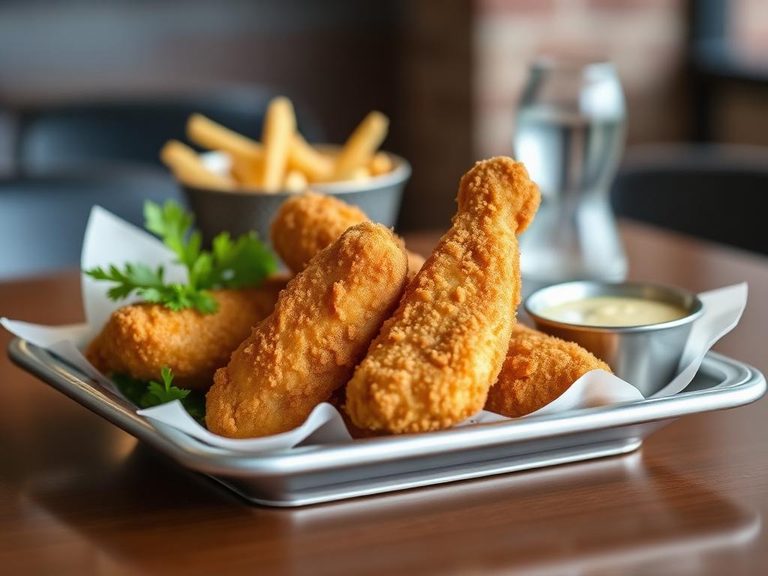
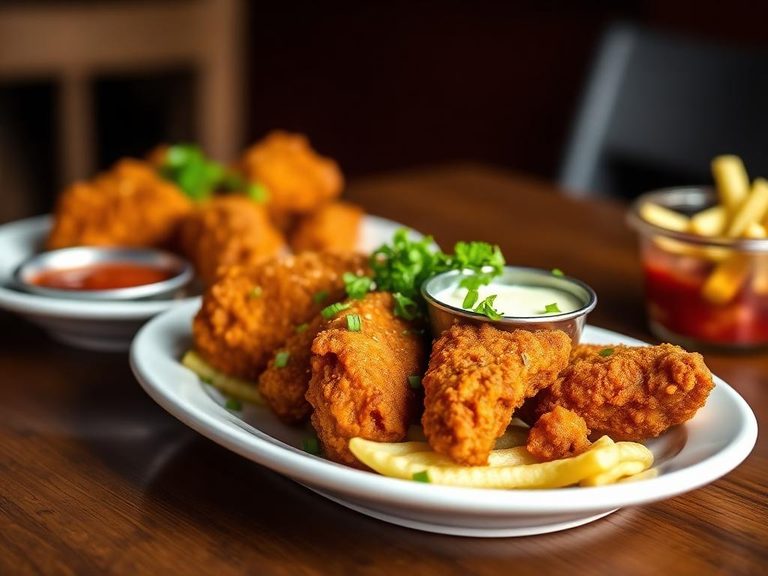
These are bite-sized, breaded, and fried chicken pieces, typically served with a side of dipping sauce. The texture is a satisfying crunch from the golden coating giving way to tender, juicy white meat inside. Nutritionally, they offer a solid protein punch but come with a significant amount of fat and refined carbohydrates from the breading.
Calorie split: 24% protein · 24% carbs · 51% fat
↓ Full nutrition💚 Why it's loved
People love them for their universally appealing combination of salty, savory flavor and the textural contrast between the crispy exterior and soft interior. They are a cultural staple of casual American dining, representing comfort, nostalgia, and a guaranteed crowd-pleaser for family meals.
⚠️ Watch-outs & how to enjoy it better
The primary downsides are the high fat content from frying and the refined carbohydrates in the breading, which can lead to a rapid blood-sugar spike followed by a crash. They are also a common vehicle for high sodium intake and are a major allergen (gluten, often egg). To counteract, pair them with a fiber-rich side like steamed broccoli or a fresh salad to slow digestion, choose a mustard-based sauce over sugary ketchup, and practice strict portion control.
Key benefits
- High-quality protein source for muscle maintenance
- Convenient and palatable way to encourage protein intake in children
- Quick energy source from carbohydrates
- Often a familiar and accepted food for picky eaters
🍽️ Popular dishes

🌍 Where it's eaten
💡 Did you know?
The popular chain restaurant chain Raising Cane's was founded specifically to serve chicken fingers and credits its success to a simple, focused menu and a secret dipping sauce recipe.
Full nutrition (USDA data · scales with serving)
| Water | 42.2 g |
| Energy | 307 kcal |
| Energy | 1284 kj |
| Protein | 18.7 g |
| Total lipid (fat) | 17.4 g |
| Ash | 2.9 g |
| Carbohydrate, by difference | 18.8 g |
| Fiber, total dietary | 1.1 g |
| Total Sugars | 0.33 g |
| Sucrose | 0.03 g |
| Glucose | 0.24 g |
| Fructose | 0.00 g |
| Lactose | 0.00 g |
| Maltose | 0.01 g |
| Galactose | 0.00 g |
| Starch | 18.0 g |
| Calcium, Ca | 21.0 mg |
| Iron, Fe | 0.76 mg |
| Magnesium, Mg | 29.0 mg |
| Phosphorus, P | 306 mg |
| Potassium, K | 322 mg |
| Sodium, Na | 809 mg |
| Zinc, Zn | 0.67 mg |
| Copper, Cu | 0.07 mg |
| Manganese, Mn | 0.25 mg |
| Selenium, Se | 20.0 ug |
| Thiamin | 0.10 mg |
| Riboflavin | 0.17 mg |
| Niacin | 7.6 mg |
| Pantothenic acid | 1.6 mg |
| Vitamin B-6 | 0.45 mg |
| Folate, total | 7.0 ug |
| Folate, food | 7.0 ug |
| Vitamin B-12 | 0.13 ug |
| Vitamin A, RAE | 5.0 ug |
| Retinol | 4.0 ug |
| Carotene, beta | 9.0 ug |
| Carotene, alpha | 0.00 ug |
| Cryptoxanthin, beta | 4.0 ug |
| Vitamin A, IU | 31.0 iu |
| Lycopene | 2.0 ug |
| Lutein + zeaxanthin | 58.0 ug |
| Vitamin E (alpha-tocopherol) | 1.5 mg |
| Tocopherol, beta | 0.19 mg |
| Tocopherol, gamma | 8.2 mg |
| Tocopherol, delta | 2.7 mg |
| Tocotrienol, alpha | 0.01 mg |
| Tocotrienol, beta | 0.10 mg |
| Tocotrienol, gamma | 0.83 mg |
| Tocotrienol, delta | 0.00 mg |
| Vitamin K (phylloquinone) | 28.0 ug |
| Vitamin K (Dihydrophylloquinone) | 0.20 ug |
| Vitamin K (Menaquinone-4) | 6.9 ug |
Fat & fatty acid profile (per 100g)
| Fatty acids, total saturated | 3.2 g |
| SFA 4:0 | 0.00 g |
| SFA 6:0 | 0.00 g |
| SFA 8:0 | 0.01 g |
| SFA 10:0 | 0.01 g |
| SFA 12:0 | 0.00 g |
| SFA 14:0 | 0.02 g |
| SFA 15:0 | 0.01 g |
| SFA 16:0 | 1.9 g |
| SFA 17:0 | 0.02 g |
| SFA 18:0 | 1.1 g |
| SFA 20:0 | 0.06 g |
| SFA 22:0 | 0.06 g |
| SFA 24:0 | 0.02 g |
| Fatty acids, total monounsaturated | 4.0 g |
| MUFA 14:1 | 0.00 g |
| MUFA 15:1 | 0.00 g |
| MUFA 16:1 | 0.05 g |
| MUFA 16:1 c | 0.05 g |
| MUFA 17:1 | 0.01 g |
| MUFA 18:1 | 3.8 g |
| MUFA 18:1 c | 3.8 g |
| MUFA 20:1 | 0.09 g |
| MUFA 22:1 | 0.00 g |
| MUFA 22:1 c | 0.00 g |
| MUFA 24:1 c | 0.00 g |
| Fatty acids, total polyunsaturated | 9.0 g |
| PUFA 18:2 | 7.9 g |
| PUFA 18:2 n-6 c,c | 7.8 g |
| PUFA 18:2 CLAs | 0.02 g |
| PUFA 18:3 | 1.0 g |
| PUFA 18:3 n-3 c,c,c (ALA) | 0.97 g |
| PUFA 18:3 n-6 c,c,c | 0.07 g |
| PUFA 18:3i | 0.00 g |
| PUFA 18:4 | 0.00 g |
| PUFA 20:2 n-6 c,c | 0.01 g |
| PUFA 20:3 | 0.01 g |
| PUFA 20:3 n-3 | 0.00 g |
| PUFA 20:3 n-6 | 0.01 g |
| PUFA 20:4 | 0.04 g |
| PUFA 20:5 n-3 (EPA) | 0.00 g |
| PUFA 22:4 | 0.01 g |
| PUFA 22:5 n-3 (DPA) | 0.00 g |
| PUFA 22:6 n-3 (DHA) | 0.00 g |
| Fatty acids, total trans | 0.13 g |
| Fatty acids, total trans-monoenoic | 0.04 g |
| TFA 16:1 t | 0.00 g |
| TFA 18:1 t | 0.04 g |
| TFA 22:1 t | 0.00 g |
| TFA 18:2 t not further defined | 0.10 g |
| Fatty acids, total trans-polyenoic | 0.10 g |
| Cholesterol | 46.0 mg |
Amino acid profile (per 100g)
| Tryptophan | 0.21 g |
| Threonine | 0.60 g |
| Isoleucine | 0.93 g |
| Leucine | 1.6 g |
| Lysine | 1.8 g |
| Methionine | 0.52 g |
| Cystine | 0.26 g |
| Phenylalanine | 0.78 g |
| Tyrosine | 0.53 g |
| Valine | 1.0 g |
| Arginine | 1.3 g |
| Histidine | 0.73 g |
| Alanine | 1.1 g |
| Aspartic acid | 1.6 g |
| Glutamic acid | 3.4 g |
| Glycine | 0.86 g |
| Proline | 1.2 g |
| Serine | 0.69 g |
| Hydroxyproline | 0.02 g |
FAQ
Are chicken fingers the same as chicken nuggets?
While similar, they are generally different. Chicken fingers are typically strips of whole muscle meat (like the tenderloin), while nuggets are often made from ground or minced chicken formed into shapes.
What is the best way to reheat them to keep them crispy?
Avoid the microwave, which makes them soggy. Reheat in an oven or toaster oven at 375°F (190°C) for 5-10 minutes, or use an air fryer for the best results.
Why are they so popular with kids?
The mild flavor of white meat, the fun dippable format, and the appealing crispy texture make them a non-threatening and enjoyable food for many children.
Nutrient density (calculated · NRF9.3)
Nutrient Rich Foods index: beneficial nutrients (protein, fiber, vitamins, minerals) minus saturated fat, added sugar & sodium, per 100 kcal.
NRF9.3 index — Fulgoni, Keast & Drewnowski, 2009. Computed from USDA nutrients.
Weight-loss friendliness (composite index)
Energy density 3.07 kcal/g · 24% calories from protein · 1.1 g fiber · 0.3 g sugar per 100 g.
Composite of energy density (Rolls et al., 1999), protein & fiber satiety, minus sugar. A calculated heuristic — ranks satiety-per-calorie, not a clinical measure.
Dietary load (calculated from USDA values)
Potential renal acid load. Positive = acid-forming, negative = alkaline-forming.
Sodium-to-potassium ratio: 2.51 (lower is better — aim for ≤ 1)
Sodium:potassium per WHO potassium guidance. Computed from USDA nutrients.