

Pork, cured, ham -- water added, rump, bone-in, separable lean only, heated, roasted
Whole food · Pork Products

Photo: Wikipedia
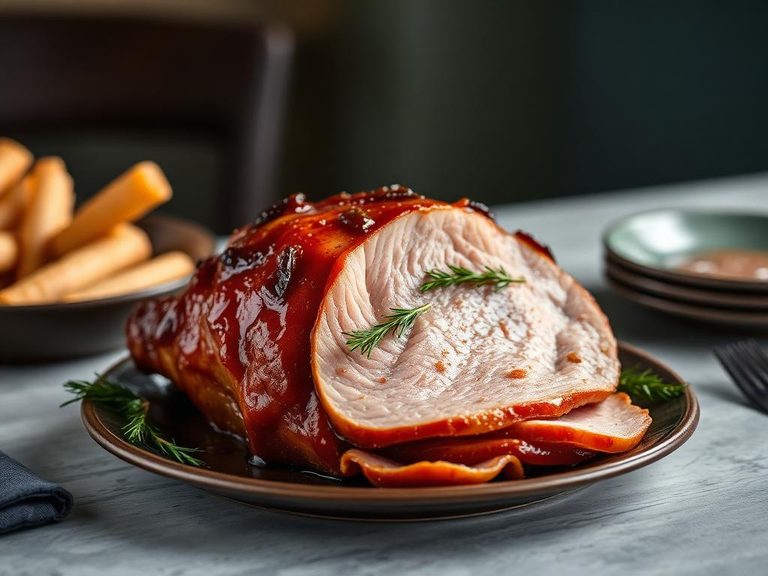
This is a lean, bone-in cut of cured pork leg, roasted to a savory, juicy finish. Its texture is tender yet firm, with a deep, salty-sweet pork flavor that intensifies with roasting. Nutritionally, it's a powerhouse of protein with minimal fat and carbohydrates, making it a lean choice for meat lovers.
Calorie split: 71% protein · 3% carbs · 26% fat
↓ Full nutrition💚 Why it's loved
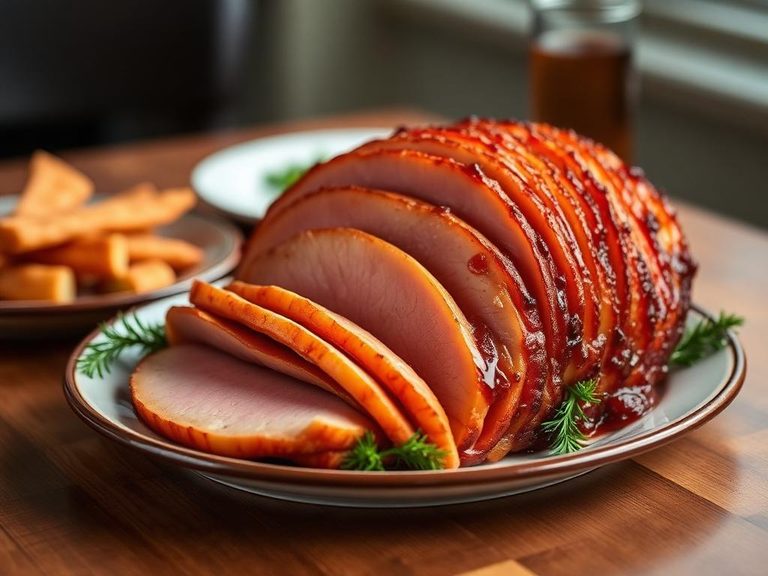
People adore its rich, savory depth and the satisfying contrast between the crispy roasted exterior and the moist, tender interior. It's a centerpiece of holiday feasts and comforting weeknight meals alike, offering a taste of tradition and indulgence.
⚠️ Watch-outs & how to enjoy it better
As a cured product, it is high in sodium, which can be a concern for those monitoring blood pressure or fluid retention. To counteract this, pair it with potassium-rich foods like roasted potatoes or steamed greens, and be mindful of portion size. Also, the curing process uses nitrates, so some prefer to enjoy it occasionally rather than daily.
Key benefits
- Excellent source of high-quality protein (21g per 100g)
- Very low in carbohydrates and sugars
- Contains B vitamins like thiamine and niacin
- Provides minerals such as zinc and selenium
- Lean cut with only 3.5g fat per 100g
🍽️ Popular dishes


🌍 Where it's eaten
💡 Did you know?
The 'water added' label indicates the ham was injected with a brine solution during curing, which helps distribute salt and seasonings evenly and ensures a juicier result after roasting.
Full nutrition (USDA data · scales with serving)
| Water | 70.9 g |
| Energy | 121 kcal |
| Energy | 507 kj |
| Protein | 21.4 g |
| Total lipid (fat) | 3.6 g |
| Ash | 3.2 g |
| Carbohydrate, by difference | 0.87 g |
| Fiber, total dietary | 0.00 g |
| Total Sugars | 0.84 g |
| Sucrose | 0.75 g |
| Glucose | 0.04 g |
| Fructose | 0.05 g |
| Lactose | 0.00 g |
| Maltose | 0.00 g |
| Galactose | 0.00 g |
| Calcium, Ca | 8.0 mg |
| Iron, Fe | 0.71 mg |
| Magnesium, Mg | 18.0 mg |
| Phosphorus, P | 246 mg |
| Potassium, K | 250 mg |
| Sodium, Na | 1150 mg |
| Zinc, Zn | 1.8 mg |
| Copper, Cu | 0.10 mg |
| Manganese, Mn | 0.02 mg |
| Selenium, Se | 27.5 ug |
| Vitamin C, total ascorbic acid | 0.00 mg |
| Thiamin | 0.36 mg |
| Riboflavin | 0.19 mg |
| Niacin | 4.4 mg |
| Pantothenic acid | 0.53 mg |
| Vitamin B-6 | 0.43 mg |
| Folate, total | 4.0 ug |
| Folic acid | 0.00 ug |
| Folate, food | 4.0 ug |
| Folate, DFE | 4.0 ug |
| Choline, total | 83.6 mg |
| Betaine | 5.0 mg |
| Vitamin B-12 | 0.36 ug |
| Vitamin B-12, added | 0.00 ug |
| Vitamin A, RAE | 11.0 ug |
| Retinol | 11.0 ug |
| Carotene, beta | 0.00 ug |
| Carotene, alpha | 0.00 ug |
| Cryptoxanthin, beta | 0.00 ug |
| Vitamin A, IU | 37.0 iu |
| Lycopene | 0.00 ug |
| Lutein + zeaxanthin | 0.00 ug |
| Vitamin E (alpha-tocopherol) | 0.20 mg |
| Vitamin E, added | 0.00 mg |
| Tocopherol, beta | 0.00 mg |
| Tocopherol, gamma | 0.05 mg |
| Tocopherol, delta | 0.00 mg |
| Tocotrienol, alpha | 0.00 mg |
| Tocotrienol, beta | 0.00 mg |
| Tocotrienol, gamma | 0.01 mg |
| Tocotrienol, delta | 0.00 mg |
| Vitamin K (phylloquinone) | 0.00 ug |
| Vitamin K (Dihydrophylloquinone) | 0.00 ug |
| Vitamin K (Menaquinone-4) | 2.5 ug |
| Alcohol, ethyl | 0.00 g |
| Caffeine | 0.00 mg |
| Theobromine | 0.00 mg |
Fat & fatty acid profile (per 100g)
| Fatty acids, total saturated | 1.3 g |
| SFA 4:0 | 0.00 g |
| SFA 6:0 | 0.00 g |
| SFA 8:0 | 0.00 g |
| SFA 10:0 | 0.00 g |
| SFA 12:0 | 0.00 g |
| SFA 14:0 | 0.04 g |
| SFA 15:0 | 0.00 g |
| SFA 16:0 | 0.78 g |
| SFA 17:0 | 0.01 g |
| SFA 18:0 | 0.40 g |
| SFA 20:0 | 0.01 g |
| SFA 22:0 | 0.01 g |
| Fatty acids, total monounsaturated | 1.6 g |
| MUFA 14:1 | 0.00 g |
| MUFA 15:1 | 0.00 g |
| MUFA 16:1 | 0.10 g |
| MUFA 17:1 | 0.00 g |
| MUFA 18:1 | 1.5 g |
| MUFA 18:1 c | 1.5 g |
| MUFA 20:1 | 0.02 g |
| MUFA 22:1 | 0.00 g |
| Fatty acids, total polyunsaturated | 0.39 g |
| PUFA 18:2 | 0.33 g |
| PUFA 18:2 n-6 c,c | 0.31 g |
| PUFA 18:2 CLAs | 0.01 g |
| PUFA 18:3 | 0.01 g |
| PUFA 18:3 n-3 c,c,c (ALA) | 0.01 g |
| PUFA 18:3 n-6 c,c,c | 0.00 g |
| PUFA 18:4 | 0.00 g |
| PUFA 20:2 n-6 c,c | 0.01 g |
| PUFA 20:3 | 0.00 g |
| PUFA 20:4 | 0.04 g |
| PUFA 20:5 n-3 (EPA) | 0.00 g |
| PUFA 22:5 n-3 (DPA) | 0.00 g |
| PUFA 22:6 n-3 (DHA) | 0.00 g |
| Fatty acids, total trans | 0.03 g |
| Fatty acids, total trans-monoenoic | 0.02 g |
| TFA 18:1 t | 0.02 g |
| TFA 18:2 t,t | 0.01 g |
| Fatty acids, total trans-polyenoic | 0.01 g |
| Cholesterol | 62.0 mg |
Amino acid profile (per 100g)
| Tryptophan | 0.20 g |
| Threonine | 0.96 g |
| Isoleucine | 0.97 g |
| Leucine | 1.7 g |
| Lysine | 1.8 g |
| Methionine | 0.51 g |
| Cystine | 0.24 g |
| Phenylalanine | 0.86 g |
| Tyrosine | 0.69 g |
| Valine | 1.1 g |
| Arginine | 1.4 g |
| Histidine | 0.93 g |
| Alanine | 1.3 g |
| Aspartic acid | 1.9 g |
| Glutamic acid | 3.1 g |
| Glycine | 1.1 g |
| Proline | 0.92 g |
| Serine | 0.84 g |
| Hydroxyproline | 0.14 g |
FAQ
How is this different from fresh ham?
This ham has been cured (salted and often smoked) before cooking, giving it its characteristic flavor and pink color. Fresh ham is uncured and pale, requiring more seasoning and longer cooking.
Can I eat the bone?
No, the bone is not meant to be eaten. It's left in for flavor and moisture during roasting and is removed before slicing and serving.
What's the best way to reheat leftovers without drying them out?
Slice the ham, place in a baking dish, add a splash of broth or water, cover tightly with foil, and warm in a 325°F (165°C) oven until heated through.
Nutrient density (calculated · NRF9.3)
Nutrient Rich Foods index: beneficial nutrients (protein, fiber, vitamins, minerals) minus saturated fat, added sugar & sodium, per 100 kcal.
NRF9.3 index — Fulgoni, Keast & Drewnowski, 2009. Computed from USDA nutrients.
Weight-loss friendliness (composite index)
Energy density 1.21 kcal/g · 71% calories from protein · 0.0 g fiber · 0.8 g sugar per 100 g.
Composite of energy density (Rolls et al., 1999), protein & fiber satiety, minus sugar. A calculated heuristic — ranks satiety-per-calorie, not a clinical measure.
Dietary load (calculated from USDA values)
Potential renal acid load. Positive = acid-forming, negative = alkaline-forming.
Sodium-to-potassium ratio: 4.60 (lower is better — aim for ≤ 1)
Sodium:potassium per WHO potassium guidance. Computed from USDA nutrients.