Onion rings, breaded, par fried, frozen, prepared, heated in oven
Whole food · Vegetables and Vegetable Products
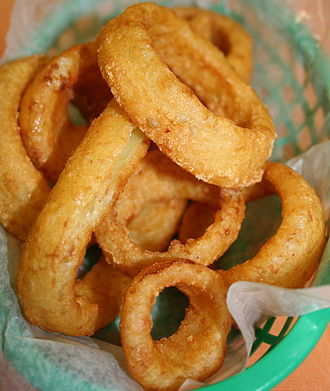
Photo: Wikipedia
These are crispy, golden-brown rings of onion encased in a seasoned breadcrumb coating, par-fried for a quick finish in the oven. The texture is a satisfying crunch giving way to a soft, sweet onion interior. Nutritionally, they are a moderate source of energy, primarily from carbohydrates and fats.
💚 Why it's loved
People adore them for the irresistible contrast between the savory, crunchy coating and the tender, sweet onion inside. They are a versatile side dish or snack that pairs perfectly with burgers, sandwiches, or a variety of dipping sauces.
⚠️ Watch-outs & how to enjoy it better
The par-frying and breading make them high in refined carbs and fats, which can cause blood sugar spikes and aren't ideal for low-carb diets. To counteract this, pair them with a protein-rich food like grilled chicken or a bean-based dip, and practice strict portion control.
Key benefits
- Provides a quick source of energy from carbohydrates.
- Contains some dietary fiber from the onion and breading.
- Offers a convenient and familiar comfort food option.
- The onion provides trace amounts of vitamin C and antioxidants.
🍽️ Popular dishes
🌍 Where it's eaten
💡 Did you know?
The first known recipe for onion rings appeared in a 1902 New York cookbook, calling for 'cored sweet onions' dipped in milk and cornmeal.
Full nutrition (scales with serving)
| Water | 46.4 g |
| Energy | 276 kcal |
| Energy | 1156 kj |
| Protein | 4.1 g |
| Total lipid (fat) | 14.3 g |
| Ash | 1.4 g |
| Carbohydrate, by difference | 33.8 g |
| Fiber, total dietary | 2.2 g |
| Total Sugars | 5.1 g |
| Sucrose | 1.8 g |
| Glucose | 1.3 g |
| Fructose | 1.3 g |
| Lactose | 0.11 g |
| Maltose | 0.66 g |
| Galactose | 0.00 g |
| Starch | 25.6 g |
| Calcium, Ca | 31.0 mg |
| Iron, Fe | 1.3 mg |
| Magnesium, Mg | 17.0 mg |
| Phosphorus, P | 71.0 mg |
| Potassium, K | 123 mg |
| Sodium, Na | 370 mg |
| Zinc, Zn | 0.42 mg |
| Copper, Cu | 0.07 mg |
| Manganese, Mn | 0.35 mg |
| Selenium, Se | 5.6 ug |
| Vitamin C, total ascorbic acid | 1.6 mg |
| Thiamin | 0.18 mg |
| Riboflavin | 0.12 mg |
| Niacin | 1.3 mg |
| Pantothenic acid | 0.29 mg |
| Vitamin B-6 | 0.12 mg |
| Folate, total | 33.0 ug |
| Folic acid | 0.00 ug |
| Folate, food | 33.0 ug |
| Folate, DFE | 33.0 ug |
| Choline, total | 10.7 mg |
| Betaine | 36.4 mg |
| Vitamin B-12 | 0.00 ug |
| Vitamin B-12, added | 0.00 ug |
| Vitamin A, RAE | 0.00 ug |
| Retinol | 0.00 ug |
| Carotene, beta | 0.00 ug |
| Carotene, alpha | 0.00 ug |
| Cryptoxanthin, beta | 0.00 ug |
| Vitamin A, IU | 0.00 iu |
| Lycopene | 0.00 ug |
| Lutein + zeaxanthin | 0.00 ug |
| Vitamin E (alpha-tocopherol) | 0.46 mg |
| Vitamin E, added | 0.00 mg |
| Tocopherol, beta | 0.41 mg |
| Tocopherol, gamma | 2.3 mg |
| Tocopherol, delta | 1.4 mg |
| Tocotrienol, alpha | 0.00 mg |
| Tocotrienol, beta | 0.15 mg |
| Tocotrienol, gamma | 0.00 mg |
| Tocotrienol, delta | 0.00 mg |
| Vitamin D (D2 + D3), International Units | 0.00 iu |
| Vitamin D (D2 + D3) | 0.00 ug |
| Vitamin K (phylloquinone) | 34.1 ug |
| Fatty acids, total saturated | 2.1 g |
| SFA 4:0 | 0.00 g |
| SFA 6:0 | 0.00 g |
| SFA 8:0 | 0.01 g |
| SFA 10:0 | 0.01 g |
| SFA 12:0 | 0.01 g |
| SFA 14:0 | 0.01 g |
| SFA 15:0 | 0.00 g |
| SFA 16:0 | 1.4 g |
| SFA 17:0 | 0.01 g |
| SFA 18:0 | 0.55 g |
| SFA 20:0 | 0.04 g |
| SFA 22:0 | 0.04 g |
| SFA 24:0 | 0.01 g |
| Fatty acids, total monounsaturated | 3.0 g |
| MUFA 14:1 | 0.00 g |
| MUFA 15:1 | 0.00 g |
| MUFA 16:1 | 0.01 g |
| MUFA 16:1 c | 0.01 g |
| MUFA 17:1 | 0.01 g |
| MUFA 18:1 | 2.8 g |
| MUFA 18:1 c | 2.8 g |
| MUFA 20:1 | 0.05 g |
| MUFA 22:1 | 0.00 g |
| MUFA 22:1 c | 0.00 g |
| MUFA 24:1 c | 0.00 g |
| Fatty acids, total polyunsaturated | 7.6 g |
| PUFA 18:2 | 6.4 g |
| PUFA 18:2 n-6 c,c | 6.3 g |
| PUFA 18:2 CLAs | 0.00 g |
| PUFA 18:3 | 0.84 g |
| PUFA 18:3 n-3 c,c,c (ALA) | 0.79 g |
| PUFA 18:3 n-6 c,c,c | 0.05 g |
| PUFA 18:3i | 0.00 g |
| PUFA 18:4 | 0.00 g |
| PUFA 20:2 n-6 c,c | 0.00 g |
| PUFA 20:3 | 0.00 g |
| PUFA 20:3 n-3 | 0.00 g |
| PUFA 20:3 n-6 | 0.00 g |
| PUFA 20:4 | 0.01 g |
| PUFA 20:5 n-3 (EPA) | 0.00 g |
| PUFA 22:4 | 0.00 g |
| PUFA 22:5 n-3 (DPA) | 0.00 g |
| PUFA 22:6 n-3 (DHA) | 0.00 g |
| Fatty acids, total trans | 0.05 g |
| Fatty acids, total trans-monoenoic | 0.02 g |
| TFA 16:1 t | 0.00 g |
| TFA 18:1 t | 0.01 g |
| TFA 22:1 t | 0.00 g |
| TFA 18:2 t not further defined | 0.04 g |
| Fatty acids, total trans-polyenoic | 0.04 g |
| Cholesterol | 0.00 mg |
| Tryptophan | 0.07 g |
| Threonine | 0.15 g |
| Isoleucine | 0.21 g |
| Leucine | 0.35 g |
| Lysine | 0.15 g |
| Methionine | 0.08 g |
| Cystine | 0.11 g |
| Phenylalanine | 0.24 g |
| Tyrosine | 0.16 g |
| Valine | 0.22 g |
| Arginine | 0.33 g |
| Histidine | 0.11 g |
| Alanine | 0.17 g |
| Aspartic acid | 0.25 g |
| Glutamic acid | 1.6 g |
| Glycine | 0.20 g |
| Proline | 0.52 g |
| Serine | 0.26 g |
| Alcohol, ethyl | 0.00 g |
| Caffeine | 0.00 mg |
| Theobromine | 0.00 mg |
FAQ
Are oven-baked onion rings healthier than deep-fried?
Generally, yes. Oven preparation uses less added oil, which can reduce the overall fat and calorie content compared to deep-frying, though the difference depends on the specific product and cooking instructions.
Why do my frozen onion rings sometimes come out soggy?
This often happens if they are overcrowded on the baking sheet, trapping steam. Ensure they are in a single layer with space between each ring, and preheat the oven fully for maximum crispness.
What are good dipping sauces for onion rings?
Classic choices include ketchup, ranch dressing, and barbecue sauce. For a twist, try a spicy mayo, a tangy remoulade, or a creamy garlic aioli.