

Fruit juice smoothie, ODWALLA, strawberry banana
Whole food · Fruits and Fruit Juices

Photo: Wikipedia
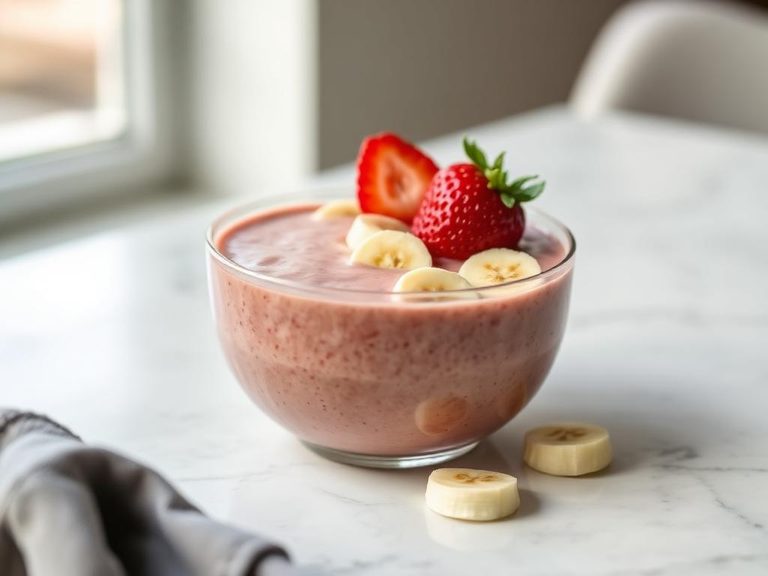
A vibrant, smooth, and refreshing fruit blend, this ODWALLA smoothie combines the sweet, tropical notes of banana with the bright, slightly tart flavor of strawberry. It has a pourable, velvety texture, making it a convenient and quick way to enjoy a fruit-forward drink. Nutritionally, it's a light, low-calorie option primarily providing quick-release carbohydrates from natural fruit sugars.
Calorie split: 4% protein · 90% carbs · 6% fat
↓ Full nutrition💚 Why it's loved
People love it for its perfectly balanced, crowd-pleasing flavor—the classic strawberry-banana duo is a nostalgic, universally appealing combination. Its smooth, drinkable consistency makes it an easy, on-the-go breakfast or snack that feels both indulgent and wholesome.
⚠️ Watch-outs & how to enjoy it better
The primary concern is the high concentration of natural sugars (nearly 10g per 100g), which can cause a rapid blood-sugar spike if consumed alone, especially by those monitoring their glucose levels. To counteract this, pair it with a source of protein or healthy fat (like a handful of nuts or a cheese stick) to slow sugar absorption and promote satiety.
Key benefits
- Provides a quick source of natural energy from fruit sugars
- Contains dietary fiber from blended whole fruits
- Offers a convenient way to increase fruit intake
- Low in fat and contains no added sodium
- A refreshing, hydrating option for a light snack
🍽️ Popular dishes
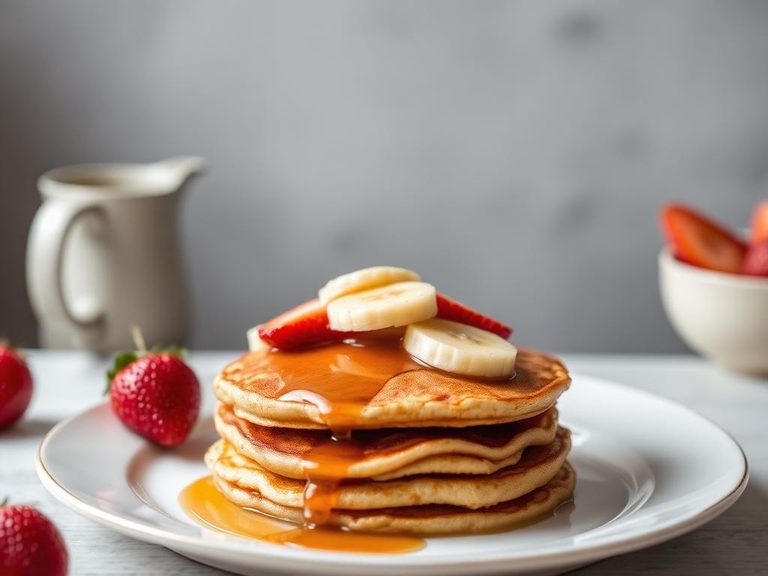
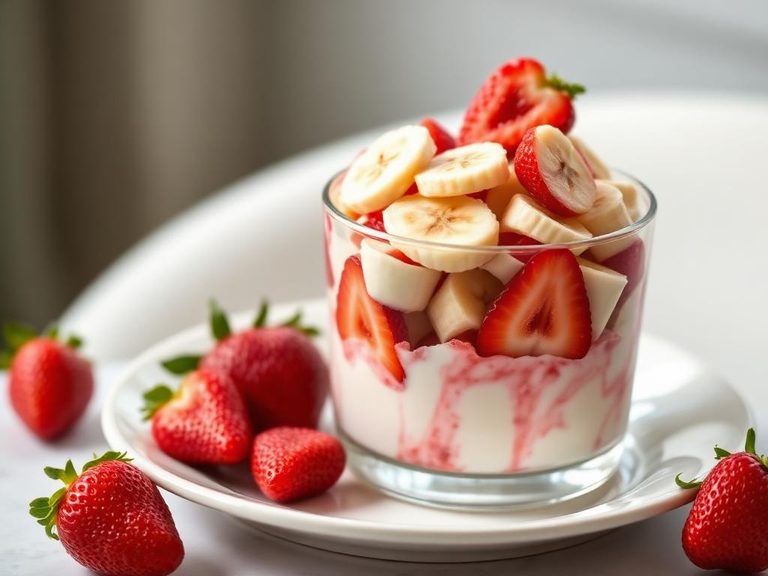
🌍 Where it's eaten
💡 Did you know?
The strawberry is the only fruit with its seeds on the outside, and a single serving of this smoothie can contain over 200 of these tiny seeds.
Full nutrition (USDA data · scales with serving)
| Water | 87.7 g |
| Energy | 48.0 kcal |
| Energy | 200 kj |
| Protein | 0.50 g |
| Total lipid (fat) | 0.32 g |
| Ash | 0.39 g |
| Carbohydrate, by difference | 11.1 g |
| Fiber, total dietary | 0.60 g |
| Total Sugars | 9.9 g |
| Sucrose | 3.5 g |
| Glucose | 2.6 g |
| Fructose | 3.8 g |
| Lactose | 0.00 g |
| Maltose | 0.00 g |
| Galactose | 0.00 g |
| Calcium, Ca | 10.0 mg |
| Iron, Fe | 0.20 mg |
| Magnesium, Mg | 14.0 mg |
| Phosphorus, P | 18.0 mg |
| Potassium, K | 201 mg |
| Sodium, Na | 2.0 mg |
| Zinc, Zn | 0.08 mg |
| Copper, Cu | 0.04 mg |
| Manganese, Mn | 0.18 mg |
| Selenium, Se | 0.20 ug |
| Vitamin C, total ascorbic acid | 38.4 mg |
| Thiamin | 0.05 mg |
| Riboflavin | 0.05 mg |
| Niacin | 0.28 mg |
| Pantothenic acid | 0.21 mg |
| Vitamin B-6 | 0.07 mg |
| Folate, total | 30.0 ug |
| Folic acid | 0.00 ug |
| Folate, food | 30.0 ug |
| Folate, DFE | 30.0 ug |
| Choline, total | 3.8 mg |
| Vitamin B-12 | 0.00 ug |
| Vitamin B-12, added | 0.00 ug |
| Vitamin A, RAE | 11.0 ug |
| Retinol | 0.00 ug |
| Carotene, beta | 45.0 ug |
| Carotene, alpha | 7.0 ug |
| Cryptoxanthin, beta | 169 ug |
| Vitamin A, IU | 222 iu |
| Lycopene | 0.00 ug |
| Lutein + zeaxanthin | 48.0 ug |
| Vitamin E (alpha-tocopherol) | 8.9 mg |
| Vitamin E, added | 8.8 mg |
| Vitamin D (D2 + D3), International Units | 0.00 iu |
| Vitamin D (D2 + D3) | 0.00 ug |
| Vitamin K (phylloquinone) | 0.80 ug |
| Vitamin K (Dihydrophylloquinone) | 0.00 ug |
| Vitamin K (Menaquinone-4) | 0.00 ug |
| Alcohol, ethyl | 0.00 g |
| Caffeine | 0.00 mg |
| Theobromine | 0.00 mg |
Fat & fatty acid profile (per 100g)
| Fatty acids, total saturated | 0.06 g |
| SFA 4:0 | 0.00 g |
| SFA 6:0 | 0.00 g |
| SFA 8:0 | 0.00 g |
| SFA 10:0 | 0.01 g |
| SFA 12:0 | 0.00 g |
| SFA 14:0 | 0.00 g |
| SFA 15:0 | 0.00 g |
| SFA 16:0 | 0.02 g |
| SFA 17:0 | 0.00 g |
| SFA 18:0 | 0.01 g |
| SFA 20:0 | 0.00 g |
| SFA 22:0 | 0.00 g |
| SFA 24:0 | 0.00 g |
| Fatty acids, total monounsaturated | 0.01 g |
| MUFA 14:1 | 0.00 g |
| MUFA 15:1 | 0.00 g |
| MUFA 16:1 | 0.00 g |
| MUFA 16:1 c | 0.00 g |
| MUFA 17:1 | 0.00 g |
| MUFA 18:1 | 0.01 g |
| MUFA 18:1 c | 0.01 g |
| MUFA 20:1 | 0.00 g |
| MUFA 22:1 | 0.00 g |
| MUFA 22:1 c | 0.00 g |
| MUFA 24:1 c | 0.00 g |
| Fatty acids, total polyunsaturated | 0.02 g |
| PUFA 18:2 | 0.01 g |
| PUFA 18:2 n-6 c,c | 0.01 g |
| PUFA 18:2 CLAs | 0.00 g |
| PUFA 18:3 | 0.01 g |
| PUFA 18:3 n-3 c,c,c (ALA) | 0.01 g |
| PUFA 18:3 n-6 c,c,c | 0.00 g |
| PUFA 18:3i | 0.00 g |
| PUFA 18:4 | 0.00 g |
| PUFA 20:2 n-6 c,c | 0.00 g |
| PUFA 20:3 | 0.00 g |
| PUFA 20:3 n-3 | 0.00 g |
| PUFA 20:3 n-6 | 0.00 g |
| PUFA 20:4 | 0.00 g |
| PUFA 20:5 n-3 (EPA) | 0.00 g |
| PUFA 22:4 | 0.00 g |
| PUFA 22:5 n-3 (DPA) | 0.00 g |
| PUFA 22:6 n-3 (DHA) | 0.00 g |
| Fatty acids, total trans | 0.00 g |
| Fatty acids, total trans-monoenoic | 0.00 g |
| TFA 16:1 t | 0.00 g |
| TFA 18:1 t | 0.00 g |
| TFA 22:1 t | 0.00 g |
| TFA 18:2 t not further defined | 0.00 g |
| Fatty acids, total trans-polyenoic | 0.00 g |
| Cholesterol | 0.00 mg |
Amino acid profile (per 100g)
Estimated from Babyfood, juice treats, fruit medley, toddler — USDA does not publish this profile for Fruit juice smoothie.
| Tryptophan | 0.00 g |
| Threonine | 0.00 g |
| Isoleucine | 0.00 g |
| Leucine | 0.00 g |
| Lysine | 0.00 g |
| Methionine | 0.00 g |
| Cystine | 0.00 g |
| Phenylalanine | 0.00 g |
| Tyrosine | 0.00 g |
| Valine | 0.00 g |
| Arginine | 0.00 g |
| Histidine | 0.00 g |
| Alanine | 0.00 g |
| Aspartic acid | 0.00 g |
| Glutamic acid | 0.00 g |
| Glycine | 0.00 g |
| Proline | 0.00 g |
| Serine | 0.00 g |
FAQ
Is this smoothie a good source of protein?
No, it is very low in protein (only 0.5g per 100g). It is primarily a source of carbohydrates. For a more balanced meal, add protein powder, Greek yogurt, or nut butter.
Does it contain added sugars?
The nutrition label lists 9.9g of sugar per 100g, which comes from the natural sugars in the fruit. ODWALLA smoothies typically do not contain added sugars like cane sugar or high-fructose corn syrup.
Is it pasteurized?
Yes, commercial bottled smoothies like ODWALLA are pasteurized (often using high-pressure processing) to ensure food safety and shelf stability, which can slightly reduce some heat-sensitive vitamin content.
Nutrient density (calculated · NRF9.3)
Nutrient Rich Foods index: beneficial nutrients (protein, fiber, vitamins, minerals) minus saturated fat, added sugar & sodium, per 100 kcal.
NRF9.3 index — Fulgoni, Keast & Drewnowski, 2009. Computed from USDA nutrients.
Weight-loss friendliness (composite index)
Energy density 0.48 kcal/g · 4% calories from protein · 0.6 g fiber · 9.9 g sugar per 100 g.
Composite of energy density (Rolls et al., 1999), protein & fiber satiety, minus sugar. A calculated heuristic — ranks satiety-per-calorie, not a clinical measure.
Dietary load (calculated from USDA values)
Potential renal acid load. Positive = acid-forming, negative = alkaline-forming.
Sodium-to-potassium ratio: 0.01 (lower is better — aim for ≤ 1)
Sodium:potassium per WHO potassium guidance. Computed from USDA nutrients.