

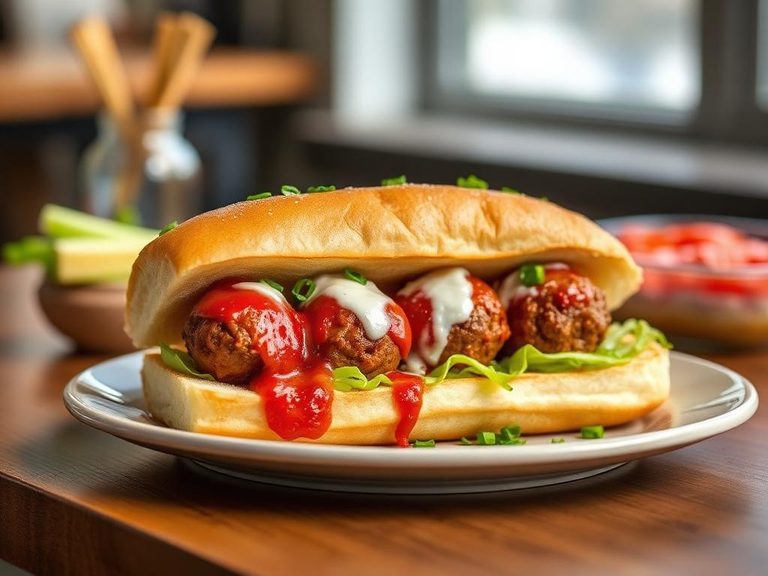
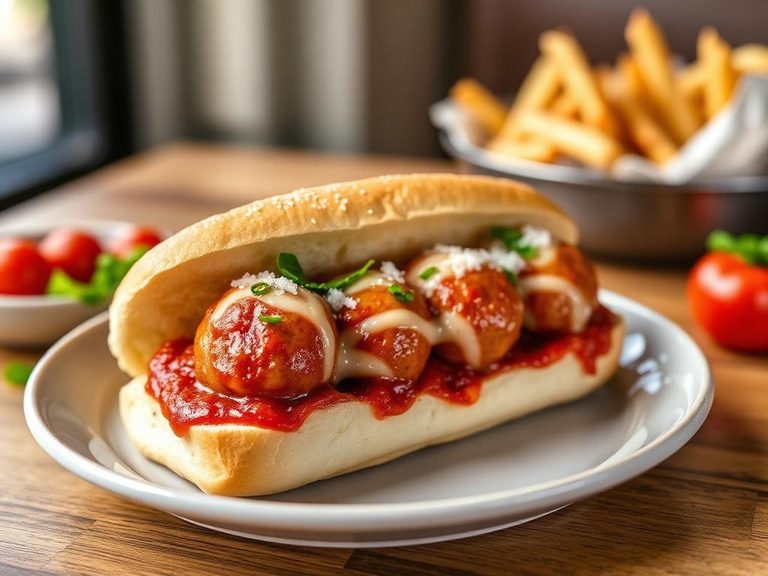
Fast foods, submarine sandwich, meatball marinara on white bread
Whole food · Fast Foods

Photo: Wikipedia
This is a classic submarine sandwich featuring savory, seasoned meatballs smothered in a rich, tangy marinara sauce, all nestled in a soft, white bread roll. The texture is a satisfying contrast between the tender, juicy meatballs, the smooth sauce, and the pillowy bread. Nutritionally, it provides a solid protein punch from the meatballs but is notably higher in carbohydrates from the bread and sauce.
Calorie split: 18% protein · 47% carbs · 35% fat
↓ Full nutrition💚 Why it's loved
People love it for the deeply satisfying, umami-rich combination of savory meat and tangy tomato sauce, a flavor profile that feels both comforting and indulgent. It's a quintessential grab-and-go meal that represents casual, hearty American-Italian fare.
⚠️ Watch-outs & how to enjoy it better
The white bread and sugary marinara can cause a rapid blood-sugar spike, and the meal can be high in sodium and saturated fat. To counteract this, pair it with a side salad or vegetable soup to add fiber, and consider eating only half the sandwich to manage portion size.
Key benefits
- Good source of protein for muscle maintenance
- Provides quick energy from carbohydrates
- Contains iron and B vitamins from the meat
- Offers some lycopene from the tomato-based sauce
🍽️ Popular dishes

🌍 Where it's eaten
💡 Did you know?
The term 'submarine' for the sandwich is widely believed to have originated during World War II, as the long, cylindrical shape of the sandwich resembled the submarines of the era.
Full nutrition (USDA data · scales with serving)
| Water | 53.6 g |
| Energy | 219 kcal |
| Energy | 917 kj |
| Protein | 9.8 g |
| Total lipid (fat) | 8.4 g |
| Ash | 2.2 g |
| Carbohydrate, by difference | 26.0 g |
| Fiber, total dietary | 2.1 g |
| Total Sugars | 5.0 g |
| Sucrose | 0.00 g |
| Glucose | 1.9 g |
| Fructose | 2.1 g |
| Lactose | 0.00 g |
| Maltose | 0.96 g |
| Galactose | 0.00 g |
| Starch | 16.4 g |
| Calcium, Ca | 176 mg |
| Iron, Fe | 2.3 mg |
| Magnesium, Mg | 29.0 mg |
| Phosphorus, P | 97.0 mg |
| Potassium, K | 275 mg |
| Sodium, Na | 437 mg |
| Zinc, Zn | 1.2 mg |
| Copper, Cu | 0.13 mg |
| Manganese, Mn | 0.43 mg |
| Selenium, Se | 13.8 ug |
| Vitamin C, total ascorbic acid | 0.40 mg |
| Thiamin | 0.25 mg |
| Riboflavin | 0.25 mg |
| Niacin | 3.5 mg |
| Pantothenic acid | 0.42 mg |
| Vitamin B-6 | 0.13 mg |
| Folate, total | 79.0 ug |
| Folic acid | 49.0 ug |
| Folate, food | 29.0 ug |
| Folate, DFE | 113 ug |
| Choline, total | 32.9 mg |
| Vitamin B-12 | 0.55 ug |
| Vitamin B-12, added | 0.00 ug |
| Vitamin A, RAE | 15.0 ug |
| Retinol | 0.00 ug |
| Carotene, beta | 175 ug |
| Carotene, alpha | 0.00 ug |
| Cryptoxanthin, beta | 0.00 ug |
| Vitamin A, IU | 292 iu |
| Lycopene | 3152 ug |
| Lutein + zeaxanthin | 95.0 ug |
| Vitamin E (alpha-tocopherol) | 0.79 mg |
| Vitamin E, added | 0.00 mg |
| Tocopherol, beta | 0.08 mg |
| Tocopherol, gamma | 0.66 mg |
| Tocopherol, delta | 0.24 mg |
| Tocotrienol, alpha | 0.04 mg |
| Tocotrienol, beta | 0.31 mg |
| Tocotrienol, gamma | 0.00 mg |
| Tocotrienol, delta | 0.00 mg |
| Vitamin D (D2 + D3), International Units | 1.0 iu |
| Vitamin D (D2 + D3) | 0.00 ug |
| Vitamin K (phylloquinone) | 6.6 ug |
| Alcohol, ethyl | 0.00 g |
| Caffeine | 0.00 mg |
| Theobromine | 0.00 mg |
Fat & fatty acid profile (per 100g)
| Fatty acids, total saturated | 3.1 g |
| SFA 4:0 | 0.00 g |
| SFA 6:0 | 0.00 g |
| SFA 8:0 | 0.00 g |
| SFA 10:0 | 0.00 g |
| SFA 12:0 | 0.01 g |
| SFA 14:0 | 0.21 g |
| SFA 15:0 | 0.04 g |
| SFA 16:0 | 1.8 g |
| SFA 17:0 | 0.09 g |
| SFA 18:0 | 0.98 g |
| SFA 20:0 | 0.01 g |
| SFA 22:0 | 0.01 g |
| SFA 24:0 | 0.00 g |
| Fatty acids, total monounsaturated | 3.6 g |
| MUFA 14:1 | 0.06 g |
| MUFA 15:1 | 0.00 g |
| MUFA 16:1 | 0.28 g |
| MUFA 16:1 c | 0.26 g |
| MUFA 17:1 | 0.06 g |
| MUFA 18:1 | 3.1 g |
| MUFA 18:1 c | 2.8 g |
| MUFA 20:1 | 0.03 g |
| MUFA 22:1 | 0.00 g |
| MUFA 22:1 c | 0.00 g |
| MUFA 24:1 c | 0.00 g |
| Fatty acids, total polyunsaturated | 1.1 g |
| PUFA 18:2 | 1.00 g |
| PUFA 18:2 n-6 c,c | 0.92 g |
| PUFA 18:2 CLAs | 0.04 g |
| PUFA 18:3 | 0.10 g |
| PUFA 18:3 n-3 c,c,c (ALA) | 0.10 g |
| PUFA 18:3 n-6 c,c,c | 0.00 g |
| PUFA 18:3i | 0.00 g |
| PUFA 18:4 | 0.00 g |
| PUFA 20:2 n-6 c,c | 0.00 g |
| PUFA 20:3 | 0.01 g |
| PUFA 20:3 n-3 | 0.00 g |
| PUFA 20:3 n-6 | 0.01 g |
| PUFA 20:4 | 0.01 g |
| PUFA 20:5 n-3 (EPA) | 0.00 g |
| PUFA 22:4 | 0.01 g |
| PUFA 22:5 n-3 (DPA) | 0.00 g |
| PUFA 22:6 n-3 (DHA) | 0.00 g |
| Fatty acids, total trans | 0.42 g |
| Fatty acids, total trans-monoenoic | 0.38 g |
| TFA 16:1 t | 0.02 g |
| TFA 18:1 t | 0.36 g |
| TFA 22:1 t | 0.00 g |
| TFA 18:2 t not further defined | 0.04 g |
| Fatty acids, total trans-polyenoic | 0.04 g |
| Cholesterol | 15.0 mg |
Amino acid profile (per 100g)
Estimated from Fast foods, english muffin, with egg, cheese, and sausage — USDA does not publish this profile for Fast foods.
| Tryptophan | 0.16 g |
| Threonine | 0.52 g |
| Isoleucine | 0.54 g |
| Leucine | 0.98 g |
| Lysine | 0.75 g |
| Methionine | 0.29 g |
| Cystine | 0.20 g |
| Phenylalanine | 0.59 g |
| Tyrosine | 0.41 g |
| Valine | 0.65 g |
| Arginine | 0.65 g |
| Histidine | 0.33 g |
| Alanine | 0.60 g |
| Aspartic acid | 1.1 g |
| Glutamic acid | 2.5 g |
| Glycine | 0.54 g |
| Proline | 0.90 g |
| Serine | 0.70 g |
FAQ
Is a meatball marinara sub a good source of protein?
Yes, it is. The meatballs provide a significant amount of protein, making it a more filling option compared to some other fast-food sandwiches.
Why is this sandwich high in sodium?
The sodium comes from multiple components: the seasoned meatballs, the marinara sauce, and often the bread itself. Processed deli meats and cheeses, if added, would increase it further.
Can I make a healthier version at home?
Absolutely. Use whole-grain bread, lean ground turkey or chicken for the meatballs, a low-sugar marinara, and load it with extra vegetables like bell peppers or spinach.
Nutrient density (calculated · NRF9.3)
Nutrient Rich Foods index: beneficial nutrients (protein, fiber, vitamins, minerals) minus saturated fat, added sugar & sodium, per 100 kcal.
NRF9.3 index — Fulgoni, Keast & Drewnowski, 2009. Computed from USDA nutrients.
Weight-loss friendliness (composite index)
Energy density 2.19 kcal/g · 18% calories from protein · 2.1 g fiber · 5.0 g sugar per 100 g.
Composite of energy density (Rolls et al., 1999), protein & fiber satiety, minus sugar. A calculated heuristic — ranks satiety-per-calorie, not a clinical measure.
Dietary load (calculated from USDA values)
Potential renal acid load. Positive = acid-forming, negative = alkaline-forming.
Sodium-to-potassium ratio: 1.59 (lower is better — aim for ≤ 1)
Sodium:potassium per WHO potassium guidance. Computed from USDA nutrients.