

Chicken, skin (drumsticks and thighs), cooked, braised
Whole food · Poultry Products
This is the rich, savory skin from braised chicken drumsticks and thighs, rendered tender and deeply flavorful by slow cooking. The texture is a luxurious, melt-in-your-mouth gelatinous layer, distinct from crispy fried skin. Nutritionally, it is an energy-dense component, providing almost all of its calories from fat with a modest amount of protein.
Calorie split: 13% protein · 0% carbs · 87% fat
↓ Full nutrition💚 Why it's loved
People adore it for its intense, umami-rich flavor and the luxurious, silky mouthfeel it imparts to braises and stews. It's a prized part of the dish in many cultures, valued for its ability to carry and deepen complex seasonings.
⚠️ Watch-outs & how to enjoy it better
Its very high fat content makes it a concern for those monitoring calorie or saturated fat intake. To enjoy it mindfully, practice strict portion control—treating it as a flavor accent rather than a main component—and pair it with large servings of fibrous vegetables to balance the meal.
Key benefits
- Excellent source of dietary fat for energy and satiety.
- Contains collagen and gelatin from slow-cooking connective tissue.
- Enhances the flavor and moisture of braised dishes.
- Provides fat-soluble vitamins like Vitamin K2.
- A traditional ingredient for enriching sauces and gravies.
🍽️ Popular dishes
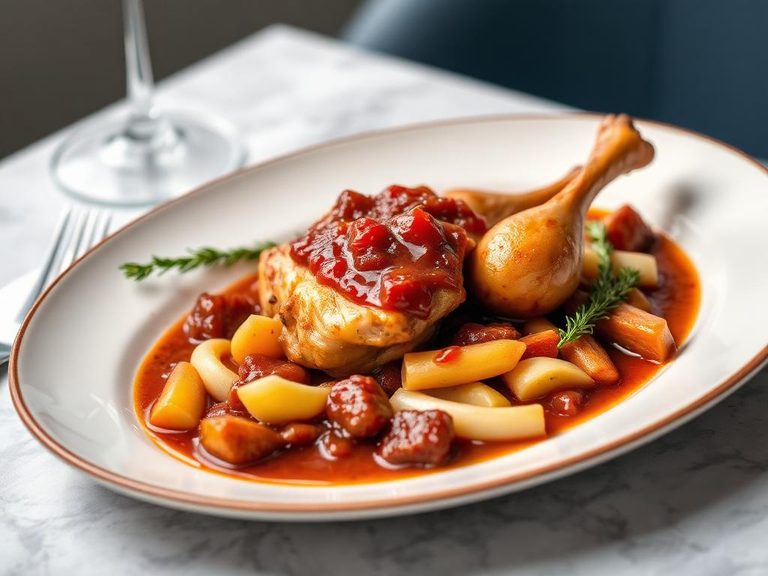
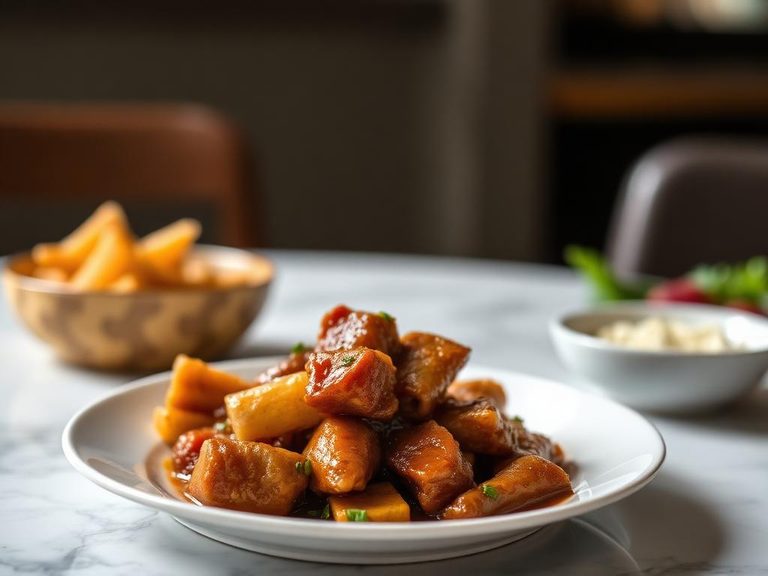
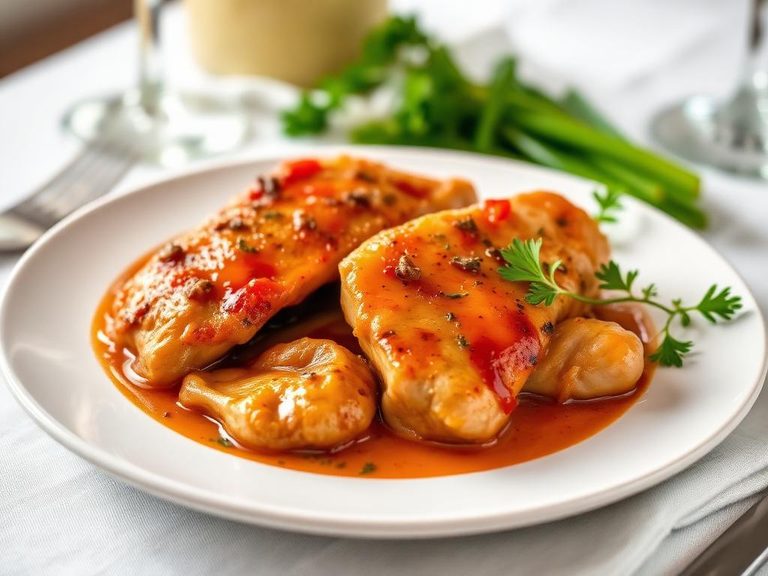
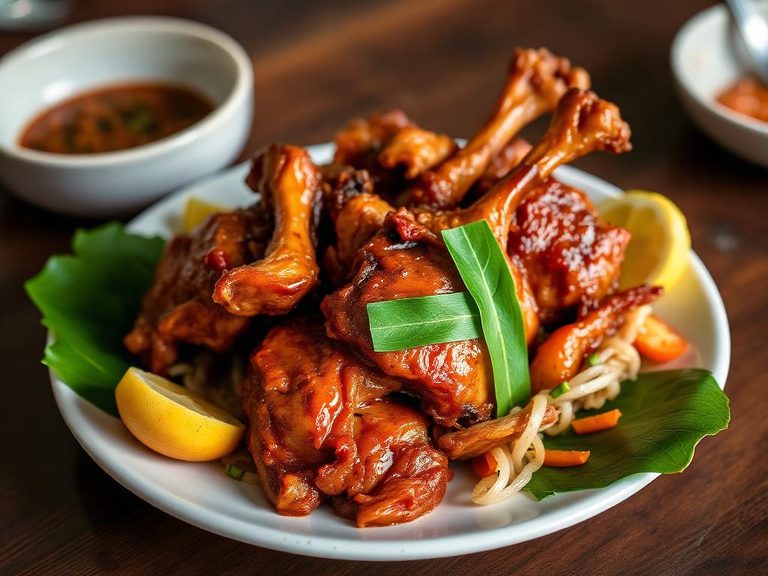
🌍 Where it's eaten
💡 Did you know?
The gelatinous quality of braised chicken skin comes from collagen, which breaks down into gelatin during the long, moist cooking process, acting as a natural thickener for the surrounding sauce.
Full nutrition (USDA data · scales with serving)
| Water | 42.1 g |
| Energy | 443 kcal |
| Energy | 1855 kj |
| Protein | 14.6 g |
| Total lipid (fat) | 42.8 g |
| Ash | 0.63 g |
| Carbohydrate, by difference | 0.00 g |
| Fiber, total dietary | 0.00 g |
| Total Sugars | 0.00 g |
| Calcium, Ca | 9.0 mg |
| Iron, Fe | 1.0 mg |
| Magnesium, Mg | 14.0 mg |
| Phosphorus, P | 130 mg |
| Potassium, K | 161 mg |
| Sodium, Na | 75.0 mg |
| Zinc, Zn | 0.74 mg |
| Copper, Cu | 0.04 mg |
| Manganese, Mn | 0.02 mg |
| Selenium, Se | 16.0 ug |
| Vitamin C, total ascorbic acid | 0.00 mg |
| Thiamin | 0.05 mg |
| Riboflavin | 0.06 mg |
| Niacin | 3.4 mg |
| Pantothenic acid | 0.79 mg |
| Vitamin B-6 | 0.18 mg |
| Folate, total | 3.0 ug |
| Folic acid | 0.00 ug |
| Folate, food | 3.0 ug |
| Folate, DFE | 3.0 ug |
| Choline, total | 43.1 mg |
| Betaine | 12.7 mg |
| Vitamin B-12 | 0.45 ug |
| Vitamin B-12, added | 0.00 ug |
| Vitamin A, RAE | 48.0 ug |
| Retinol | 48.0 ug |
| Carotene, beta | 0.00 ug |
| Carotene, alpha | 0.00 ug |
| Cryptoxanthin, beta | 1.0 ug |
| Vitamin A, IU | 161 iu |
| Lycopene | 0.00 ug |
| Lutein + zeaxanthin | 101 ug |
| Vitamin E (alpha-tocopherol) | 0.19 mg |
| Vitamin E, added | 0.00 mg |
| Tocopherol, beta | 0.00 mg |
| Tocopherol, gamma | 0.11 mg |
| Tocopherol, delta | 0.00 mg |
| Tocotrienol, alpha | 0.00 mg |
| Tocotrienol, beta | 0.00 mg |
| Tocotrienol, gamma | 0.09 mg |
| Tocotrienol, delta | 0.01 mg |
| Vitamin D (D2 + D3), International Units | 4.0 iu |
| Vitamin D (D2 + D3) | 0.10 ug |
| Vitamin D3 (cholecalciferol) | 0.10 ug |
| Vitamin K (phylloquinone) | 0.40 ug |
| Alcohol, ethyl | 0.00 g |
| Caffeine | 0.00 mg |
| Theobromine | 0.00 mg |
Fat & fatty acid profile (per 100g)
| Fatty acids, total saturated | 11.9 g |
| SFA 4:0 | 0.00 g |
| SFA 6:0 | 0.00 g |
| SFA 8:0 | 0.00 g |
| SFA 10:0 | 0.01 g |
| SFA 12:0 | 0.02 g |
| SFA 14:0 | 0.25 g |
| SFA 15:0 | 0.03 g |
| SFA 16:0 | 9.4 g |
| SFA 17:0 | 0.04 g |
| SFA 18:0 | 2.1 g |
| SFA 20:0 | 0.03 g |
| SFA 22:0 | 0.02 g |
| SFA 24:0 | 0.00 g |
| Fatty acids, total monounsaturated | 18.7 g |
| MUFA 14:1 | 0.09 g |
| MUFA 15:1 | 0.00 g |
| MUFA 16:1 | 2.7 g |
| MUFA 16:1 c | 2.7 g |
| MUFA 17:1 | 0.04 g |
| MUFA 18:1 | 15.6 g |
| MUFA 18:1 c | 15.5 g |
| MUFA 20:1 | 0.25 g |
| MUFA 22:1 | 0.01 g |
| MUFA 22:1 c | 0.01 g |
| MUFA 24:1 c | 0.00 g |
| Fatty acids, total polyunsaturated | 8.6 g |
| PUFA 18:2 | 7.9 g |
| PUFA 18:2 n-6 c,c | 7.8 g |
| PUFA 18:2 CLAs | 0.06 g |
| PUFA 18:3 | 0.38 g |
| PUFA 18:3 n-3 c,c,c (ALA) | 0.38 g |
| PUFA 18:3 n-6 c,c,c | 0.00 g |
| PUFA 18:4 | 0.01 g |
| PUFA 20:2 n-6 c,c | 0.05 g |
| PUFA 20:3 | 0.07 g |
| PUFA 20:3 n-3 | 0.00 g |
| PUFA 20:3 n-6 | 0.07 g |
| PUFA 20:4 | 0.13 g |
| PUFA 20:5 n-3 (EPA) | 0.01 g |
| PUFA 22:4 | 0.03 g |
| PUFA 22:5 n-3 (DPA) | 0.01 g |
| PUFA 22:6 n-3 (DHA) | 0.01 g |
| Fatty acids, total trans | 0.23 g |
| Fatty acids, total trans-monoenoic | 0.16 g |
| TFA 16:1 t | 0.02 g |
| TFA 18:1 t | 0.14 g |
| TFA 22:1 t | 0.00 g |
| TFA 18:2 t not further defined | 0.07 g |
| Fatty acids, total trans-polyenoic | 0.07 g |
| Cholesterol | 130 mg |
Amino acid profile (per 100g)
| Tryptophan | 0.07 g |
| Threonine | 0.46 g |
| Isoleucine | 0.41 g |
| Leucine | 0.81 g |
| Lysine | 0.83 g |
| Methionine | 0.25 g |
| Cystine | 0.12 g |
| Phenylalanine | 0.44 g |
| Tyrosine | 0.34 g |
| Valine | 0.52 g |
| Arginine | 1.0 g |
| Histidine | 0.30 g |
| Alanine | 1.0 g |
| Aspartic acid | 1.1 g |
| Glutamic acid | 1.7 g |
| Glycine | 1.9 g |
| Proline | 1.1 g |
| Serine | 0.53 g |
FAQ
Is braised chicken skin the same as fried chicken skin?
No. Braised skin is soft, gelatinous, and cooked in liquid, while fried skin is rendered and crisped in fat, resulting in a very different texture and higher fat absorption.
Can I remove the skin after braising to reduce fat?
Yes, you can easily peel it off before eating. However, much of the fat will have already rendered into the cooking liquid, so the dish will still be rich.
Why does braised chicken skin sometimes have a purple hue?
A harmless purple or blue discoloration can occur due to a reaction between pigments in the bone marrow and the chicken's skin, often seen in slow-cooked dark meat.
Nutrient density (calculated · NRF9.3)
Nutrient Rich Foods index: beneficial nutrients (protein, fiber, vitamins, minerals) minus saturated fat, added sugar & sodium, per 100 kcal.
NRF9.3 index — Fulgoni, Keast & Drewnowski, 2009. Computed from USDA nutrients.
Weight-loss friendliness (composite index)
Energy density 4.43 kcal/g · 13% calories from protein · 0.0 g fiber · 0.0 g sugar per 100 g.
Composite of energy density (Rolls et al., 1999), protein & fiber satiety, minus sugar. A calculated heuristic — ranks satiety-per-calorie, not a clinical measure.
Dietary load (calculated from USDA values)
Potential renal acid load. Positive = acid-forming, negative = alkaline-forming.
Sodium-to-potassium ratio: 0.47 (lower is better — aim for ≤ 1)
Sodium:potassium per WHO potassium guidance. Computed from USDA nutrients.