

Soup, chicken noodle, canned, condensed
Whole food · Soups, Sauces, and Gravies
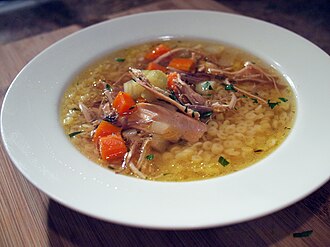
Photo: Wikipedia
This is a concentrated, shelf-stable base of savory chicken broth, tender egg noodles, and small chicken pieces, designed to be diluted with water or milk. Its flavor is deeply savory and salty, with a soft, comforting texture once rehydrated. Nutritionally, it's a low-calorie, low-fat option that provides a modest protein boost.
Calorie split: 20% protein · 51% carbs · 29% fat
↓ Full nutrition💚 Why it's loved
People love it for its nostalgic, comforting flavor that evokes childhood and home cooking. Its extreme versatility allows it to be a quick standalone soup or a flavorful starter for countless casseroles, stews, and sauces.
⚠️ Watch-outs & how to enjoy it better
The condensed form is typically very high in sodium, which can be problematic for blood pressure. The refined noodles can cause a quick blood-sugar spike. To counteract, dilute with water instead of milk, add extra vegetables and lean protein like shredded chicken, and consider a low-sodium version if available.
Key benefits
- Excellent source of quick, hydrating calories
- Provides modest protein for muscle maintenance
- Very low in fat, supporting heart-healthy diets
- Long shelf life reduces food waste
- Convenient base for quick meal preparation
🍽️ Popular dishes
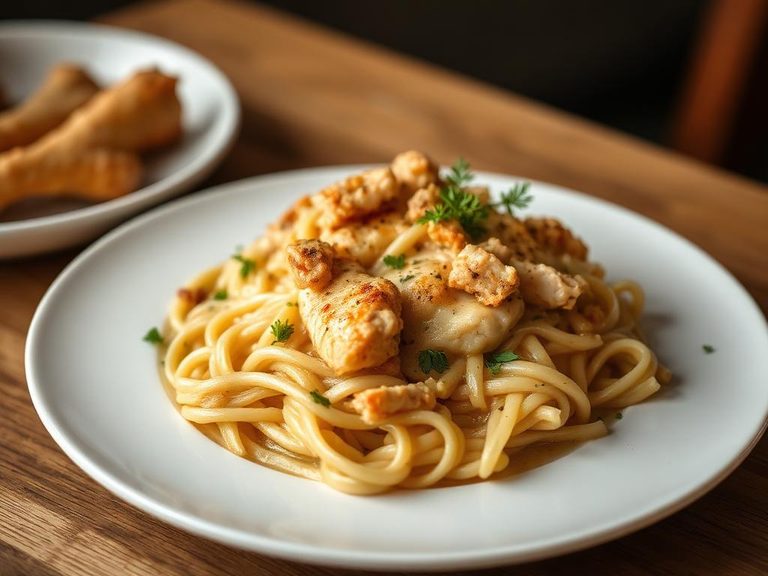
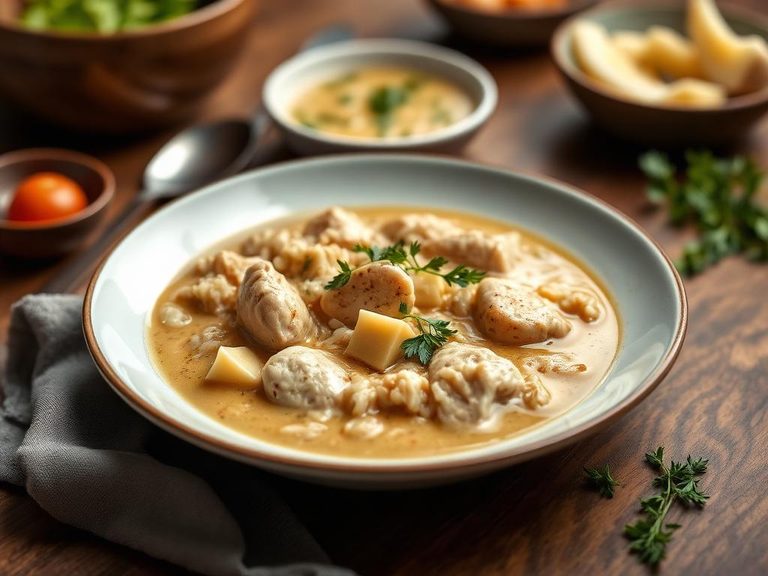
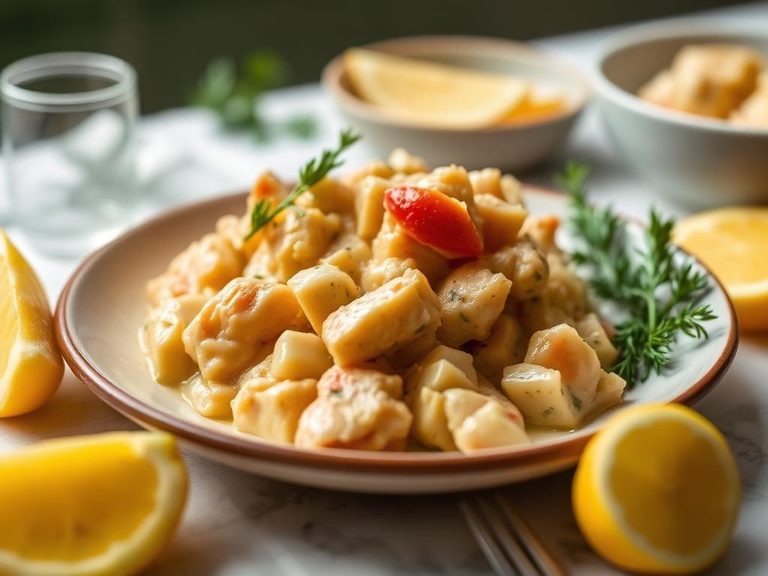
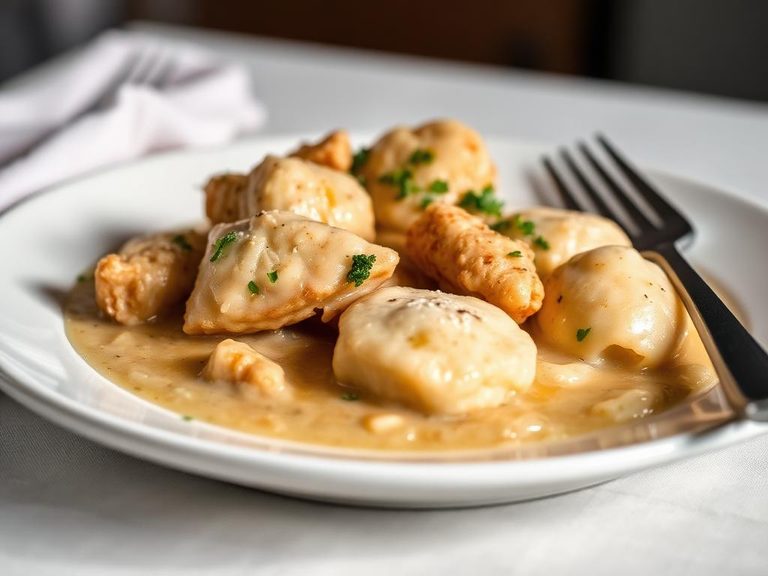
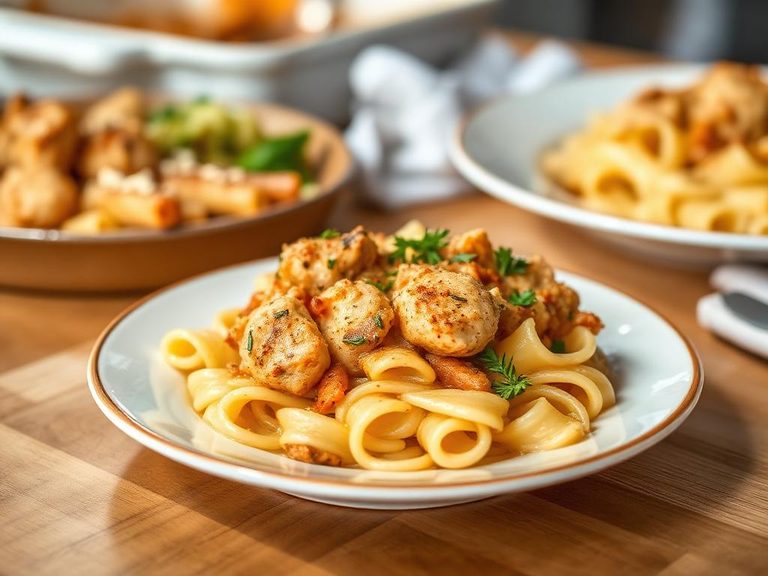
🌍 Where it's eaten
💡 Did you know?
During World War II, condensed chicken noodle soup was included in U.S. Army K-rations as a morale-boosting, easy-to-prepare comfort food for soldiers.
Full nutrition (USDA data · scales with serving)
| Water | 88.2 g |
| Energy | 48.0 kcal |
| Energy | 200 kj |
| Protein | 2.4 g |
| Total lipid (fat) | 1.6 g |
| Ash | 1.8 g |
| Carbohydrate, by difference | 6.1 g |
| Fiber, total dietary | 0.90 g |
| Total Sugars | 0.00 g |
| Sucrose | 0.00 g |
| Glucose | 0.00 g |
| Fructose | 0.00 g |
| Lactose | 0.00 g |
| Maltose | 0.00 g |
| Galactose | 0.00 g |
| Calcium, Ca | 6.0 mg |
| Iron, Fe | 0.67 mg |
| Magnesium, Mg | 8.0 mg |
| Phosphorus, P | 38.0 mg |
| Potassium, K | 48.0 mg |
| Sodium, Na | 681 mg |
| Zinc, Zn | 0.28 mg |
| Copper, Cu | 0.03 mg |
| Manganese, Mn | 0.10 mg |
| Selenium, Se | 6.3 ug |
| Vitamin C, total ascorbic acid | 0.00 mg |
| Thiamin | 0.08 mg |
| Riboflavin | 0.07 mg |
| Niacin | 1.2 mg |
| Pantothenic acid | 0.11 mg |
| Vitamin B-6 | 0.04 mg |
| Folate, total | 14.0 ug |
| Folic acid | 10.0 ug |
| Folate, food | 5.0 ug |
| Folate, DFE | 21.0 ug |
| Choline, total | 11.2 mg |
| Vitamin B-12 | 0.12 ug |
| Vitamin B-12, added | 0.00 ug |
| Vitamin A, RAE | 22.0 ug |
| Retinol | 2.0 ug |
| Carotene, beta | 243 ug |
| Carotene, alpha | 0.00 ug |
| Cryptoxanthin, beta | 0.00 ug |
| Vitamin A, IU | 410 iu |
| Lycopene | 0.00 ug |
| Lutein + zeaxanthin | 7.0 ug |
| Vitamin E (alpha-tocopherol) | 0.05 mg |
| Vitamin E, added | 0.00 mg |
| Vitamin D (D2 + D3), International Units | 0.00 iu |
| Vitamin D (D2 + D3) | 0.00 ug |
| Vitamin K (phylloquinone) | 0.00 ug |
| Alcohol, ethyl | 0.00 g |
| Caffeine | 0.00 mg |
| Theobromine | 0.00 mg |
Fat & fatty acid profile (per 100g)
| Fatty acids, total saturated | 0.39 g |
| SFA 4:0 | 0.00 g |
| SFA 6:0 | 0.00 g |
| SFA 8:0 | 0.00 g |
| SFA 10:0 | 0.00 g |
| SFA 12:0 | 0.00 g |
| SFA 14:0 | 0.01 g |
| SFA 15:0 | 0.00 g |
| SFA 16:0 | 0.30 g |
| SFA 17:0 | 0.00 g |
| SFA 18:0 | 0.07 g |
| SFA 20:0 | 0.00 g |
| SFA 22:0 | 0.00 g |
| SFA 24:0 | 0.00 g |
| Fatty acids, total monounsaturated | 0.54 g |
| MUFA 14:1 | 0.00 g |
| MUFA 15:1 | 0.00 g |
| MUFA 16:1 | 0.06 g |
| MUFA 16:1 c | 0.06 g |
| MUFA 17:1 | 0.00 g |
| MUFA 18:1 | 0.47 g |
| MUFA 18:1 c | 0.46 g |
| MUFA 20:1 | 0.01 g |
| MUFA 22:1 | 0.00 g |
| MUFA 22:1 c | 0.00 g |
| MUFA 24:1 c | 0.00 g |
| Fatty acids, total polyunsaturated | 0.34 g |
| PUFA 18:2 | 0.31 g |
| PUFA 18:2 n-6 c,c | 0.31 g |
| PUFA 18:2 CLAs | 0.00 g |
| PUFA 18:3 | 0.01 g |
| PUFA 18:3 n-3 c,c,c (ALA) | 0.01 g |
| PUFA 18:3 n-6 c,c,c | 0.00 g |
| PUFA 18:3i | 0.00 g |
| PUFA 18:4 | 0.00 g |
| PUFA 20:2 n-6 c,c | 0.00 g |
| PUFA 20:3 | 0.00 g |
| PUFA 20:3 n-3 | 0.00 g |
| PUFA 20:3 n-6 | 0.00 g |
| PUFA 20:4 | 0.01 g |
| PUFA 20:5 n-3 (EPA) | 0.00 g |
| PUFA 22:4 | 0.00 g |
| PUFA 22:5 n-3 (DPA) | 0.00 g |
| PUFA 22:6 n-3 (DHA) | 0.00 g |
| Fatty acids, total trans | 0.01 g |
| Fatty acids, total trans-monoenoic | 0.01 g |
| TFA 16:1 t | 0.00 g |
| TFA 18:1 t | 0.01 g |
| TFA 22:1 t | 0.00 g |
| TFA 18:2 t not further defined | 0.00 g |
| Fatty acids, total trans-polyenoic | 0.00 g |
| Cholesterol | 8.0 mg |
Amino acid profile (per 100g)
Estimated from Soup, bean with pork, canned, condensed — USDA does not publish this profile for Soup.
| Tryptophan | 0.06 g |
| Threonine | 0.24 g |
| Isoleucine | 0.29 g |
| Leucine | 0.48 g |
| Lysine | 0.40 g |
| Methionine | 0.07 g |
| Cystine | 0.07 g |
| Phenylalanine | 0.33 g |
| Tyrosine | 0.18 g |
| Valine | 0.32 g |
| Arginine | 0.31 g |
| Histidine | 0.15 g |
| Alanine | 0.29 g |
| Aspartic acid | 0.66 g |
| Glutamic acid | 1.1 g |
| Glycine | 0.28 g |
| Proline | 0.27 g |
| Serine | 0.29 g |
FAQ
How is condensed soup different from ready-to-serve soup?
Condensed soup is a thick, concentrated base that requires the addition of water or milk (typically one can's worth) before eating. Ready-to-serve soup is pre-diluted and ready to heat and eat.
Can I use this condensed soup as a sauce or ingredient?
Yes, it's a classic kitchen hack. Undiluted, it can be used as a creamy, savory sauce for casseroles, a binder for meatloaf, or a flavor base for gravies and pot pies.
Is the nutrition information for the condensed soup or the prepared soup?
The provided nutrition is for the condensed soup itself (per 100g). Once prepared with water, the calories, sodium, and nutrients per serving are diluted.
Nutrient density (calculated · NRF9.3)
Nutrient Rich Foods index: beneficial nutrients (protein, fiber, vitamins, minerals) minus saturated fat, added sugar & sodium, per 100 kcal.
NRF9.3 index — Fulgoni, Keast & Drewnowski, 2009. Computed from USDA nutrients.
Weight-loss friendliness (composite index)
Energy density 0.48 kcal/g · 20% calories from protein · 0.9 g fiber · 0.0 g sugar per 100 g.
Composite of energy density (Rolls et al., 1999), protein & fiber satiety, minus sugar. A calculated heuristic — ranks satiety-per-calorie, not a clinical measure.
Dietary load (calculated from USDA values)
Potential renal acid load. Positive = acid-forming, negative = alkaline-forming.
Sodium-to-potassium ratio: 14.19 (lower is better — aim for ≤ 1)
Sodium:potassium per WHO potassium guidance. Computed from USDA nutrients.