

Restaurant, Italian, spaghetti with meat sauce
Whole food · Restaurant Foods
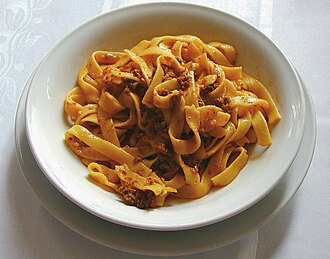
Photo: Wikipedia
A classic Italian-American comfort dish featuring al dente spaghetti tossed in a rich, savory meat-based tomato sauce. The texture is a satisfying contrast between the firm pasta and the tender, crumbly meat in the thick, slightly sweet sauce. Nutritionally, it's a balanced meal providing a good source of protein and carbohydrates, with a moderate fat content per serving.
Calorie split: 19% protein · 54% carbs · 27% fat
↓ Full nutrition💚 Why it's loved
People adore it for its deeply savory, umami-rich flavor profile and the comforting, hearty texture of the sauce clinging to each strand of pasta. It's a universally recognized symbol of Italian-American home cooking and family gatherings, often evoking strong nostalgic feelings.
⚠️ Watch-outs & how to enjoy it better
The dish can be high in sodium and saturated fat, especially in restaurant versions, and the refined pasta may cause blood sugar spikes in some individuals. To counteract this, opt for a smaller portion, pair it with a side salad or steamed vegetables for fiber, and choose whole-wheat pasta when possible to slow digestion.
Key benefits
- Good source of complete protein from the meat component
- Provides complex carbohydrates for sustained energy
- Contains dietary fiber from the tomato sauce and pasta
- Offers iron and B vitamins from the meat
- Can be a balanced, satisfying meal when portion-controlled
🍽️ Popular dishes
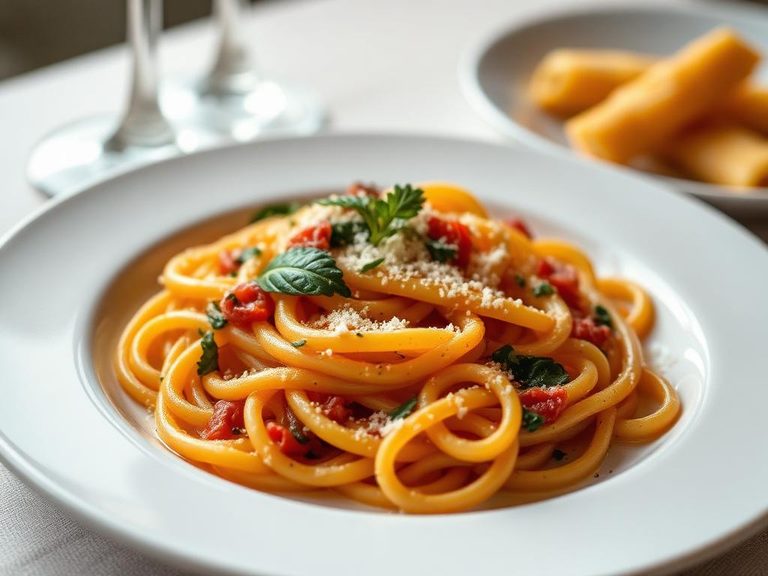
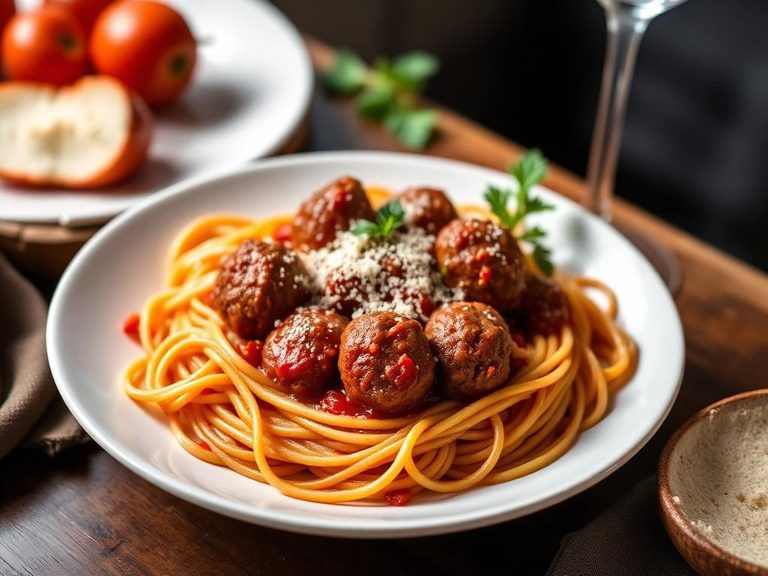
🌍 Where it's eaten
💡 Did you know?
The classic Italian 'ragù alla bolognese' is traditionally served with tagliatelle, not spaghetti, and its meat sauce is often enriched with milk or cream to balance the acidity of the tomatoes.
Full nutrition (USDA data · scales with serving)
| Water | 73.2 g |
| Energy | 121 kcal |
| Energy | 507 kj |
| Protein | 5.8 g |
| Total lipid (fat) | 3.6 g |
| Ash | 1.1 g |
| Carbohydrate, by difference | 16.4 g |
| Fiber, total dietary | 1.6 g |
| Total Sugars | 1.8 g |
| Sucrose | 0.00 g |
| Glucose | 0.87 g |
| Fructose | 0.95 g |
| Lactose | 0.00 g |
| Maltose | 0.00 g |
| Galactose | 0.00 g |
| Starch | 12.2 g |
| Calcium, Ca | 17.0 mg |
| Iron, Fe | 0.97 mg |
| Magnesium, Mg | 17.0 mg |
| Phosphorus, P | 59.0 mg |
| Potassium, K | 172 mg |
| Sodium, Na | 230 mg |
| Zinc, Zn | 0.69 mg |
| Copper, Cu | 0.10 mg |
| Manganese, Mn | 0.21 mg |
| Selenium, Se | 13.1 ug |
| Vitamin C, total ascorbic acid | 0.70 mg |
| Thiamin | 0.09 mg |
| Riboflavin | 0.15 mg |
| Niacin | 1.6 mg |
| Pantothenic acid | 0.25 mg |
| Vitamin B-6 | 0.11 mg |
| Folate, total | 30.0 ug |
| Choline, total | 15.6 mg |
| Betaine | 546 mg |
| Vitamin B-12 | 0.17 ug |
| Vitamin A, RAE | 12.0 ug |
| Retinol | 0.00 ug |
| Carotene, beta | 134 ug |
| Carotene, alpha | 6.0 ug |
| Cryptoxanthin, beta | 4.0 ug |
| Vitamin A, IU | 232 iu |
| Lycopene | 2236 ug |
| Lutein + zeaxanthin | 122 ug |
| Vitamin E (alpha-tocopherol) | 0.63 mg |
| Tocopherol, beta | 0.00 mg |
| Tocopherol, gamma | 0.10 mg |
| Tocopherol, delta | 0.00 mg |
| Tocotrienol, alpha | 0.03 mg |
| Tocotrienol, beta | 0.24 mg |
| Tocotrienol, gamma | 0.03 mg |
| Tocotrienol, delta | 0.00 mg |
| Vitamin K (phylloquinone) | 4.2 ug |
| Vitamin K (Dihydrophylloquinone) | 0.00 ug |
| Vitamin K (Menaquinone-4) | 0.50 ug |
Fat & fatty acid profile (per 100g)
| Fatty acids, total saturated | 1.1 g |
| SFA 4:0 | 0.01 g |
| SFA 6:0 | 0.00 g |
| SFA 8:0 | 0.00 g |
| SFA 10:0 | 0.01 g |
| SFA 12:0 | 0.01 g |
| SFA 14:0 | 0.06 g |
| SFA 15:0 | 0.01 g |
| SFA 16:0 | 0.65 g |
| SFA 17:0 | 0.02 g |
| SFA 18:0 | 0.30 g |
| SFA 20:0 | 0.01 g |
| SFA 22:0 | 0.00 g |
| SFA 24:0 | 0.00 g |
| Fatty acids, total monounsaturated | 1.5 g |
| MUFA 14:1 | 0.01 g |
| MUFA 15:1 | 0.00 g |
| MUFA 16:1 | 0.06 g |
| MUFA 16:1 c | 0.06 g |
| MUFA 17:1 | 0.01 g |
| MUFA 18:1 | 1.4 g |
| MUFA 18:1 c | 1.3 g |
| MUFA 20:1 | 0.02 g |
| MUFA 22:1 | 0.00 g |
| MUFA 22:1 c | 0.00 g |
| MUFA 24:1 c | 0.00 g |
| Fatty acids, total polyunsaturated | 0.51 g |
| PUFA 18:2 | 0.45 g |
| PUFA 18:2 n-6 c,c | 0.43 g |
| PUFA 18:2 CLAs | 0.01 g |
| PUFA 18:3 | 0.04 g |
| PUFA 18:3 n-3 c,c,c (ALA) | 0.04 g |
| PUFA 18:3 n-6 c,c,c | 0.00 g |
| PUFA 18:3i | 0.00 g |
| PUFA 18:4 | 0.00 g |
| PUFA 20:2 n-6 c,c | 0.01 g |
| PUFA 20:3 | 0.01 g |
| PUFA 20:3 n-3 | 0.00 g |
| PUFA 20:3 n-6 | 0.00 g |
| PUFA 20:4 | 0.01 g |
| PUFA 20:5 n-3 (EPA) | 0.00 g |
| PUFA 22:4 | 0.00 g |
| PUFA 22:5 n-3 (DPA) | 0.00 g |
| PUFA 22:6 n-3 (DHA) | 0.00 g |
| Fatty acids, total trans | 0.07 g |
| Fatty acids, total trans-monoenoic | 0.06 g |
| TFA 16:1 t | 0.00 g |
| TFA 18:1 t | 0.05 g |
| TFA 22:1 t | 0.00 g |
| TFA 18:2 t not further defined | 0.01 g |
| Fatty acids, total trans-polyenoic | 0.01 g |
| Cholesterol | 9.0 mg |
Amino acid profile (per 100g)
| Tryptophan | 0.05 g |
| Threonine | 0.19 g |
| Isoleucine | 0.20 g |
| Leucine | 0.37 g |
| Lysine | 0.23 g |
| Methionine | 0.11 g |
| Cystine | 0.09 g |
| Phenylalanine | 0.26 g |
| Tyrosine | 0.14 g |
| Valine | 0.22 g |
| Arginine | 0.28 g |
| Histidine | 0.14 g |
| Alanine | 0.25 g |
| Aspartic acid | 0.44 g |
| Glutamic acid | 1.6 g |
| Glycine | 0.23 g |
| Proline | 0.51 g |
| Serine | 0.24 g |
| Hydroxyproline | 0.00 g |
FAQ
Is spaghetti with meat sauce a healthy meal?
It can be part of a balanced diet, providing protein, carbs, and some vitamins. However, restaurant versions are often high in sodium and fat. Opt for lean meat, whole-wheat pasta, and a generous side of vegetables to make it more nutritious.
How does the nutrition differ between homemade and restaurant versions?
Homemade versions allow control over ingredients, often resulting in lower sodium and fat. Restaurant portions are typically larger and may use more oil, salt, and fatty cuts of meat, increasing calorie and sodium content significantly.
Can I make it vegetarian?
Yes, a popular vegetarian version uses lentils, mushrooms, or a mix of vegetables to create a hearty, protein-rich sauce. This reduces saturated fat and adds more fiber, making it a nutritious alternative.
Nutrient density (calculated · NRF9.3)
Nutrient Rich Foods index: beneficial nutrients (protein, fiber, vitamins, minerals) minus saturated fat, added sugar & sodium, per 100 kcal.
NRF9.3 index — Fulgoni, Keast & Drewnowski, 2009. Computed from USDA nutrients.
Weight-loss friendliness (composite index)
Energy density 1.21 kcal/g · 19% calories from protein · 1.6 g fiber · 1.8 g sugar per 100 g.
Composite of energy density (Rolls et al., 1999), protein & fiber satiety, minus sugar. A calculated heuristic — ranks satiety-per-calorie, not a clinical measure.
Dietary load (calculated from USDA values)
Potential renal acid load. Positive = acid-forming, negative = alkaline-forming.
Sodium-to-potassium ratio: 1.34 (lower is better — aim for ≤ 1)
Sodium:potassium per WHO potassium guidance. Computed from USDA nutrients.