

OLIVE GARDEN, spaghetti with pomodoro sauce
Whole food · Restaurant Foods
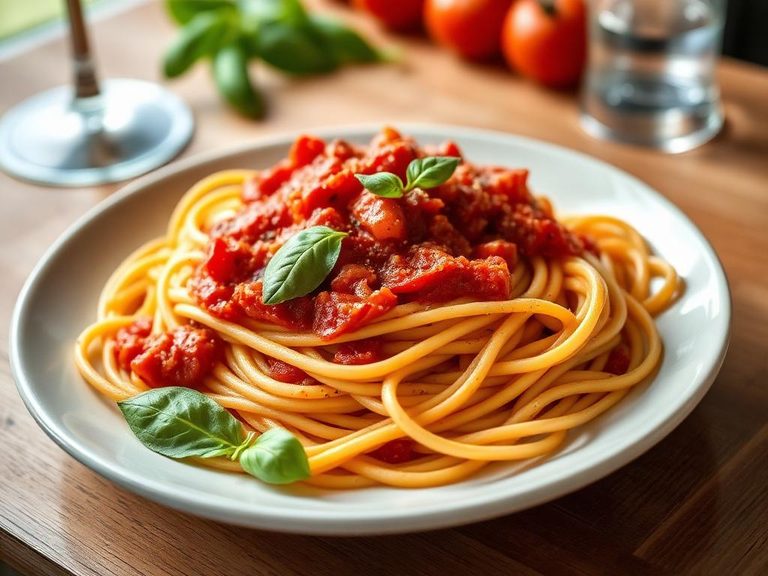
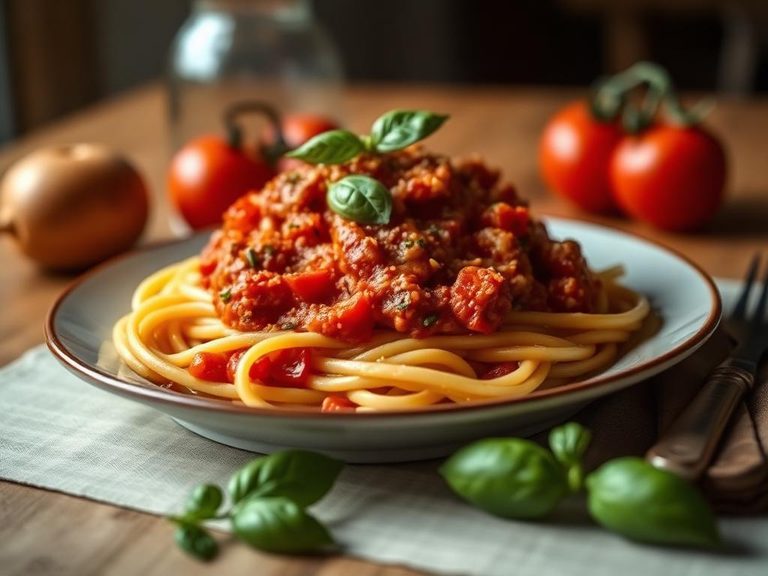
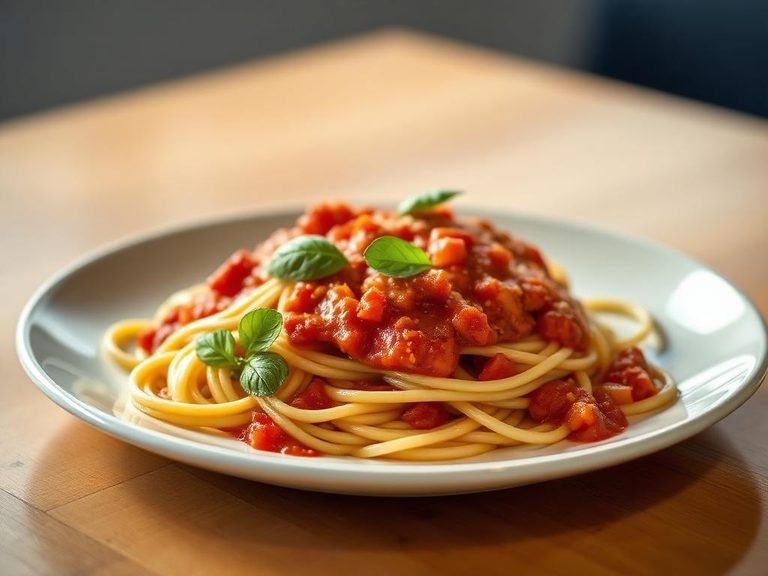
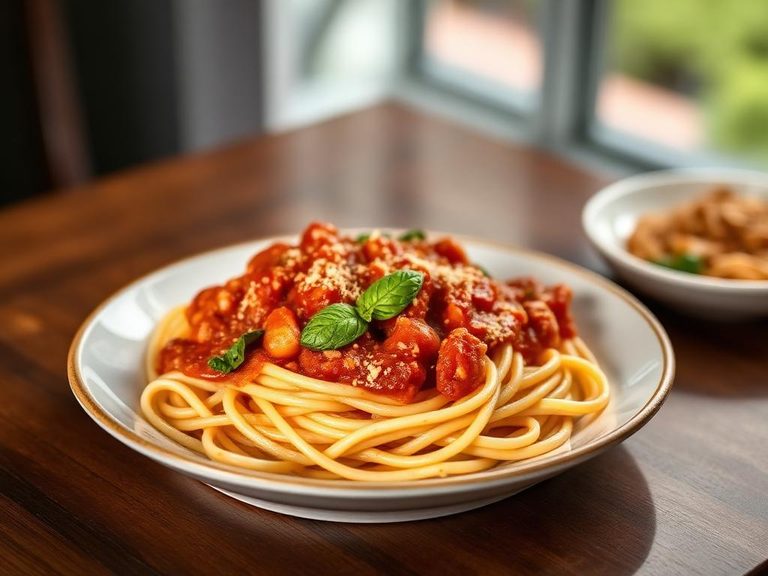
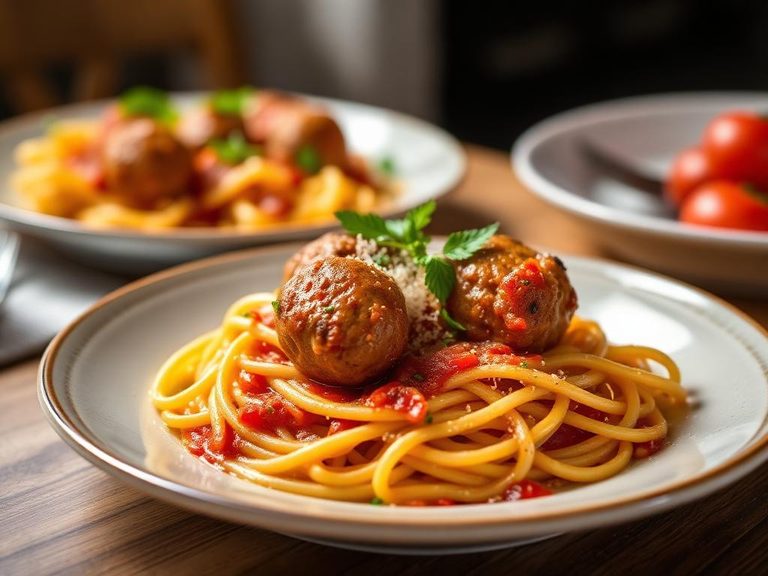
A classic Italian-American pasta dish featuring tender spaghetti noodles coated in a vibrant, smooth tomato-based pomodoro sauce. The texture is soft and yielding, with a bright, tangy, and subtly sweet tomato flavor. Nutritionally, it's a light, low-fat option with a moderate carbohydrate content, providing a quick source of energy.
Calorie split: 17% protein · 67% carbs · 16% fat
↓ Full nutrition💚 Why it's loved
People love it for its comforting, familiar simplicity and the bright, clean taste of ripe tomatoes. It's a versatile canvas that pairs well with countless proteins and vegetables, embodying the casual, hearty spirit of Italian-American dining.
⚠️ Watch-outs & how to enjoy it better
The dish is high in refined carbohydrates and low in protein, which can lead to rapid blood-sugar spikes and hunger soon after eating. To counteract this, always pair it with a significant protein source (like grilled chicken or meatballs) and add healthy fats (like a drizzle of olive oil or a side salad) to slow digestion and increase satiety.
Key benefits
- Low in fat and calories, suitable for light meals.
- Source of quick energy from complex carbohydrates.
- Contains dietary fiber from tomatoes and pasta.
- Simple, digestible ingredients.
🍽️ Popular dishes
🌍 Where it's eaten
💡 Did you know?
The classic pomodoro sauce is intentionally simple—often just tomatoes, garlic, basil, and olive oil—to showcase the quality of the tomatoes themselves, a philosophy central to Italian cooking.
Full nutrition (USDA data · scales with serving)
| Water | 75.9 g |
| Energy | 102 kcal |
| Energy | 428 kj |
| Protein | 4.3 g |
| Total lipid (fat) | 1.9 g |
| Ash | 0.82 g |
| Carbohydrate, by difference | 17.1 g |
| Fiber, total dietary | 1.7 g |
| Total Sugars | 1.8 g |
| Sucrose | 0.00 g |
| Glucose | 0.89 g |
| Fructose | 0.87 g |
| Lactose | 0.00 g |
| Maltose | 0.00 g |
| Galactose | 0.00 g |
| Starch | 11.6 g |
| Calcium, Ca | 11.0 mg |
| Iron, Fe | 0.98 mg |
| Magnesium, Mg | 16.0 mg |
| Phosphorus, P | 44.0 mg |
| Potassium, K | 124 mg |
| Sodium, Na | 183 mg |
| Zinc, Zn | 0.34 mg |
| Copper, Cu | 0.07 mg |
| Manganese, Mn | 0.21 mg |
| Selenium, Se | 13.3 ug |
| Vitamin C, total ascorbic acid | 1.2 mg |
| Thiamin | 0.07 mg |
| Riboflavin | 0.12 mg |
| Niacin | 1.1 mg |
| Pantothenic acid | 0.18 mg |
| Vitamin B-6 | 0.08 mg |
| Folate, total | 27.0 ug |
| Choline, total | 7.8 mg |
| Betaine | 469 mg |
| Vitamin A, RAE | 11.0 ug |
| Carotene, beta | 131 ug |
| Carotene, alpha | 0.00 ug |
| Cryptoxanthin, beta | 0.00 ug |
| Vitamin A, IU | 218 iu |
| Lycopene | 1781 ug |
| Lutein + zeaxanthin | 128 ug |
| Vitamin E (alpha-tocopherol) | 0.79 mg |
| Tocopherol, beta | 0.00 mg |
| Tocopherol, gamma | 0.54 mg |
| Tocopherol, delta | 0.05 mg |
| Tocotrienol, alpha | 0.03 mg |
| Tocotrienol, beta | 0.26 mg |
| Tocotrienol, gamma | 0.00 mg |
| Tocotrienol, delta | 0.00 mg |
| Vitamin K (phylloquinone) | 4.2 ug |
| Vitamin K (Dihydrophylloquinone) | 0.00 ug |
| Vitamin K (Menaquinone-4) | 0.00 ug |
Fat & fatty acid profile (per 100g)
| Fatty acids, total saturated | 0.34 g |
| SFA 4:0 | 0.00 g |
| SFA 6:0 | 0.00 g |
| SFA 8:0 | 0.00 g |
| SFA 10:0 | 0.00 g |
| SFA 12:0 | 0.00 g |
| SFA 14:0 | 0.01 g |
| SFA 15:0 | 0.00 g |
| SFA 16:0 | 0.23 g |
| SFA 17:0 | 0.00 g |
| SFA 18:0 | 0.07 g |
| SFA 20:0 | 0.01 g |
| SFA 22:0 | 0.00 g |
| SFA 24:0 | 0.00 g |
| Fatty acids, total monounsaturated | 0.84 g |
| MUFA 14:1 | 0.00 g |
| MUFA 15:1 | 0.00 g |
| MUFA 16:1 | 0.01 g |
| MUFA 16:1 c | 0.01 g |
| MUFA 17:1 | 0.00 g |
| MUFA 18:1 | 0.81 g |
| MUFA 18:1 c | 0.80 g |
| MUFA 20:1 | 0.02 g |
| MUFA 22:1 | 0.00 g |
| MUFA 22:1 c | 0.00 g |
| MUFA 24:1 c | 0.00 g |
| Fatty acids, total polyunsaturated | 0.65 g |
| PUFA 18:2 | 0.53 g |
| PUFA 18:2 n-6 c,c | 0.52 g |
| PUFA 18:2 CLAs | 0.00 g |
| PUFA 18:3 | 0.12 g |
| PUFA 18:3 n-3 c,c,c (ALA) | 0.12 g |
| PUFA 18:3 n-6 c,c,c | 0.00 g |
| PUFA 18:3i | 0.00 g |
| PUFA 18:4 | 0.00 g |
| PUFA 20:2 n-6 c,c | 0.00 g |
| PUFA 20:3 | 0.00 g |
| PUFA 20:3 n-3 | 0.00 g |
| PUFA 20:3 n-6 | 0.00 g |
| PUFA 20:4 | 0.00 g |
| PUFA 20:5 n-3 (EPA) | 0.00 g |
| PUFA 22:4 | 0.00 g |
| PUFA 22:5 n-3 (DPA) | 0.00 g |
| PUFA 22:6 n-3 (DHA) | 0.00 g |
| Fatty acids, total trans | 0.01 g |
| Fatty acids, total trans-monoenoic | 0.01 g |
| TFA 16:1 t | 0.00 g |
| TFA 18:1 t | 0.01 g |
| TFA 22:1 t | 0.00 g |
| TFA 18:2 t not further defined | 0.00 g |
| Fatty acids, total trans-polyenoic | 0.00 g |
| Cholesterol | 0.00 mg |
Amino acid profile (per 100g)
| Tryptophan | 0.04 g |
| Threonine | 0.10 g |
| Isoleucine | 0.13 g |
| Leucine | 0.24 g |
| Lysine | 0.08 g |
| Methionine | 0.06 g |
| Cystine | 0.07 g |
| Phenylalanine | 0.17 g |
| Tyrosine | 0.09 g |
| Valine | 0.15 g |
| Arginine | 0.15 g |
| Histidine | 0.08 g |
| Alanine | 0.13 g |
| Aspartic acid | 0.25 g |
| Glutamic acid | 1.4 g |
| Glycine | 0.10 g |
| Proline | 0.42 g |
| Serine | 0.17 g |
| Hydroxyproline | 0.00 g |
FAQ
Is this the same as spaghetti marinara?
Very similar, but pomodoro (literally 'tomato' in Italian) is typically a simpler sauce focused purely on tomatoes, while marinara often includes additional herbs and sometimes onions or capers.
Why is the serving size so small (100g)?
The nutritional data is given per 100 grams for standardized comparison. A typical restaurant or home serving of spaghetti with sauce is usually 2-3 times that amount.
How can I make this more balanced?
Add lean protein like grilled chicken, shrimp, or white beans, and mix in vegetables like spinach, zucchini, or bell peppers to boost fiber and nutrient density.
Nutrient density (calculated · NRF9.3)
Nutrient Rich Foods index: beneficial nutrients (protein, fiber, vitamins, minerals) minus saturated fat, added sugar & sodium, per 100 kcal.
NRF9.3 index — Fulgoni, Keast & Drewnowski, 2009. Computed from USDA nutrients.
Weight-loss friendliness (composite index)
Energy density 1.02 kcal/g · 17% calories from protein · 1.7 g fiber · 1.8 g sugar per 100 g.
Composite of energy density (Rolls et al., 1999), protein & fiber satiety, minus sugar. A calculated heuristic — ranks satiety-per-calorie, not a clinical measure.
Dietary load (calculated from USDA values)
Potential renal acid load. Positive = acid-forming, negative = alkaline-forming.
Sodium-to-potassium ratio: 1.48 (lower is better — aim for ≤ 1)
Sodium:potassium per WHO potassium guidance. Computed from USDA nutrients.