

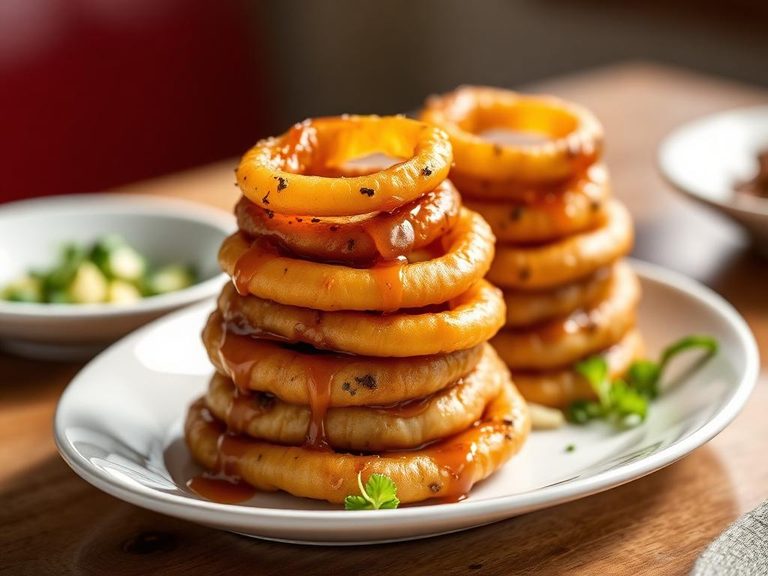
Fast foods, onion rings, breaded and fried
Whole food · Fast Foods

Photo: Wikipedia
Golden, crispy rings of sweet onion encased in a seasoned batter and deep-fried to a satisfying crunch. The exterior shatters to reveal a soft, tender, and slightly sweet interior. Nutritionally, it's a high-calorie, high-fat side dish, with a 100g serving packing over 400 kcal and more than 25g of fat.
Calorie split: 4% protein · 42% carbs · 54% fat
↓ Full nutrition💚 Why it's loved
People adore the irresistible combination of a salty, crunchy batter and the sweet, melt-in-your-mouth onion inside. It's a quintessential comfort food, often enjoyed as a shareable appetizer or a side to burgers and sandwiches in casual dining culture.
⚠️ Watch-outs & how to enjoy it better
The deep-frying process adds significant calories, fat, and potentially unhealthy compounds, making it a poor choice for low-fat or heart-healthy diets. The refined batter can cause rapid blood-sugar spikes, and the high sodium content is a concern for those monitoring blood pressure. To counteract, pair with a lean protein (like grilled chicken) and a fiber-rich salad to slow digestion, practice strict portion control (e.g., sharing an order), or look for oven-baked versions to reduce fat.
Key benefits
- Provides quick energy from carbohydrates
- Source of dietary fiber from the onion
- Contains some protein from the batter and onion
- Offers a satisfying textural contrast (crisp outside, soft inside)
- A popular comfort food for psychological enjoyment
🍽️ Popular dishes
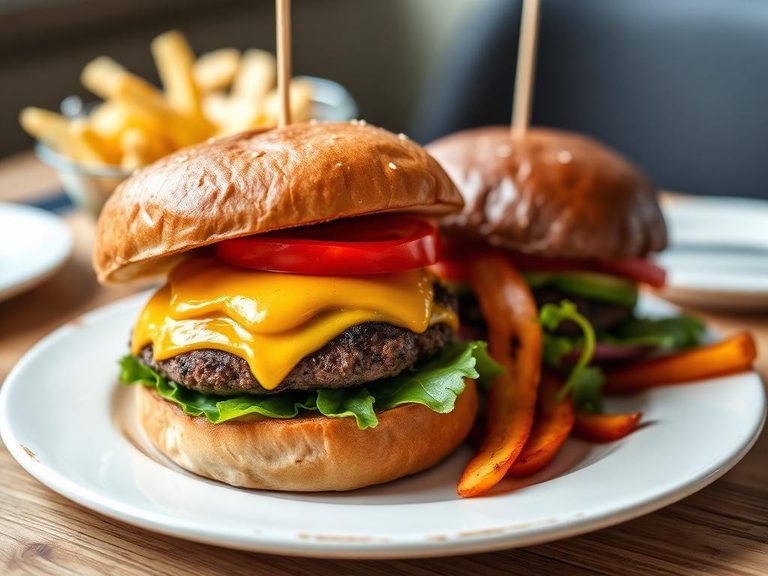
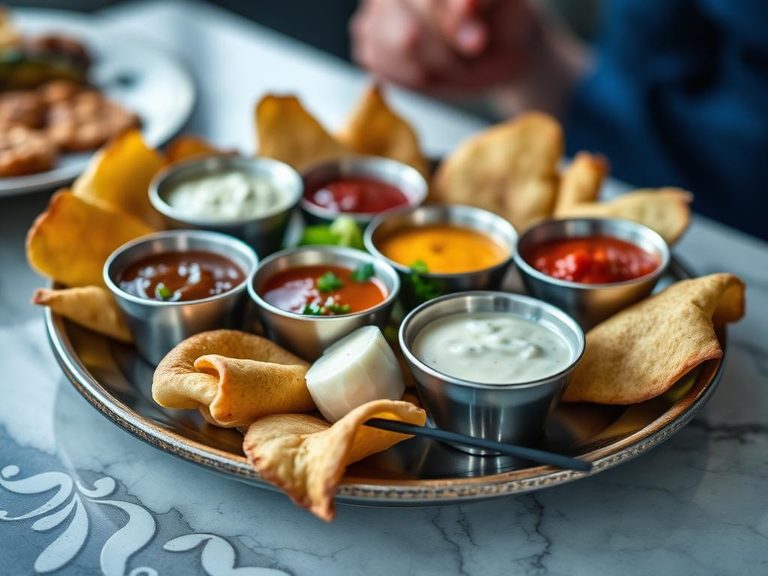
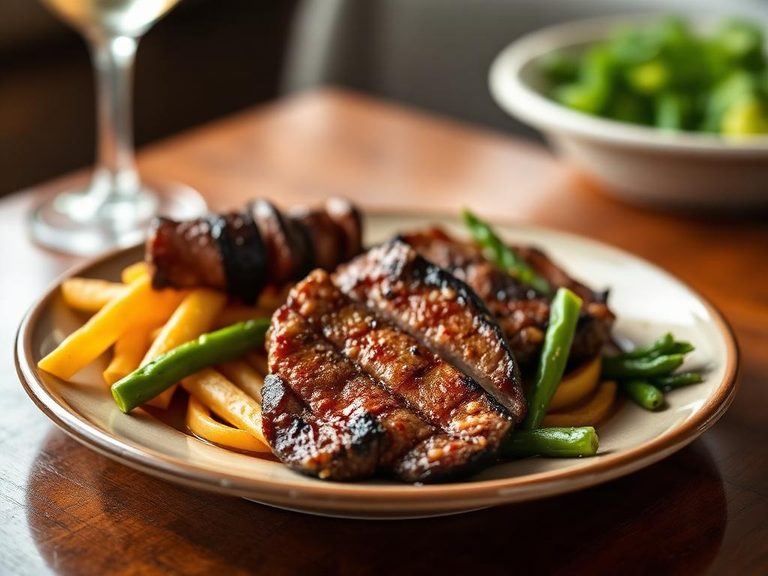
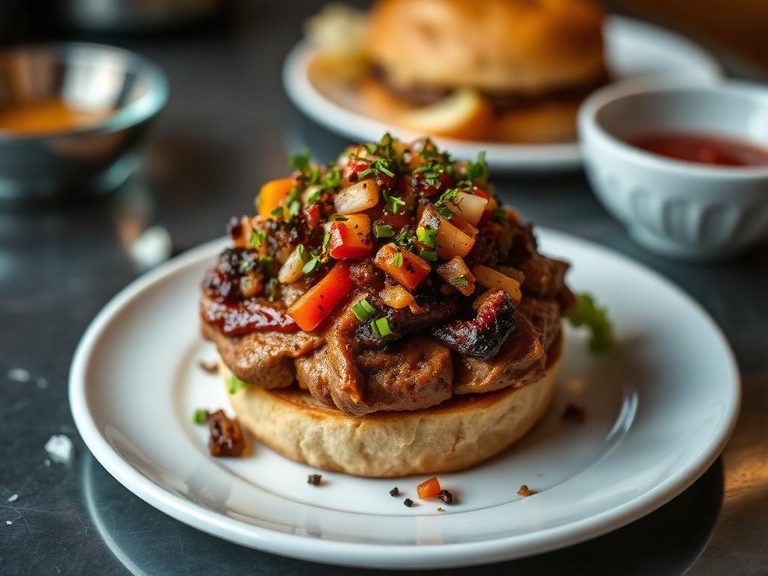
🌍 Where it's eaten
💡 Did you know?
The largest onion ring ever made, according to Guinness World Records, was created in 2004 in Minnesota, USA, and measured over 51 inches (130 cm) in diameter.
Full nutrition (USDA data · scales with serving)
| Water | 24.5 g |
| Energy | 411 kcal |
| Energy | 1718 kj |
| Protein | 3.9 g |
| Total lipid (fat) | 25.2 g |
| Ash | 2.8 g |
| Carbohydrate, by difference | 43.6 g |
| Fiber, total dietary | 2.7 g |
| Total Sugars | 5.4 g |
| Sucrose | 3.6 g |
| Glucose | 0.44 g |
| Fructose | 0.98 g |
| Lactose | 0.00 g |
| Maltose | 0.45 g |
| Galactose | 0.00 g |
| Starch | 26.5 g |
| Calcium, Ca | 115 mg |
| Iron, Fe | 0.78 mg |
| Magnesium, Mg | 19.0 mg |
| Phosphorus, P | 158 mg |
| Potassium, K | 167 mg |
| Sodium, Na | 776 mg |
| Zinc, Zn | 0.51 mg |
| Copper, Cu | 0.07 mg |
| Manganese, Mn | 0.34 mg |
| Selenium, Se | 5.7 ug |
| Vitamin C, total ascorbic acid | 1.4 mg |
| Thiamin | 0.11 mg |
| Riboflavin | 0.06 mg |
| Niacin | 0.67 mg |
| Pantothenic acid | 0.33 mg |
| Vitamin B-6 | 0.13 mg |
| Folate, total | 42.0 ug |
| Folic acid | 0.00 ug |
| Folate, food | 42.0 ug |
| Folate, DFE | 42.0 ug |
| Choline, total | 8.4 mg |
| Betaine | 16.6 mg |
| Vitamin B-12 | 0.00 ug |
| Vitamin B-12, added | 0.00 ug |
| Vitamin A, RAE | 0.00 ug |
| Retinol | 0.00 ug |
| Carotene, beta | 2.0 ug |
| Carotene, alpha | 0.00 ug |
| Cryptoxanthin, beta | 3.0 ug |
| Vitamin A, IU | 6.0 iu |
| Lycopene | 0.00 ug |
| Lutein + zeaxanthin | 38.0 ug |
| Vitamin E (alpha-tocopherol) | 4.9 mg |
| Vitamin E, added | 0.00 mg |
| Tocopherol, beta | 0.18 mg |
| Tocopherol, gamma | 11.0 mg |
| Tocopherol, delta | 1.2 mg |
| Tocotrienol, alpha | 0.15 mg |
| Tocotrienol, beta | 0.00 mg |
| Tocotrienol, gamma | 0.10 mg |
| Tocotrienol, delta | 0.06 mg |
| Vitamin D (D2 + D3), International Units | 0.00 iu |
| Vitamin D (D2 + D3) | 0.00 ug |
| Vitamin K (phylloquinone) | 55.8 ug |
| Alcohol, ethyl | 0.00 g |
| Caffeine | 0.00 mg |
| Theobromine | 0.00 mg |
Fat & fatty acid profile (per 100g)
| Fatty acids, total saturated | 4.2 g |
| SFA 4:0 | 0.00 g |
| SFA 6:0 | 0.00 g |
| SFA 8:0 | 0.01 g |
| SFA 10:0 | 0.01 g |
| SFA 12:0 | 0.01 g |
| SFA 14:0 | 0.06 g |
| SFA 15:0 | 0.01 g |
| SFA 16:0 | 3.2 g |
| SFA 17:0 | 0.02 g |
| SFA 18:0 | 0.66 g |
| SFA 20:0 | 0.09 g |
| SFA 22:0 | 0.05 g |
| SFA 24:0 | 0.04 g |
| Fatty acids, total monounsaturated | 6.9 g |
| MUFA 14:1 | 0.00 g |
| MUFA 15:1 | 0.00 g |
| MUFA 16:1 | 0.05 g |
| MUFA 16:1 c | 0.05 g |
| MUFA 17:1 | 0.01 g |
| MUFA 18:1 | 6.7 g |
| MUFA 18:1 c | 6.7 g |
| MUFA 20:1 | 0.08 g |
| MUFA 22:1 | 0.01 g |
| MUFA 22:1 c | 0.00 g |
| MUFA 24:1 c | 0.01 g |
| Fatty acids, total polyunsaturated | 12.1 g |
| PUFA 18:2 | 11.5 g |
| PUFA 18:2 n-6 c,c | 11.3 g |
| PUFA 18:2 CLAs | 0.04 g |
| PUFA 18:3 | 0.62 g |
| PUFA 18:3 n-3 c,c,c (ALA) | 0.58 g |
| PUFA 18:3 n-6 c,c,c | 0.04 g |
| PUFA 18:4 | 0.00 g |
| PUFA 20:2 n-6 c,c | 0.01 g |
| PUFA 20:3 | 0.00 g |
| PUFA 20:3 n-3 | 0.00 g |
| PUFA 20:3 n-6 | 0.00 g |
| PUFA 20:4 | 0.01 g |
| PUFA 20:5 n-3 (EPA) | 0.00 g |
| PUFA 22:4 | 0.00 g |
| PUFA 22:5 n-3 (DPA) | 0.00 g |
| PUFA 22:6 n-3 (DHA) | 0.00 g |
| Fatty acids, total trans | 0.16 g |
| Fatty acids, total trans-monoenoic | 0.03 g |
| TFA 16:1 t | 0.00 g |
| TFA 18:1 t | 0.03 g |
| TFA 22:1 t | 0.00 g |
| TFA 18:2 t not further defined | 0.13 g |
| Fatty acids, total trans-polyenoic | 0.13 g |
| Cholesterol | 0.00 mg |
Amino acid profile (per 100g)
Estimated from Fast foods, english muffin, with egg, cheese, and sausage — USDA does not publish this profile for Fast foods.
| Tryptophan | 0.16 g |
| Threonine | 0.52 g |
| Isoleucine | 0.54 g |
| Leucine | 0.98 g |
| Lysine | 0.75 g |
| Methionine | 0.29 g |
| Cystine | 0.20 g |
| Phenylalanine | 0.59 g |
| Tyrosine | 0.41 g |
| Valine | 0.65 g |
| Arginine | 0.65 g |
| Histidine | 0.33 g |
| Alanine | 0.60 g |
| Aspartic acid | 1.1 g |
| Glutamic acid | 2.5 g |
| Glycine | 0.54 g |
| Proline | 0.90 g |
| Serine | 0.70 g |
FAQ
Why do my homemade onion rings get soggy so quickly?
Sogginess is caused by steam from the hot onion getting trapped in the batter. Ensure your oil is hot enough (350-375°F/175-190°C) before frying, don't overcrowd the pan, and drain on a wire rack instead of paper towels to allow air circulation.
What is the best onion for making onion rings?
Sweet, large-diameter onions like Vidalia, Walla Walla, or Spanish onions are ideal. They have a mild flavor and a size that yields substantial rings, and their higher sugar content caramelizes nicely during frying.
Can onion rings be made in an air fryer?
Yes, for a lower-fat alternative. Lightly spray the battered rings with oil and cook at a high temperature (around 400°F/200°C), flipping halfway, until golden and crisp. The texture will be slightly different but still satisfying.
Nutrient density (calculated · NRF9.3)
Nutrient Rich Foods index: beneficial nutrients (protein, fiber, vitamins, minerals) minus saturated fat, added sugar & sodium, per 100 kcal.
NRF9.3 index — Fulgoni, Keast & Drewnowski, 2009. Computed from USDA nutrients.
Weight-loss friendliness (composite index)
Energy density 4.11 kcal/g · 4% calories from protein · 2.7 g fiber · 5.4 g sugar per 100 g.
Composite of energy density (Rolls et al., 1999), protein & fiber satiety, minus sugar. A calculated heuristic — ranks satiety-per-calorie, not a clinical measure.
Dietary load (calculated from USDA values)
Potential renal acid load. Positive = acid-forming, negative = alkaline-forming.
Sodium-to-potassium ratio: 4.65 (lower is better — aim for ≤ 1)
Sodium:potassium per WHO potassium guidance. Computed from USDA nutrients.