

Fast foods, nachos, with cheese, beans, ground beef, and tomatoes
Whole food · Fast Foods

Photo: Wikipedia
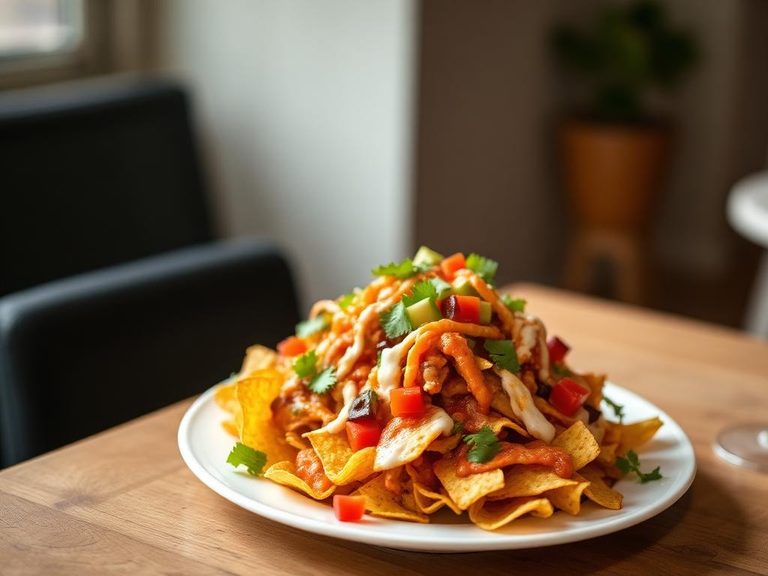
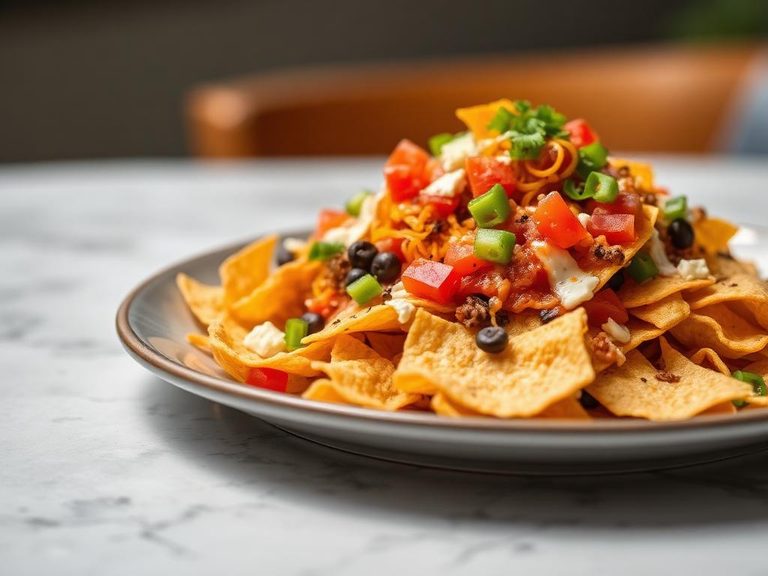
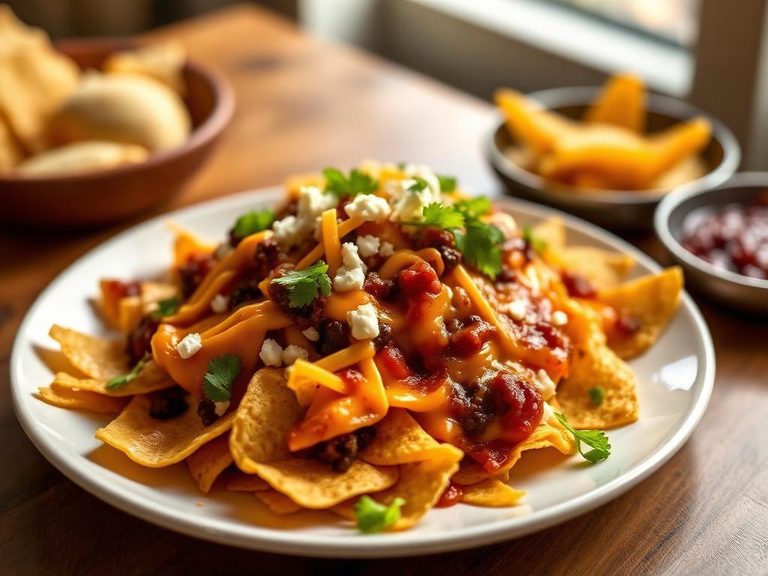
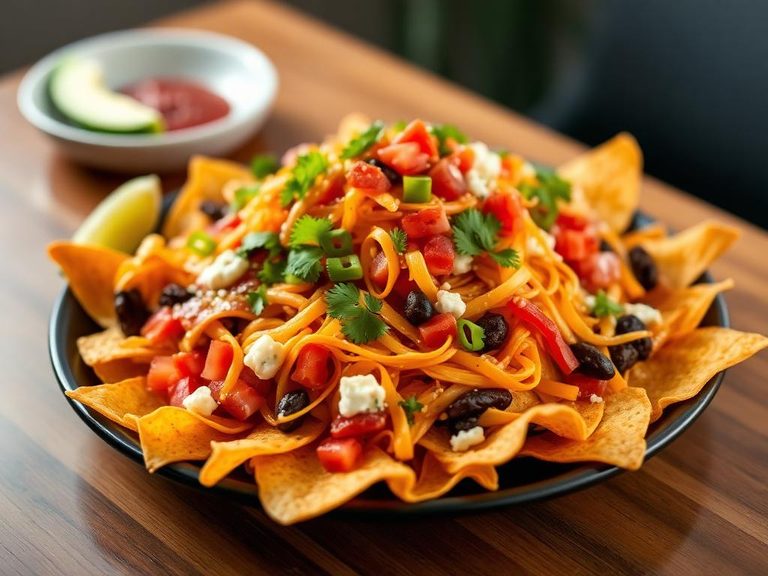
A hearty, shareable pile of crispy corn tortilla chips smothered in warm, gooey cheese sauce, seasoned ground beef, creamy refried beans, and fresh diced tomatoes. The texture is a satisfying crunch against soft, savory toppings, creating a rich, salty, and slightly spicy flavor profile. Per 100g, it provides a notable 12.5g of fat and 6.2g of protein, making it a more substantial snack than plain chips.
Calorie split: 11% protein · 38% carbs · 50% fat
↓ Full nutrition💚 Why it's loved
People love nachos for their irresistible combination of salty, cheesy, and savory flavors, and the fun, interactive experience of loading up a plate with customizable toppings. They are a staple of casual social gatherings, sports events, and Tex-Mex cuisine, embodying comfort food and communal eating.
⚠️ Watch-outs & how to enjoy it better
This dish can be high in sodium, saturated fat, and refined carbohydrates, which may cause blood-sugar spikes and isn't ideal for those monitoring calorie or sodium intake. The cheese sauce often contains common allergens like milk, and the chips are made from corn, a potential allergen. To counteract, practice portion control, load up on extra fresh veggies like jalapeños or onions for volume, and pair with a side of guacamole (healthy fat) or a simple salad to increase fiber and nutrient density.
Key benefits
- Provides a quick source of energy from carbohydrates and fats.
- The beans and beef contribute dietary protein and iron.
- Contains dietary fiber from the beans and tomatoes.
- Offers a convenient and customizable all-in-one meal or snack.
🍽️ Popular dishes

🌍 Where it's eaten
💡 Did you know?
The dish was invented by Ignacio Anaya García, a maître d' at a restaurant in Piedras Negras, Mexico, in 1943. He named them 'Nachos Especiales' after his nickname, 'Nacho.'
Full nutrition (USDA data · scales with serving)
| Water | 58.1 g |
| Energy | 219 kcal |
| Energy | 915 kj |
| Protein | 6.2 g |
| Total lipid (fat) | 12.5 g |
| Ash | 1.8 g |
| Carbohydrate, by difference | 21.4 g |
| Fiber, total dietary | 3.7 g |
| Total Sugars | 1.6 g |
| Sucrose | 0.27 g |
| Glucose | 0.23 g |
| Fructose | 0.27 g |
| Lactose | 0.87 g |
| Maltose | 0.00 g |
| Galactose | 0.00 g |
| Starch | 15.0 g |
| Calcium, Ca | 47.0 mg |
| Iron, Fe | 1.0 mg |
| Magnesium, Mg | 33.0 mg |
| Phosphorus, P | 153 mg |
| Potassium, K | 298 mg |
| Sodium, Na | 348 mg |
| Zinc, Zn | 1.1 mg |
| Copper, Cu | 0.10 mg |
| Manganese, Mn | 0.20 mg |
| Selenium, Se | 8.1 ug |
| Vitamin C, total ascorbic acid | 0.00 mg |
| Thiamin | 0.07 mg |
| Riboflavin | 0.14 mg |
| Niacin | 1.0 mg |
| Pantothenic acid | 0.33 mg |
| Vitamin B-6 | 0.16 mg |
| Folate, total | 14.0 ug |
| Folic acid | 0.00 ug |
| Folate, food | 14.0 ug |
| Folate, DFE | 14.0 ug |
| Choline, total | 28.1 mg |
| Vitamin B-12 | 0.31 ug |
| Vitamin B-12, added | 0.00 ug |
| Vitamin A, RAE | 42.0 ug |
| Retinol | 36.0 ug |
| Carotene, beta | 64.0 ug |
| Carotene, alpha | 1.0 ug |
| Cryptoxanthin, beta | 19.0 ug |
| Vitamin A, IU | 242 iu |
| Lycopene | 252 ug |
| Lutein + zeaxanthin | 46.0 ug |
| Vitamin E (alpha-tocopherol) | 1.8 mg |
| Vitamin E, added | 0.00 mg |
| Tocopherol, beta | 0.04 mg |
| Tocopherol, gamma | 3.0 mg |
| Tocopherol, delta | 0.24 mg |
| Tocotrienol, alpha | 0.11 mg |
| Tocotrienol, beta | 0.17 mg |
| Tocotrienol, gamma | 0.00 mg |
| Tocotrienol, delta | 0.12 mg |
| Vitamin D (D2 + D3), International Units | 2.0 iu |
| Vitamin D (D2 + D3) | 0.10 ug |
| Vitamin K (phylloquinone) | 5.4 ug |
| Alcohol, ethyl | 0.00 g |
| Caffeine | 0.00 mg |
| Theobromine | 0.00 mg |
Fat & fatty acid profile (per 100g)
| Fatty acids, total saturated | 2.5 g |
| SFA 4:0 | 0.02 g |
| SFA 6:0 | 0.01 g |
| SFA 8:0 | 0.01 g |
| SFA 10:0 | 0.03 g |
| SFA 12:0 | 0.03 g |
| SFA 14:0 | 0.17 g |
| SFA 15:0 | 0.02 g |
| SFA 16:0 | 1.4 g |
| SFA 17:0 | 0.04 g |
| SFA 18:0 | 0.72 g |
| SFA 20:0 | 0.06 g |
| SFA 22:0 | 0.03 g |
| SFA 24:0 | 0.02 g |
| Fatty acids, total monounsaturated | 6.7 g |
| MUFA 14:1 | 0.03 g |
| MUFA 15:1 | 0.00 g |
| MUFA 16:1 | 0.11 g |
| MUFA 16:1 c | 0.10 g |
| MUFA 17:1 | 0.03 g |
| MUFA 18:1 | 6.4 g |
| MUFA 18:1 c | 6.2 g |
| MUFA 20:1 | 0.11 g |
| MUFA 22:1 | 0.00 g |
| MUFA 22:1 c | 0.00 g |
| MUFA 24:1 c | 0.00 g |
| Fatty acids, total polyunsaturated | 2.5 g |
| PUFA 18:2 | 2.1 g |
| PUFA 18:2 n-6 c,c | 2.1 g |
| PUFA 18:2 CLAs | 0.02 g |
| PUFA 18:3 | 0.33 g |
| PUFA 18:3 n-3 c,c,c (ALA) | 0.32 g |
| PUFA 18:3 n-6 c,c,c | 0.01 g |
| PUFA 18:3i | 0.00 g |
| PUFA 18:4 | 0.00 g |
| PUFA 20:2 n-6 c,c | 0.01 g |
| PUFA 20:3 | 0.00 g |
| PUFA 20:3 n-3 | 0.00 g |
| PUFA 20:3 n-6 | 0.00 g |
| PUFA 20:4 | 0.01 g |
| PUFA 20:5 n-3 (EPA) | 0.00 g |
| PUFA 22:4 | 0.00 g |
| PUFA 22:5 n-3 (DPA) | 0.00 g |
| PUFA 22:6 n-3 (DHA) | 0.00 g |
| Fatty acids, total trans | 0.17 g |
| Fatty acids, total trans-monoenoic | 0.14 g |
| TFA 16:1 t | 0.01 g |
| TFA 18:1 t | 0.13 g |
| TFA 22:1 t | 0.00 g |
| TFA 18:2 t not further defined | 0.03 g |
| Fatty acids, total trans-polyenoic | 0.03 g |
| Cholesterol | 14.0 mg |
Amino acid profile (per 100g)
| Tryptophan | 0.06 g |
| Threonine | 0.22 g |
| Isoleucine | 0.28 g |
| Leucine | 0.54 g |
| Lysine | 0.34 g |
| Methionine | 0.12 g |
| Phenylalanine | 0.28 g |
| Tyrosine | 0.17 g |
| Valine | 0.33 g |
| Arginine | 0.35 g |
| Histidine | 0.19 g |
| Alanine | 0.35 g |
| Aspartic acid | 0.59 g |
| Glutamic acid | 1.1 g |
| Glycine | 0.33 g |
| Proline | 0.51 g |
| Serine | 0.28 g |
| Hydroxyproline | 0.09 g |
FAQ
Are nachos a complete meal?
While they contain carbs, protein, and fat, they are often imbalanced and high in sodium. Adding a side of vegetables or a salad can make it more nutritionally complete.
What is the best way to reheat leftover nachos?
Spread them on a baking sheet and reheat in a 350°F (175°C) oven for 5-10 minutes to re-crisp the chips. Microwaving will make them soggy.
Can I make nachos healthier?
Yes. Use baked tortilla chips, low-fat cheese, lean ground turkey, and load up on fresh toppings like pico de gallo, black beans, corn, and avocado instead of just more cheese and meat.
Nutrient density (calculated · NRF9.3)
Nutrient Rich Foods index: beneficial nutrients (protein, fiber, vitamins, minerals) minus saturated fat, added sugar & sodium, per 100 kcal.
NRF9.3 index — Fulgoni, Keast & Drewnowski, 2009. Computed from USDA nutrients.
Weight-loss friendliness (composite index)
Energy density 2.19 kcal/g · 11% calories from protein · 3.7 g fiber · 1.6 g sugar per 100 g.
Composite of energy density (Rolls et al., 1999), protein & fiber satiety, minus sugar. A calculated heuristic — ranks satiety-per-calorie, not a clinical measure.
Dietary load (calculated from USDA values)
Potential renal acid load. Positive = acid-forming, negative = alkaline-forming.
Sodium-to-potassium ratio: 1.17 (lower is better — aim for ≤ 1)
Sodium:potassium per WHO potassium guidance. Computed from USDA nutrients.