

Corn dogs, frozen, prepared
Whole food · Meals, Entrees, and Side Dishes
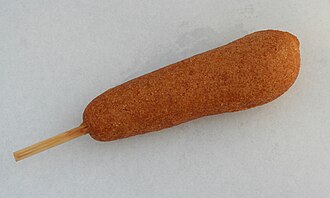
Photo: Wikipedia
A golden, crispy cornmeal-battered sausage on a stick, offering a satisfying crunch followed by a savory, juicy interior. Nutritionally, it's a calorie-dense, energy-rich food with a notable balance of protein and carbohydrates, though relatively low in fiber.
Calorie split: 14% protein · 43% carbs · 43% fat
↓ Full nutrition💚 Why it's loved
People love corn dogs for their perfect marriage of savory, salty hot dog and sweet, crunchy cornmeal batter, a flavor combination that feels like a nostalgic treat at fairs and ballparks. Their handheld, mess-free format makes them an ideal, fun food for both kids and adults.
⚠️ Watch-outs & how to enjoy it better
The high sodium, fat, and refined carbohydrate content can contribute to blood-sugar spikes and may not suit those monitoring their heart health or blood sugar. To counteract this, pair a corn dog with a side of non-starchy vegetables (like a simple green salad) to add fiber and slow digestion, and practice portion control by enjoying just one as an occasional treat rather than a staple.
Key benefits
- Provides a quick source of energy from carbohydrates and fat.
- Offers a decent amount of protein per serving.
- Convenient and easy to prepare from frozen.
- A classic, nostalgic comfort food for many.
🍽️ Popular dishes





🌍 Where it's eaten
💡 Did you know?
The modern corn dog is often credited to a German immigrant, Anton Feuchtwanger, who reportedly first sold them at the 1904 St. Louis World's Fair, initially using a glove to hold the hot sausage before switching to a stick.
Full nutrition (USDA data · scales with serving)
| Water | 50.3 g |
| Energy | 250 kcal |
| Energy | 1047 kj |
| Protein | 8.6 g |
| Total lipid (fat) | 12.0 g |
| Ash | 2.1 g |
| Carbohydrate, by difference | 27.0 g |
| Fiber, total dietary | 1.0 g |
| Total Sugars | 7.5 g |
| Sucrose | 6.2 g |
| Glucose | 0.62 g |
| Fructose | 0.00 g |
| Lactose | 0.00 g |
| Maltose | 0.69 g |
| Galactose | 0.00 g |
| Starch | 17.6 g |
| Calcium, Ca | 72.0 mg |
| Iron, Fe | 1.9 mg |
| Magnesium, Mg | 17.0 mg |
| Phosphorus, P | 224 mg |
| Potassium, K | 125 mg |
| Sodium, Na | 668 mg |
| Zinc, Zn | 0.85 mg |
| Copper, Cu | 0.07 mg |
| Manganese, Mn | 0.17 mg |
| Selenium, Se | 27.6 ug |
| Vitamin C, total ascorbic acid | 0.50 mg |
| Thiamin | 0.14 mg |
| Riboflavin | 0.15 mg |
| Niacin | 2.8 mg |
| Pantothenic acid | 0.41 mg |
| Vitamin B-6 | 0.12 mg |
| Folate, total | 60.0 ug |
| Folic acid | 53.0 ug |
| Folate, food | 7.0 ug |
| Folate, DFE | 97.0 ug |
| Choline, total | 26.9 mg |
| Vitamin B-12 | 0.48 ug |
| Vitamin B-12, added | 0.00 ug |
| Vitamin A, RAE | 48.0 ug |
| Retinol | 47.0 ug |
| Carotene, beta | 3.0 ug |
| Carotene, alpha | 0.00 ug |
| Cryptoxanthin, beta | 4.0 ug |
| Vitamin A, IU | 166 iu |
| Lycopene | 0.00 ug |
| Lutein + zeaxanthin | 132 ug |
| Vitamin E (alpha-tocopherol) | 0.60 mg |
| Vitamin E, added | 0.00 mg |
| Tocopherol, beta | 0.04 mg |
| Tocopherol, gamma | 0.89 mg |
| Tocopherol, delta | 0.39 mg |
| Tocotrienol, alpha | 0.04 mg |
| Tocotrienol, beta | 0.19 mg |
| Tocotrienol, gamma | 0.06 mg |
| Tocotrienol, delta | 0.00 mg |
| Vitamin D (D2 + D3), International Units | 15.0 iu |
| Vitamin D (D2 + D3) | 0.40 ug |
| Vitamin K (phylloquinone) | 5.8 ug |
| Vitamin K (Dihydrophylloquinone) | 1.2 ug |
| Vitamin K (Menaquinone-4) | 11.1 ug |
| Alcohol, ethyl | 0.00 g |
| Caffeine | 0.00 mg |
| Theobromine | 0.00 mg |
Fat & fatty acid profile (per 100g)
| Fatty acids, total saturated | 3.5 g |
| SFA 4:0 | 0.00 g |
| SFA 6:0 | 0.00 g |
| SFA 8:0 | 0.00 g |
| SFA 10:0 | 0.00 g |
| SFA 12:0 | 0.01 g |
| SFA 14:0 | 0.08 g |
| SFA 15:0 | 0.01 g |
| SFA 16:0 | 2.6 g |
| SFA 17:0 | 0.02 g |
| SFA 18:0 | 0.72 g |
| SFA 20:0 | 0.02 g |
| SFA 22:0 | 0.02 g |
| SFA 24:0 | 0.01 g |
| Fatty acids, total monounsaturated | 4.7 g |
| MUFA 14:1 | 0.02 g |
| MUFA 15:1 | 0.00 g |
| MUFA 16:1 | 0.48 g |
| MUFA 16:1 c | 0.48 g |
| MUFA 17:1 | 0.01 g |
| MUFA 18:1 | 4.1 g |
| MUFA 18:1 c | 4.0 g |
| MUFA 20:1 | 0.07 g |
| MUFA 22:1 | 0.03 g |
| MUFA 22:1 c | 0.03 g |
| MUFA 24:1 c | 0.00 g |
| Fatty acids, total polyunsaturated | 3.4 g |
| PUFA 18:2 | 3.1 g |
| PUFA 18:2 n-6 c,c | 3.0 g |
| PUFA 18:2 CLAs | 0.02 g |
| PUFA 18:3 | 0.19 g |
| PUFA 18:3 n-3 c,c,c (ALA) | 0.18 g |
| PUFA 18:3 n-6 c,c,c | 0.01 g |
| PUFA 18:4 | 0.00 g |
| PUFA 20:2 n-6 c,c | 0.01 g |
| PUFA 20:3 | 0.02 g |
| PUFA 20:3 n-3 | 0.00 g |
| PUFA 20:3 n-6 | 0.02 g |
| PUFA 20:4 | 0.04 g |
| PUFA 20:5 n-3 (EPA) | 0.00 g |
| PUFA 22:4 | 0.01 g |
| PUFA 22:5 n-3 (DPA) | 0.01 g |
| PUFA 22:6 n-3 (DHA) | 0.00 g |
| Fatty acids, total trans | 0.17 g |
| Fatty acids, total trans-monoenoic | 0.12 g |
| TFA 16:1 t | 0.01 g |
| TFA 18:1 t | 0.12 g |
| TFA 22:1 t | 0.00 g |
| TFA 18:2 t not further defined | 0.05 g |
| Fatty acids, total trans-polyenoic | 0.05 g |
| Cholesterol | 44.0 mg |
Amino acid profile (per 100g)
| Tryptophan | 0.09 g |
| Threonine | 0.27 g |
| Isoleucine | 0.33 g |
| Leucine | 0.63 g |
| Lysine | 0.45 g |
| Methionine | 0.15 g |
| Cystine | 0.12 g |
| Phenylalanine | 0.37 g |
| Tyrosine | 0.23 g |
| Valine | 0.41 g |
| Arginine | 0.39 g |
| Histidine | 0.22 g |
| Alanine | 0.40 g |
| Aspartic acid | 0.59 g |
| Glutamic acid | 1.8 g |
| Glycine | 0.41 g |
| Proline | 0.60 g |
| Serine | 0.35 g |
FAQ
Are corn dogs a good source of protein?
They provide a moderate amount of protein (about 8.5g per 100g), primarily from the hot dog sausage inside, but they are not considered a high-protein food compared to lean meats or legumes.
Why are frozen corn dogs often high in sodium?
The sodium comes from both the processed hot dog sausage and the seasoned cornmeal batter, which is used for flavor and preservation. A single corn dog can contain a significant portion of your daily recommended sodium intake.
Can I make corn dogs healthier at home?
Yes, you can use lean turkey or chicken sausages, make a whole-grain cornmeal batter, and bake them instead of frying to reduce fat. Adding a side of vegetables also balances the meal.
Nutrient density (calculated · NRF9.3)
Nutrient Rich Foods index: beneficial nutrients (protein, fiber, vitamins, minerals) minus saturated fat, added sugar & sodium, per 100 kcal.
NRF9.3 index — Fulgoni, Keast & Drewnowski, 2009. Computed from USDA nutrients.
Weight-loss friendliness (composite index)
Energy density 2.50 kcal/g · 14% calories from protein · 1.0 g fiber · 7.5 g sugar per 100 g.
Composite of energy density (Rolls et al., 1999), protein & fiber satiety, minus sugar. A calculated heuristic — ranks satiety-per-calorie, not a clinical measure.
Dietary load (calculated from USDA values)
Potential renal acid load. Positive = acid-forming, negative = alkaline-forming.
Sodium-to-potassium ratio: 5.34 (lower is better — aim for ≤ 1)
Sodium:potassium per WHO potassium guidance. Computed from USDA nutrients.