

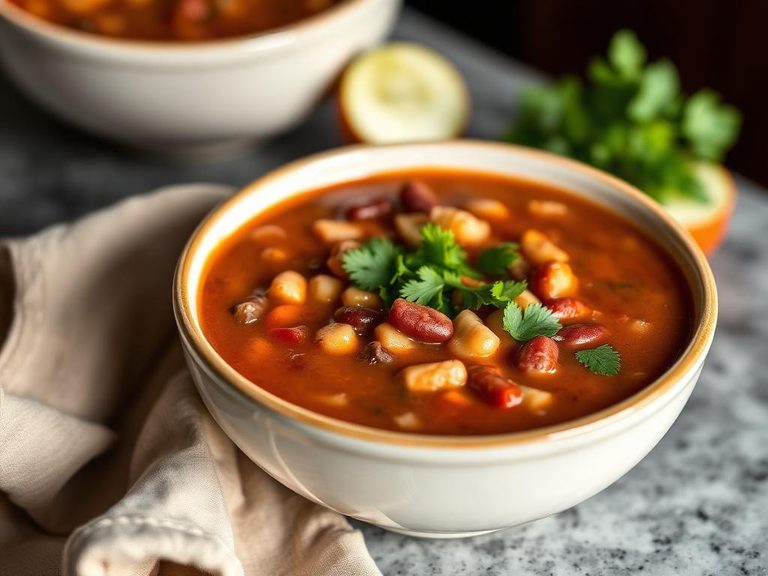
Stew, pinto bean and hominy, badufsuki (Hopi)
Whole food · American Indian/Alaska Native Foods

Photo: Wikipedia
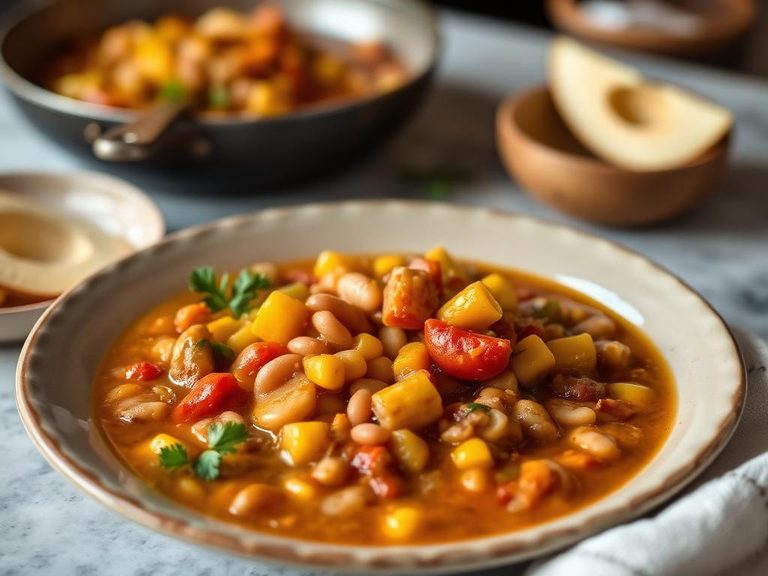
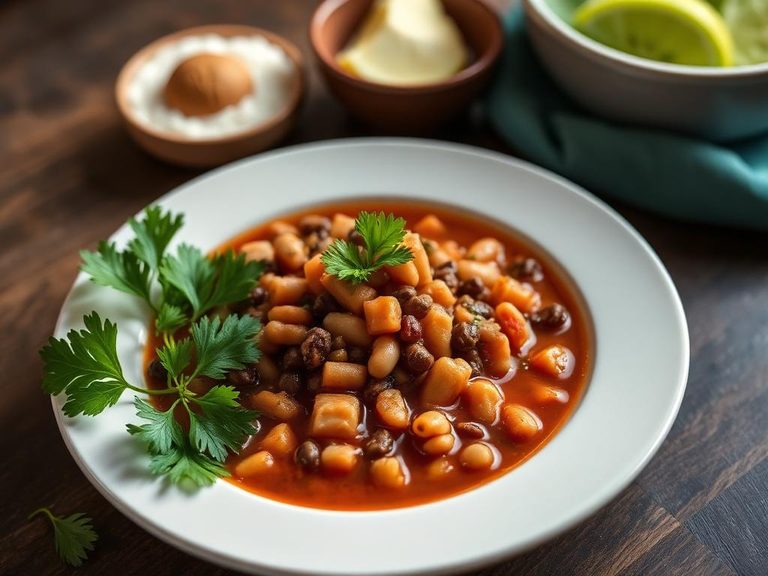
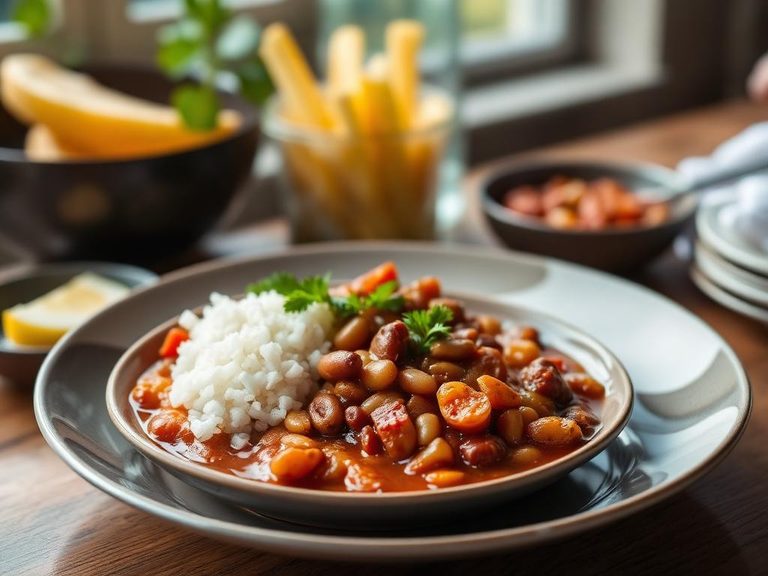
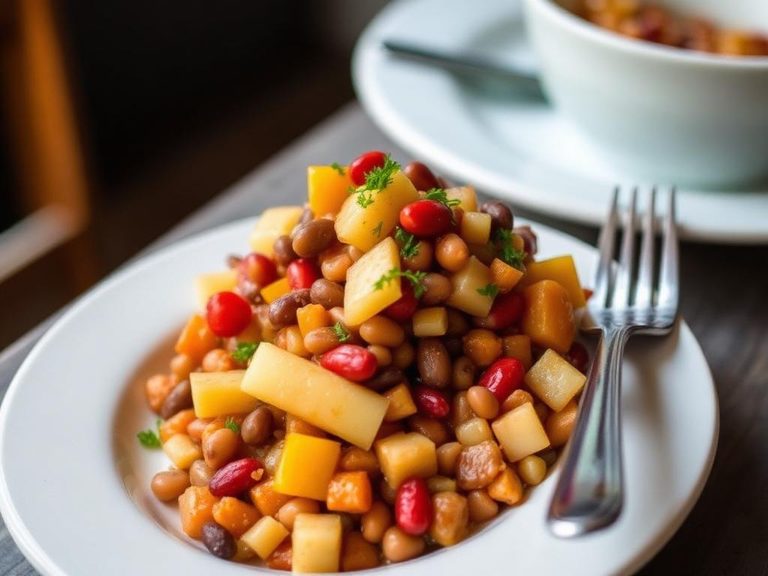
Badufsuki is a traditional Hopi stew featuring pinto beans and hominy (nixtamalized corn), simmered into a hearty, earthy dish with a soft, slightly chewy texture. It's a nutritional powerhouse, delivering significant fiber and plant-based protein for very few calories. The flavor is subtly savory and nutty, often enhanced with herbs and chili.
Calorie split: 18% protein · 67% carbs · 15% fat
↓ Full nutrition💚 Why it's loved
People love it for its comforting, rustic flavor and satisfying texture that makes it a filling meal. It's deeply tied to Hopi culture and agricultural traditions, representing a connection to heritage and sustainable farming.
⚠️ Watch-outs & how to enjoy it better
The high fiber content can cause digestive discomfort like bloating for those not accustomed to it. To counteract, increase intake gradually and ensure adequate water intake. The dish is also low in certain essential amino acids; pairing it with a side of squash, greens, or a small amount of meat can create a more complete protein profile.
Key benefits
- Excellent source of dietary fiber for digestive health.
- High in plant-based protein for muscle maintenance.
- Very low in fat and naturally sugar-free.
- Provides complex carbohydrates for sustained energy.
- Rich in minerals like iron and magnesium from beans and corn.
🍽️ Popular dishes
🌍 Where it's eaten
💡 Did you know?
Hominy is made from corn kernels treated with an alkaline solution (nixtamalization), a process developed in Mesoamerica that dramatically increases the bioavailability of niacin (vitamin B3) and improves protein quality.
Full nutrition (USDA data · scales with serving)
| Water | 92.3 g |
| Energy | 32.0 kcal |
| Energy | 134 kj |
| Protein | 1.4 g |
| Total lipid (fat) | 0.54 g |
| Ash | 0.41 g |
| Carbohydrate, by difference | 5.4 g |
| Fiber, total dietary | 1.5 g |
| Total Sugars | 0.00 g |
| Sucrose | 0.00 g |
| Glucose | 0.00 g |
| Fructose | 0.00 g |
| Lactose | 0.00 g |
| Maltose | 0.00 g |
| Galactose | 0.00 g |
| Starch | 4.1 g |
| Calcium, Ca | 7.0 mg |
| Iron, Fe | 0.37 mg |
| Magnesium, Mg | 11.0 mg |
| Phosphorus, P | 25.0 mg |
| Potassium, K | 86.0 mg |
| Sodium, Na | 45.0 mg |
| Zinc, Zn | 0.18 mg |
| Copper, Cu | 0.04 mg |
| Manganese, Mn | 0.06 mg |
| Selenium, Se | 2.2 ug |
| Thiamin | 0.00 mg |
| Riboflavin | 0.00 mg |
| Niacin | 0.10 mg |
| Pantothenic acid | 0.20 mg |
| Vitamin B-6 | 0.04 mg |
| Vitamin A, RAE | 0.00 ug |
| Carotene, beta | 0.00 ug |
| Carotene, alpha | 0.00 ug |
| Cryptoxanthin, beta | 0.00 ug |
| Vitamin A, IU | 1.0 iu |
| Lycopene | 0.00 ug |
| Lutein + zeaxanthin | 1.0 ug |
| Vitamin E (alpha-tocopherol) | 0.04 mg |
| Tocopherol, beta | 0.00 mg |
| Tocopherol, gamma | 0.25 mg |
| Tocopherol, delta | 0.01 mg |
| Tocotrienol, alpha | 0.02 mg |
| Tocotrienol, beta | 0.00 mg |
| Tocotrienol, gamma | 0.05 mg |
| Tocotrienol, delta | 0.00 mg |
| Vitamin K (phylloquinone) | 0.20 ug |
Fat & fatty acid profile (per 100g)
| Fatty acids, total saturated | 0.09 g |
| SFA 4:0 | 0.01 g |
| SFA 6:0 | 0.00 g |
| SFA 8:0 | 0.00 g |
| SFA 10:0 | 0.00 g |
| SFA 12:0 | 0.00 g |
| SFA 14:0 | 0.00 g |
| SFA 15:0 | 0.00 g |
| SFA 16:0 | 0.05 g |
| SFA 17:0 | 0.00 g |
| SFA 18:0 | 0.02 g |
| SFA 20:0 | 0.00 g |
| SFA 22:0 | 0.00 g |
| SFA 24:0 | 0.00 g |
| Fatty acids, total monounsaturated | 0.08 g |
| MUFA 14:1 | 0.00 g |
| MUFA 15:1 | 0.00 g |
| MUFA 16:1 | 0.00 g |
| MUFA 16:1 c | 0.00 g |
| MUFA 17:1 | 0.00 g |
| MUFA 18:1 | 0.08 g |
| MUFA 18:1 c | 0.08 g |
| MUFA 20:1 | 0.00 g |
| MUFA 22:1 | 0.00 g |
| MUFA 22:1 c | 0.00 g |
| MUFA 24:1 c | 0.00 g |
| Fatty acids, total polyunsaturated | 0.12 g |
| PUFA 18:2 | 0.09 g |
| PUFA 18:2 n-6 c,c | 0.09 g |
| PUFA 18:2 CLAs | 0.00 g |
| PUFA 18:3 | 0.04 g |
| PUFA 18:3 n-3 c,c,c (ALA) | 0.04 g |
| PUFA 18:3 n-6 c,c,c | 0.00 g |
| PUFA 18:4 | 0.00 g |
| PUFA 20:2 n-6 c,c | 0.00 g |
| PUFA 20:3 | 0.00 g |
| PUFA 20:3 n-3 | 0.00 g |
| PUFA 20:3 n-6 | 0.00 g |
| PUFA 20:4 | 0.00 g |
| PUFA 20:5 n-3 (EPA) | 0.00 g |
| PUFA 22:4 | 0.00 g |
| PUFA 22:5 n-3 (DPA) | 0.00 g |
| PUFA 22:6 n-3 (DHA) | 0.00 g |
| Fatty acids, total trans | 0.00 g |
| Fatty acids, total trans-monoenoic | 0.00 g |
| TFA 16:1 t | 0.00 g |
| TFA 18:1 t | 0.00 g |
| TFA 22:1 t | 0.00 g |
| TFA 18:2 t not further defined | 0.00 g |
| Fatty acids, total trans-polyenoic | 0.00 g |
| Cholesterol | 0.00 mg |
| Stigmasterol | 2.0 mg |
| Campesterol | 1.0 mg |
| Beta-sitosterol | 4.0 mg |
Amino acid profile (per 100g)
Estimated from Stew, hominy with mutton (Navajo) — USDA does not publish this profile for Stew.
| Tryptophan | 0.04 g |
| Threonine | 0.24 g |
| Isoleucine | 0.25 g |
| Leucine | 0.54 g |
| Lysine | 0.43 g |
| Methionine | 0.16 g |
| Cystine | 0.07 g |
| Phenylalanine | 0.26 g |
| Tyrosine | 0.18 g |
| Valine | 0.29 g |
| Arginine | 0.39 g |
| Histidine | 0.16 g |
| Alanine | 0.42 g |
| Aspartic acid | 0.53 g |
| Glutamic acid | 0.99 g |
| Glycine | 0.45 g |
| Proline | 0.39 g |
| Serine | 0.25 g |
FAQ
What gives hominy its distinctive chewy texture?
The nixtamalization process, where corn is cooked in an alkaline solution (like lime water), causes the kernels to swell and develop their characteristic large, puffy, and chewy texture.
Is this dish suitable for a gluten-free diet?
Yes, traditional badufsuki made from pinto beans, hominy, and basic seasonings is naturally gluten-free. Always check any added broths or seasonings for hidden gluten.
Can I make this dish in a slow cooker?
Absolutely. It's ideal for slow cooking. Sauté aromatics first, then combine all ingredients in the slow cooker and cook on low for 6-8 hours until the beans are very tender.
Nutrient density (calculated · NRF9.3)
Nutrient Rich Foods index: beneficial nutrients (protein, fiber, vitamins, minerals) minus saturated fat, added sugar & sodium, per 100 kcal.
NRF9.3 index — Fulgoni, Keast & Drewnowski, 2009. Computed from USDA nutrients.
Weight-loss friendliness (composite index)
Energy density 0.32 kcal/g · 18% calories from protein · 1.5 g fiber · 0.0 g sugar per 100 g.
Composite of energy density (Rolls et al., 1999), protein & fiber satiety, minus sugar. A calculated heuristic — ranks satiety-per-calorie, not a clinical measure.
Dietary load (calculated from USDA values)
Potential renal acid load. Positive = acid-forming, negative = alkaline-forming.
Sodium-to-potassium ratio: 0.52 (lower is better — aim for ≤ 1)
Sodium:potassium per WHO potassium guidance. Computed from USDA nutrients.