

Fruit juice smoothie, NAKED JUICE, strawberry banana
Whole food · Fruits and Fruit Juices

Photo: Wikipedia
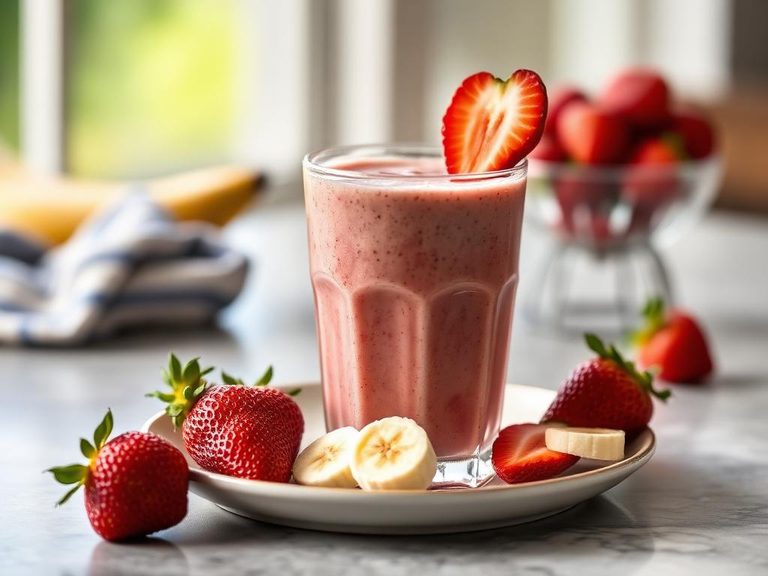
This is a vibrant, ready-to-drink blend of strawberry and banana, offering a smooth, slightly pulpy texture and a sweet, familiar fruit-forward taste. With just 50 calories per 100g, it's a light, hydrating option primarily composed of natural fruit sugars and carbohydrates. Its low fat and protein content make it a quick source of energy rather than a substantial meal replacement.
Calorie split: 4% protein · 91% carbs · 5% fat
↓ Full nutrition💚 Why it's loved
People love it for the classic, crowd-pleasing combination of sweet strawberry and creamy banana, which tastes like a fresh, drinkable fruit salad. Its convenience and familiar flavor make it a popular, nostalgic pick-me-up or breakfast accompaniment.
⚠️ Watch-outs & how to enjoy it better
The primary concern is the high sugar content (over 10g per 100g), which can cause rapid blood-sugar spikes, especially for those with insulin sensitivity or diabetes. To counteract this, pair it with a source of protein (like Greek yogurt or nuts) or healthy fat (like a handful of almonds) to slow sugar absorption, or consider it an occasional treat rather than a daily staple.
Key benefits
- Provides a quick source of natural energy from fruit sugars.
- Contains small amounts of dietary fiber from whole fruit.
- Offers a convenient way to consume fruit on the go.
- Naturally low in fat and cholesterol-free.
- Hydrating due to its high water content.
🍽️ Popular dishes
🌍 Where it's eaten
💡 Did you know?
The 'Naked Juice' brand was famously started by three guys in a home kitchen, blending juice and handing it out from a cart on the Santa Monica beach.
Full nutrition (USDA data · scales with serving)
| Water | 87.3 g |
| Energy | 50.0 kcal |
| Energy | 207 kj |
| Protein | 0.48 g |
| Total lipid (fat) | 0.27 g |
| Ash | 0.31 g |
| Carbohydrate, by difference | 11.7 g |
| Fiber, total dietary | 0.60 g |
| Total Sugars | 10.1 g |
| Sucrose | 2.8 g |
| Glucose | 2.8 g |
| Fructose | 4.4 g |
| Lactose | 0.00 g |
| Maltose | 0.00 g |
| Galactose | 0.00 g |
| Calcium, Ca | 10.0 mg |
| Iron, Fe | 0.20 mg |
| Magnesium, Mg | 14.0 mg |
| Phosphorus, P | 18.0 mg |
| Potassium, K | 201 mg |
| Sodium, Na | 2.0 mg |
| Zinc, Zn | 0.08 mg |
| Copper, Cu | 0.04 mg |
| Manganese, Mn | 0.18 mg |
| Selenium, Se | 0.40 ug |
| Vitamin C, total ascorbic acid | 8.4 mg |
| Thiamin | 0.04 mg |
| Riboflavin | 0.06 mg |
| Niacin | 0.31 mg |
| Vitamin B-6 | 0.12 mg |
| Folate, total | 35.0 ug |
| Folic acid | 0.00 ug |
| Folate, food | 35.0 ug |
| Folate, DFE | 35.0 ug |
| Choline, total | 3.8 mg |
| Betaine | 0.10 mg |
| Vitamin B-12 | 0.00 ug |
| Vitamin B-12, added | 0.00 ug |
| Vitamin A, RAE | 2.0 ug |
| Retinol | 0.00 ug |
| Carotene, beta | 11.0 ug |
| Carotene, alpha | 7.0 ug |
| Cryptoxanthin, beta | 9.0 ug |
| Vitamin A, IU | 31.0 iu |
| Lycopene | 0.00 ug |
| Lutein + zeaxanthin | 26.0 ug |
| Vitamin E (alpha-tocopherol) | 0.13 mg |
| Vitamin E, added | 0.00 mg |
| Vitamin D (D2 + D3) | 0.00 ug |
| Vitamin K (phylloquinone) | 2.1 ug |
| Vitamin K (Dihydrophylloquinone) | 0.00 ug |
| Vitamin K (Menaquinone-4) | 0.00 ug |
| Alcohol, ethyl | 0.00 g |
| Caffeine | 0.00 mg |
| Theobromine | 0.00 mg |
Fat & fatty acid profile (per 100g)
| Fatty acids, total saturated | 0.06 g |
| SFA 4:0 | 0.00 g |
| SFA 6:0 | 0.01 g |
| SFA 8:0 | 0.00 g |
| SFA 10:0 | 0.01 g |
| SFA 12:0 | 0.00 g |
| SFA 14:0 | 0.00 g |
| SFA 15:0 | 0.00 g |
| SFA 16:0 | 0.03 g |
| SFA 17:0 | 0.00 g |
| SFA 18:0 | 0.01 g |
| SFA 20:0 | 0.00 g |
| SFA 22:0 | 0.00 g |
| SFA 24:0 | 0.00 g |
| Fatty acids, total monounsaturated | 0.02 g |
| MUFA 14:1 | 0.00 g |
| MUFA 15:1 | 0.00 g |
| MUFA 16:1 | 0.00 g |
| MUFA 16:1 c | 0.00 g |
| MUFA 17:1 | 0.00 g |
| MUFA 18:1 | 0.01 g |
| MUFA 18:1 c | 0.01 g |
| MUFA 20:1 | 0.00 g |
| MUFA 22:1 | 0.00 g |
| MUFA 22:1 c | 0.00 g |
| MUFA 24:1 c | 0.00 g |
| Fatty acids, total polyunsaturated | 0.03 g |
| PUFA 18:2 | 0.02 g |
| PUFA 18:2 n-6 c,c | 0.02 g |
| PUFA 18:2 CLAs | 0.00 g |
| PUFA 18:3 | 0.01 g |
| PUFA 18:3 n-3 c,c,c (ALA) | 0.01 g |
| PUFA 18:3 n-6 c,c,c | 0.00 g |
| PUFA 18:3i | 0.00 g |
| PUFA 18:4 | 0.00 g |
| PUFA 20:2 n-6 c,c | 0.00 g |
| PUFA 20:3 | 0.00 g |
| PUFA 20:3 n-3 | 0.00 g |
| PUFA 20:3 n-6 | 0.00 g |
| PUFA 20:4 | 0.00 g |
| PUFA 20:5 n-3 (EPA) | 0.00 g |
| PUFA 22:4 | 0.00 g |
| PUFA 22:5 n-3 (DPA) | 0.00 g |
| PUFA 22:6 n-3 (DHA) | 0.00 g |
| Fatty acids, total trans | 0.00 g |
| Fatty acids, total trans-monoenoic | 0.00 g |
| TFA 16:1 t | 0.00 g |
| TFA 18:1 t | 0.00 g |
| TFA 22:1 t | 0.00 g |
| TFA 18:2 t not further defined | 0.00 g |
| Fatty acids, total trans-polyenoic | 0.00 g |
| Cholesterol | 0.00 mg |
Amino acid profile (per 100g)
Estimated from Babyfood, juice treats, fruit medley, toddler — USDA does not publish this profile for Fruit juice smoothie.
| Tryptophan | 0.00 g |
| Threonine | 0.00 g |
| Isoleucine | 0.00 g |
| Leucine | 0.00 g |
| Lysine | 0.00 g |
| Methionine | 0.00 g |
| Cystine | 0.00 g |
| Phenylalanine | 0.00 g |
| Tyrosine | 0.00 g |
| Valine | 0.00 g |
| Arginine | 0.00 g |
| Histidine | 0.00 g |
| Alanine | 0.00 g |
| Aspartic acid | 0.00 g |
| Glutamic acid | 0.00 g |
| Glycine | 0.00 g |
| Proline | 0.00 g |
| Serine | 0.00 g |
FAQ
Is this smoothie a good source of vitamins?
It contains some vitamins from the fruit, like Vitamin C from strawberries and potassium from bananas, but the amounts are modest per serving. It's not a significant source of most micronutrients.
Can I use this as a meal replacement?
It's not ideal as a full meal replacement due to its very low protein and fat content. It lacks the satiety and balanced nutrition needed to sustain you for long. It works better as a snack or beverage alongside a meal.
Is the sugar in this juice natural or added?
The sugar is primarily natural sugar from the fruit itself. However, check the label, as some commercial blends may have added sugars or fruit juice concentrates that increase the total sugar content.
Nutrient density (calculated · NRF9.3)
Nutrient Rich Foods index: beneficial nutrients (protein, fiber, vitamins, minerals) minus saturated fat, added sugar & sodium, per 100 kcal.
NRF9.3 index — Fulgoni, Keast & Drewnowski, 2009. Computed from USDA nutrients.
Weight-loss friendliness (composite index)
Energy density 0.50 kcal/g · 4% calories from protein · 0.6 g fiber · 10.1 g sugar per 100 g.
Composite of energy density (Rolls et al., 1999), protein & fiber satiety, minus sugar. A calculated heuristic — ranks satiety-per-calorie, not a clinical measure.
Dietary load (calculated from USDA values)
Potential renal acid load. Positive = acid-forming, negative = alkaline-forming.
Sodium-to-potassium ratio: 0.01 (lower is better — aim for ≤ 1)
Sodium:potassium per WHO potassium guidance. Computed from USDA nutrients.