

Egg, whole, cooked, omelet
Whole food · Dairy and Egg Products
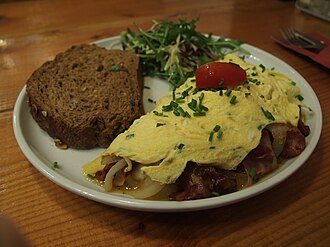
Photo: Wikipedia
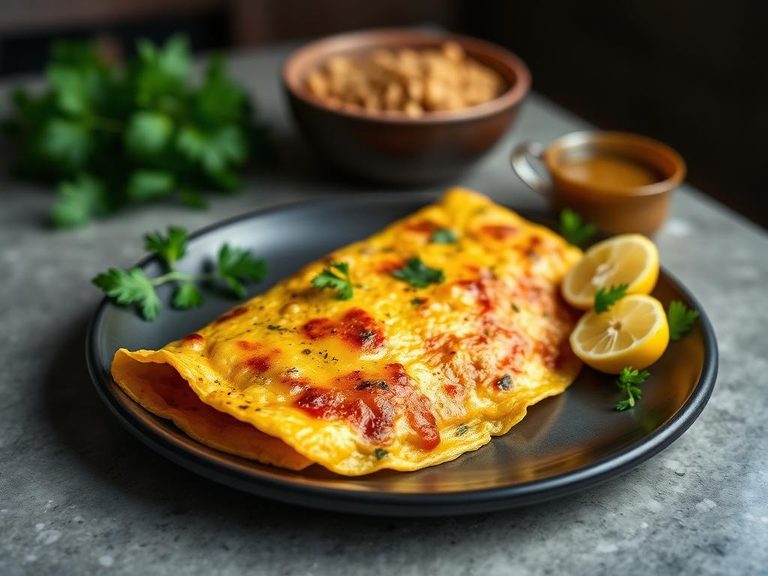
A whole egg cooked into a flat, folded patty, the omelet is a savory, tender dish with a rich, buttery mouthfeel. It is a protein powerhouse, delivering over 10 grams of high-quality protein per 100 grams, with minimal carbohydrates. Its flavor is mild and eggy, serving as a perfect canvas for countless fillings.
Calorie split: 28% protein · 2% carbs · 70% fat
↓ Full nutrition💚 Why it's loved
People love omelets for their incredible versatility and speed; they can be a simple breakfast or a loaded dinner in minutes. The ability to customize with herbs, cheese, and vegetables makes it a universally beloved comfort food across many cultures.
⚠️ Watch-outs & how to enjoy it better
As a common egg allergen, it can cause reactions in sensitive individuals. The high fat content, especially from added butter or oil, can be a concern for those monitoring saturated fat intake. To mitigate, use non-stick pans with minimal oil, and pair the omelet with fiber-rich vegetables like spinach or mushrooms to balance the meal.
Key benefits
- Excellent source of complete protein for muscle repair and satiety.
- Rich in choline, essential for brain health and liver function.
- Contains lutein and zeaxanthin, antioxidants that support eye health.
- Provides healthy fats and fat-soluble vitamins like A, D, E, and K.
- Low in carbohydrates, making it suitable for low-carb and keto diets.
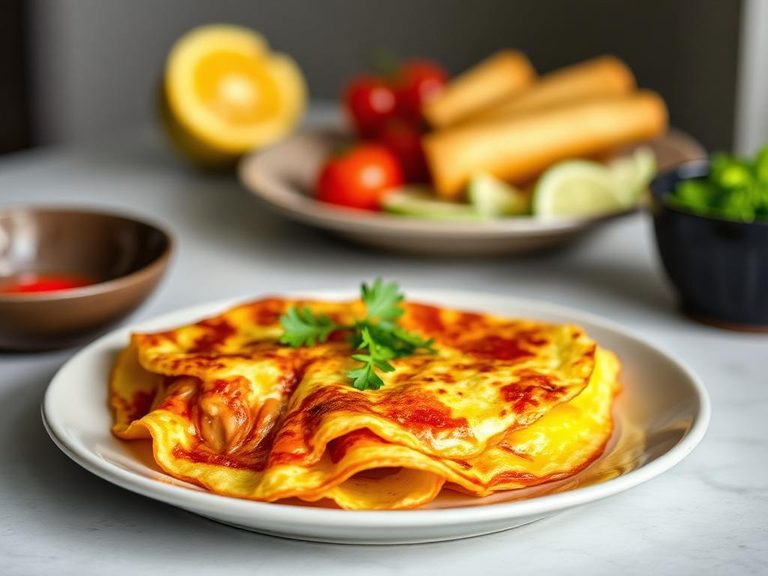
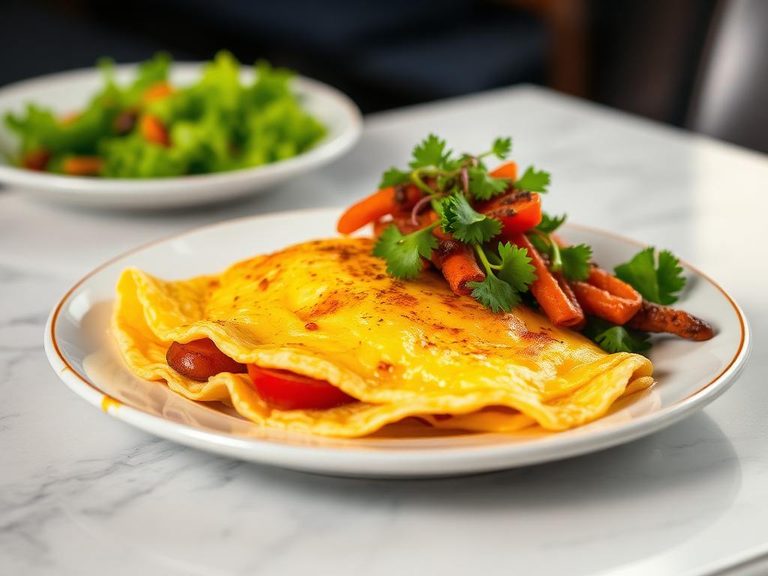
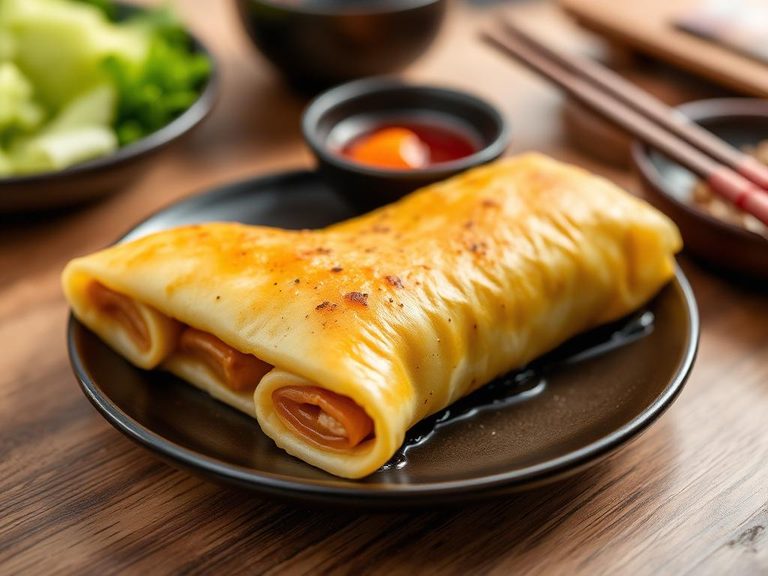
🍽️ Popular dishes

🌍 Where it's eaten
💡 Did you know?
The French omelette is considered a test of a chef's skill; a perfect one should be smooth, pale yellow with no browning, and have a creamy, custard-like interior.
Full nutrition (USDA data · scales with serving)
| Water | 76.1 g |
| Energy | 154 kcal |
| Energy | 643 kj |
| Protein | 10.6 g |
| Total lipid (fat) | 11.7 g |
| Ash | 1.0 g |
| Carbohydrate, by difference | 0.64 g |
| Fiber, total dietary | 0.00 g |
| Total Sugars | 0.31 g |
| Sucrose | 0.00 g |
| Glucose | 0.31 g |
| Fructose | 0.00 g |
| Lactose | 0.00 g |
| Maltose | 0.00 g |
| Galactose | 0.00 g |
| Calcium, Ca | 48.0 mg |
| Iron, Fe | 1.5 mg |
| Magnesium, Mg | 11.0 mg |
| Phosphorus, P | 167 mg |
| Potassium, K | 117 mg |
| Sodium, Na | 155 mg |
| Zinc, Zn | 1.1 mg |
| Copper, Cu | 0.06 mg |
| Manganese, Mn | 0.02 mg |
| Selenium, Se | 25.8 ug |
| Fluoride, F | 21.2 ug |
| Vitamin C, total ascorbic acid | 0.00 mg |
| Thiamin | 0.03 mg |
| Riboflavin | 0.39 mg |
| Niacin | 0.06 mg |
| Pantothenic acid | 1.3 mg |
| Vitamin B-6 | 0.14 mg |
| Folate, total | 39.0 ug |
| Folic acid | 0.00 ug |
| Folate, food | 39.0 ug |
| Folate, DFE | 39.0 ug |
| Choline, total | 248 mg |
| Betaine | 0.20 mg |
| Vitamin B-12 | 0.76 ug |
| Vitamin B-12, added | 0.00 ug |
| Vitamin A, RAE | 172 ug |
| Retinol | 169 ug |
| Carotene, beta | 28.0 ug |
| Carotene, alpha | 0.00 ug |
| Cryptoxanthin, beta | 8.0 ug |
| Vitamin A, IU | 617 iu |
| Lycopene | 0.00 ug |
| Lutein + zeaxanthin | 423 ug |
| Vitamin E (alpha-tocopherol) | 1.3 mg |
| Vitamin E, added | 0.00 mg |
| Tocopherol, beta | 0.03 mg |
| Tocopherol, gamma | 2.4 mg |
| Tocopherol, delta | 0.74 mg |
| Tocotrienol, alpha | 0.05 mg |
| Tocotrienol, beta | 0.00 mg |
| Tocotrienol, gamma | 0.01 mg |
| Tocotrienol, delta | 0.00 mg |
| Vitamin D (D2 + D3), International Units | 69.0 iu |
| Vitamin D (D2 + D3) | 1.7 ug |
| Vitamin D3 (cholecalciferol) | 1.7 ug |
| Vitamin K (phylloquinone) | 4.5 ug |
| Vitamin K (Dihydrophylloquinone) | 0.10 ug |
| Alcohol, ethyl | 0.00 g |
| Caffeine | 0.00 mg |
| Theobromine | 0.00 mg |
Fat & fatty acid profile (per 100g)
| Fatty acids, total saturated | 3.3 g |
| SFA 4:0 | 0.00 g |
| SFA 6:0 | 0.00 g |
| SFA 8:0 | 0.00 g |
| SFA 10:0 | 0.01 g |
| SFA 12:0 | 0.00 g |
| SFA 14:0 | 0.03 g |
| SFA 15:0 | 0.01 g |
| SFA 16:0 | 2.3 g |
| SFA 17:0 | 0.02 g |
| SFA 18:0 | 0.96 g |
| SFA 20:0 | 0.01 g |
| SFA 22:0 | 0.01 g |
| SFA 24:0 | 0.00 g |
| Fatty acids, total monounsaturated | 4.8 g |
| MUFA 14:1 | 0.01 g |
| MUFA 15:1 | 0.00 g |
| MUFA 16:1 | 0.17 g |
| MUFA 17:1 | 0.01 g |
| MUFA 18:1 | 4.6 g |
| MUFA 20:1 | 0.03 g |
| MUFA 22:1 | 0.00 g |
| MUFA 24:1 c | 0.00 g |
| Fatty acids, total polyunsaturated | 2.7 g |
| PUFA 18:2 | 2.3 g |
| PUFA 18:3 | 0.13 g |
| PUFA 18:4 | 0.00 g |
| PUFA 20:2 n-6 c,c | 0.01 g |
| PUFA 20:3 | 0.02 g |
| PUFA 20:4 | 0.16 g |
| PUFA 20:5 n-3 (EPA) | 0.00 g |
| PUFA 22:4 | 0.01 g |
| PUFA 22:5 n-3 (DPA) | 0.01 g |
| PUFA 22:6 n-3 (DHA) | 0.05 g |
| Fatty acids, total trans | 0.71 g |
| Cholesterol | 313 mg |
| Phytosterols | 10.0 mg |
Amino acid profile (per 100g)
| Tryptophan | 0.14 g |
| Threonine | 0.47 g |
| Isoleucine | 0.56 g |
| Leucine | 0.91 g |
| Lysine | 0.77 g |
| Methionine | 0.32 g |
| Cystine | 0.23 g |
| Phenylalanine | 0.57 g |
| Tyrosine | 0.42 g |
| Valine | 0.72 g |
| Arginine | 0.69 g |
| Histidine | 0.26 g |
| Alanine | 0.62 g |
| Aspartic acid | 1.1 g |
| Glutamic acid | 1.4 g |
| Glycine | 0.36 g |
| Proline | 0.43 g |
| Serine | 0.82 g |
FAQ
What is the difference between an omelet and a frittata?
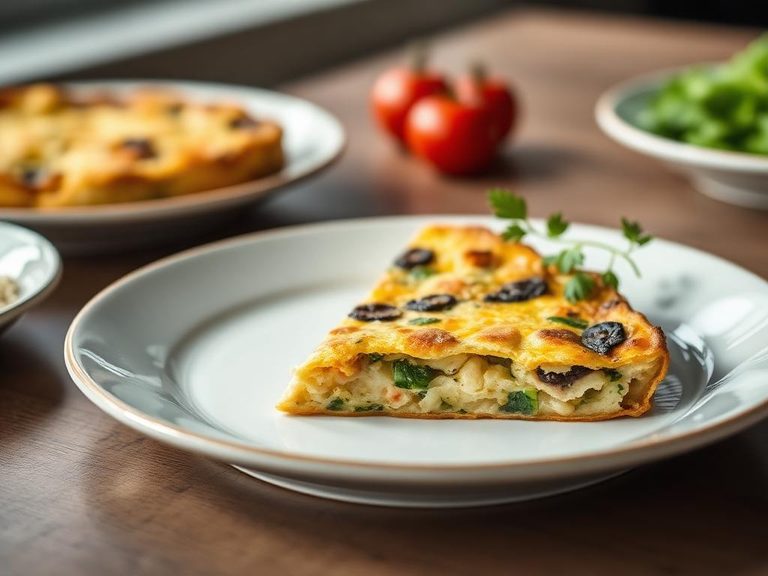
An omelet is typically folded over fillings and cooked quickly, while a frittata is an open-faced Italian egg dish that is started on the stovetop and finished in the oven, often with ingredients mixed directly into the eggs.
How many calories are in a standard 2-egg omelet?
A basic 2-egg omelet (about 100g of eggs) has roughly 150-180 calories, depending on added fat like butter or oil. Adding cheese, meat, or vegetables will increase the calorie count.
Is an omelet a good post-workout meal?
Yes, it's an excellent post-workout choice due to its high protein content, which aids muscle recovery. Pairing it with complex carbs like whole-grain toast can help replenish glycogen stores.
Nutrient density (calculated · NRF9.3)
Nutrient Rich Foods index: beneficial nutrients (protein, fiber, vitamins, minerals) minus saturated fat, added sugar & sodium, per 100 kcal.
NRF9.3 index — Fulgoni, Keast & Drewnowski, 2009. Computed from USDA nutrients.
Weight-loss friendliness (composite index)
Energy density 1.54 kcal/g · 27% calories from protein · 0.0 g fiber · 0.3 g sugar per 100 g.
Composite of energy density (Rolls et al., 1999), protein & fiber satiety, minus sugar. A calculated heuristic — ranks satiety-per-calorie, not a clinical measure.
Dietary load (calculated from USDA values)
Potential renal acid load. Positive = acid-forming, negative = alkaline-forming.
Sodium-to-potassium ratio: 1.32 (lower is better — aim for ≤ 1)
Sodium:potassium per WHO potassium guidance. Computed from USDA nutrients.