

Egg, whole, cooked, fried
Whole food · Dairy and Egg Products
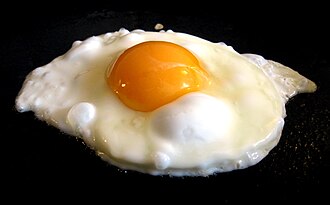
Photo: Wikipedia
A fried whole egg features a set white and a yolk that can range from runny to fully firm, offering a rich, savory flavor and a satisfying contrast of textures. It's a protein-packed staple, delivering over 13 grams of high-quality protein per 100 grams with minimal carbohydrates.
Calorie split: 28% protein · 2% carbs · 70% fat
↓ Full nutrition💚 Why it's loved
People adore the fried egg for its comforting, savory taste and the delightful textural contrast between the crispy, lacy edges and the rich, creamy yolk. Its incredible versatility makes it a perfect topping for ramen, a filling for sandwiches, or the star of a simple breakfast plate.
⚠️ Watch-outs & how to enjoy it better
The frying process adds significant fat and calories compared to other cooking methods. Those monitoring cholesterol or saturated fat intake should be mindful, and the yolk is a common allergen. To counteract, use a non-stick pan with minimal healthy oil (like avocado oil), opt for poaching or boiling, or pair with fiber-rich vegetables to balance the meal.
Key benefits
- Excellent source of complete protein for muscle maintenance
- Rich in choline, essential for brain and liver health
- Provides vitamin D, especially from pasture-raised eggs
- Contains lutein and zeaxanthin, antioxidants for eye health
- High in selenium, a key mineral for immune function
🍽️ Popular dishes

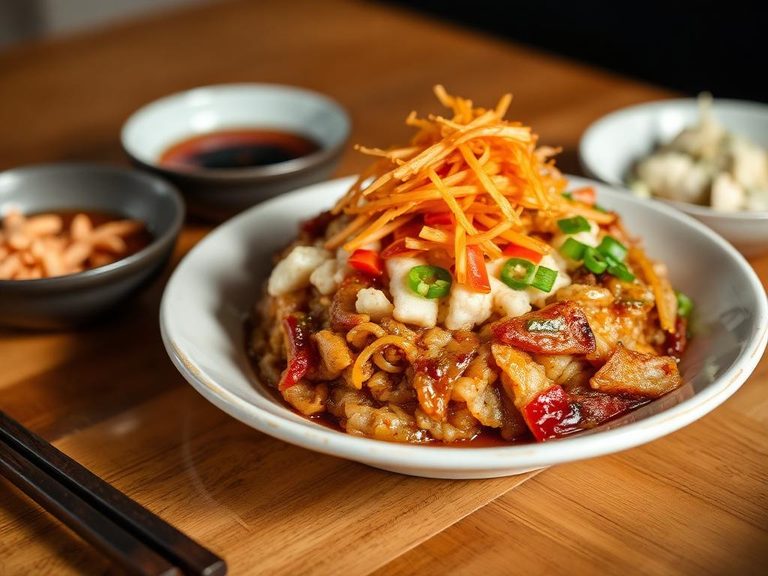

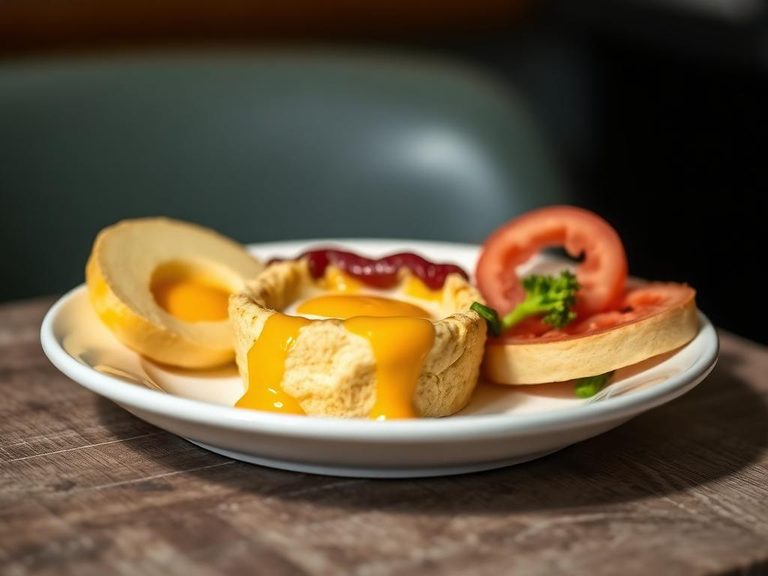
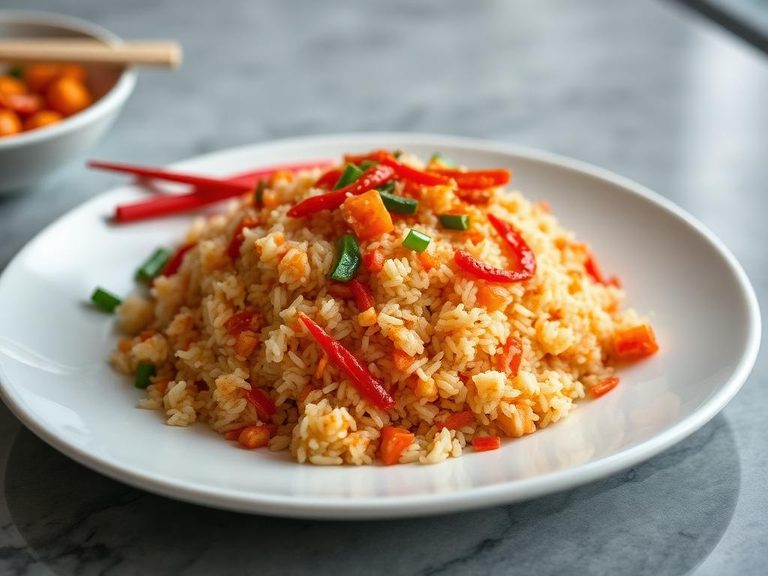
🌍 Where it's eaten
💡 Did you know?
The 'fried egg test' was once a crude method used by early pilots to check if an airplane engine was hot enough for takeoff—if they could fry an egg on the engine cowling, it was ready.
Full nutrition (USDA data · scales with serving)
| Water | 69.5 g |
| Energy | 196 kcal |
| Energy | 821 kj |
| Protein | 13.6 g |
| Total lipid (fat) | 14.8 g |
| Ash | 1.3 g |
| Carbohydrate, by difference | 0.83 g |
| Fiber, total dietary | 0.00 g |
| Total Sugars | 0.40 g |
| Sucrose | 0.00 g |
| Glucose | 0.40 g |
| Fructose | 0.00 g |
| Lactose | 0.00 g |
| Maltose | 0.00 g |
| Galactose | 0.00 g |
| Calcium, Ca | 62.0 mg |
| Iron, Fe | 1.9 mg |
| Magnesium, Mg | 13.0 mg |
| Phosphorus, P | 215 mg |
| Potassium, K | 152 mg |
| Sodium, Na | 207 mg |
| Zinc, Zn | 1.4 mg |
| Copper, Cu | 0.08 mg |
| Manganese, Mn | 0.03 mg |
| Selenium, Se | 33.1 ug |
| Fluoride, F | 1.2 ug |
| Vitamin C, total ascorbic acid | 0.00 mg |
| Thiamin | 0.04 mg |
| Riboflavin | 0.49 mg |
| Niacin | 0.08 mg |
| Pantothenic acid | 1.7 mg |
| Vitamin B-6 | 0.18 mg |
| Folate, total | 51.0 ug |
| Folic acid | 0.00 ug |
| Folate, food | 51.0 ug |
| Folate, DFE | 51.0 ug |
| Choline, total | 317 mg |
| Betaine | 0.30 mg |
| Vitamin B-12 | 0.97 ug |
| Vitamin B-12, added | 0.00 ug |
| Vitamin A, RAE | 219 ug |
| Retinol | 216 ug |
| Carotene, beta | 35.0 ug |
| Carotene, alpha | 0.00 ug |
| Cryptoxanthin, beta | 10.0 ug |
| Vitamin A, IU | 787 iu |
| Lycopene | 0.00 ug |
| Lutein + zeaxanthin | 543 ug |
| Vitamin E (alpha-tocopherol) | 1.3 mg |
| Vitamin E, added | 0.00 mg |
| Tocopherol, beta | 0.02 mg |
| Tocopherol, gamma | 0.54 mg |
| Tocopherol, delta | 0.06 mg |
| Tocotrienol, alpha | 0.06 mg |
| Tocotrienol, beta | 0.00 mg |
| Tocotrienol, gamma | 0.01 mg |
| Tocotrienol, delta | 0.00 mg |
| Vitamin D (D2 + D3), International Units | 88.0 iu |
| Vitamin D (D2 + D3) | 2.2 ug |
| Vitamin D3 (cholecalciferol) | 2.2 ug |
| Vitamin K (phylloquinone) | 5.6 ug |
| Vitamin K (Dihydrophylloquinone) | 0.10 ug |
| Alcohol, ethyl | 0.00 g |
| Caffeine | 0.00 mg |
| Theobromine | 0.00 mg |
Fat & fatty acid profile (per 100g)
| Fatty acids, total saturated | 4.3 g |
| SFA 4:0 | 0.00 g |
| SFA 6:0 | 0.00 g |
| SFA 8:0 | 0.00 g |
| SFA 10:0 | 0.01 g |
| SFA 12:0 | 0.00 g |
| SFA 14:0 | 0.05 g |
| SFA 15:0 | 0.01 g |
| SFA 16:0 | 3.0 g |
| SFA 17:0 | 0.02 g |
| SFA 18:0 | 1.3 g |
| SFA 20:0 | 0.00 g |
| SFA 22:0 | 0.01 g |
| SFA 24:0 | 0.00 g |
| Fatty acids, total monounsaturated | 6.2 g |
| MUFA 14:1 | 0.01 g |
| MUFA 15:1 | 0.00 g |
| MUFA 16:1 | 0.23 g |
| MUFA 17:1 | 0.01 g |
| MUFA 18:1 | 5.9 g |
| MUFA 20:1 | 0.03 g |
| MUFA 22:1 | 0.00 g |
| MUFA 24:1 c | 0.00 g |
| Fatty acids, total polyunsaturated | 3.3 g |
| PUFA 18:2 | 2.8 g |
| PUFA 18:3 | 0.14 g |
| PUFA 18:4 | 0.00 g |
| PUFA 20:2 n-6 c,c | 0.02 g |
| PUFA 20:3 | 0.03 g |
| PUFA 20:4 | 0.20 g |
| PUFA 20:5 n-3 (EPA) | 0.00 g |
| PUFA 22:4 | 0.01 g |
| PUFA 22:5 n-3 (DPA) | 0.01 g |
| PUFA 22:6 n-3 (DHA) | 0.06 g |
| Fatty acids, total trans | 0.04 g |
| Cholesterol | 401 mg |
| Phytosterols | 8.0 mg |
Amino acid profile (per 100g)
| Tryptophan | 0.18 g |
| Threonine | 0.60 g |
| Isoleucine | 0.73 g |
| Leucine | 1.2 g |
| Lysine | 0.99 g |
| Methionine | 0.41 g |
| Cystine | 0.29 g |
| Phenylalanine | 0.74 g |
| Tyrosine | 0.54 g |
| Valine | 0.93 g |
| Arginine | 0.89 g |
| Histidine | 0.34 g |
| Alanine | 0.80 g |
| Aspartic acid | 1.4 g |
| Glutamic acid | 1.8 g |
| Glycine | 0.47 g |
| Proline | 0.56 g |
| Serine | 1.1 g |
FAQ
How do I get a perfectly runny yolk with fully set whites?
Use medium-low heat and cover the pan for the last 30-60 seconds. This steams the top of the egg, setting the whites without overcooking the yolk.
Is the white stuff that forms when frying an egg safe to eat?
Yes, that's albumin, a harmless protein. To minimize it, use very fresh eggs and fry in a non-stick pan with a bit of oil or butter.
How does frying affect the nutritional profile compared to boiling?
Frying adds fat and calories from the cooking oil. A large fried egg can have about 25-30 more calories and 3-4 grams more fat than a large boiled egg.
Nutrient density (calculated · NRF9.3)
Nutrient Rich Foods index: beneficial nutrients (protein, fiber, vitamins, minerals) minus saturated fat, added sugar & sodium, per 100 kcal.
NRF9.3 index — Fulgoni, Keast & Drewnowski, 2009. Computed from USDA nutrients.
Weight-loss friendliness (composite index)
Energy density 1.96 kcal/g · 28% calories from protein · 0.0 g fiber · 0.4 g sugar per 100 g.
Composite of energy density (Rolls et al., 1999), protein & fiber satiety, minus sugar. A calculated heuristic — ranks satiety-per-calorie, not a clinical measure.
Dietary load (calculated from USDA values)
Potential renal acid load. Positive = acid-forming, negative = alkaline-forming.
Sodium-to-potassium ratio: 1.36 (lower is better — aim for ≤ 1)
Sodium:potassium per WHO potassium guidance. Computed from USDA nutrients.