

Doughnuts, yeast-leavened, glazed, enriched (includes honey buns)
Whole food · Baked Products
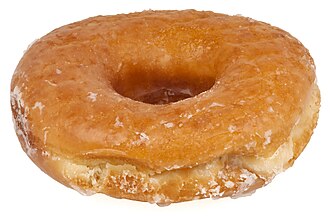
Photo: Wikipedia
A pillowy, yeast-risen doughnut with a soft, airy crumb, coated in a sweet, crackly sugar glaze. It's a classic indulgence, offering a rich, buttery flavor with a satisfyingly sweet finish. Nutritionally, it's a dense source of energy, primarily from refined carbohydrates and fats.
Calorie split: 6% protein · 46% carbs · 49% fat
↓ Full nutrition💚 Why it's loved
People adore the perfect contrast between the soft, fluffy interior and the sweet, sticky glaze that melts in the mouth. It's a versatile comfort food, enjoyed for breakfast, as a snack, or a dessert, and is deeply embedded in many cultures as a symbol of joy and indulgence.
⚠️ Watch-outs & how to enjoy it better
Its high sugar and refined carbohydrate content can lead to rapid blood-sugar spikes and subsequent crashes. Those monitoring calorie, fat, or sugar intake should be cautious. To enjoy mindfully, pair it with a source of protein (like Greek yogurt) or healthy fat (like nuts) to slow sugar absorption, and practice strict portion control by sharing or choosing a mini version.
Key benefits
- Quick source of energy from carbohydrates
- Contains small amounts of protein and iron
- Provides a morale-boosting treat or reward
- Cultural staple for celebrations and comfort food
🍽️ Popular dishes





🌍 Where it's eaten
💡 Did you know?
The 'hole' in a doughnut is popularly credited to a 19th-century sailor named Hanson Gregory, who claimed to have punched out the center to solve the problem of undercooked, doughy middles in fried cakes.
Full nutrition (USDA data · scales with serving)
| Water | 22.0 g |
| Energy | 421 kcal |
| Energy | 1760 kj |
| Protein | 6.1 g |
| Total lipid (fat) | 22.7 g |
| Ash | 1.2 g |
| Carbohydrate, by difference | 47.9 g |
| Fiber, total dietary | 2.1 g |
| Total Sugars | 22.8 g |
| Sucrose | 18.4 g |
| Glucose | 2.2 g |
| Fructose | 0.64 g |
| Lactose | 0.00 g |
| Maltose | 1.5 g |
| Galactose | 0.00 g |
| Starch | 26.4 g |
| Calcium, Ca | 101 mg |
| Iron, Fe | 2.4 mg |
| Magnesium, Mg | 17.0 mg |
| Phosphorus, P | 117 mg |
| Potassium, K | 102 mg |
| Sodium, Na | 316 mg |
| Zinc, Zn | 0.61 mg |
| Copper, Cu | 0.09 mg |
| Manganese, Mn | 0.31 mg |
| Selenium, Se | 15.7 ug |
| Vitamin C, total ascorbic acid | 1.2 mg |
| Thiamin | 0.31 mg |
| Riboflavin | 0.18 mg |
| Niacin | 2.6 mg |
| Pantothenic acid | 0.21 mg |
| Vitamin B-6 | 0.04 mg |
| Folate, total | 108 ug |
| Folic acid | 68.0 ug |
| Folate, food | 40.0 ug |
| Folate, DFE | 155 ug |
| Choline, total | 29.1 mg |
| Vitamin B-12 | 0.11 ug |
| Vitamin B-12, added | 0.00 ug |
| Vitamin A, RAE | 5.0 ug |
| Retinol | 5.0 ug |
| Carotene, beta | 3.0 ug |
| Carotene, alpha | 1.0 ug |
| Cryptoxanthin, beta | 1.0 ug |
| Vitamin A, IU | 23.0 iu |
| Lycopene | 0.00 ug |
| Lutein + zeaxanthin | 36.0 ug |
| Vitamin E (alpha-tocopherol) | 1.4 mg |
| Vitamin E, added | 0.00 mg |
| Vitamin D (D2 + D3), International Units | 3.0 iu |
| Vitamin D (D2 + D3) | 0.10 ug |
| Vitamin K (phylloquinone) | 11.5 ug |
| Vitamin K (Dihydrophylloquinone) | 34.4 ug |
| Alcohol, ethyl | 0.00 g |
| Caffeine | 0.00 mg |
| Theobromine | 0.00 mg |
Fat & fatty acid profile (per 100g)
| Fatty acids, total saturated | 9.5 g |
| SFA 4:0 | 0.00 g |
| SFA 6:0 | 0.00 g |
| SFA 8:0 | 0.01 g |
| SFA 10:0 | 0.01 g |
| SFA 12:0 | 0.12 g |
| SFA 13:0 | 0.00 g |
| SFA 14:0 | 0.20 g |
| SFA 15:0 | 0.01 g |
| SFA 16:0 | 7.3 g |
| SFA 17:0 | 0.02 g |
| SFA 18:0 | 1.6 g |
| SFA 20:0 | 0.07 g |
| SFA 22:0 | 0.03 g |
| SFA 24:0 | 0.02 g |
| Fatty acids, total monounsaturated | 7.2 g |
| MUFA 14:1 | 0.00 g |
| MUFA 15:1 | 0.00 g |
| MUFA 16:1 | 0.05 g |
| MUFA 16:1 c | 0.05 g |
| MUFA 17:1 | 0.01 g |
| MUFA 18:1 | 7.1 g |
| MUFA 18:1 c | 6.8 g |
| MUFA 20:1 | 0.05 g |
| MUFA 22:1 | 0.00 g |
| MUFA 22:1 c | 0.00 g |
| MUFA 24:1 c | 0.00 g |
| Fatty acids, total polyunsaturated | 3.6 g |
| PUFA 18:2 | 3.4 g |
| PUFA 18:2 n-6 c,c | 3.2 g |
| PUFA 18:2 CLAs | 0.01 g |
| PUFA 18:3 | 0.21 g |
| PUFA 18:3 n-3 c,c,c (ALA) | 0.20 g |
| PUFA 18:3 n-6 c,c,c | 0.01 g |
| PUFA 18:4 | 0.00 g |
| PUFA 20:2 n-6 c,c | 0.00 g |
| PUFA 20:3 | 0.00 g |
| PUFA 20:3 n-3 | 0.00 g |
| PUFA 20:3 n-6 | 0.00 g |
| PUFA 20:4 | 0.00 g |
| PUFA 20:5 n-3 (EPA) | 0.00 g |
| PUFA 22:4 | 0.00 g |
| PUFA 22:5 n-3 (DPA) | 0.00 g |
| PUFA 22:6 n-3 (DHA) | 0.01 g |
| Fatty acids, total trans | 0.46 g |
| Fatty acids, total trans-monoenoic | 0.34 g |
| TFA 16:1 t | 0.00 g |
| TFA 18:1 t | 0.34 g |
| TFA 22:1 t | 0.00 g |
| TFA 18:2 t not further defined | 0.12 g |
| Fatty acids, total trans-polyenoic | 0.12 g |
| Cholesterol | 30.0 mg |
Amino acid profile (per 100g)
| Tryptophan | 0.04 g |
| Threonine | 0.17 g |
| Isoleucine | 0.24 g |
| Leucine | 0.44 g |
| Lysine | 0.19 g |
| Methionine | 0.09 g |
| Cystine | 0.11 g |
| Phenylalanine | 0.28 g |
| Tyrosine | 0.19 g |
| Valine | 0.29 g |
| Arginine | 0.25 g |
| Histidine | 0.12 g |
| Alanine | 0.21 g |
| Aspartic acid | 0.47 g |
| Glutamic acid | 2.1 g |
| Glycine | 0.24 g |
| Proline | 0.70 g |
| Serine | 0.34 g |
| Hydroxyproline | 0.00 g |
FAQ
What makes a yeast-leavened doughnut different from a cake doughnut?
A yeast-leavened doughnut uses yeast as a leavening agent, resulting in a light, airy, and chewy texture similar to bread. A cake doughnut uses chemical leaveners like baking powder, giving it a denser, more crumbly, cake-like texture.
Is the glaze the main source of sugar in a glazed doughnut?
Yes, the sugar glaze is the primary source of added sugar. However, the dough itself often contains sugar as well, contributing to the total carbohydrate and sugar content.
How does the nutritional profile change if it's a honey bun?
A honey bun is essentially a rolled, yeast-leavened doughnut pastry. Its nutritional profile is very similar, though it may have slightly more sugar and calories due to the honey-sugar filling and glaze, and a denser texture from being rolled.
Nutrient density (calculated · NRF9.3)
Nutrient Rich Foods index: beneficial nutrients (protein, fiber, vitamins, minerals) minus saturated fat, added sugar & sodium, per 100 kcal.
NRF9.3 index — Fulgoni, Keast & Drewnowski, 2009. Computed from USDA nutrients.
Weight-loss friendliness (composite index)
Energy density 4.21 kcal/g · 6% calories from protein · 2.1 g fiber · 22.8 g sugar per 100 g.
Composite of energy density (Rolls et al., 1999), protein & fiber satiety, minus sugar. A calculated heuristic — ranks satiety-per-calorie, not a clinical measure.
Dietary load (calculated from USDA values)
Potential renal acid load. Positive = acid-forming, negative = alkaline-forming.
Sodium-to-potassium ratio: 3.10 (lower is better — aim for ≤ 1)
Sodium:potassium per WHO potassium guidance. Computed from USDA nutrients.