

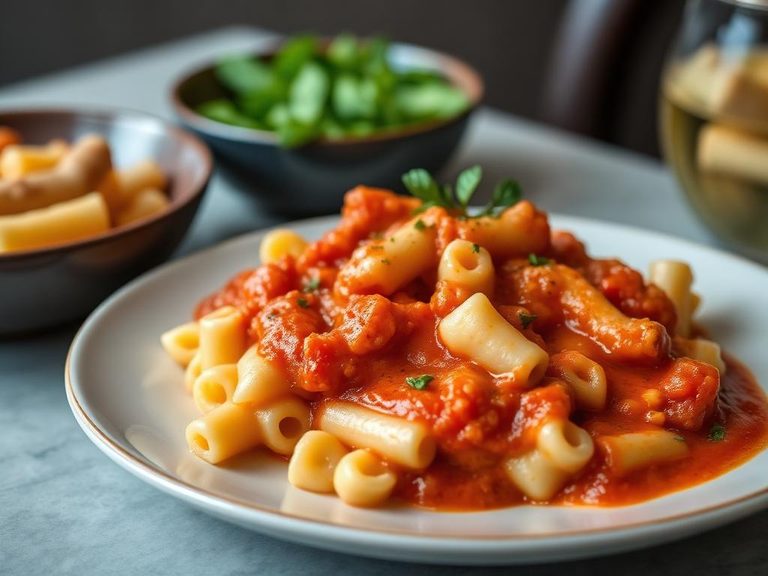
DENNY'S, macaroni & cheese, from kid's menu
Whole food · Restaurant Foods

Photo: Wikipedia
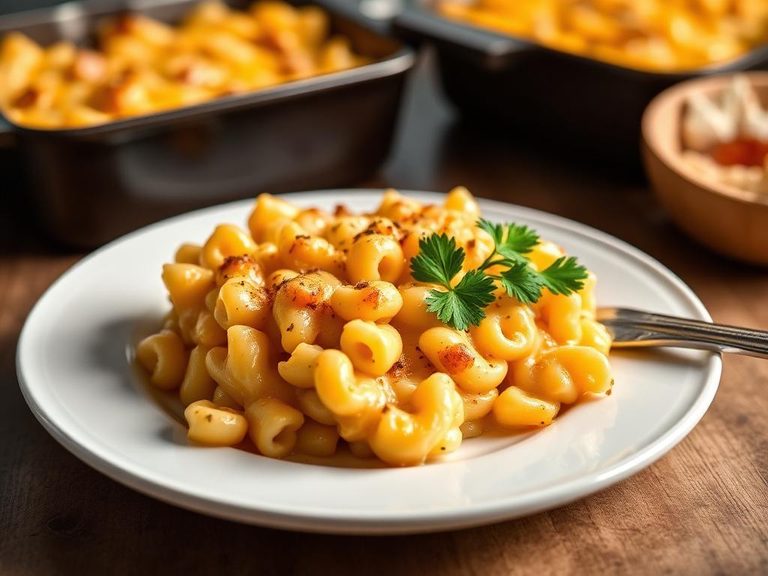
Denny's Kid's Macaroni & Cheese is a classic, creamy comfort dish featuring tender elbow pasta coated in a smooth, mild cheese sauce. It offers a rich, savory flavor with a soft, yielding texture that appeals to both children and nostalgic adults. Nutritionally, it provides a moderate calorie count (150 kcal per 100g) with a balance of carbohydrates and protein, though it is relatively low in fiber.
Calorie split: 14% protein · 57% carbs · 30% fat
↓ Full nutrition💚 Why it's loved
People love this dish for its nostalgic, comforting appeal and the creamy, cheesy flavor that feels like a warm hug. It's a versatile side that pairs well with many main courses and is often a go-to for picky eaters due to its mild taste and familiar texture.
⚠️ Watch-outs & how to enjoy it better
The dish can be high in sodium and saturated fat, which may concern those watching their blood pressure or cholesterol. To counteract this, pair it with a fiber-rich vegetable like steamed broccoli and limit portion sizes to avoid blood-sugar spikes from the refined carbs.
Key benefits
- Provides a quick source of energy from carbohydrates
- Contains a moderate amount of protein for muscle maintenance
- Low in fiber, making it easy to digest for sensitive stomachs
- Offers calcium and phosphorus from cheese for bone health
- Convenient and kid-friendly meal option
🍽️ Popular dishes

🌍 Where it's eaten
💡 Did you know?
Macaroni and cheese was first recorded in a recipe book in 1769, but it became a staple in American cuisine after Thomas Jefferson served it at a state dinner in 1802.
Full nutrition (USDA data · scales with serving)
| Water | 67.4 g |
| Energy | 150 kcal |
| Energy | 626 kj |
| Protein | 5.2 g |
| Total lipid (fat) | 4.9 g |
| Ash | 1.4 g |
| Carbohydrate, by difference | 21.2 g |
| Fiber, total dietary | 1.2 g |
| Total Sugars | 4.2 g |
| Sucrose | 0.00 g |
| Glucose | 0.00 g |
| Fructose | 0.00 g |
| Lactose | 4.1 g |
| Maltose | 0.13 g |
| Galactose | 0.00 g |
| Starch | 14.9 g |
| Calcium, Ca | 83.0 mg |
| Iron, Fe | 0.79 mg |
| Magnesium, Mg | 23.0 mg |
| Phosphorus, P | 113 mg |
| Potassium, K | 165 mg |
| Sodium, Na | 300 mg |
| Zinc, Zn | 0.58 mg |
| Copper, Cu | 0.07 mg |
| Manganese, Mn | 0.26 mg |
| Selenium, Se | 20.8 ug |
| Thiamin | 0.10 mg |
| Riboflavin | 0.28 mg |
| Niacin | 0.87 mg |
| Pantothenic acid | 0.49 mg |
| Vitamin B-6 | 0.08 mg |
| Folate, total | 36.0 ug |
| Vitamin B-12 | 0.19 ug |
| Vitamin A, RAE | 15.0 ug |
| Retinol | 15.0 ug |
| Carotene, beta | 5.0 ug |
| Carotene, alpha | 1.0 ug |
| Cryptoxanthin, beta | 0.00 ug |
| Vitamin A, IU | 58.0 iu |
| Lycopene | 0.00 ug |
| Lutein + zeaxanthin | 110 ug |
| Vitamin E (alpha-tocopherol) | 0.53 mg |
| Tocopherol, beta | 0.01 mg |
| Tocopherol, gamma | 0.99 mg |
| Tocopherol, delta | 0.03 mg |
| Tocotrienol, alpha | 0.05 mg |
| Tocotrienol, beta | 0.29 mg |
| Tocotrienol, gamma | 0.00 mg |
| Tocotrienol, delta | 0.00 mg |
| Vitamin K (phylloquinone) | 3.0 ug |
| Vitamin K (Dihydrophylloquinone) | 0.00 ug |
| Vitamin K (Menaquinone-4) | 0.00 ug |
Fat & fatty acid profile (per 100g)
| Fatty acids, total saturated | 1.4 g |
| SFA 4:0 | 0.03 g |
| SFA 6:0 | 0.03 g |
| SFA 8:0 | 0.02 g |
| SFA 10:0 | 0.04 g |
| SFA 12:0 | 0.05 g |
| SFA 14:0 | 0.16 g |
| SFA 15:0 | 0.02 g |
| SFA 16:0 | 0.68 g |
| SFA 17:0 | 0.01 g |
| SFA 18:0 | 0.30 g |
| SFA 20:0 | 0.02 g |
| SFA 22:0 | 0.01 g |
| SFA 24:0 | 0.01 g |
| Fatty acids, total monounsaturated | 2.0 g |
| MUFA 14:1 | 0.02 g |
| MUFA 15:1 | 0.00 g |
| MUFA 16:1 | 0.03 g |
| MUFA 16:1 c | 0.03 g |
| MUFA 17:1 | 0.01 g |
| MUFA 18:1 | 1.9 g |
| MUFA 18:1 c | 1.9 g |
| MUFA 20:1 | 0.04 g |
| MUFA 22:1 | 0.00 g |
| MUFA 22:1 c | 0.00 g |
| MUFA 24:1 c | 0.00 g |
| Fatty acids, total polyunsaturated | 1.0 g |
| PUFA 18:2 | 0.76 g |
| PUFA 18:2 n-6 c,c | 0.73 g |
| PUFA 18:2 CLAs | 0.01 g |
| PUFA 18:3 | 0.24 g |
| PUFA 18:3 n-3 c,c,c (ALA) | 0.23 g |
| PUFA 18:3 n-6 c,c,c | 0.01 g |
| PUFA 18:3i | 0.00 g |
| PUFA 18:4 | 0.00 g |
| PUFA 20:2 n-6 c,c | 0.00 g |
| PUFA 20:3 | 0.00 g |
| PUFA 20:3 n-3 | 0.00 g |
| PUFA 20:3 n-6 | 0.00 g |
| PUFA 20:4 | 0.01 g |
| PUFA 20:5 n-3 (EPA) | 0.00 g |
| PUFA 22:4 | 0.00 g |
| PUFA 22:5 n-3 (DPA) | 0.00 g |
| PUFA 22:6 n-3 (DHA) | 0.00 g |
| Fatty acids, total trans | 0.07 g |
| Fatty acids, total trans-monoenoic | 0.05 g |
| TFA 16:1 t | 0.01 g |
| TFA 18:1 t | 0.04 g |
| TFA 22:1 t | 0.00 g |
| TFA 18:2 t not further defined | 0.02 g |
| Fatty acids, total trans-polyenoic | 0.02 g |
| Cholesterol | 7.0 mg |
Amino acid profile (per 100g)
| Tryptophan | 0.07 g |
| Threonine | 0.12 g |
| Isoleucine | 0.26 g |
| Leucine | 0.52 g |
| Lysine | 0.37 g |
| Methionine | 0.12 g |
| Cystine | 0.10 g |
| Phenylalanine | 0.29 g |
| Tyrosine | 0.17 g |
| Valine | 0.29 g |
| Arginine | 0.25 g |
| Histidine | 0.17 g |
| Alanine | 0.18 g |
| Aspartic acid | 0.28 g |
| Glutamic acid | 1.6 g |
| Glycine | 0.18 g |
| Proline | 0.75 g |
| Serine | 0.27 g |
| Hydroxyproline | 0.00 g |
FAQ
Is Denny's macaroni and cheese suitable for vegetarians?
Yes, it is generally vegetarian, as it contains no meat products, but always check for any hidden animal-derived ingredients like certain cheeses.
How does the nutritional profile compare to homemade mac and cheese?
Denny's version is typically lower in calories and fat than many homemade recipes, which often use more butter and cheese, but it may have higher sodium content.
Can I make a healthier version at home?
Yes, you can use whole-grain pasta, low-fat cheese, and add vegetables like spinach or carrots to boost fiber and nutrients while reducing calories.
Nutrient density (calculated · NRF9.3)
Nutrient Rich Foods index: beneficial nutrients (protein, fiber, vitamins, minerals) minus saturated fat, added sugar & sodium, per 100 kcal.
NRF9.3 index — Fulgoni, Keast & Drewnowski, 2009. Computed from USDA nutrients.
Weight-loss friendliness (composite index)
Energy density 1.50 kcal/g · 14% calories from protein · 1.2 g fiber · 4.2 g sugar per 100 g.
Composite of energy density (Rolls et al., 1999), protein & fiber satiety, minus sugar. A calculated heuristic — ranks satiety-per-calorie, not a clinical measure.
Dietary load (calculated from USDA values)
Potential renal acid load. Positive = acid-forming, negative = alkaline-forming.
Sodium-to-potassium ratio: 1.82 (lower is better — aim for ≤ 1)
Sodium:potassium per WHO potassium guidance. Computed from USDA nutrients.