

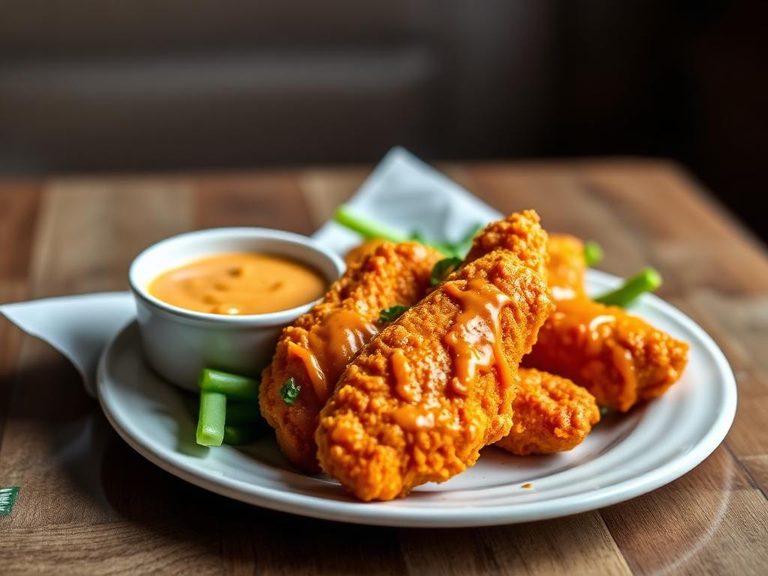
CRACKER BARREL, chicken tenderloin platter, fried
Whole food · Restaurant Foods

Photo: Wikipedia
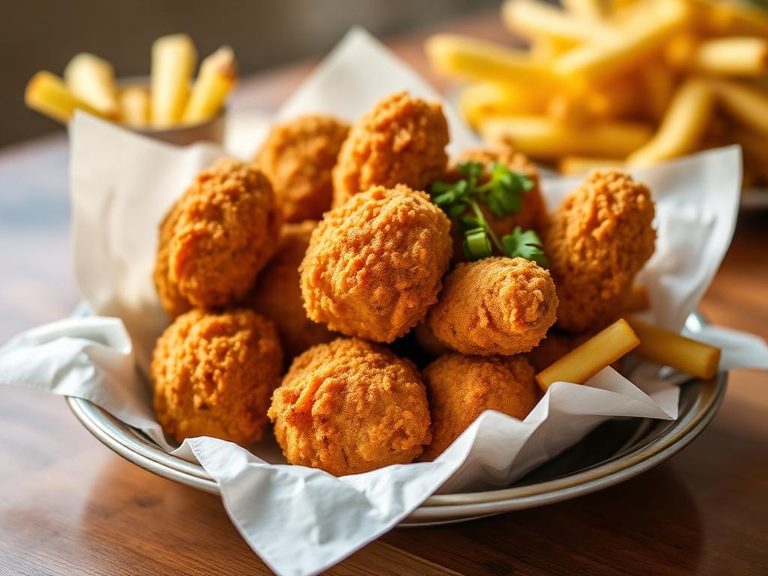
This is a classic American comfort food dish featuring tender chicken breast pieces, breaded and deep-fried to a golden, crispy exterior while remaining juicy inside. The nutrition profile is notably high in protein for its calorie count, making it a substantial, satisfying meal centerpiece. It's a staple of casual dining, offering a hearty, savory flavor with a satisfying crunch.
Calorie split: 25% protein · 28% carbs · 48% fat
↓ Full nutrition💚 Why it's loved
People love the irresistible contrast between the crunchy, seasoned coating and the tender, juicy chicken inside. It's a versatile crowd-pleaser, often served with a variety of dipping sauces and classic sides, embodying a sense of nostalgic, casual American dining.
⚠️ Watch-outs & how to enjoy it better
The frying process significantly increases the calorie and fat content, particularly saturated fat, and the dish is often high in sodium from the seasoning and breading. To counteract this, pair it with a large portion of non-starchy vegetables (like steamed broccoli or a side salad) to add fiber and nutrients, and choose a dipping sauce like mustard or hot sauce over creamy, high-calorie options.
Key benefits
- High-quality complete protein source
- Provides essential B vitamins like niacin
- Quick and convenient meal option
- Satiating due to protein and fat content
- Comfort food with cultural familiarity
🍽️ Popular dishes
🌍 Where it's eaten
💡 Did you know?
Chicken tenders, also known as chicken strips or fingers, are not actually a cut of the bird but are the pectoralis minor muscle—a small strip of meat located underneath the breast.
Full nutrition (USDA data · scales with serving)
| Water | 43.1 g |
| Energy | 293 kcal |
| Energy | 1225 kj |
| Protein | 18.1 g |
| Total lipid (fat) | 15.5 g |
| Ash | 3.1 g |
| Carbohydrate, by difference | 20.3 g |
| Fiber, total dietary | 0.70 g |
| Total Sugars | 0.09 g |
| Sucrose | 0.09 g |
| Glucose | 0.00 g |
| Fructose | 0.00 g |
| Lactose | 0.00 g |
| Maltose | 0.00 g |
| Galactose | 0.00 g |
| Starch | 19.6 g |
| Calcium, Ca | 12.0 mg |
| Iron, Fe | 0.59 mg |
| Magnesium, Mg | 28.0 mg |
| Phosphorus, P | 268 mg |
| Potassium, K | 319 mg |
| Sodium, Na | 874 mg |
| Zinc, Zn | 0.66 mg |
| Copper, Cu | 0.07 mg |
| Manganese, Mn | 0.26 mg |
| Selenium, Se | 16.3 ug |
| Thiamin | 0.10 mg |
| Riboflavin | 0.13 mg |
| Niacin | 6.7 mg |
| Pantothenic acid | 1.4 mg |
| Vitamin B-6 | 0.49 mg |
| Folate, total | 7.0 ug |
| Folate, food | 7.0 ug |
| Vitamin B-12 | 0.11 ug |
| Vitamin A, RAE | 2.0 ug |
| Retinol | 2.0 ug |
| Carotene, beta | 3.0 ug |
| Carotene, alpha | 0.00 ug |
| Cryptoxanthin, beta | 1.0 ug |
| Vitamin A, IU | 11.0 iu |
| Lycopene | 0.00 ug |
| Lutein + zeaxanthin | 49.0 ug |
| Vitamin E (alpha-tocopherol) | 1.2 mg |
| Tocopherol, beta | 0.15 mg |
| Tocopherol, gamma | 7.0 mg |
| Tocopherol, delta | 2.5 mg |
| Tocotrienol, alpha | 0.00 mg |
| Tocotrienol, beta | 0.09 mg |
| Tocotrienol, gamma | 0.06 mg |
| Tocotrienol, delta | 0.00 mg |
Fat & fatty acid profile (per 100g)
| Fatty acids, total saturated | 2.8 g |
| SFA 4:0 | 0.00 g |
| SFA 6:0 | 0.00 g |
| SFA 8:0 | 0.01 g |
| SFA 10:0 | 0.01 g |
| SFA 12:0 | 0.00 g |
| SFA 14:0 | 0.02 g |
| SFA 15:0 | 0.00 g |
| SFA 16:0 | 1.7 g |
| SFA 17:0 | 0.01 g |
| SFA 18:0 | 0.92 g |
| SFA 20:0 | 0.05 g |
| SFA 22:0 | 0.05 g |
| SFA 24:0 | 0.02 g |
| Fatty acids, total monounsaturated | 3.3 g |
| MUFA 14:1 | 0.00 g |
| MUFA 15:1 | 0.00 g |
| MUFA 16:1 | 0.04 g |
| MUFA 16:1 c | 0.04 g |
| MUFA 17:1 | 0.01 g |
| MUFA 18:1 | 3.2 g |
| MUFA 18:1 c | 3.2 g |
| MUFA 20:1 | 0.05 g |
| MUFA 22:1 | 0.00 g |
| MUFA 22:1 c | 0.00 g |
| MUFA 24:1 c | 0.00 g |
| Fatty acids, total polyunsaturated | 7.9 g |
| PUFA 18:2 | 6.9 g |
| PUFA 18:2 n-6 c,c | 6.8 g |
| PUFA 18:2 CLAs | 0.02 g |
| PUFA 18:3 | 0.89 g |
| PUFA 18:3 n-3 c,c,c (ALA) | 0.83 g |
| PUFA 18:3 n-6 c,c,c | 0.07 g |
| PUFA 18:3i | 0.00 g |
| PUFA 18:4 | 0.00 g |
| PUFA 20:2 n-6 c,c | 0.01 g |
| PUFA 20:3 | 0.01 g |
| PUFA 20:3 n-3 | 0.00 g |
| PUFA 20:3 n-6 | 0.01 g |
| PUFA 20:4 | 0.03 g |
| PUFA 20:5 n-3 (EPA) | 0.00 g |
| PUFA 22:4 | 0.01 g |
| PUFA 22:5 n-3 (DPA) | 0.00 g |
| PUFA 22:6 n-3 (DHA) | 0.00 g |
| Fatty acids, total trans | 0.12 g |
| Fatty acids, total trans-monoenoic | 0.03 g |
| TFA 16:1 t | 0.00 g |
| TFA 18:1 t | 0.03 g |
| TFA 22:1 t | 0.00 g |
| TFA 18:2 t not further defined | 0.09 g |
| Fatty acids, total trans-polyenoic | 0.09 g |
| Cholesterol | 40.0 mg |
Amino acid profile (per 100g)
| Tryptophan | 0.19 g |
| Threonine | 0.60 g |
| Isoleucine | 0.77 g |
| Leucine | 1.4 g |
| Lysine | 2.3 g |
| Methionine | 0.48 g |
| Cystine | 0.27 g |
| Phenylalanine | 0.69 g |
| Tyrosine | 0.50 g |
| Valine | 0.83 g |
| Arginine | 1.2 g |
| Histidine | 0.69 g |
| Alanine | 0.89 g |
| Aspartic acid | 1.3 g |
| Glutamic acid | 3.0 g |
| Glycine | 0.80 g |
| Proline | 1.1 g |
| Serine | 0.69 g |
| Hydroxyproline | 0.00 g |
FAQ
What part of the chicken is used for tenders?
Chicken tenders are the pectoralis minor muscle, a small strip of meat attached to the underside of the chicken breast. It's a naturally tender cut.
Is fried chicken tenderloin a good source of protein?
Yes, it is. At 18.06g of protein per 100g, it provides a substantial amount of high-quality protein essential for muscle maintenance and repair.
How can I make this dish a bit healthier?
Consider baking or air-frying the tenders instead of deep-frying to reduce fat content. Using whole-grain breadcrumbs and pairing with a large, fiber-rich salad can also create a more balanced meal.
Nutrient density (calculated · NRF9.3)
Nutrient Rich Foods index: beneficial nutrients (protein, fiber, vitamins, minerals) minus saturated fat, added sugar & sodium, per 100 kcal.
NRF9.3 index — Fulgoni, Keast & Drewnowski, 2009. Computed from USDA nutrients.
Weight-loss friendliness (composite index)
Energy density 2.93 kcal/g · 25% calories from protein · 0.7 g fiber · 0.1 g sugar per 100 g.
Composite of energy density (Rolls et al., 1999), protein & fiber satiety, minus sugar. A calculated heuristic — ranks satiety-per-calorie, not a clinical measure.
Dietary load (calculated from USDA values)
Potential renal acid load. Positive = acid-forming, negative = alkaline-forming.
Sodium-to-potassium ratio: 2.74 (lower is better — aim for ≤ 1)
Sodium:potassium per WHO potassium guidance. Computed from USDA nutrients.