

Almond milk, unsweetened, plain, shelf stable
Whole food · Beverages
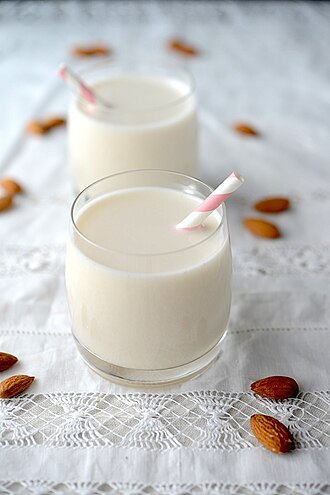
Photo: Wikipedia
Unsweetened, shelf-stable almond milk is a light, creamy, and subtly nutty plant-based beverage made from ground almonds and water. Its texture is smooth and thin, offering a delicate flavor that doesn't overpower other ingredients. Nutritionally, it's an ultra-low-calorie option, providing just 15 kcal per 100g, with most of its calories coming from healthy fats.
Calorie split: 15% protein · 9% carbs · 75% fat
↓ Full nutrition💚 Why it's loved
People love it for its mild, nutty taste that blends seamlessly into coffee, smoothies, and cereals without adding sweetness. Its versatility as a dairy substitute in both sweet and savory dishes, combined with its long shelf life, makes it a pantry staple for many.
⚠️ Watch-outs & how to enjoy it better
It is very low in protein and calcium compared to dairy milk, so it shouldn't be relied upon as a primary source of these nutrients. Additionally, almonds are tree nuts, making this a common allergen; those with nut allergies must avoid it. To counteract the low protein, pair it with protein-rich foods like nuts, seeds, or protein powder in smoothies.
Key benefits
- Very low in calories, making it ideal for calorie-conscious diets.
- Naturally lactose-free and dairy-free, suitable for vegans and those with lactose intolerance.
- A good source of vitamin E, an antioxidant that supports skin health.
- Shelf-stable packaging allows for long-term storage without refrigeration.
- Provides a creamy texture to recipes without the saturated fat of dairy cream.
🍽️ Popular dishes
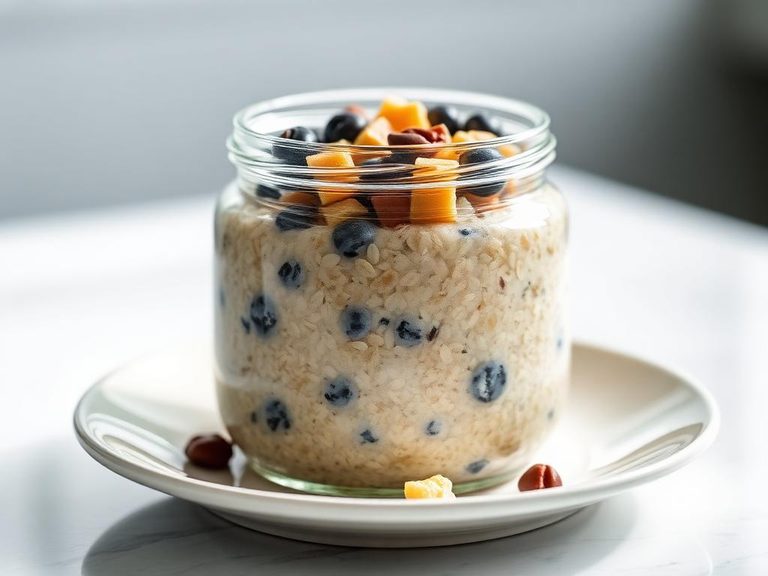
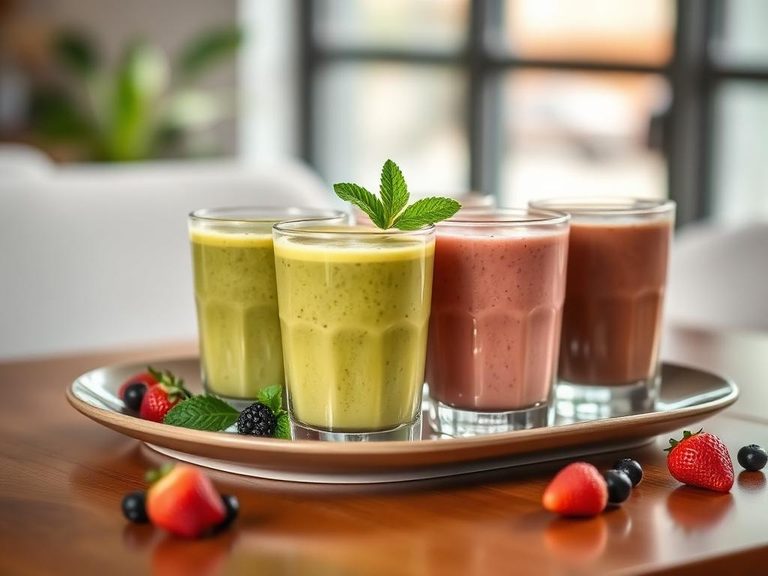



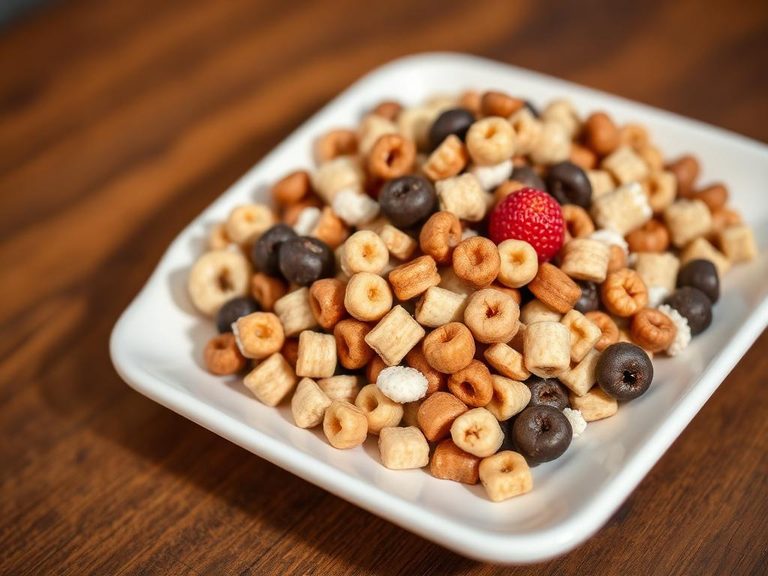
🌍 Where it's eaten
💡 Did you know?
Almond milk was a staple in medieval European cuisine, often used as a dairy substitute during Lent and other fasting periods when animal products were forbidden.
Full nutrition (USDA data · scales with serving)
| Water | 97.4 g |
| Energy (Atwater General Factors) | 14.6 kcal |
| Energy (Atwater Specific Factors) | 14.6 kcal |
| Nitrogen | 0.09 g |
| Protein | 0.55 g |
| Total lipid (fat) | 1.2 g |
| Total fat (NLEA) | 1.1 g |
| Ash | 0.49 g |
| Carbohydrate, by difference | 0.34 g |
| Fiber, total dietary | 0.00 g |
| Sugars, Total | 0.00 g |
| Sucrose | 0.00 g |
| Glucose | 0.00 g |
| Fructose | 0.00 g |
| Lactose | 0.00 g |
| Maltose | 0.00 g |
| Galactose | 0.00 g |
| Raffinose | 0.01 g |
| Stachyose | 0.01 g |
| Verbascose | 0.00 g |
| Calcium, Ca | 173 mg |
| Iron, Fe | 0.29 mg |
| Magnesium, Mg | 6.8 mg |
| Phosphorus, P | 29.9 mg |
| Potassium, K | 30.8 mg |
| Sodium, Na | 59.6 mg |
| Zinc, Zn | 0.17 mg |
| Copper, Cu | 0.02 mg |
| Manganese, Mn | 0.04 mg |
| Iodine, I | 0.00 ug |
| Selenium, Se | 0.00 ug |
| Molybdenum, Mo | 0.00 ug |
| Thiamin | 0.00 mg |
| Riboflavin | 0.03 mg |
| Niacin | 0.07 mg |
| Vitamin B-6 | 0.00 mg |
| Biotin | 1.0 ug |
| Folate, total | 0.00 ug |
| Vitamin B-12 | 0.34 ug |
| Vitamin A, RAE | 41.4 ug |
| Retinol | 41.4 ug |
| Vitamin E (alpha-tocopherol) | 3.3 mg |
| Tocopherol, beta | 0.00 mg |
| Tocopherol, gamma | 0.03 mg |
| Tocopherol, delta | 0.00 mg |
| Tocotrienol, alpha | 0.00 mg |
| Tocotrienol, beta | 0.00 mg |
| Tocotrienol, gamma | 0.00 mg |
| Tocotrienol, delta | 0.00 mg |
| Vitamin D (D2 + D3), International Units | 37.1 iu |
| Vitamin D (D2 + D3) | 0.93 ug |
| Vitamin D2 (ergocalciferol) | 0.93 ug |
| Vitamin D3 (cholecalciferol) | 0.00 ug |
Fat & fatty acid profile (per 100g)
| Fatty acids, total saturated | 0.10 g |
| SFA 4:0 | 0.00 g |
| SFA 5:0 | 0.00 g |
| SFA 6:0 | 0.00 g |
| SFA 7:0 | 0.00 g |
| SFA 8:0 | 0.00 g |
| SFA 9:0 | 0.00 g |
| SFA 10:0 | 0.00 g |
| SFA 11:0 | 0.00 g |
| SFA 12:0 | 0.00 g |
| SFA 14:0 | 0.00 g |
| SFA 15:0 | 0.00 g |
| SFA 16:0 | 0.08 g |
| SFA 17:0 | 0.00 g |
| SFA 18:0 | 0.02 g |
| SFA 20:0 | 0.00 g |
| SFA 21:0 | 0.00 g |
| SFA 22:0 | 0.00 g |
| SFA 23:0 | 0.00 g |
| SFA 24:0 | 0.00 g |
| Fatty acids, total monounsaturated | 0.73 g |
| MUFA 12:1 | 0.00 g |
| MUFA 14:1 c | 0.00 g |
| MUFA 15:1 | 0.00 g |
| MUFA 16:1 c | 0.01 g |
| MUFA 17:1 | 0.00 g |
| MUFA 17:1 c | 0.00 g |
| MUFA 18:1 c | 0.72 g |
| MUFA 20:1 c | 0.00 g |
| MUFA 22:1 c | 0.00 g |
| MUFA 22:1 n-9 | 0.00 g |
| MUFA 22:1 n-11 | 0.00 g |
| MUFA 24:1 c | 0.00 g |
| Fatty acids, total polyunsaturated | 0.28 g |
| PUFA 18:2 c | 0.28 g |
| PUFA 18:2 n-6 c,c | 0.28 g |
| PUFA 18:2 CLAs | 0.00 g |
| PUFA 18:3 c | 0.00 g |
| PUFA 18:3 n-3 c,c,c (ALA) | 0.00 g |
| PUFA 18:3 n-6 c,c,c | 0.00 g |
| PUFA 18:4 | 0.00 g |
| PUFA 20:2 c | 0.00 g |
| PUFA 20:2 n-6 c,c | 0.00 g |
| PUFA 20:3 c | 0.00 g |
| PUFA 20:3 n-3 | 0.00 g |
| PUFA 20:3 n-6 | 0.00 g |
| PUFA 20:3 n-9 | 0.00 g |
| PUFA 22:3 | 0.00 g |
| PUFA 20:4 | 0.00 g |
| PUFA 20:4c | 0.00 g |
| PUFA 20:5c | 0.00 g |
| PUFA 20:5 n-3 (EPA) | 0.00 g |
| PUFA 22:2 | 0.00 g |
| PUFA 22:5 c | 0.00 g |
| PUFA 22:4 | 0.00 g |
| PUFA 22:5 n-3 (DPA) | 0.00 g |
| PUFA 22:6 c | 0.00 g |
| PUFA 22:6 n-3 (DHA) | 0.00 g |
| Fatty acids, total trans | 0.00 g |
| Fatty acids, total trans-monoenoic | 0.00 g |
| TFA 14:1 t | 0.00 g |
| TFA 16:1 t | 0.00 g |
| TFA 18:1 t | 0.00 g |
| TFA 20:1 t | 0.00 g |
| TFA 22:1 t | 0.00 g |
| TFA 18:2 t not further defined | 0.00 g |
| TFA 18:2 t | 0.00 g |
| Fatty acids, total trans-polyenoic | 0.00 g |
| TFA 18:3 t | 0.00 g |
Amino acid profile (per 100g)
Estimated from Beverages, almond milk, chocolate, ready-to-drink — USDA does not publish this profile for Almond milk.
| Tryptophan | 0.01 g |
| Threonine | 0.01 g |
| Isoleucine | 0.02 g |
| Leucine | 0.04 g |
| Lysine | 0.01 g |
| Methionine | 0.00 g |
| Cystine | 0.01 g |
| Phenylalanine | 0.03 g |
| Tyrosine | 0.01 g |
| Valine | 0.02 g |
| Arginine | 0.06 g |
| Histidine | 0.01 g |
| Alanine | 0.03 g |
| Aspartic acid | 0.07 g |
| Glutamic acid | 0.17 g |
| Glycine | 0.04 g |
| Proline | 0.03 g |
| Serine | 0.02 g |
FAQ
Is unsweetened almond milk good for weight loss?
Yes, it's very low in calories (about 15 kcal per 100g) and can be a good substitute for higher-calorie dairy milk or sweetened plant milks, helping to reduce overall calorie intake.
Can I use shelf-stable almond milk in cooking and baking?
Absolutely. It works well in recipes for pancakes, muffins, sauces, and soups. However, it may curdle slightly if boiled directly, so it's best to add it at the end of cooking or use it in baked goods.
How does unsweetened almond milk compare to dairy milk nutritionally?
It is significantly lower in calories, protein, and calcium than dairy milk. While it provides healthy fats and vitamin E, it's not a direct nutritional replacement for dairy unless fortified.
Nutrient density (calculated · NRF9.3)
Nutrient Rich Foods index: beneficial nutrients (protein, fiber, vitamins, minerals) minus saturated fat, added sugar & sodium, per 100 kcal.
NRF9.3 index — Fulgoni, Keast & Drewnowski, 2009. Computed from USDA nutrients.
Weight-loss friendliness (composite index)
Energy density 0.15 kcal/g · 15% calories from protein · 0.0 g fiber · 0.0 g sugar per 100 g.
Composite of energy density (Rolls et al., 1999), protein & fiber satiety, minus sugar. A calculated heuristic — ranks satiety-per-calorie, not a clinical measure.
Dietary load (calculated from USDA values)
Potential renal acid load. Positive = acid-forming, negative = alkaline-forming.
Sodium-to-potassium ratio: 1.94 (lower is better — aim for ≤ 1)
Sodium:potassium per WHO potassium guidance. Computed from USDA nutrients.