

SUBWAY, tuna sub on white bread with lettuce and tomato
Whole food · Fast Foods

Photo: Wikipedia
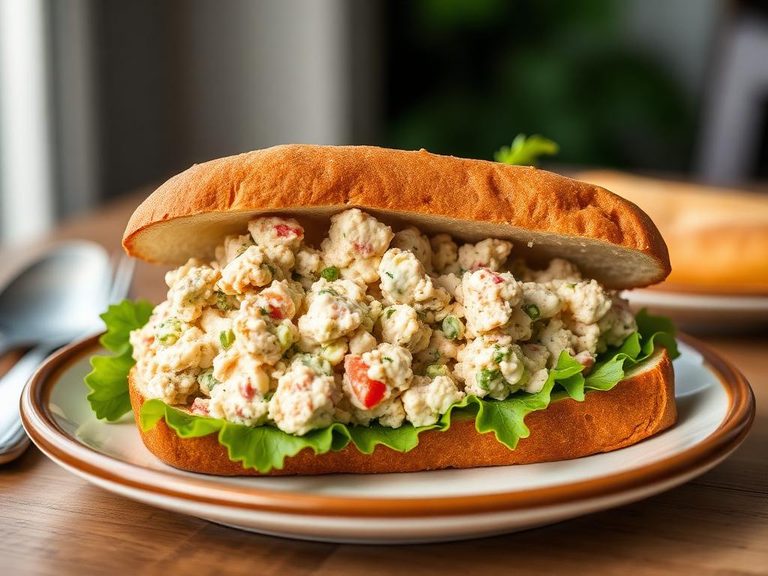
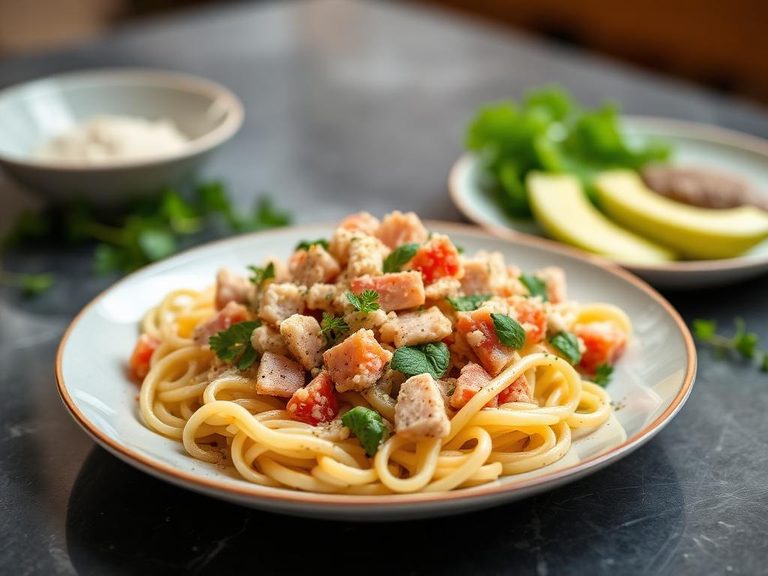
A classic fast-food staple, this sub features tender, flaky tuna mixed with a creamy, tangy dressing, served on soft, slightly sweet white bread with crisp lettuce and juicy tomato. It's a satisfying, protein-rich bite that balances the savory fish with fresh, crunchy vegetables. The nutrition profile is notable for its high protein content relative to its calorie count, making it a surprisingly filling option.
Calorie split: 22% protein · 29% carbs · 49% fat
↓ Full nutrition💚 Why it's loved
People love it for its familiar, comforting flavor profile—the creamy, savory tuna salad paired with the soft bread and fresh crunch of lettuce and tomato. It's a versatile, no-fuss meal that feels both indulgent and practical, often evoking nostalgia for classic deli or fast-food lunches.
⚠️ Watch-outs & how to enjoy it better
The white bread can cause a rapid blood-sugar spike, and the tuna salad dressing may be high in sodium and saturated fat. To counteract this, pair it with a side of vegetables or a piece of fruit, opt for whole-grain bread if available, and consider a smaller portion size to manage intake.
Key benefits
- Good source of lean protein from tuna
- Provides essential omega-3 fatty acids
- Contains vitamin C from fresh tomato
- Offers a convenient, quick meal option
- Lower in calories than many other sub options
🍽️ Popular dishes
🌍 Where it's eaten
💡 Did you know?
The 'tuna sub' at Subway was one of the chain's original menu items when it launched in the U.S. in 1965, and it remains one of its most popular choices worldwide, with over 100 million sold annually in the U.S. alone.
Full nutrition (USDA data · scales with serving)
| Water | 58.2 g |
| Energy | 221 kcal |
| Energy | 927 kj |
| Protein | 12.3 g |
| Total lipid (fat) | 12.0 g |
| Ash | 1.5 g |
| Carbohydrate, by difference | 15.9 g |
| Fiber, total dietary | 0.70 g |
| Total Sugars | 1.9 g |
| Sucrose | 0.00 g |
| Glucose | 0.47 g |
| Fructose | 1.1 g |
| Lactose | 0.00 g |
| Maltose | 0.37 g |
| Galactose | 0.00 g |
| Starch | 12.4 g |
| Calcium, Ca | 136 mg |
| Iron, Fe | 1.6 mg |
| Magnesium, Mg | 22.0 mg |
| Phosphorus, P | 109 mg |
| Potassium, K | 177 mg |
| Sodium, Na | 329 mg |
| Zinc, Zn | 0.67 mg |
| Copper, Cu | 0.07 mg |
| Manganese, Mn | 0.21 mg |
| Selenium, Se | 39.2 ug |
| Vitamin C, total ascorbic acid | 0.00 mg |
| Thiamin | 0.19 mg |
| Riboflavin | 0.22 mg |
| Niacin | 7.7 mg |
| Pantothenic acid | 0.35 mg |
| Vitamin B-6 | 0.27 mg |
| Folate, total | 51.0 ug |
| Choline, total | 30.5 mg |
| Betaine | 16.1 mg |
| Vitamin B-12 | 1.1 ug |
| Vitamin A, RAE | 11.0 ug |
| Retinol | 9.0 ug |
| Carotene, beta | 29.0 ug |
| Carotene, alpha | 0.00 ug |
| Cryptoxanthin, beta | 1.0 ug |
| Vitamin A, IU | 78.0 iu |
| Lycopene | 143 ug |
| Lutein + zeaxanthin | 51.0 ug |
| Vitamin E (alpha-tocopherol) | 1.6 mg |
| Tocopherol, beta | 0.17 mg |
| Tocopherol, gamma | 7.1 mg |
| Tocopherol, delta | 2.4 mg |
| Tocotrienol, alpha | 0.04 mg |
| Tocotrienol, beta | 0.24 mg |
| Tocotrienol, gamma | 0.00 mg |
| Tocotrienol, delta | 0.00 mg |
Fat & fatty acid profile (per 100g)
| Fatty acids, total saturated | 2.2 g |
| SFA 4:0 | 0.01 g |
| SFA 6:0 | 0.00 g |
| SFA 8:0 | 0.00 g |
| SFA 10:0 | 0.01 g |
| SFA 12:0 | 0.01 g |
| SFA 14:0 | 0.04 g |
| SFA 15:0 | 0.01 g |
| SFA 16:0 | 1.4 g |
| SFA 17:0 | 0.02 g |
| SFA 18:0 | 0.64 g |
| SFA 20:0 | 0.04 g |
| SFA 22:0 | 0.04 g |
| SFA 24:0 | 0.02 g |
| Fatty acids, total monounsaturated | 2.8 g |
| MUFA 14:1 | 0.00 g |
| MUFA 15:1 | 0.00 g |
| MUFA 16:1 | 0.04 g |
| MUFA 16:1 c | 0.04 g |
| MUFA 17:1 | 0.01 g |
| MUFA 18:1 | 2.7 g |
| MUFA 18:1 c | 2.7 g |
| MUFA 20:1 | 0.05 g |
| MUFA 22:1 | 0.00 g |
| MUFA 22:1 c | 0.00 g |
| MUFA 24:1 c | 0.00 g |
| Fatty acids, total polyunsaturated | 6.9 g |
| PUFA 18:2 | 5.9 g |
| PUFA 18:2 n-6 c,c | 5.9 g |
| PUFA 18:2 CLAs | 0.01 g |
| PUFA 18:3 | 0.77 g |
| PUFA 18:3 n-3 c,c,c (ALA) | 0.74 g |
| PUFA 18:3 n-6 c,c,c | 0.03 g |
| PUFA 18:3i | 0.00 g |
| PUFA 18:4 | 0.00 g |
| PUFA 20:2 n-6 c,c | 0.01 g |
| PUFA 20:3 | 0.00 g |
| PUFA 20:3 n-3 | 0.00 g |
| PUFA 20:3 n-6 | 0.00 g |
| PUFA 20:4 | 0.02 g |
| PUFA 20:5 n-3 (EPA) | 0.03 g |
| PUFA 22:4 | 0.00 g |
| PUFA 22:5 n-3 (DPA) | 0.00 g |
| PUFA 22:6 n-3 (DHA) | 0.12 g |
| Fatty acids, total trans | 0.05 g |
| Fatty acids, total trans-monoenoic | 0.01 g |
| TFA 16:1 t | 0.00 g |
| TFA 18:1 t | 0.01 g |
| TFA 22:1 t | 0.00 g |
| TFA 18:2 t not further defined | 0.03 g |
| Fatty acids, total trans-polyenoic | 0.03 g |
| Cholesterol | 28.0 mg |
Amino acid profile (per 100g)
| Tryptophan | 0.12 g |
| Threonine | 0.44 g |
| Isoleucine | 0.55 g |
| Leucine | 0.90 g |
| Lysine | 0.73 g |
| Methionine | 0.30 g |
| Phenylalanine | 0.52 g |
| Tyrosine | 0.34 g |
| Valine | 0.64 g |
| Arginine | 0.60 g |
| Histidine | 0.69 g |
| Alanine | 0.59 g |
| Aspartic acid | 0.96 g |
| Glutamic acid | 2.4 g |
| Glycine | 0.49 g |
| Proline | 0.96 g |
| Serine | 0.48 g |
| Hydroxyproline | 0.00 g |
FAQ
Is the tuna in a Subway sub real tuna?
Yes, Subway's tuna is made from real, flaked tuna mixed with mayonnaise and seasonings, though the exact blend can vary by region.
How much protein is in a typical Subway tuna sub?
A 6-inch tuna sub on white bread contains about 20-25 grams of protein, depending on the exact ingredients and portion size.
Can I make a healthier version at home?
Absolutely—use whole-grain bread, light mayo or Greek yogurt for the dressing, and add extra veggies like cucumber or bell peppers to boost fiber and nutrients.
Nutrient density (calculated · NRF9.3)
Nutrient Rich Foods index: beneficial nutrients (protein, fiber, vitamins, minerals) minus saturated fat, added sugar & sodium, per 100 kcal.
NRF9.3 index — Fulgoni, Keast & Drewnowski, 2009. Computed from USDA nutrients.
Weight-loss friendliness (composite index)
Energy density 2.21 kcal/g · 22% calories from protein · 0.7 g fiber · 1.9 g sugar per 100 g.
Composite of energy density (Rolls et al., 1999), protein & fiber satiety, minus sugar. A calculated heuristic — ranks satiety-per-calorie, not a clinical measure.
Dietary load (calculated from USDA values)
Potential renal acid load. Positive = acid-forming, negative = alkaline-forming.
Sodium-to-potassium ratio: 1.86 (lower is better — aim for ≤ 1)
Sodium:potassium per WHO potassium guidance. Computed from USDA nutrients.