

Soup, wonton, Chinese restaurant
Whole food · Soups, Sauces, and Gravies

Photo: Wikipedia
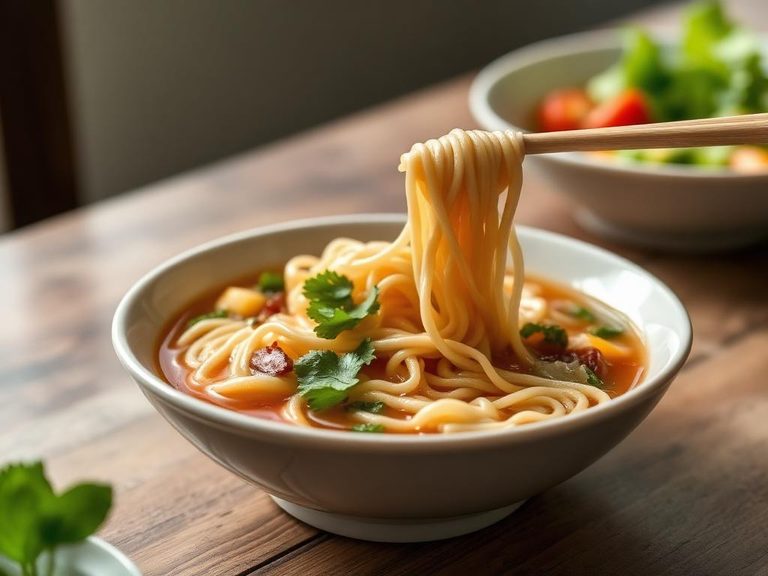
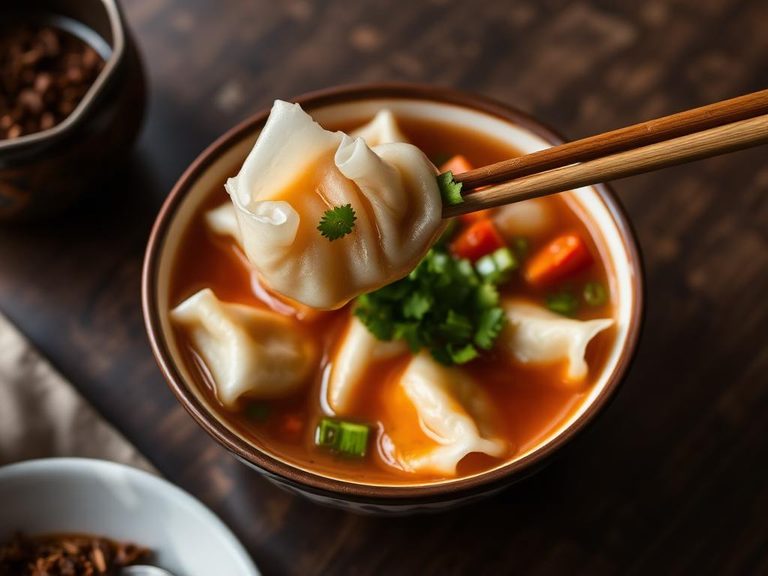
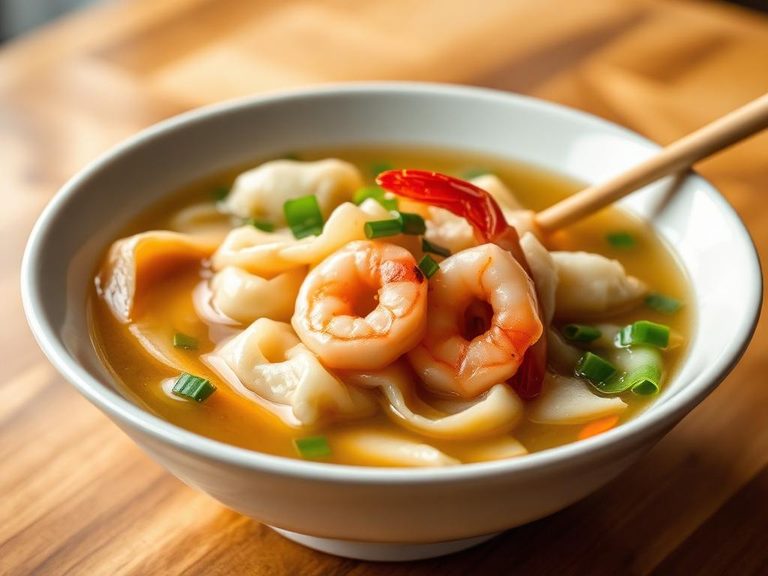
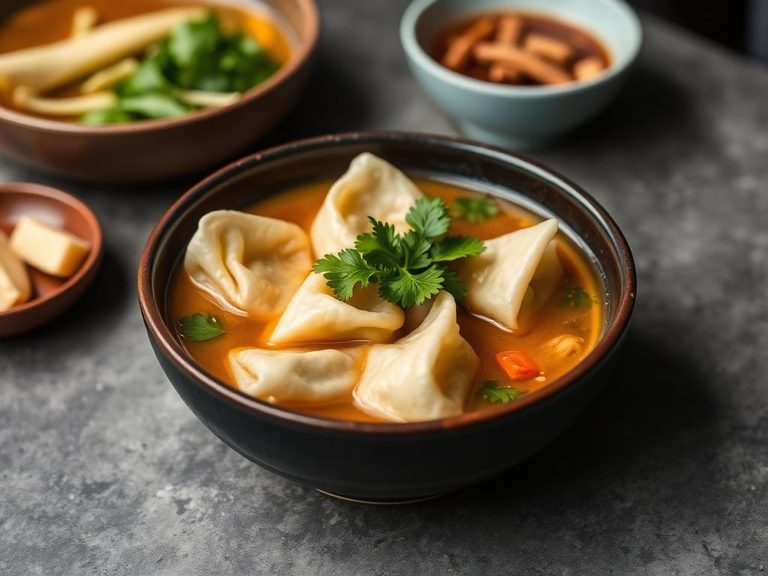
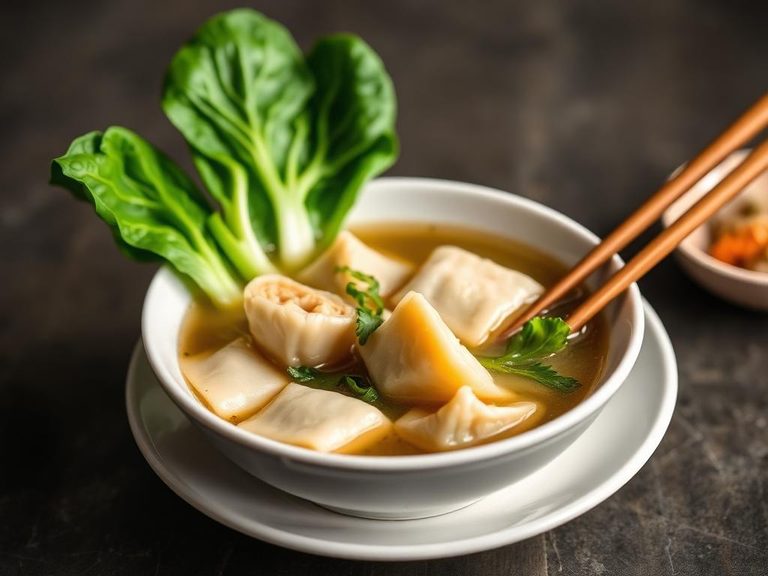
Wonton soup is a classic Chinese comfort dish featuring delicate, pleated dumplings filled with seasoned pork or shrimp, floating in a clear, savory broth. The broth is light yet deeply flavorful, often infused with ginger, scallions, and a hint of sesame, while the wontons offer a tender, slightly bouncy texture. At just 32 calories per 100g, it's a remarkably low-calorie, high-protein option that satisfies without heaviness.
Calorie split: 26% protein · 66% carbs · 7% fat
↓ Full nutrition💚 Why it's loved
People love wonton soup for its comforting warmth and the satisfying burst of flavor from the savory filling, which often includes ginger, garlic, and sesame oil. It's a versatile dish that can be enjoyed as a starter, a light meal, or a soothing remedy on cold days, deeply rooted in Chinese culinary tradition.
⚠️ Watch-outs & how to enjoy it better
The main downside is its high sodium content from the broth and seasonings, which can be problematic for those with hypertension or fluid retention. Additionally, the wonton wrappers are made from wheat flour, a common allergen, and the filling may contain shellfish or pork, which some avoid. To counteract sodium, opt for low-sodium broth or reduce soy sauce, and pair with a side of vegetables to balance the meal.
Key benefits
- Extremely low-calorie at 32 kcal per 100g
- Good protein source (2.08g per 100g) for muscle maintenance
- Very low in fat (0.26g per 100g), making it heart-friendly
- Hydrating due to high broth content
- Gentle on digestion, suitable for light meals or recovery
🍽️ Popular dishes
🌍 Where it's eaten
💡 Did you know?
In Chinese, 'wonton' (云吞) literally means 'cloud swallow,' referring to the dumplings' light, floating appearance in the broth, which resembles clouds drifting in the sky.
Full nutrition (USDA data · scales with serving)
| Water | 91.2 g |
| Energy | 32.0 kcal |
| Energy | 133 kj |
| Protein | 2.1 g |
| Total lipid (fat) | 0.26 g |
| Ash | 1.2 g |
| Carbohydrate, by difference | 5.3 g |
| Fiber, total dietary | 0.20 g |
| Total Sugars | 0.34 g |
| Sucrose | 0.24 g |
| Glucose | 0.00 g |
| Fructose | 0.00 g |
| Lactose | 0.00 g |
| Maltose | 0.09 g |
| Galactose | 0.00 g |
| Starch | 4.8 g |
| Calcium, Ca | 5.0 mg |
| Iron, Fe | 0.21 mg |
| Magnesium, Mg | 3.0 mg |
| Phosphorus, P | 18.0 mg |
| Potassium, K | 32.0 mg |
| Sodium, Na | 406 mg |
| Zinc, Zn | 0.12 mg |
| Copper, Cu | 0.02 mg |
| Manganese, Mn | 0.03 mg |
| Selenium, Se | 1.1 ug |
| Vitamin C, total ascorbic acid | 0.70 mg |
| Thiamin | 0.02 mg |
| Riboflavin | 0.02 mg |
| Niacin | 0.58 mg |
| Pantothenic acid | 0.14 mg |
| Vitamin B-6 | 0.08 mg |
| Folate, total | 13.0 ug |
| Folic acid | 7.0 ug |
| Folate, food | 6.0 ug |
| Folate, DFE | 18.0 ug |
| Choline, total | 19.0 mg |
| Vitamin B-12 | 0.09 ug |
| Vitamin B-12, added | 0.00 ug |
| Vitamin A, RAE | 1.0 ug |
| Retinol | 1.0 ug |
| Carotene, beta | 6.0 ug |
| Carotene, alpha | 0.00 ug |
| Cryptoxanthin, beta | 0.00 ug |
| Vitamin A, IU | 13.0 iu |
| Lycopene | 0.00 ug |
| Lutein + zeaxanthin | 12.0 ug |
| Vitamin E (alpha-tocopherol) | 0.06 mg |
| Vitamin E, added | 0.00 mg |
| Vitamin D (D2 + D3), International Units | 0.00 iu |
| Vitamin D (D2 + D3) | 0.00 ug |
| Vitamin K (phylloquinone) | 0.90 ug |
| Vitamin K (Dihydrophylloquinone) | 0.00 ug |
| Vitamin K (Menaquinone-4) | 0.00 ug |
| Alcohol, ethyl | 0.00 g |
| Caffeine | 0.00 mg |
| Theobromine | 0.00 mg |
Fat & fatty acid profile (per 100g)
| Fatty acids, total saturated | 0.06 g |
| SFA 4:0 | 0.00 g |
| SFA 6:0 | 0.00 g |
| SFA 8:0 | 0.00 g |
| SFA 10:0 | 0.00 g |
| SFA 12:0 | 0.00 g |
| SFA 14:0 | 0.00 g |
| SFA 15:0 | 0.00 g |
| SFA 16:0 | 0.05 g |
| SFA 17:0 | 0.00 g |
| SFA 18:0 | 0.01 g |
| SFA 20:0 | 0.00 g |
| SFA 22:0 | 0.00 g |
| SFA 24:0 | 0.00 g |
| Fatty acids, total monounsaturated | 0.08 g |
| MUFA 14:1 | 0.00 g |
| MUFA 15:1 | 0.00 g |
| MUFA 16:1 | 0.01 g |
| MUFA 16:1 c | 0.01 g |
| MUFA 17:1 | 0.00 g |
| MUFA 18:1 | 0.07 g |
| MUFA 18:1 c | 0.07 g |
| MUFA 20:1 | 0.00 g |
| MUFA 22:1 | 0.00 g |
| MUFA 22:1 c | 0.00 g |
| MUFA 24:1 c | 0.00 g |
| Fatty acids, total polyunsaturated | 0.07 g |
| PUFA 18:2 | 0.07 g |
| PUFA 18:2 n-6 c,c | 0.07 g |
| PUFA 18:2 CLAs | 0.00 g |
| PUFA 18:3 | 0.00 g |
| PUFA 18:3 n-3 c,c,c (ALA) | 0.00 g |
| PUFA 18:3 n-6 c,c,c | 0.00 g |
| PUFA 18:4 | 0.00 g |
| PUFA 20:2 n-6 c,c | 0.00 g |
| PUFA 20:3 | 0.00 g |
| PUFA 20:3 n-3 | 0.00 g |
| PUFA 20:3 n-6 | 0.00 g |
| PUFA 20:4 | 0.00 g |
| PUFA 20:5 n-3 (EPA) | 0.00 g |
| PUFA 22:4 | 0.00 g |
| PUFA 22:5 n-3 (DPA) | 0.00 g |
| PUFA 22:6 n-3 (DHA) | 0.00 g |
| Fatty acids, total trans | 0.00 g |
| Fatty acids, total trans-monoenoic | 0.00 g |
| TFA 16:1 t | 0.00 g |
| TFA 18:1 t | 0.00 g |
| TFA 22:1 t | 0.00 g |
| TFA 18:2 t not further defined | 0.00 g |
| Fatty acids, total trans-polyenoic | 0.00 g |
| Cholesterol | 4.0 mg |
Amino acid profile (per 100g)
| Tryptophan | 0.01 g |
| Threonine | 0.08 g |
| Isoleucine | 0.06 g |
| Leucine | 0.12 g |
| Lysine | 0.06 g |
| Methionine | 0.03 g |
| Cystine | 0.04 g |
| Phenylalanine | 0.07 g |
| Tyrosine | 0.05 g |
| Valine | 0.07 g |
| Arginine | 0.09 g |
| Histidine | 0.04 g |
| Alanine | 0.07 g |
| Aspartic acid | 0.11 g |
| Glutamic acid | 1.2 g |
| Glycine | 0.11 g |
| Proline | 0.20 g |
| Serine | 0.07 g |
FAQ
Is wonton soup healthy?
Yes, it's low in calories and fat, providing protein and hydration, but watch for high sodium in restaurant versions. Homemade broth can be made healthier by using low-sodium stock and fresh ingredients.
What's the difference between wonton and dumpling?
Wontons are typically smaller with thinner wrappers, often served in broth, while dumplings (like jiaozi) are larger, thicker-skinned, and usually steamed or pan-fried. Wontons are more soup-centric.
Can I make wonton soup gluten-free?
Traditional wonton wrappers contain wheat flour, but gluten-free versions using rice flour or tapioca starch are available. Ensure the broth and fillings are also gluten-free by avoiding soy sauce or using tamari.
How many calories are in a typical restaurant serving?
A standard restaurant bowl (about 300-400g) can range from 100-200 calories, depending on the broth richness and filling. The low calorie count per 100g makes it a light option, but added oils or MSG can increase calories slightly.
Nutrient density (calculated · NRF9.3)
Nutrient Rich Foods index: beneficial nutrients (protein, fiber, vitamins, minerals) minus saturated fat, added sugar & sodium, per 100 kcal.
NRF9.3 index — Fulgoni, Keast & Drewnowski, 2009. Computed from USDA nutrients.
Weight-loss friendliness (composite index)
Energy density 0.32 kcal/g · 26% calories from protein · 0.2 g fiber · 0.3 g sugar per 100 g.
Composite of energy density (Rolls et al., 1999), protein & fiber satiety, minus sugar. A calculated heuristic — ranks satiety-per-calorie, not a clinical measure.
Dietary load (calculated from USDA values)
Potential renal acid load. Positive = acid-forming, negative = alkaline-forming.
Sodium-to-potassium ratio: 12.69 (lower is better — aim for ≤ 1)
Sodium:potassium per WHO potassium guidance. Computed from USDA nutrients.