

Egg, whole, cooked, scrambled
Whole food · Dairy and Egg Products
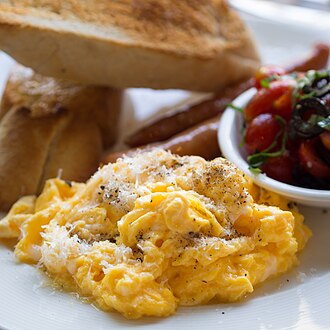
Photo: Wikipedia
Scrambled eggs are a beloved breakfast staple made by gently beating whole eggs and cooking them until soft, creamy, or firm, depending on preference. They offer a rich, savory flavor with a tender, custard-like texture, and are a powerhouse of high-quality protein and healthy fats. With nearly 11g of fat and 10g of protein per 100g, they provide sustained energy and are a versatile canvas for countless flavor additions.
Calorie split: 28% protein · 4% carbs · 68% fat
↓ Full nutrition💚 Why it's loved
People love scrambled eggs for their comforting, savory richness and incredible versatility—they can be plain, loaded with cheese, herbs, or vegetables, and adapt to any meal from breakfast to dinner. Their cultural ubiquity makes them a nostalgic, quick, and satisfying comfort food worldwide.
⚠️ Watch-outs & how to enjoy it better
Scrambled eggs are a common allergen, and their cholesterol content may concern some individuals, though current research suggests dietary cholesterol has minimal impact for most people. To mitigate, pair with fiber-rich vegetables or whole-grain toast to balance the meal, and consider using a non-stick pan with minimal added fat to keep calories in check.
Key benefits
- Excellent source of complete protein with all essential amino acids
- Rich in choline, crucial for brain health and liver function
- Contains lutein and zeaxanthin, antioxidants that support eye health
- Provides vitamin D, B12, and selenium in a highly bioavailable form
- Naturally low in carbohydrates, making it suitable for low-carb diets
🍽️ Popular dishes
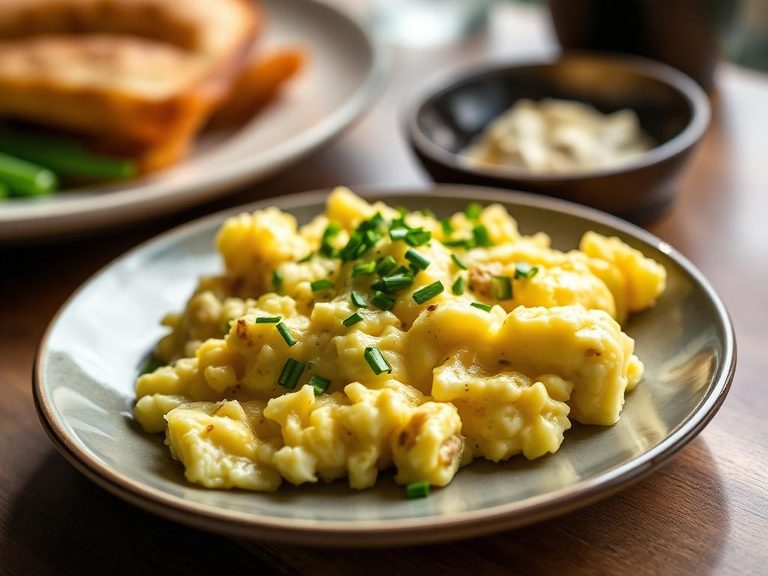

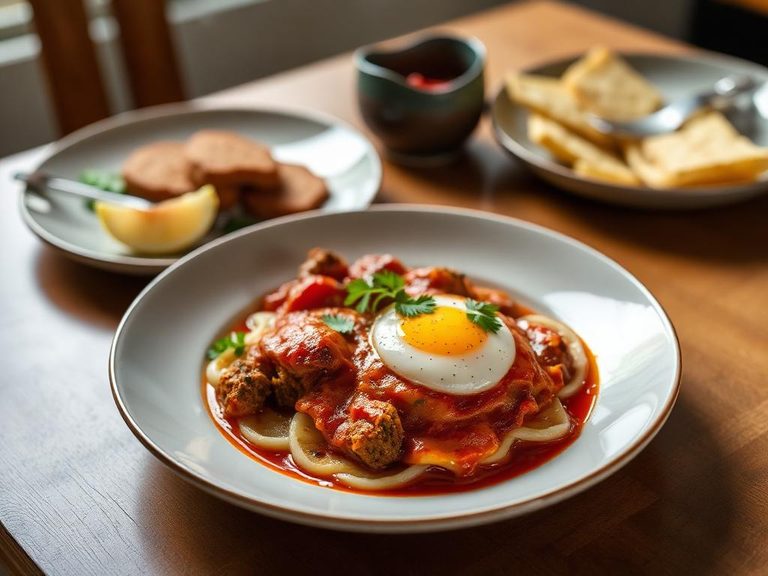

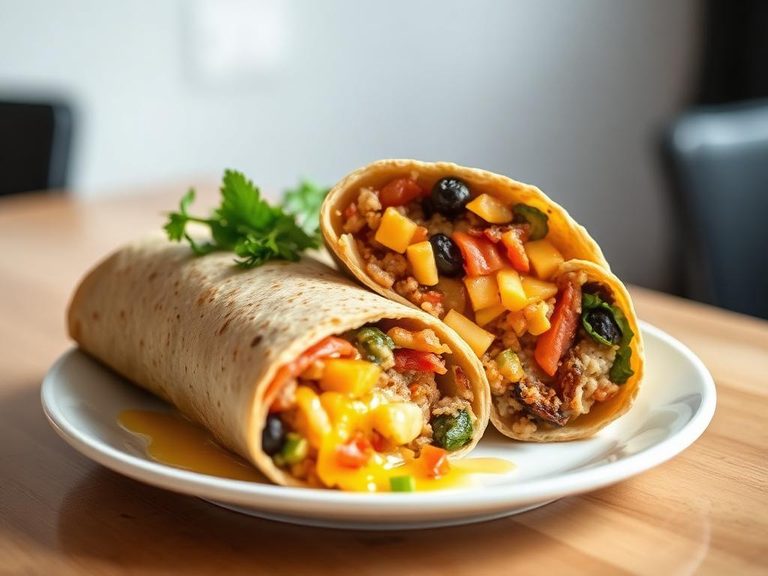
🌍 Where it's eaten
💡 Did you know?
The world's largest scrambled egg dish was made in 2012 in the U.S., using over 30,000 eggs to create a single massive scramble weighing 1,500 pounds.
Full nutrition (USDA data · scales with serving)
| Water | 76.4 g |
| Energy | 149 kcal |
| Energy | 621 kj |
| Protein | 10.0 g |
| Total lipid (fat) | 11.0 g |
| Ash | 1.0 g |
| Carbohydrate, by difference | 1.6 g |
| Fiber, total dietary | 0.00 g |
| Total Sugars | 1.4 g |
| Sucrose | 0.00 g |
| Glucose | 0.28 g |
| Fructose | 0.00 g |
| Lactose | 1.1 g |
| Maltose | 0.00 g |
| Galactose | 0.00 g |
| Calcium, Ca | 66.0 mg |
| Iron, Fe | 1.3 mg |
| Magnesium, Mg | 11.0 mg |
| Phosphorus, P | 165 mg |
| Potassium, K | 132 mg |
| Sodium, Na | 145 mg |
| Zinc, Zn | 1.0 mg |
| Copper, Cu | 0.06 mg |
| Manganese, Mn | 0.02 mg |
| Selenium, Se | 23.5 ug |
| Fluoride, F | 0.80 ug |
| Vitamin C, total ascorbic acid | 0.00 mg |
| Thiamin | 0.04 mg |
| Riboflavin | 0.38 mg |
| Niacin | 0.08 mg |
| Pantothenic acid | 1.2 mg |
| Vitamin B-6 | 0.13 mg |
| Folate, total | 36.0 ug |
| Folic acid | 0.00 ug |
| Folate, food | 36.0 ug |
| Folate, DFE | 36.0 ug |
| Choline, total | 221 mg |
| Betaine | 0.30 mg |
| Vitamin B-12 | 0.76 ug |
| Vitamin B-12, added | 0.00 ug |
| Vitamin A, RAE | 161 ug |
| Retinol | 159 ug |
| Carotene, beta | 26.0 ug |
| Carotene, alpha | 0.00 ug |
| Cryptoxanthin, beta | 7.0 ug |
| Vitamin A, IU | 578 iu |
| Lycopene | 0.00 ug |
| Lutein + zeaxanthin | 372 ug |
| Vitamin E (alpha-tocopherol) | 1.1 mg |
| Vitamin E, added | 0.00 mg |
| Tocopherol, beta | 0.03 mg |
| Tocopherol, gamma | 2.1 mg |
| Tocopherol, delta | 0.65 mg |
| Tocotrienol, alpha | 0.04 mg |
| Tocotrienol, beta | 0.00 mg |
| Tocotrienol, gamma | 0.01 mg |
| Tocotrienol, delta | 0.00 mg |
| Vitamin D (D2 + D3), International Units | 72.0 iu |
| Vitamin D (D2 + D3) | 1.8 ug |
| Vitamin D3 (cholecalciferol) | 1.8 ug |
| Vitamin K (phylloquinone) | 4.0 ug |
| Vitamin K (Dihydrophylloquinone) | 0.10 ug |
| Vitamin K (Menaquinone-4) | 0.20 ug |
| Alcohol, ethyl | 0.00 g |
| Caffeine | 0.00 mg |
| Theobromine | 0.00 mg |
Fat & fatty acid profile (per 100g)
| Fatty acids, total saturated | 3.3 g |
| SFA 4:0 | 0.02 g |
| SFA 6:0 | 0.02 g |
| SFA 8:0 | 0.02 g |
| SFA 10:0 | 0.02 g |
| SFA 12:0 | 0.02 g |
| SFA 13:0 | 0.00 g |
| SFA 14:0 | 0.09 g |
| SFA 15:0 | 0.01 g |
| SFA 16:0 | 2.2 g |
| SFA 17:0 | 0.02 g |
| SFA 18:0 | 0.93 g |
| SFA 20:0 | 0.01 g |
| SFA 22:0 | 0.01 g |
| SFA 24:0 | 0.00 g |
| Fatty acids, total monounsaturated | 4.4 g |
| MUFA 14:1 | 0.01 g |
| MUFA 15:1 | 0.00 g |
| MUFA 16:1 | 0.15 g |
| MUFA 17:1 | 0.01 g |
| MUFA 18:1 | 4.3 g |
| MUFA 20:1 | 0.03 g |
| MUFA 22:1 | 0.00 g |
| MUFA 24:1 c | 0.00 g |
| Fatty acids, total polyunsaturated | 2.4 g |
| PUFA 18:2 | 2.1 g |
| PUFA 18:3 | 0.13 g |
| PUFA 18:4 | 0.00 g |
| PUFA 20:2 n-6 c,c | 0.01 g |
| PUFA 20:3 | 0.02 g |
| PUFA 20:4 | 0.14 g |
| PUFA 20:5 n-3 (EPA) | 0.00 g |
| PUFA 22:4 | 0.01 g |
| PUFA 22:5 n-3 (DPA) | 0.01 g |
| PUFA 22:6 n-3 (DHA) | 0.04 g |
| Fatty acids, total trans | 0.62 g |
| Cholesterol | 277 mg |
| Phytosterols | 10.0 mg |
Amino acid profile (per 100g)
| Tryptophan | 0.14 g |
| Threonine | 0.44 g |
| Isoleucine | 0.53 g |
| Leucine | 0.86 g |
| Lysine | 0.70 g |
| Methionine | 0.30 g |
| Cystine | 0.20 g |
| Phenylalanine | 0.54 g |
| Tyrosine | 0.40 g |
| Valine | 0.68 g |
| Arginine | 0.62 g |
| Histidine | 0.24 g |
| Alanine | 0.57 g |
| Aspartic acid | 1.0 g |
| Glutamic acid | 1.4 g |
| Glycine | 0.34 g |
| Proline | 0.45 g |
| Serine | 0.74 g |
FAQ
Are scrambled eggs healthy for weight loss?
Yes, they are high in protein and low in carbs, which can promote satiety and help control appetite, making them a good choice for weight management when portion-controlled.
How do I make scrambled eggs fluffy without adding milk?
Whisk the eggs vigorously to incorporate air, cook on low heat, and stir gently with a spatula. Adding a small amount of water or butter can also help achieve a light, fluffy texture.
Can scrambled eggs be part of a low-cholesterol diet?
For most people, moderate egg consumption (1-2 per day) is safe and does not significantly raise blood cholesterol. Those with specific conditions should consult a doctor, but pairing eggs with fiber-rich foods can help manage cholesterol levels.
Nutrient density (calculated · NRF9.3)
Nutrient Rich Foods index: beneficial nutrients (protein, fiber, vitamins, minerals) minus saturated fat, added sugar & sodium, per 100 kcal.
NRF9.3 index — Fulgoni, Keast & Drewnowski, 2009. Computed from USDA nutrients.
Weight-loss friendliness (composite index)
Energy density 1.49 kcal/g · 27% calories from protein · 0.0 g fiber · 1.4 g sugar per 100 g.
Composite of energy density (Rolls et al., 1999), protein & fiber satiety, minus sugar. A calculated heuristic — ranks satiety-per-calorie, not a clinical measure.
Dietary load (calculated from USDA values)
Potential renal acid load. Positive = acid-forming, negative = alkaline-forming.
Sodium-to-potassium ratio: 1.10 (lower is better — aim for ≤ 1)
Sodium:potassium per WHO potassium guidance. Computed from USDA nutrients.