

Tamales, masa and pork filling (Hopi)
Whole food · American Indian/Alaska Native Foods

Photo: Wikipedia
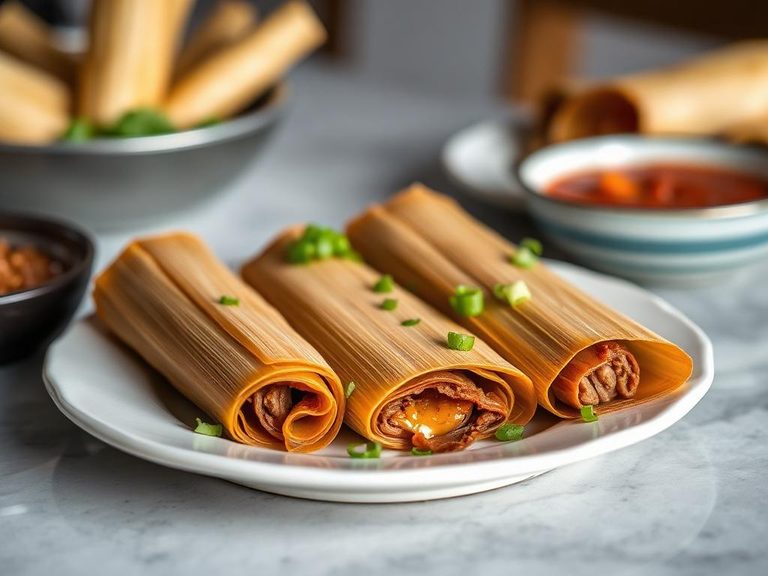
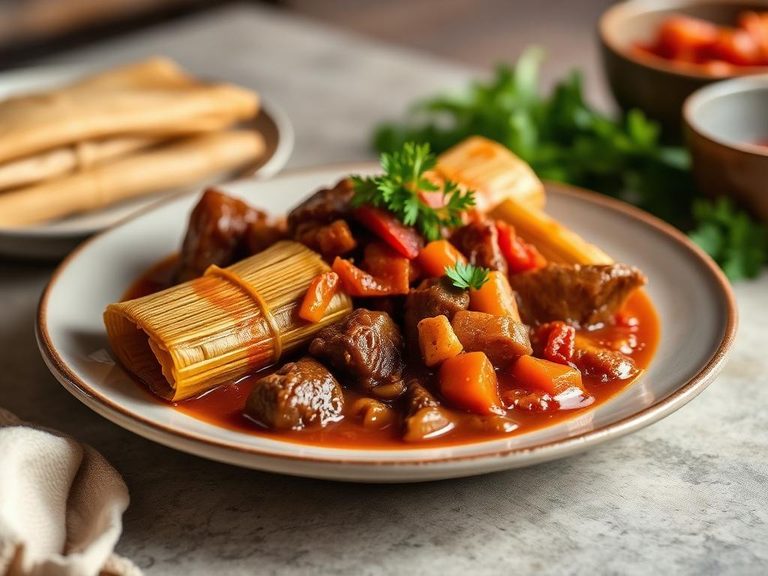
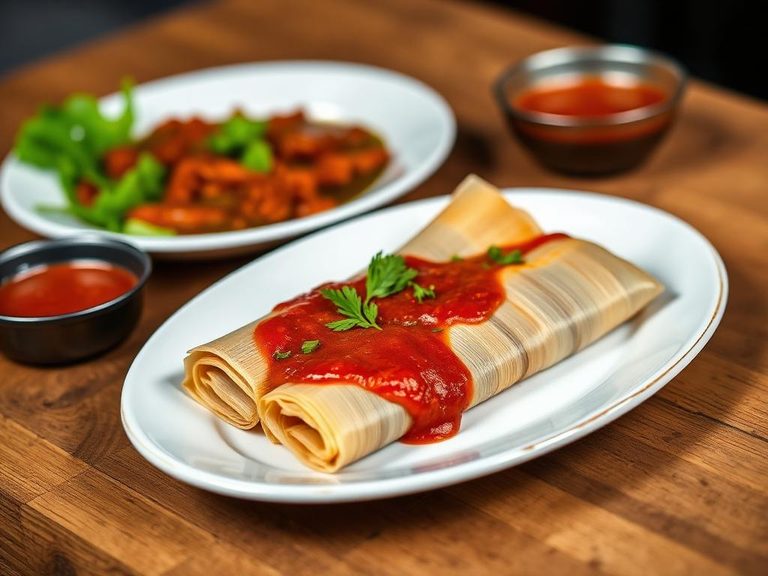
Hopi tamales are a traditional corn-based dish featuring a tender, earthy masa dough wrapped around a savory pork filling. The texture is soft and slightly dense, with a rich, meaty flavor from the pork and a subtle sweetness from the corn. Nutritionally, they provide a good source of protein and fiber, making them a satisfying and balanced meal option.
Calorie split: 31% protein · 43% carbs · 25% fat
↓ Full nutrition💚 Why it's loved
People love Hopi tamales for their comforting, hearty flavor and the way they bring together the earthy taste of corn with savory pork. They are cherished for their cultural roots and the communal experience of preparing and sharing them during festivals and family gatherings.
⚠️ Watch-outs & how to enjoy it better
Some may find the dense masa texture heavy or the pork filling too rich, especially for those with dietary restrictions. To counteract, pair with a light salad or vegetables to balance the meal, and opt for smaller portions if watching calorie or fat intake. Those sensitive to gluten should note that masa is gluten-free, but cross-contamination is possible in some preparations.
Key benefits
- Rich in protein for muscle maintenance
- Good source of dietary fiber for digestive health
- Provides complex carbohydrates for sustained energy
- Contains essential vitamins and minerals from corn and pork
- Traditional food with cultural significance
🍽️ Popular dishes
🌍 Where it's eaten
💡 Did you know?
Hopi tamales are often wrapped in corn husks or sometimes even in large leaves like corn or banana leaves, which impart a subtle, earthy aroma during steaming.
Full nutrition (USDA data · scales with serving)
| Water | 62.4 g |
| Energy | 168 kcal |
| Energy | 704 kj |
| Protein | 13.2 g |
| Total lipid (fat) | 4.7 g |
| Ash | 1.4 g |
| Carbohydrate, by difference | 18.3 g |
| Fiber, total dietary | 3.3 g |
| Total Sugars | 1.6 g |
| Sucrose | 0.48 g |
| Glucose | 0.49 g |
| Fructose | 0.60 g |
| Lactose | 0.00 g |
| Maltose | 0.00 g |
| Galactose | 0.00 g |
| Starch | 15.1 g |
| Calcium, Ca | 18.0 mg |
| Iron, Fe | 0.66 mg |
| Magnesium, Mg | 35.0 mg |
| Phosphorus, P | 141 mg |
| Potassium, K | 250 mg |
| Sodium, Na | 298 mg |
| Zinc, Zn | 1.3 mg |
| Copper, Cu | 0.09 mg |
| Manganese, Mn | 0.16 mg |
| Selenium, Se | 32.6 ug |
| Thiamin | 0.17 mg |
| Riboflavin | 0.07 mg |
| Niacin | 2.8 mg |
| Pantothenic acid | 0.82 mg |
| Vitamin B-6 | 0.26 mg |
| Vitamin B-12 | 0.22 ug |
| Vitamin A, RAE | 81.0 ug |
| Retinol | 5.0 ug |
| Carotene, beta | 740 ug |
| Carotene, alpha | 17.0 ug |
| Cryptoxanthin, beta | 342 ug |
| Vitamin A, IU | 1548 iu |
| Lycopene | 0.00 ug |
| Lutein + zeaxanthin | 616 ug |
| Vitamin E (alpha-tocopherol) | 1.1 mg |
| Tocopherol, beta | 0.03 mg |
| Tocopherol, gamma | 0.95 mg |
| Tocopherol, delta | 0.02 mg |
| Tocotrienol, alpha | 0.05 mg |
| Tocotrienol, beta | 0.00 mg |
| Tocotrienol, gamma | 0.24 mg |
| Tocotrienol, delta | 0.00 mg |
| Vitamin K (phylloquinone) | 3.2 ug |
| Vitamin K (Menaquinone-4) | 2.7 ug |
Fat & fatty acid profile (per 100g)
| Fatty acids, total saturated | 1.4 g |
| SFA 4:0 | 0.00 g |
| SFA 6:0 | 0.00 g |
| SFA 8:0 | 0.00 g |
| SFA 10:0 | 0.00 g |
| SFA 12:0 | 0.00 g |
| SFA 14:0 | 0.05 g |
| SFA 15:0 | 0.00 g |
| SFA 16:0 | 0.91 g |
| SFA 17:0 | 0.01 g |
| SFA 18:0 | 0.39 g |
| SFA 20:0 | 0.01 g |
| SFA 22:0 | 0.00 g |
| SFA 24:0 | 0.00 g |
| Fatty acids, total monounsaturated | 1.6 g |
| MUFA 14:1 | 0.00 g |
| MUFA 15:1 | 0.00 g |
| MUFA 16:1 | 0.09 g |
| MUFA 16:1 c | 0.09 g |
| MUFA 17:1 | 0.01 g |
| MUFA 18:1 | 1.5 g |
| MUFA 18:1 c | 1.5 g |
| MUFA 20:1 | 0.03 g |
| MUFA 22:1 | 0.00 g |
| MUFA 22:1 c | 0.00 g |
| MUFA 24:1 c | 0.00 g |
| Fatty acids, total polyunsaturated | 1.0 g |
| PUFA 18:2 | 0.91 g |
| PUFA 18:2 n-6 c,c | 0.90 g |
| PUFA 18:2 CLAs | 0.00 g |
| PUFA 18:3 | 0.03 g |
| PUFA 18:3 n-3 c,c,c (ALA) | 0.03 g |
| PUFA 18:3 n-6 c,c,c | 0.00 g |
| PUFA 18:4 | 0.00 g |
| PUFA 20:2 n-6 c,c | 0.01 g |
| PUFA 20:3 | 0.01 g |
| PUFA 20:3 n-3 | 0.00 g |
| PUFA 20:3 n-6 | 0.00 g |
| PUFA 20:4 | 0.04 g |
| PUFA 20:5 n-3 (EPA) | 0.00 g |
| PUFA 22:4 | 0.01 g |
| PUFA 22:5 n-3 (DPA) | 0.00 g |
| PUFA 22:6 n-3 (DHA) | 0.00 g |
| Fatty acids, total trans | 0.01 g |
| Fatty acids, total trans-monoenoic | 0.01 g |
| TFA 16:1 t | 0.00 g |
| TFA 18:1 t | 0.01 g |
| TFA 22:1 t | 0.00 g |
| TFA 18:2 t not further defined | 0.00 g |
| Fatty acids, total trans-polyenoic | 0.00 g |
| Cholesterol | 27.0 mg |
Amino acid profile (per 100g)
Estimated from Tamales (Navajo) — USDA does not publish this profile for Tamales.
| Tryptophan | 0.05 g |
| Threonine | 0.24 g |
| Isoleucine | 0.27 g |
| Leucine | 0.57 g |
| Lysine | 0.43 g |
| Methionine | 0.15 g |
| Cystine | 0.08 g |
| Phenylalanine | 0.28 g |
| Tyrosine | 0.20 g |
| Valine | 0.32 g |
| Arginine | 0.39 g |
| Histidine | 0.20 g |
| Alanine | 0.42 g |
| Aspartic acid | 0.56 g |
| Glutamic acid | 1.0 g |
| Glycine | 0.38 g |
| Proline | 0.38 g |
| Serine | 0.27 g |
FAQ
What makes Hopi tamales different from other tamales?
Hopi tamales are distinct due to their use of traditional Hopi corn varieties and preparation methods, often featuring a simpler, earthier masa and pork filling, reflecting the agricultural practices and cultural heritage of the Hopi people.
Are Hopi tamales gluten-free?
Yes, Hopi tamales are typically gluten-free as they are made from corn masa, which is naturally gluten-free. However, it's important to ensure that no gluten-containing additives are used in the preparation.
How can I make Hopi tamales at home?
To make Hopi tamales, prepare a masa dough from corn flour, mix with a savory pork filling, wrap in corn husks, and steam until cooked. Traditional recipes may include specific spices or herbs, so consulting a reliable source for authentic instructions is recommended.
Nutrient density (calculated · NRF9.3)
Nutrient Rich Foods index: beneficial nutrients (protein, fiber, vitamins, minerals) minus saturated fat, added sugar & sodium, per 100 kcal.
NRF9.3 index — Fulgoni, Keast & Drewnowski, 2009. Computed from USDA nutrients.
Weight-loss friendliness (composite index)
Energy density 1.68 kcal/g · 31% calories from protein · 3.3 g fiber · 1.6 g sugar per 100 g.
Composite of energy density (Rolls et al., 1999), protein & fiber satiety, minus sugar. A calculated heuristic — ranks satiety-per-calorie, not a clinical measure.
Dietary load (calculated from USDA values)
Potential renal acid load. Positive = acid-forming, negative = alkaline-forming.
Sodium-to-potassium ratio: 1.19 (lower is better — aim for ≤ 1)
Sodium:potassium per WHO potassium guidance. Computed from USDA nutrients.