

Spanish rice mix, dry mix, prepared (with canola/vegetable oil blend or diced tomatoes and margarine)
Whole food · Meals, Entrees, and Side Dishes

Photo: Wikipedia
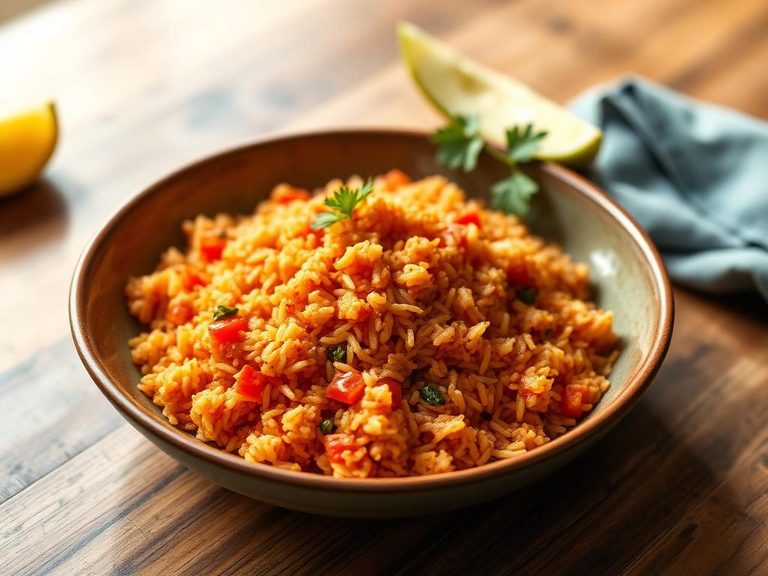
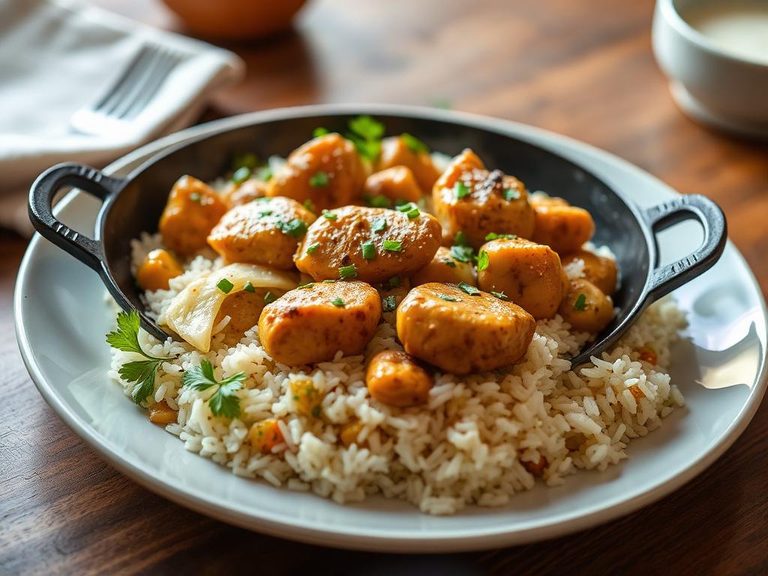
Spanish rice mix is a savory, tomato-infused blend of long-grain rice, dehydrated vegetables, and spices that transforms into a fluffy, aromatic side dish when cooked. Its signature reddish-orange hue comes from paprika and tomato, while the texture remains light and separate, not mushy. Nutritionally, it's a carbohydrate-rich base that provides quick energy with a modest amount of plant-based protein.
Calorie split: 10% protein · 73% carbs · 17% fat
↓ Full nutrition💚 Why it's loved
People love it for its comforting, savory tomato flavor that pairs perfectly with everything from grilled chicken to beans, and for its role as a cultural staple in Tex-Mex and Southwestern cuisine that evokes a sense of home cooking.
⚠️ Watch-outs & how to enjoy it better
The dry mix can be high in sodium, and the prepared dish is a concentrated source of carbohydrates, which may cause blood-sugar spikes if eaten alone. To counteract this, pair it with a lean protein (like grilled fish or chicken) and non-starchy vegetables to balance the meal and slow digestion.
Key benefits
- Quick-cooking convenience for weeknight meals
- Good source of energy from complex carbohydrates
- Contains dietary fiber for digestive health
- Versatile base for adding proteins or vegetables
- Provides a small amount of plant-based protein
🍽️ Popular dishes
🌍 Where it's eaten
💡 Did you know?
Despite its name, 'Spanish rice' as commonly prepared in the U.S. is not a traditional dish from Spain; it's a Mexican-American adaptation, often using long-grain rice instead of the short-grain rice typical in authentic Spanish paellas.
Full nutrition (USDA data · scales with serving)
| Water | 70.3 g |
| Energy | 125 kcal |
| Energy | 525 kj |
| Protein | 3.3 g |
| Total lipid (fat) | 2.4 g |
| Ash | 1.4 g |
| Carbohydrate, by difference | 22.7 g |
| Fiber, total dietary | 1.5 g |
| Total Sugars | 1.8 g |
| Sucrose | 0.26 g |
| Glucose | 0.61 g |
| Fructose | 0.64 g |
| Lactose | 0.00 g |
| Maltose | 0.29 g |
| Galactose | 0.00 g |
| Starch | 19.3 g |
| Calcium, Ca | 18.0 mg |
| Iron, Fe | 1.0 mg |
| Magnesium, Mg | 13.0 mg |
| Phosphorus, P | 45.0 mg |
| Potassium, K | 185 mg |
| Sodium, Na | 349 mg |
| Zinc, Zn | 0.30 mg |
| Copper, Cu | 0.06 mg |
| Manganese, Mn | 0.22 mg |
| Selenium, Se | 9.6 ug |
| Thiamin | 0.29 mg |
| Riboflavin | 0.14 mg |
| Niacin | 2.4 mg |
| Pantothenic acid | 0.21 mg |
| Vitamin B-6 | 0.10 mg |
| Folate, total | 68.0 ug |
| Vitamin A, RAE | 10.0 ug |
| Carotene, beta | 116 ug |
| Carotene, alpha | 0.00 ug |
| Cryptoxanthin, beta | 19.0 ug |
| Vitamin A, IU | 208 iu |
| Lycopene | 1580 ug |
| Lutein + zeaxanthin | 102 ug |
| Vitamin E (alpha-tocopherol) | 0.67 mg |
| Tocopherol, beta | 0.01 mg |
| Tocopherol, gamma | 0.88 mg |
| Tocopherol, delta | 0.22 mg |
| Tocotrienol, alpha | 0.00 mg |
| Tocotrienol, beta | 0.08 mg |
| Tocotrienol, gamma | 0.04 mg |
| Tocotrienol, delta | 0.06 mg |
| Vitamin K (phylloquinone) | 2.9 ug |
| Vitamin K (Dihydrophylloquinone) | 0.70 ug |
| Vitamin K (Menaquinone-4) | 0.00 ug |
Fat & fatty acid profile (per 100g)
| Fatty acids, total saturated | 0.39 g |
| SFA 4:0 | 0.00 g |
| SFA 6:0 | 0.00 g |
| SFA 8:0 | 0.00 g |
| SFA 10:0 | 0.00 g |
| SFA 12:0 | 0.00 g |
| SFA 14:0 | 0.01 g |
| SFA 15:0 | 0.00 g |
| SFA 16:0 | 0.25 g |
| SFA 17:0 | 0.00 g |
| SFA 18:0 | 0.11 g |
| SFA 20:0 | 0.01 g |
| SFA 22:0 | 0.01 g |
| SFA 24:0 | 0.01 g |
| Fatty acids, total monounsaturated | 0.83 g |
| MUFA 14:1 | 0.00 g |
| MUFA 15:1 | 0.00 g |
| MUFA 16:1 | 0.00 g |
| MUFA 16:1 c | 0.00 g |
| MUFA 17:1 | 0.00 g |
| MUFA 18:1 | 0.82 g |
| MUFA 18:1 c | 0.72 g |
| MUFA 20:1 | 0.01 g |
| MUFA 22:1 | 0.00 g |
| MUFA 22:1 c | 0.00 g |
| MUFA 24:1 c | 0.00 g |
| Fatty acids, total polyunsaturated | 0.87 g |
| PUFA 18:2 | 0.74 g |
| PUFA 18:2 n-6 c,c | 0.73 g |
| PUFA 18:2 CLAs | 0.00 g |
| PUFA 18:3 | 0.13 g |
| PUFA 18:3 n-3 c,c,c (ALA) | 0.12 g |
| PUFA 18:3 n-6 c,c,c | 0.00 g |
| PUFA 18:3i | 0.00 g |
| PUFA 18:4 | 0.00 g |
| PUFA 20:2 n-6 c,c | 0.00 g |
| PUFA 20:3 | 0.00 g |
| PUFA 20:3 n-3 | 0.00 g |
| PUFA 20:3 n-6 | 0.00 g |
| PUFA 20:4 | 0.00 g |
| PUFA 20:5 n-3 (EPA) | 0.00 g |
| PUFA 22:4 | 0.00 g |
| PUFA 22:5 n-3 (DPA) | 0.00 g |
| PUFA 22:6 n-3 (DHA) | 0.00 g |
| Fatty acids, total trans | 0.10 g |
| Fatty acids, total trans-monoenoic | 0.10 g |
| TFA 16:1 t | 0.00 g |
| TFA 18:1 t | 0.10 g |
| TFA 22:1 t | 0.00 g |
| TFA 18:2 t not further defined | 0.01 g |
| Fatty acids, total trans-polyenoic | 0.01 g |
Amino acid profile (per 100g)
Estimated from Restaurant, Mexican, spanish rice — USDA does not publish this profile for Spanish rice mix.
| Tryptophan | 0.04 g |
| Threonine | 0.10 g |
| Isoleucine | 0.11 g |
| Leucine | 0.24 g |
| Lysine | 0.13 g |
| Methionine | 0.07 g |
| Cystine | 0.07 g |
| Phenylalanine | 0.15 g |
| Tyrosine | 0.10 g |
| Valine | 0.14 g |
| Arginine | 0.26 g |
| Histidine | 0.07 g |
| Alanine | 0.17 g |
| Aspartic acid | 0.27 g |
| Glutamic acid | 0.61 g |
| Glycine | 0.14 g |
| Proline | 0.14 g |
| Serine | 0.15 g |
| Hydroxyproline | 0.00 g |
FAQ
Is Spanish rice mix gluten-free?
Most plain rice mixes are naturally gluten-free, but always check the label for added seasonings or anti-caking agents that might contain wheat derivatives or be processed in a facility with gluten.
How can I reduce the sodium in prepared Spanish rice?
Rinse the cooked rice thoroughly under water, or prepare it using low-sodium broth and a reduced amount of the seasoning packet. You can also mix it with plain, unseasoned rice.
Can I make this dish vegan?
Yes, if the dry mix itself contains no animal products. Simply prepare it with vegetable broth and oil or margarine instead of chicken broth or butter.
Nutrient density (calculated · NRF9.3)
Nutrient Rich Foods index: beneficial nutrients (protein, fiber, vitamins, minerals) minus saturated fat, added sugar & sodium, per 100 kcal.
NRF9.3 index — Fulgoni, Keast & Drewnowski, 2009. Computed from USDA nutrients.
Weight-loss friendliness (composite index)
Energy density 1.25 kcal/g · 10% calories from protein · 1.5 g fiber · 1.8 g sugar per 100 g.
Composite of energy density (Rolls et al., 1999), protein & fiber satiety, minus sugar. A calculated heuristic — ranks satiety-per-calorie, not a clinical measure.
Dietary load (calculated from USDA values)
Potential renal acid load. Positive = acid-forming, negative = alkaline-forming.
Sodium-to-potassium ratio: 1.89 (lower is better — aim for ≤ 1)
Sodium:potassium per WHO potassium guidance. Computed from USDA nutrients.