

Restaurant, Italian, chicken parmesan without pasta
Whole food · Restaurant Foods
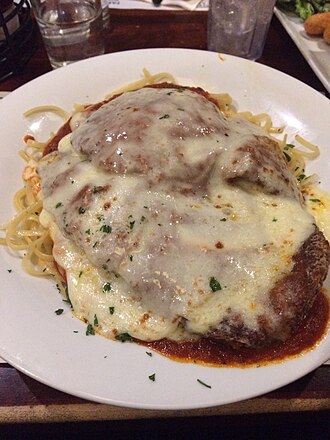
Photo: Wikipedia
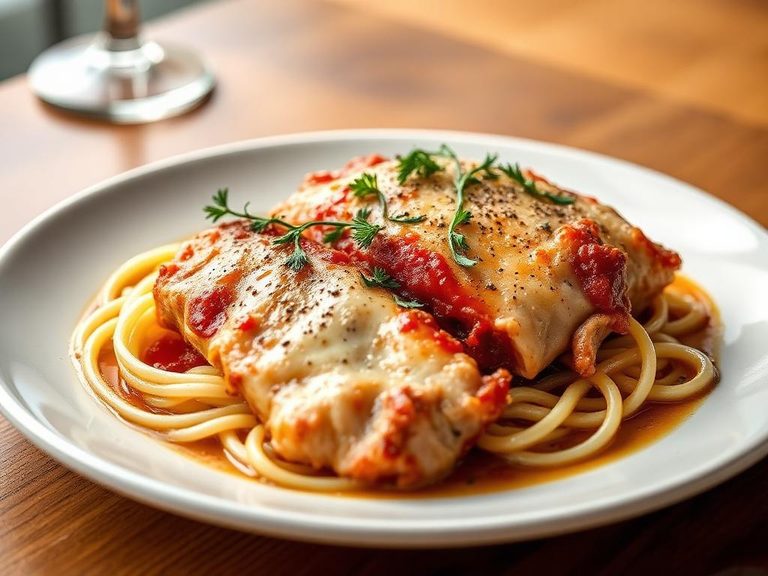
This is a classic Italian-American comfort dish featuring a breaded, fried chicken cutlet topped with marinara sauce and melted cheese, served without the traditional pasta side. The result is a savory, crispy, and cheesy experience with a tender interior, offering a solid protein boost while being lower in carbohydrates than the full pasta meal. It delivers a satisfying, rich flavor profile with a notable fat content from the frying and cheese.
Calorie split: 32% protein · 21% carbs · 47% fat
↓ Full nutrition💚 Why it's loved
People love it for its comforting, indulgent combination of crispy breading, tangy tomato sauce, and gooey, melted cheese, which delivers a satisfying umami punch. It's a beloved staple in Italian-American cuisine, often seen as a hearty, crowd-pleasing main course.
⚠️ Watch-outs & how to enjoy it better
The dish can be high in sodium from the sauce, cheese, and breading, and the frying method adds significant fat, which may concern those watching their calorie or fat intake. To counteract this, pair it with a large side of steamed or roasted non-starchy vegetables to add fiber and volume, and consider using a light hand with the cheese or opting for a baked version to reduce fat content.
Key benefits
- Good source of high-quality protein (16.17g per 100g).
- Lower in carbohydrates than the pasta-included version.
- Provides calcium from the cheese topping.
- Can be part of a balanced meal when paired with vegetables.
🍽️ Popular dishes
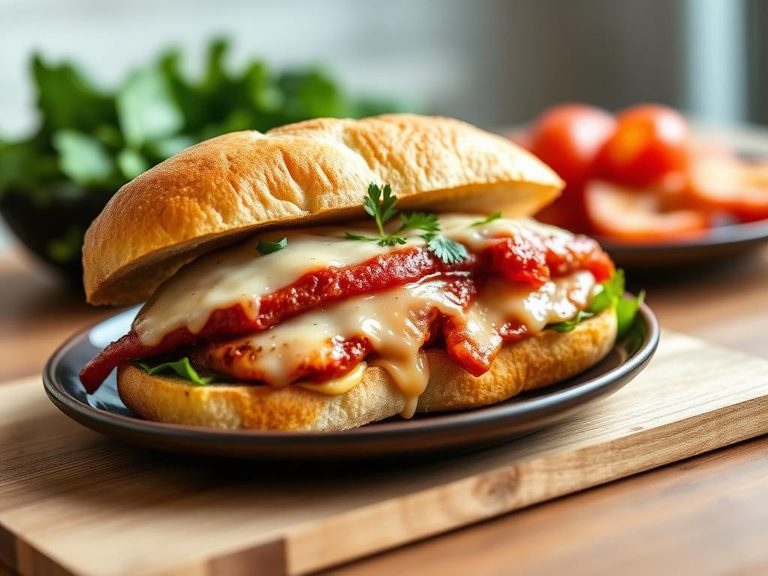
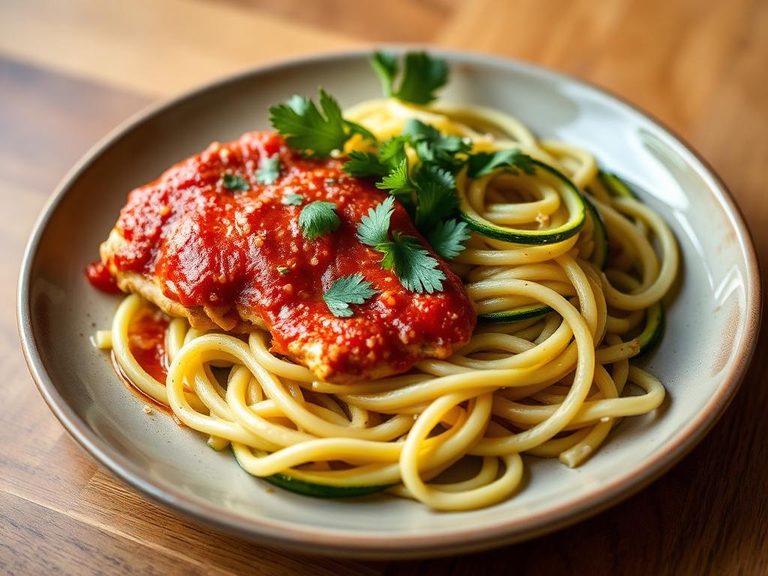
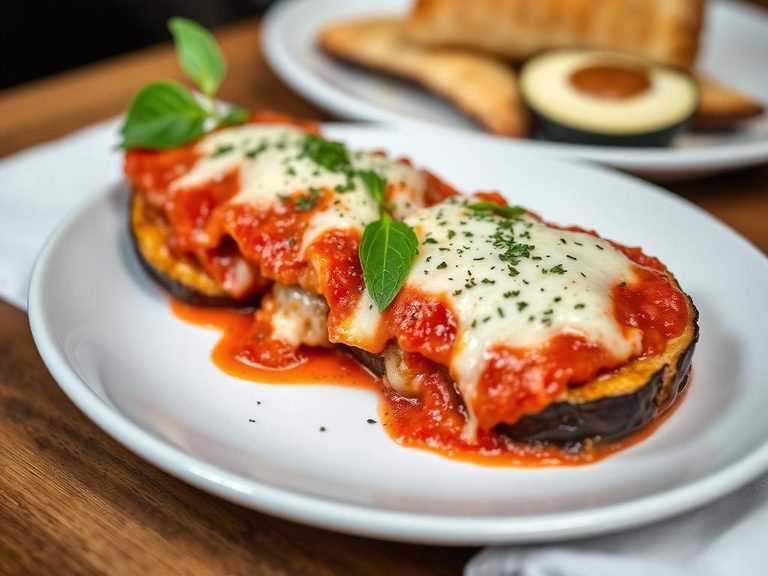
🌍 Where it's eaten
💡 Did you know?
The dish is a mid-20th century Italian-American creation, inspired by the classic Italian 'melanzane alla parmigiana' (eggplant parmesan), but adapted to use chicken, which was more abundant and affordable in the United States.
Full nutrition (USDA data · scales with serving)
| Water | 59.9 g |
| Energy | 204 kcal |
| Energy | 854 kj |
| Protein | 16.2 g |
| Total lipid (fat) | 10.6 g |
| Ash | 2.4 g |
| Carbohydrate, by difference | 10.9 g |
| Fiber, total dietary | 0.90 g |
| Total Sugars | 2.8 g |
| Sucrose | 0.00 g |
| Glucose | 1.1 g |
| Fructose | 0.82 g |
| Lactose | 0.35 g |
| Maltose | 0.51 g |
| Galactose | 0.05 g |
| Starch | 6.5 g |
| Calcium, Ca | 106 mg |
| Iron, Fe | 0.68 mg |
| Magnesium, Mg | 26.0 mg |
| Phosphorus, P | 227 mg |
| Potassium, K | 293 mg |
| Sodium, Na | 536 mg |
| Zinc, Zn | 0.95 mg |
| Copper, Cu | 0.07 mg |
| Manganese, Mn | 0.15 mg |
| Selenium, Se | 24.7 ug |
| Thiamin | 0.08 mg |
| Riboflavin | 0.19 mg |
| Niacin | 6.0 mg |
| Pantothenic acid | 1.1 mg |
| Vitamin B-6 | 0.20 mg |
| Folate, total | 19.0 ug |
| Vitamin B-12 | 0.40 ug |
| Vitamin A, RAE | 45.0 ug |
| Retinol | 36.0 ug |
| Carotene, beta | 113 ug |
| Carotene, alpha | 0.00 ug |
| Cryptoxanthin, beta | 0.00 ug |
| Vitamin A, IU | 307 iu |
| Lycopene | 1605 ug |
| Lutein + zeaxanthin | 86.0 ug |
| Vitamin E (alpha-tocopherol) | 1.7 mg |
| Tocopherol, beta | 0.02 mg |
| Tocopherol, gamma | 1.6 mg |
| Tocopherol, delta | 0.18 mg |
| Tocotrienol, alpha | 0.05 mg |
| Tocotrienol, beta | 0.00 mg |
| Tocotrienol, gamma | 0.04 mg |
| Tocotrienol, delta | 0.00 mg |
Fat & fatty acid profile (per 100g)
| Fatty acids, total saturated | 2.5 g |
| SFA 4:0 | 0.06 g |
| SFA 6:0 | 0.04 g |
| SFA 8:0 | 0.03 g |
| SFA 10:0 | 0.07 g |
| SFA 12:0 | 0.08 g |
| SFA 14:0 | 0.26 g |
| SFA 15:0 | 0.03 g |
| SFA 16:0 | 1.4 g |
| SFA 17:0 | 0.02 g |
| SFA 18:0 | 0.53 g |
| SFA 20:0 | 0.04 g |
| SFA 22:0 | 0.02 g |
| SFA 24:0 | 0.01 g |
| Fatty acids, total monounsaturated | 4.9 g |
| MUFA 14:1 | 0.03 g |
| MUFA 15:1 | 0.00 g |
| MUFA 16:1 | 0.12 g |
| MUFA 16:1 c | 0.11 g |
| MUFA 17:1 | 0.01 g |
| MUFA 18:1 | 4.6 g |
| MUFA 18:1 c | 4.6 g |
| MUFA 20:1 | 0.07 g |
| MUFA 22:1 | 0.00 g |
| MUFA 22:1 c | 0.00 g |
| MUFA 24:1 c | 0.01 g |
| Fatty acids, total polyunsaturated | 2.0 g |
| PUFA 18:2 | 1.7 g |
| PUFA 18:2 n-6 c,c | 1.6 g |
| PUFA 18:2 CLAs | 0.02 g |
| PUFA 18:3 | 0.23 g |
| PUFA 18:3 n-3 c,c,c (ALA) | 0.22 g |
| PUFA 18:3 n-6 c,c,c | 0.01 g |
| PUFA 18:3i | 0.00 g |
| PUFA 18:4 | 0.00 g |
| PUFA 20:2 n-6 c,c | 0.01 g |
| PUFA 20:3 | 0.01 g |
| PUFA 20:3 n-3 | 0.00 g |
| PUFA 20:3 n-6 | 0.01 g |
| PUFA 20:4 | 0.03 g |
| PUFA 20:5 n-3 (EPA) | 0.00 g |
| PUFA 22:4 | 0.01 g |
| PUFA 22:5 n-3 (DPA) | 0.00 g |
| PUFA 22:6 n-3 (DHA) | 0.00 g |
| Fatty acids, total trans | 0.11 g |
| Fatty acids, total trans-monoenoic | 0.08 g |
| TFA 16:1 t | 0.01 g |
| TFA 18:1 t | 0.07 g |
| TFA 22:1 t | 0.00 g |
| TFA 18:2 t not further defined | 0.03 g |
| Fatty acids, total trans-polyenoic | 0.03 g |
| Cholesterol | 54.0 mg |
Amino acid profile (per 100g)
| Tryptophan | 0.20 g |
| Threonine | 0.66 g |
| Isoleucine | 0.72 g |
| Leucine | 1.3 g |
| Lysine | 1.3 g |
| Methionine | 0.41 g |
| Cystine | 0.20 g |
| Phenylalanine | 1.1 g |
| Tyrosine | 0.53 g |
| Valine | 0.81 g |
| Arginine | 0.93 g |
| Histidine | 0.50 g |
| Alanine | 0.79 g |
| Aspartic acid | 1.4 g |
| Glutamic acid | 2.8 g |
| Glycine | 0.61 g |
| Proline | 1.3 g |
| Serine | 0.70 g |
| Hydroxyproline | 0.04 g |
FAQ
Is chicken parmesan without pasta healthier than with pasta?
Yes, omitting the pasta significantly reduces the carbohydrate and calorie count, making it a more protein-focused meal. However, the breading and cheese still contribute fat and sodium, so it's best enjoyed in moderation.
Can I make chicken parmesan without frying?
Absolutely. Baking or air-frying the breaded chicken cutlet is a popular healthier alternative that reduces the fat content while still achieving a crispy texture.
What is the main source of fat in chicken parmesan?
The primary sources of fat are the oil used for frying the breaded chicken and the cheese (typically mozzarella and Parmesan) used in the topping.
Nutrient density (calculated · NRF9.3)
Nutrient Rich Foods index: beneficial nutrients (protein, fiber, vitamins, minerals) minus saturated fat, added sugar & sodium, per 100 kcal.
NRF9.3 index — Fulgoni, Keast & Drewnowski, 2009. Computed from USDA nutrients.
Weight-loss friendliness (composite index)
Energy density 2.04 kcal/g · 32% calories from protein · 0.9 g fiber · 2.8 g sugar per 100 g.
Composite of energy density (Rolls et al., 1999), protein & fiber satiety, minus sugar. A calculated heuristic — ranks satiety-per-calorie, not a clinical measure.
Dietary load (calculated from USDA values)
Potential renal acid load. Positive = acid-forming, negative = alkaline-forming.
Sodium-to-potassium ratio: 1.83 (lower is better — aim for ≤ 1)
Sodium:potassium per WHO potassium guidance. Computed from USDA nutrients.