

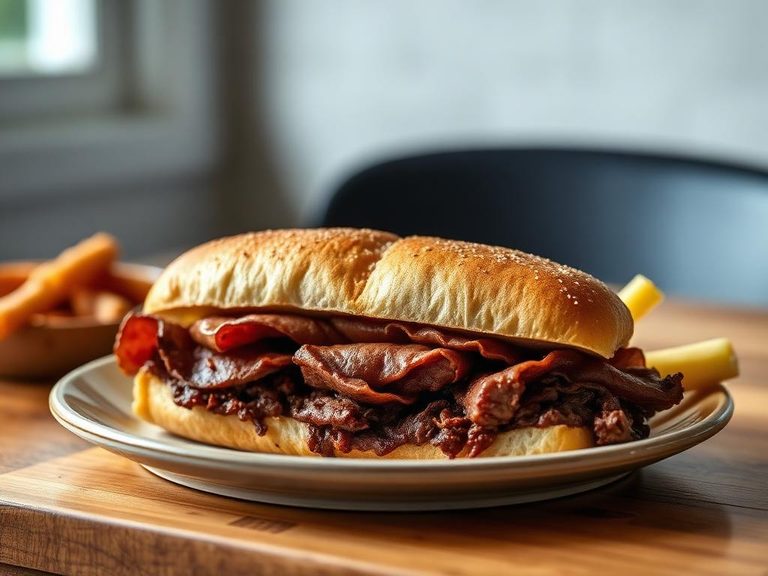
Fast foods, roast beef sandwich, plain
Whole food · Fast Foods

Photo: Wikipedia
A fast-food roast beef sandwich, plain, is a straightforward, savory handheld meal centered on thinly sliced, seasoned beef piled onto a soft bun. Its taste is a balance of rich, meaty umami from the roast beef and mild, starchy sweetness from the bread, with a tender yet slightly chewy texture. Nutritionally, it delivers a solid 15.17g of protein per 100g, making it a more protein-dense option compared to many other fast-food sandwiches.
Calorie split: 25% protein · 37% carbs · 38% fat
↓ Full nutrition💚 Why it's loved
People love it for its simple, satisfying combination of savory roast beef and soft bread, offering a comforting and familiar flavor profile. It's also valued for its versatility, easily customizable with condiments like mustard or horseradish to suit individual tastes.
⚠️ Watch-outs & how to enjoy it better
The sandwich can be high in sodium, which may concern those monitoring blood pressure, and the refined white bun can cause a blood-sugar spike. To counteract this, pair it with a side of vegetables or a salad to add fiber, and choose a whole-grain bun if available to slow carbohydrate absorption.
Key benefits
- Good source of protein for muscle maintenance and satiety.
- Relatively moderate in fat compared to fried fast-food items.
- Provides quick energy from carbohydrates in the bun.
- Convenient, portable meal for on-the-go consumption.
- Lower in sugar than many sweetened fast-food options.
🍽️ Popular dishes
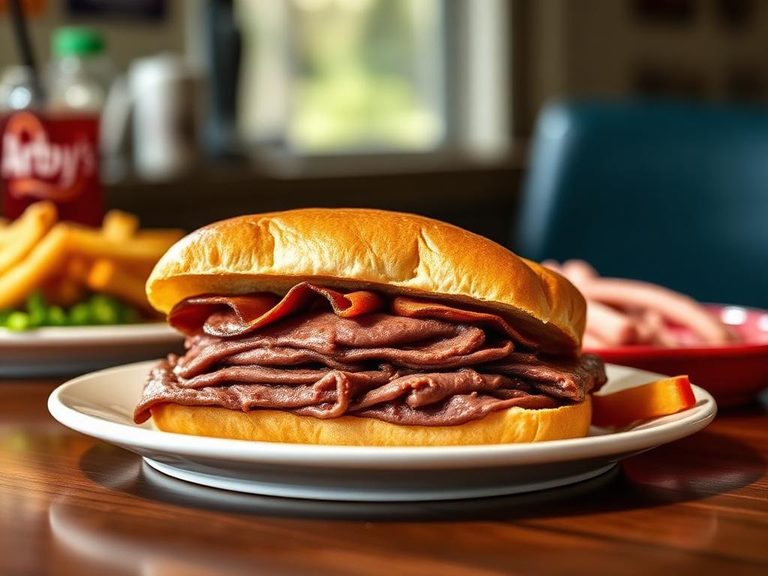
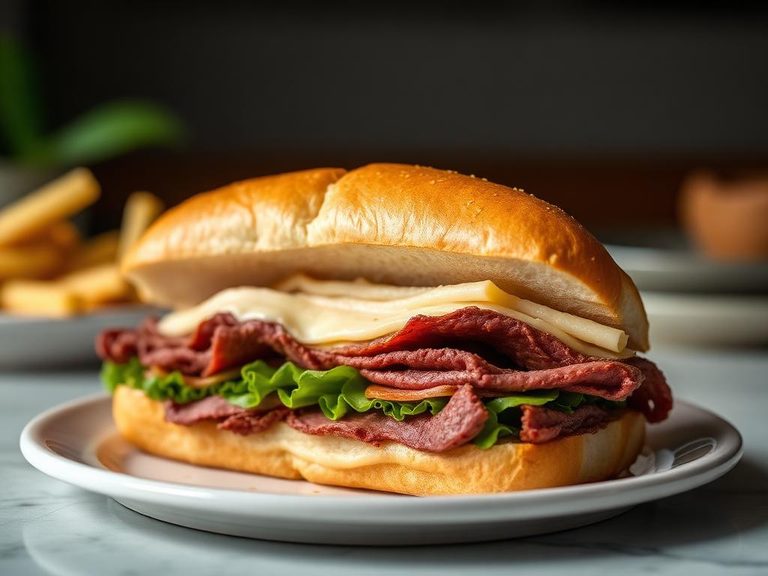
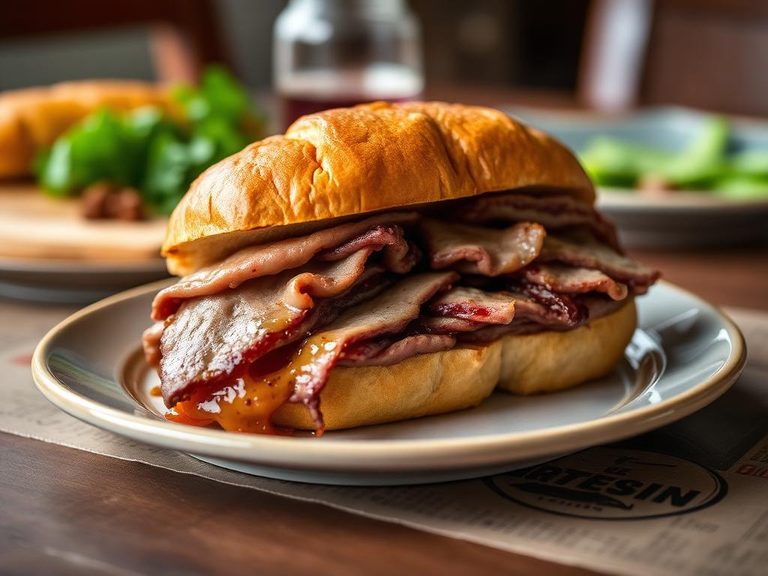
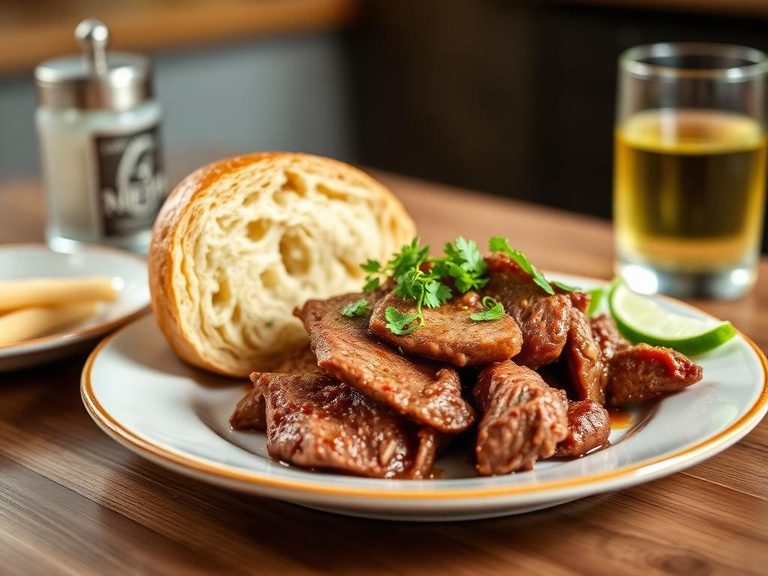
🌍 Where it's eaten
💡 Did you know?
The French Dip sandwich, a popular roast beef sandwich variant, was reportedly invented in Los Angeles in 1908 by Philippe Mathieu, who accidentally dropped a French roll into the beef drippings, creating a now-iconic dipping sauce.
Full nutrition (USDA data · scales with serving)
| Water | 49.9 g |
| Energy | 244 kcal |
| Energy | 1019 kj |
| Protein | 15.2 g |
| Total lipid (fat) | 10.3 g |
| Ash | 2.4 g |
| Carbohydrate, by difference | 22.2 g |
| Fiber, total dietary | 1.3 g |
| Total Sugars | 3.8 g |
| Sucrose | 0.00 g |
| Glucose | 1.3 g |
| Fructose | 1.5 g |
| Lactose | 0.00 g |
| Maltose | 1.0 g |
| Galactose | 0.00 g |
| Starch | 17.6 g |
| Calcium, Ca | 55.0 mg |
| Iron, Fe | 2.6 mg |
| Magnesium, Mg | 23.0 mg |
| Phosphorus, P | 200 mg |
| Potassium, K | 224 mg |
| Sodium, Na | 653 mg |
| Zinc, Zn | 2.3 mg |
| Copper, Cu | 0.11 mg |
| Manganese, Mn | 0.23 mg |
| Selenium, Se | 18.2 ug |
| Vitamin C, total ascorbic acid | 0.00 mg |
| Thiamin | 0.22 mg |
| Riboflavin | 0.29 mg |
| Niacin | 4.3 mg |
| Vitamin B-6 | 0.21 mg |
| Folate, total | 51.0 ug |
| Folic acid | 12.0 ug |
| Folate, food | 39.0 ug |
| Folate, DFE | 60.0 ug |
| Choline, total | 40.1 mg |
| Betaine | 21.3 mg |
| Vitamin B-12 | 0.96 ug |
| Vitamin B-12, added | 0.00 ug |
| Vitamin A, RAE | 2.0 ug |
| Retinol | 2.0 ug |
| Carotene, beta | 0.00 ug |
| Carotene, alpha | 0.00 ug |
| Cryptoxanthin, beta | 0.00 ug |
| Vitamin A, IU | 8.0 iu |
| Lycopene | 0.00 ug |
| Lutein + zeaxanthin | 19.0 ug |
| Vitamin E (alpha-tocopherol) | 0.43 mg |
| Vitamin E, added | 0.00 mg |
| Vitamin D (D2 + D3), International Units | 1.0 iu |
| Vitamin D (D2 + D3) | 0.00 ug |
| Vitamin K (phylloquinone) | 2.8 ug |
| Alcohol, ethyl | 0.00 g |
| Caffeine | 0.00 mg |
| Theobromine | 0.00 mg |
Fat & fatty acid profile (per 100g)
| Fatty acids, total saturated | 3.4 g |
| SFA 4:0 | 0.00 g |
| SFA 6:0 | 0.00 g |
| SFA 8:0 | 0.00 g |
| SFA 10:0 | 0.00 g |
| SFA 12:0 | 0.00 g |
| SFA 14:0 | 0.20 g |
| SFA 15:0 | 0.03 g |
| SFA 16:0 | 2.0 g |
| SFA 17:0 | 0.08 g |
| SFA 18:0 | 1.1 g |
| SFA 20:0 | 0.01 g |
| SFA 22:0 | 0.01 g |
| SFA 24:0 | 0.00 g |
| Fatty acids, total monounsaturated | 4.0 g |
| MUFA 14:1 | 0.06 g |
| MUFA 15:1 | 0.00 g |
| MUFA 16:1 | 0.28 g |
| MUFA 16:1 c | 0.26 g |
| MUFA 17:1 | 0.05 g |
| MUFA 18:1 | 3.6 g |
| MUFA 18:1 c | 3.2 g |
| MUFA 20:1 | 0.03 g |
| MUFA 22:1 | 0.00 g |
| MUFA 22:1 c | 0.00 g |
| MUFA 24:1 c | 0.00 g |
| Fatty acids, total polyunsaturated | 1.8 g |
| PUFA 18:2 | 1.6 g |
| PUFA 18:2 n-6 c,c | 1.5 g |
| PUFA 18:2 CLAs | 0.04 g |
| PUFA 18:3 | 0.16 g |
| PUFA 18:3 n-3 c,c,c (ALA) | 0.15 g |
| PUFA 18:3 n-6 c,c,c | 0.01 g |
| PUFA 18:3i | 0.00 g |
| PUFA 18:4 | 0.00 g |
| PUFA 20:2 n-6 c,c | 0.00 g |
| PUFA 20:3 | 0.01 g |
| PUFA 20:3 n-3 | 0.00 g |
| PUFA 20:3 n-6 | 0.01 g |
| PUFA 20:4 | 0.02 g |
| PUFA 20:5 n-3 (EPA) | 0.01 g |
| PUFA 22:4 | 0.00 g |
| PUFA 22:5 n-3 (DPA) | 0.01 g |
| PUFA 22:6 n-3 (DHA) | 0.00 g |
| Fatty acids, total trans | 0.39 g |
| Fatty acids, total trans-monoenoic | 0.35 g |
| TFA 16:1 t | 0.02 g |
| TFA 18:1 t | 0.33 g |
| TFA 22:1 t | 0.00 g |
| TFA 18:2 t not further defined | 0.04 g |
| Fatty acids, total trans-polyenoic | 0.04 g |
| Cholesterol | 30.0 mg |
Amino acid profile (per 100g)
Estimated from Fast foods, english muffin, with egg, cheese, and sausage — USDA does not publish this profile for Fast foods.
| Tryptophan | 0.16 g |
| Threonine | 0.52 g |
| Isoleucine | 0.54 g |
| Leucine | 0.98 g |
| Lysine | 0.75 g |
| Methionine | 0.29 g |
| Cystine | 0.20 g |
| Phenylalanine | 0.59 g |
| Tyrosine | 0.41 g |
| Valine | 0.65 g |
| Arginine | 0.65 g |
| Histidine | 0.33 g |
| Alanine | 0.60 g |
| Aspartic acid | 1.1 g |
| Glutamic acid | 2.5 g |
| Glycine | 0.54 g |
| Proline | 0.90 g |
| Serine | 0.70 g |
FAQ
How does the protein content of a plain roast beef sandwich compare to other fast-food sandwiches?
At 15.17g of protein per 100g, it's generally higher in protein than chicken or fish sandwiches that are breaded and fried, but may be similar to grilled chicken options. It's a good choice for those seeking a protein-rich fast-food meal.
Is a plain roast beef sandwich a good option for someone trying to lose weight?
It can be, as it's relatively high in protein and lower in fat than many fast-food items. However, portion control is key, and it's best paired with a side salad or vegetables instead of fries to keep calories in check.
What are common allergens in a plain roast beef sandwich?
Common allergens include wheat (in the bun) and potentially soy or dairy if the roast beef is processed with certain seasonings or additives. Always check ingredients if you have specific allergies.
Nutrient density (calculated · NRF9.3)
Nutrient Rich Foods index: beneficial nutrients (protein, fiber, vitamins, minerals) minus saturated fat, added sugar & sodium, per 100 kcal.
NRF9.3 index — Fulgoni, Keast & Drewnowski, 2009. Computed from USDA nutrients.
Weight-loss friendliness (composite index)
Energy density 2.44 kcal/g · 25% calories from protein · 1.3 g fiber · 3.8 g sugar per 100 g.
Composite of energy density (Rolls et al., 1999), protein & fiber satiety, minus sugar. A calculated heuristic — ranks satiety-per-calorie, not a clinical measure.
Dietary load (calculated from USDA values)
Potential renal acid load. Positive = acid-forming, negative = alkaline-forming.
Sodium-to-potassium ratio: 2.92 (lower is better — aim for ≤ 1)
Sodium:potassium per WHO potassium guidance. Computed from USDA nutrients.