

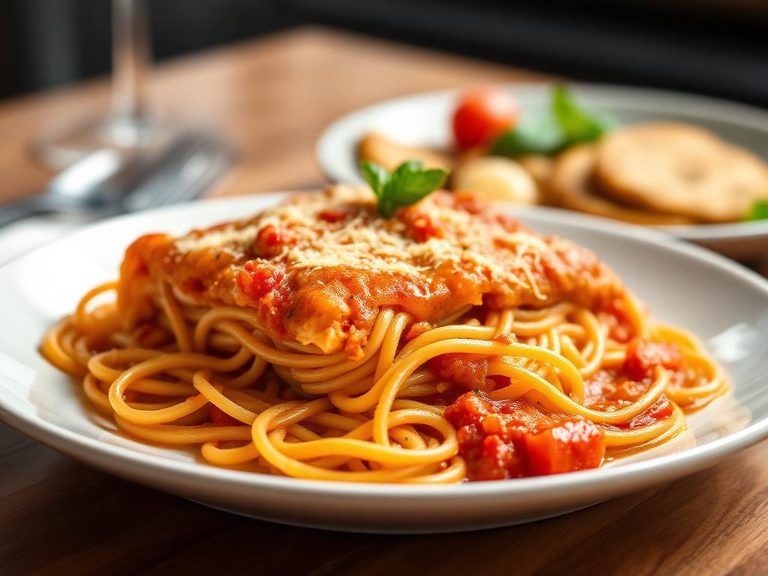
DENNY'S, spaghetti and meatballs
Whole food · Restaurant Foods

Photo: Wikipedia
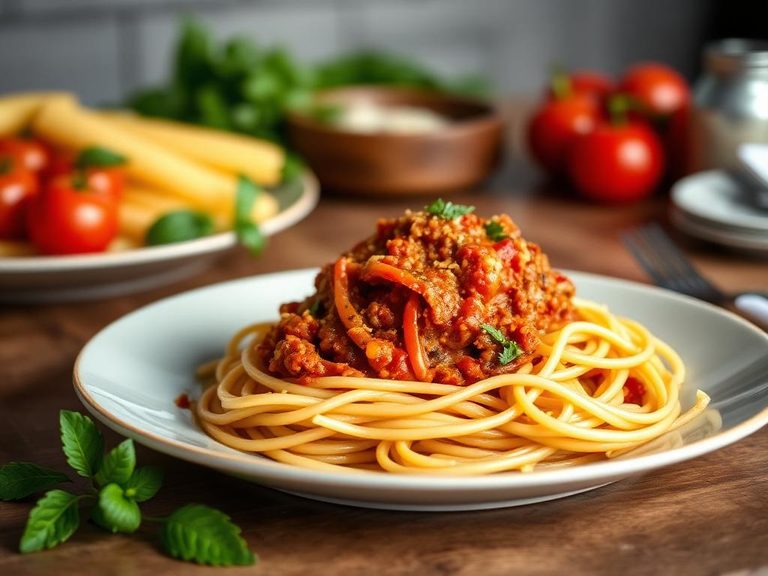
Denny's spaghetti and meatballs is a classic American diner staple, featuring tender pasta twirls coated in a tangy, sweet tomato sauce and paired with savory, ground-beef meatballs. The dish offers a comforting balance of soft noodles and hearty protein, with a texture that is both satisfying and familiar. Nutritionally, it provides a moderate calorie count with a notable protein content, making it a filling option for a quick meal.
Calorie split: 18% protein · 36% carbs · 45% fat
↓ Full nutrition💚 Why it's loved
People love it for its nostalgic, homestyle appeal and the satisfying combination of savory meatballs with sweet-tangy tomato sauce. It's a versatile comfort food that can be enjoyed as a hearty standalone meal or paired with a side salad for a more complete dining experience.
⚠️ Watch-outs & how to enjoy it better
The dish can be high in sodium and added sugars, which may concern those monitoring blood pressure or blood sugar levels. To counteract this, pair it with a fiber-rich vegetable side like steamed broccoli or a leafy green salad to help slow carbohydrate absorption and add nutritional balance.
Key benefits
- Provides a balanced mix of carbohydrates for energy and protein for muscle maintenance.
- Contains dietary fiber, which supports digestive health and promotes satiety.
- Offers a convenient and satisfying meal with a familiar, comforting flavor profile.
- The tomato-based sauce contributes a source of antioxidants like lycopene.
🍽️ Popular dishes
🌍 Where it's eaten
💡 Did you know?
The meatball in spaghetti and meatballs is an Italian-American invention; in Italy, meatballs (polpette) are typically served as a separate course, not on top of pasta.
Full nutrition (USDA data · scales with serving)
| Water | 66.6 g |
| Energy | 170 kcal |
| Energy | 712 kj |
| Protein | 7.8 g |
| Total lipid (fat) | 8.5 g |
| Ash | 1.5 g |
| Carbohydrate, by difference | 15.5 g |
| Fiber, total dietary | 1.5 g |
| Total Sugars | 2.0 g |
| Sucrose | 0.50 g |
| Glucose | 0.63 g |
| Fructose | 0.70 g |
| Lactose | 0.00 g |
| Maltose | 0.20 g |
| Galactose | 0.00 g |
| Starch | 11.4 g |
| Calcium, Ca | 45.0 mg |
| Iron, Fe | 1.3 mg |
| Magnesium, Mg | 23.0 mg |
| Phosphorus, P | 89.0 mg |
| Potassium, K | 206 mg |
| Sodium, Na | 351 mg |
| Zinc, Zn | 1.0 mg |
| Copper, Cu | 0.11 mg |
| Manganese, Mn | 0.28 mg |
| Selenium, Se | 18.4 ug |
| Vitamin C, total ascorbic acid | 0.90 mg |
| Thiamin | 0.11 mg |
| Riboflavin | 0.17 mg |
| Niacin | 2.0 mg |
| Pantothenic acid | 0.44 mg |
| Vitamin B-6 | 0.14 mg |
| Folate, total | 36.0 ug |
| Vitamin B-12 | 0.39 ug |
| Vitamin A, RAE | 28.0 ug |
| Retinol | 18.0 ug |
| Carotene, beta | 120 ug |
| Carotene, alpha | 0.00 ug |
| Cryptoxanthin, beta | 0.00 ug |
| Vitamin A, IU | 258 iu |
| Lycopene | 2740 ug |
| Lutein + zeaxanthin | 159 ug |
| Vitamin E (alpha-tocopherol) | 0.75 mg |
| Tocopherol, beta | 0.00 mg |
| Tocopherol, gamma | 0.36 mg |
| Tocopherol, delta | 0.06 mg |
| Tocotrienol, alpha | 0.03 mg |
| Tocotrienol, beta | 0.27 mg |
| Tocotrienol, gamma | 0.08 mg |
| Tocotrienol, delta | 0.00 mg |
Fat & fatty acid profile (per 100g)
| Fatty acids, total saturated | 3.1 g |
| SFA 4:0 | 0.01 g |
| SFA 6:0 | 0.01 g |
| SFA 8:0 | 0.01 g |
| SFA 10:0 | 0.02 g |
| SFA 12:0 | 0.02 g |
| SFA 14:0 | 0.20 g |
| SFA 15:0 | 0.03 g |
| SFA 16:0 | 1.8 g |
| SFA 17:0 | 0.06 g |
| SFA 18:0 | 0.92 g |
| SFA 20:0 | 0.01 g |
| SFA 22:0 | 0.01 g |
| SFA 24:0 | 0.00 g |
| Fatty acids, total monounsaturated | 3.6 g |
| MUFA 14:1 | 0.04 g |
| MUFA 15:1 | 0.00 g |
| MUFA 16:1 | 0.21 g |
| MUFA 16:1 c | 0.20 g |
| MUFA 17:1 | 0.04 g |
| MUFA 18:1 | 3.3 g |
| MUFA 18:1 c | 3.1 g |
| MUFA 20:1 | 0.05 g |
| MUFA 22:1 | 0.00 g |
| MUFA 22:1 c | 0.00 g |
| MUFA 24:1 c | 0.00 g |
| Fatty acids, total polyunsaturated | 1.2 g |
| PUFA 18:2 | 1.1 g |
| PUFA 18:2 n-6 c,c | 0.99 g |
| PUFA 18:2 CLAs | 0.03 g |
| PUFA 18:3 | 0.09 g |
| PUFA 18:3 n-3 c,c,c (ALA) | 0.08 g |
| PUFA 18:3 n-6 c,c,c | 0.00 g |
| PUFA 18:3i | 0.00 g |
| PUFA 18:4 | 0.00 g |
| PUFA 20:2 n-6 c,c | 0.03 g |
| PUFA 20:3 | 0.01 g |
| PUFA 20:3 n-3 | 0.00 g |
| PUFA 20:3 n-6 | 0.01 g |
| PUFA 20:4 | 0.02 g |
| PUFA 20:5 n-3 (EPA) | 0.00 g |
| PUFA 22:4 | 0.01 g |
| PUFA 22:5 n-3 (DPA) | 0.01 g |
| PUFA 22:6 n-3 (DHA) | 0.00 g |
| Fatty acids, total trans | 0.22 g |
| Fatty acids, total trans-monoenoic | 0.18 g |
| TFA 16:1 t | 0.02 g |
| TFA 18:1 t | 0.17 g |
| TFA 22:1 t | 0.00 g |
| TFA 18:2 t not further defined | 0.03 g |
| Fatty acids, total trans-polyenoic | 0.03 g |
| Cholesterol | 19.0 mg |
Amino acid profile (per 100g)
| Tryptophan | 0.09 g |
| Threonine | 0.33 g |
| Isoleucine | 0.37 g |
| Leucine | 0.71 g |
| Lysine | 0.56 g |
| Methionine | 0.19 g |
| Cystine | 0.14 g |
| Phenylalanine | 0.40 g |
| Tyrosine | 0.25 g |
| Valine | 0.45 g |
| Arginine | 0.50 g |
| Histidine | 0.27 g |
| Alanine | 0.44 g |
| Aspartic acid | 0.69 g |
| Glutamic acid | 2.2 g |
| Glycine | 0.46 g |
| Proline | 0.79 g |
| Serine | 0.39 g |
| Hydroxyproline | 0.06 g |
FAQ
Is Denny's spaghetti and meatballs a good source of protein?
Yes, it provides a moderate amount of protein (7.84g per 100g), which can contribute to daily protein needs, especially when paired with other protein-rich foods.
How does the sugar content affect the dish?
The sugar content (2.03g per 100g) comes primarily from the tomato sauce and can contribute to a slight sweetness. For those managing blood sugar, pairing with protein or fat can help mitigate spikes.
Can I make a healthier version at home?
Absolutely. Use whole-grain pasta, lean ground turkey or plant-based meatballs, and a low-sugar tomato sauce to reduce calories and increase fiber and nutrients.
Nutrient density (calculated · NRF9.3)
Nutrient Rich Foods index: beneficial nutrients (protein, fiber, vitamins, minerals) minus saturated fat, added sugar & sodium, per 100 kcal.
NRF9.3 index — Fulgoni, Keast & Drewnowski, 2009. Computed from USDA nutrients.
Weight-loss friendliness (composite index)
Energy density 1.70 kcal/g · 18% calories from protein · 1.5 g fiber · 2.0 g sugar per 100 g.
Composite of energy density (Rolls et al., 1999), protein & fiber satiety, minus sugar. A calculated heuristic — ranks satiety-per-calorie, not a clinical measure.
Dietary load (calculated from USDA values)
Potential renal acid load. Positive = acid-forming, negative = alkaline-forming.
Sodium-to-potassium ratio: 1.70 (lower is better — aim for ≤ 1)
Sodium:potassium per WHO potassium guidance. Computed from USDA nutrients.