

Cornmeal, degermed, enriched, white
Whole food · Cereal Grains and Pasta

Photo: Wikipedia
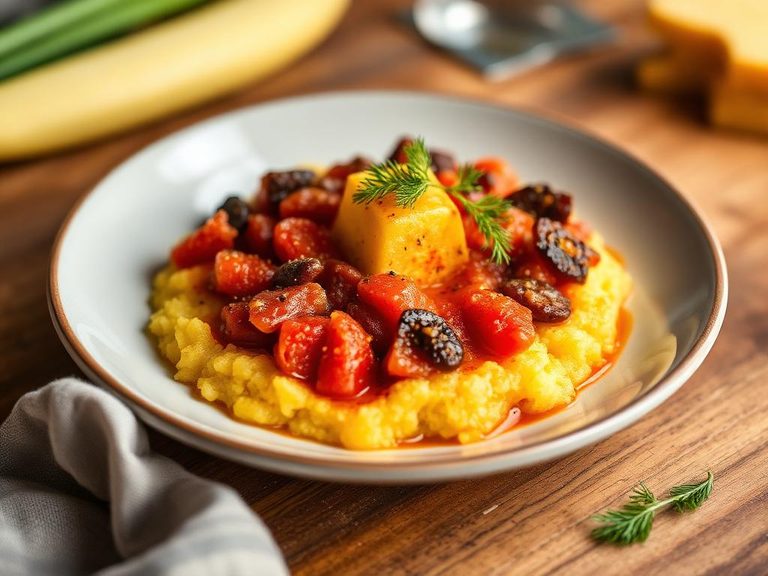
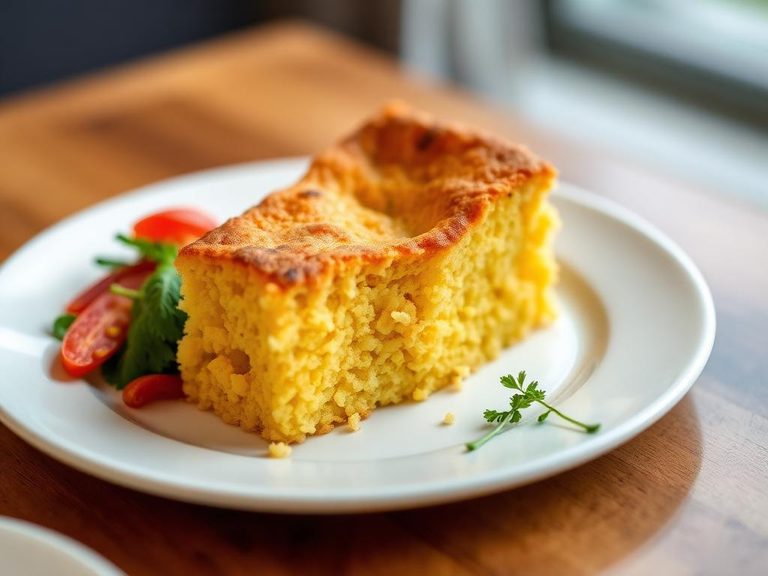
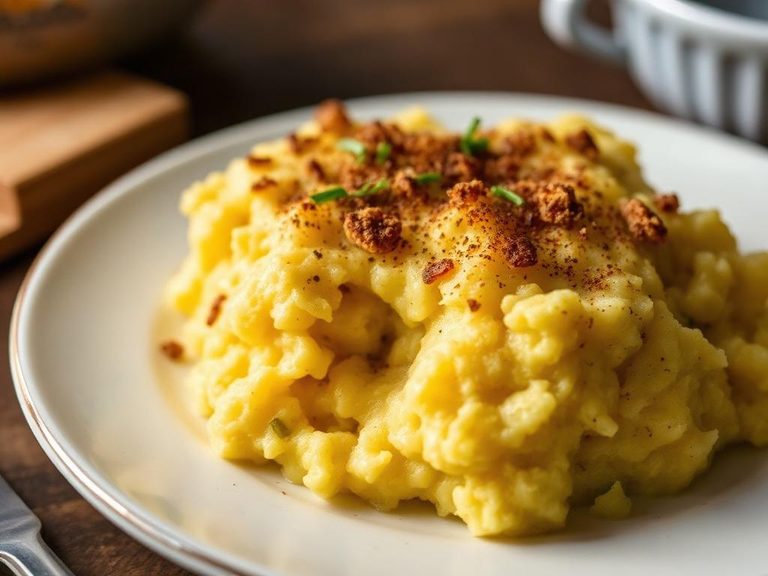
Degermed, enriched white cornmeal is a finely ground, shelf-stable powder made from corn kernels with the germ and hull removed. It cooks into a smooth, creamy porridge or a tender, crumbly bread with a mild, slightly sweet corn flavor. Nutritionally, it's a concentrated source of carbohydrates, providing quick energy, and is fortified with B vitamins and iron.
Calorie split: 8% protein · 88% carbs · 4% fat
↓ Full nutrition💚 Why it's loved
People love it for its comforting, mild corn flavor and its incredible versatility—it's the foundation for everything from creamy breakfast porridge to savory polenta cakes and tender cornbread. It's a beloved staple in many cultures, representing home cooking and hearty, simple meals.
⚠️ Watch-outs & how to enjoy it better
As a refined grain, it can cause rapid blood-sugar spikes due to its high glycemic index. To counteract this, pair it with protein (like cheese in polenta or eggs with cornbread) or healthy fats, and consider mixing it with whole-grain cornmeal for added fiber to slow digestion.
Key benefits
- Provides quick, easily digestible energy
- Fortified with B vitamins (thiamin, niacin, folic acid) and iron
- Naturally low in fat and cholesterol-free
- A good source of dietary fiber, especially when cooked
- Gluten-free, making it suitable for celiac diets
🍽️ Popular dishes



🌍 Where it's eaten
💡 Did you know?
The 'degerming' process, which removes the oily germ to extend shelf life, was commercialized in the early 1900s and fundamentally changed cornmeal from a perishable, coarse product into the stable, fine-textured staple we know today.
Full nutrition (USDA data · scales with serving)
| Water | 11.2 g |
| Energy | 370 kcal |
| Energy | 1547 kj |
| Protein | 7.1 g |
| Total lipid (fat) | 1.8 g |
| Ash | 0.51 g |
| Carbohydrate, by difference | 79.5 g |
| Fiber, total dietary | 3.9 g |
| Total Sugars | 1.6 g |
| Sucrose | 0.68 g |
| Glucose | 0.56 g |
| Fructose | 0.17 g |
| Lactose | 0.00 g |
| Maltose | 0.19 g |
| Galactose | 0.00 g |
| Starch | 73.3 g |
| Calcium, Ca | 3.0 mg |
| Iron, Fe | 4.4 mg |
| Magnesium, Mg | 32.0 mg |
| Phosphorus, P | 99.0 mg |
| Potassium, K | 142 mg |
| Sodium, Na | 7.0 mg |
| Zinc, Zn | 0.66 mg |
| Copper, Cu | 0.08 mg |
| Manganese, Mn | 0.17 mg |
| Selenium, Se | 10.5 ug |
| Vitamin C, total ascorbic acid | 0.00 mg |
| Thiamin | 0.55 mg |
| Riboflavin | 0.38 mg |
| Niacin | 5.0 mg |
| Pantothenic acid | 0.24 mg |
| Vitamin B-6 | 0.18 mg |
| Folate, total | 209 ug |
| Folic acid | 180 ug |
| Folate, food | 30.0 ug |
| Folate, DFE | 335 ug |
| Choline, total | 8.6 mg |
| Betaine | 1.0 mg |
| Vitamin B-12 | 0.00 ug |
| Vitamin B-12, added | 0.00 ug |
| Vitamin A, RAE | 0.00 ug |
| Retinol | 0.00 ug |
| Carotene, beta | 1.0 ug |
| Carotene, alpha | 0.00 ug |
| Cryptoxanthin, beta | 1.0 ug |
| Vitamin A, IU | 3.0 iu |
| Lycopene | 0.00 ug |
| Lutein + zeaxanthin | 5.0 ug |
| Vitamin E (alpha-tocopherol) | 0.12 mg |
| Vitamin E, added | 0.00 mg |
| Tocopherol, beta | 0.02 mg |
| Tocopherol, gamma | 0.45 mg |
| Tocopherol, delta | 0.04 mg |
| Tocotrienol, alpha | 0.35 mg |
| Tocotrienol, beta | 0.00 mg |
| Tocotrienol, gamma | 0.58 mg |
| Tocotrienol, delta | 0.00 mg |
| Vitamin D (D2 + D3), International Units | 0.00 iu |
| Vitamin D (D2 + D3) | 0.00 ug |
| Vitamin K (phylloquinone) | 0.00 ug |
| Vitamin K (Dihydrophylloquinone) | 0.00 ug |
| Alcohol, ethyl | 0.00 g |
| Caffeine | 0.00 mg |
| Theobromine | 0.00 mg |
Fat & fatty acid profile (per 100g)
| Fatty acids, total saturated | 0.22 g |
| SFA 4:0 | 0.00 g |
| SFA 6:0 | 0.00 g |
| SFA 8:0 | 0.00 g |
| SFA 10:0 | 0.00 g |
| SFA 12:0 | 0.00 g |
| SFA 13:0 | 0.00 g |
| SFA 14:0 | 0.00 g |
| SFA 15:0 | 0.00 g |
| SFA 16:0 | 0.17 g |
| SFA 17:0 | 0.00 g |
| SFA 18:0 | 0.04 g |
| SFA 20:0 | 0.00 g |
| SFA 22:0 | 0.00 g |
| SFA 24:0 | 0.00 g |
| Fatty acids, total monounsaturated | 0.39 g |
| MUFA 14:1 | 0.00 g |
| MUFA 15:1 | 0.00 g |
| MUFA 16:1 | 0.00 g |
| MUFA 17:1 | 0.00 g |
| MUFA 18:1 | 0.39 g |
| MUFA 20:1 | 0.00 g |
| MUFA 22:1 | 0.00 g |
| MUFA 24:1 c | 0.00 g |
| Fatty acids, total polyunsaturated | 0.83 g |
| PUFA 18:2 | 0.81 g |
| PUFA 18:3 | 0.02 g |
| PUFA 18:3 n-6 c,c,c | 0.00 g |
| PUFA 18:4 | 0.00 g |
| PUFA 20:2 n-6 c,c | 0.00 g |
| PUFA 20:3 | 0.00 g |
| PUFA 20:4 | 0.00 g |
| PUFA 20:5 n-3 (EPA) | 0.00 g |
| PUFA 21:5 | 0.00 g |
| PUFA 22:4 | 0.00 g |
| PUFA 22:5 n-3 (DPA) | 0.00 g |
| PUFA 22:6 n-3 (DHA) | 0.00 g |
| Fatty acids, total trans | 0.00 g |
| Fatty acids, total trans-monoenoic | 0.00 g |
| TFA 18:1 t | 0.00 g |
| Cholesterol | 0.00 mg |
Amino acid profile (per 100g)
| Tryptophan | 0.04 g |
| Threonine | 0.17 g |
| Isoleucine | 0.24 g |
| Leucine | 1.0 g |
| Lysine | 0.10 g |
| Methionine | 0.16 g |
| Cystine | 0.16 g |
| Phenylalanine | 0.37 g |
| Tyrosine | 0.19 g |
| Valine | 0.34 g |
| Arginine | 0.24 g |
| Histidine | 0.17 g |
| Alanine | 0.56 g |
| Aspartic acid | 0.47 g |
| Glutamic acid | 1.5 g |
| Glycine | 0.22 g |
| Proline | 0.75 g |
| Serine | 0.34 g |
| Hydroxyproline | 0.00 g |
FAQ
What's the difference between degermed cornmeal and stone-ground cornmeal?
Degermed cornmeal has the oily germ and hull removed for a longer shelf life and finer texture. Stone-ground cornmeal retains the germ and hull, giving it a coarser texture, more nutrients, and a shorter shelf life.
Is this the same as cornstarch?
No. Cornmeal is ground from the whole corn kernel (minus the germ), while cornstarch is a pure starch extracted from the endosperm. They are not interchangeable in recipes.
Why is it 'enriched'?
The refining process removes some natural nutrients. Enrichment adds back key B vitamins (thiamin, niacin, folic acid) and iron to improve its nutritional profile.
Nutrient density (calculated · NRF9.3)
Nutrient Rich Foods index: beneficial nutrients (protein, fiber, vitamins, minerals) minus saturated fat, added sugar & sodium, per 100 kcal.
NRF9.3 index — Fulgoni, Keast & Drewnowski, 2009. Computed from USDA nutrients.
Weight-loss friendliness (composite index)
Energy density 3.70 kcal/g · 8% calories from protein · 3.9 g fiber · 1.6 g sugar per 100 g.
Composite of energy density (Rolls et al., 1999), protein & fiber satiety, minus sugar. A calculated heuristic — ranks satiety-per-calorie, not a clinical measure.
Dietary load (calculated from USDA values)
Potential renal acid load. Positive = acid-forming, negative = alkaline-forming.
Sodium-to-potassium ratio: 0.05 (lower is better — aim for ≤ 1)
Sodium:potassium per WHO potassium guidance. Computed from USDA nutrients.