

DENNY'S, fish fillet, battered or breaded, fried
Whole food · Restaurant Foods

Photo: Wikipedia
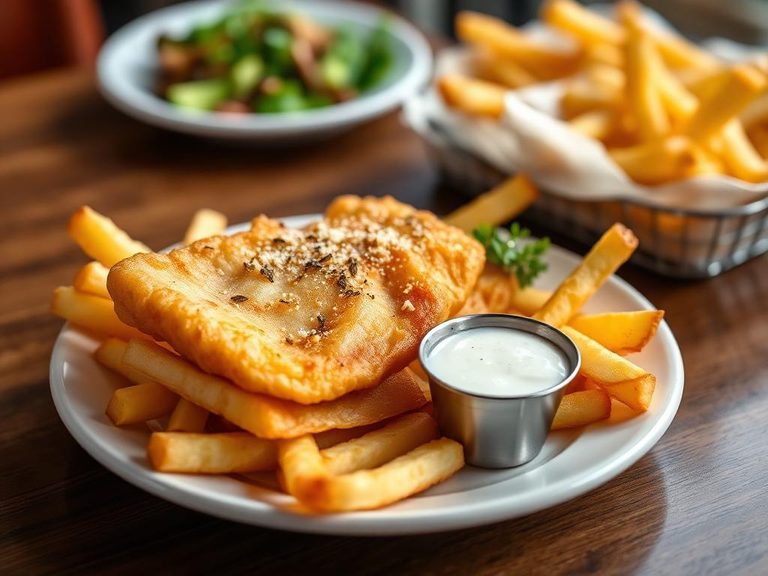
A classic diner staple, this battered or breaded fish fillet features a crispy, golden-brown exterior that gives way to tender, flaky white fish inside. It's a satisfying comfort food, offering a notable protein boost (13.75g per 100g) alongside its signature crunch.
Calorie split: 23% protein · 30% carbs · 47% fat
↓ Full nutrition💚 Why it's loved
People adore it for the universal appeal of the crispy-on-the-outside, tender-on-the-inside texture and its mild, savory flavor that pairs perfectly with tangy tartar sauce or a squeeze of lemon. It's a nostalgic comfort food, evoking casual family meals and classic American diner culture.
⚠️ Watch-outs & how to enjoy it better
The frying process adds significant fat and calories, and the batter can be high in sodium and refined carbohydrates, potentially causing blood sugar spikes. To counteract this, pair it with non-starchy vegetables (like coleslaw or steamed broccoli) to add fiber, practice portion control, and opt for a side salad instead of fries.
Key benefits
- Good source of lean protein
- Provides essential B vitamins like niacin and B12
- Contains minerals such as selenium and phosphorus
- Quick and convenient hot meal option
- Satisfying texture contrast (crispy outside, soft inside)
🍽️ Popular dishes




🌍 Where it's eaten
💡 Did you know?
The 'Filet-O-Fish' sandwich, introduced by McDonald's in 1962, was created specifically to cater to Catholic customers who abstained from meat on Fridays during Lent.
Full nutrition (USDA data · scales with serving)
| Water | 54.7 g |
| Energy | 234 kcal |
| Energy | 979 kj |
| Protein | 13.8 g |
| Total lipid (fat) | 12.2 g |
| Ash | 2.0 g |
| Carbohydrate, by difference | 17.4 g |
| Fiber, total dietary | 1.0 g |
| Total Sugars | 0.40 g |
| Sucrose | 0.20 g |
| Glucose | 0.00 g |
| Fructose | 0.00 g |
| Lactose | 0.00 g |
| Maltose | 0.20 g |
| Galactose | 0.00 g |
| Starch | 16.2 g |
| Calcium, Ca | 14.0 mg |
| Iron, Fe | 0.41 mg |
| Magnesium, Mg | 25.0 mg |
| Phosphorus, P | 181 mg |
| Potassium, K | 261 mg |
| Sodium, Na | 516 mg |
| Zinc, Zn | 0.44 mg |
| Copper, Cu | 0.05 mg |
| Manganese, Mn | 0.16 mg |
| Selenium, Se | 17.2 ug |
| Thiamin | 0.07 mg |
| Riboflavin | 0.10 mg |
| Niacin | 2.7 mg |
| Pantothenic acid | 0.32 mg |
| Vitamin B-6 | 0.26 mg |
| Folate, total | 17.0 ug |
| Vitamin B-12 | 1.1 ug |
| Vitamin A, RAE | 2.0 ug |
| Retinol | 2.0 ug |
| Carotene, beta | 1.0 ug |
| Carotene, alpha | 0.00 ug |
| Cryptoxanthin, beta | 3.0 ug |
| Vitamin A, IU | 11.0 iu |
| Lycopene | 1.0 ug |
| Lutein + zeaxanthin | 48.0 ug |
| Vitamin E (alpha-tocopherol) | 1.0 mg |
| Tocopherol, beta | 0.08 mg |
| Tocopherol, gamma | 5.2 mg |
| Tocopherol, delta | 1.8 mg |
| Tocotrienol, alpha | 0.03 mg |
| Tocotrienol, beta | 0.02 mg |
| Tocotrienol, gamma | 0.11 mg |
| Tocotrienol, delta | 0.00 mg |
Fat & fatty acid profile (per 100g)
| Fatty acids, total saturated | 2.1 g |
| SFA 4:0 | 0.00 g |
| SFA 6:0 | 0.00 g |
| SFA 8:0 | 0.01 g |
| SFA 10:0 | 0.01 g |
| SFA 12:0 | 0.01 g |
| SFA 14:0 | 0.02 g |
| SFA 15:0 | 0.00 g |
| SFA 16:0 | 1.3 g |
| SFA 17:0 | 0.01 g |
| SFA 18:0 | 0.67 g |
| SFA 20:0 | 0.04 g |
| SFA 22:0 | 0.04 g |
| SFA 24:0 | 0.01 g |
| Fatty acids, total monounsaturated | 2.6 g |
| MUFA 14:1 | 0.00 g |
| MUFA 15:1 | 0.00 g |
| MUFA 16:1 | 0.02 g |
| MUFA 16:1 c | 0.02 g |
| MUFA 17:1 | 0.01 g |
| MUFA 18:1 | 2.5 g |
| MUFA 18:1 c | 2.5 g |
| MUFA 20:1 | 0.04 g |
| MUFA 22:1 | 0.00 g |
| MUFA 22:1 c | 0.00 g |
| MUFA 24:1 c | 0.00 g |
| Fatty acids, total polyunsaturated | 6.1 g |
| PUFA 18:2 | 5.2 g |
| PUFA 18:2 n-6 c,c | 5.1 g |
| PUFA 18:2 CLAs | 0.02 g |
| PUFA 18:3 | 0.69 g |
| PUFA 18:3 n-3 c,c,c (ALA) | 0.63 g |
| PUFA 18:3 n-6 c,c,c | 0.06 g |
| PUFA 18:3i | 0.00 g |
| PUFA 18:4 | 0.01 g |
| PUFA 20:2 n-6 c,c | 0.01 g |
| PUFA 20:3 | 0.00 g |
| PUFA 20:3 n-3 | 0.00 g |
| PUFA 20:3 n-6 | 0.00 g |
| PUFA 20:4 | 0.01 g |
| PUFA 20:5 n-3 (EPA) | 0.06 g |
| PUFA 22:4 | 0.00 g |
| PUFA 22:5 n-3 (DPA) | 0.00 g |
| PUFA 22:6 n-3 (DHA) | 0.11 g |
| Fatty acids, total trans | 0.11 g |
| Fatty acids, total trans-monoenoic | 0.04 g |
| TFA 16:1 t | 0.00 g |
| TFA 18:1 t | 0.04 g |
| TFA 22:1 t | 0.00 g |
| TFA 18:2 t not further defined | 0.08 g |
| Fatty acids, total trans-polyenoic | 0.08 g |
| Cholesterol | 37.0 mg |
Amino acid profile (per 100g)
| Tryptophan | 0.15 g |
| Threonine | 0.47 g |
| Isoleucine | 0.57 g |
| Leucine | 1.1 g |
| Lysine | 1.2 g |
| Methionine | 0.38 g |
| Cystine | 0.19 g |
| Phenylalanine | 0.50 g |
| Tyrosine | 0.42 g |
| Valine | 0.66 g |
| Arginine | 0.81 g |
| Histidine | 0.31 g |
| Alanine | 0.73 g |
| Aspartic acid | 1.2 g |
| Glutamic acid | 2.1 g |
| Glycine | 0.61 g |
| Proline | 0.76 g |
| Serine | 0.58 g |
FAQ
Is the fish inside the fillet typically a specific type?
While it varies by restaurant, common choices include mild white fish like cod, pollock, haddock, or tilapia, chosen for their flaky texture and neutral flavor that complements the seasoned batter.
How does the nutritional profile change if it's baked instead of fried?
Baking or air-frying significantly reduces the total fat and calorie content compared to deep-frying, while preserving most of the protein. The texture will be less uniformly crispy but can still be satisfying.
What is a common allergen concern with battered fish?
The batter typically contains wheat (gluten) and may contain milk or egg, making it unsuitable for those with celiac disease, gluten intolerance, or specific egg/dairy allergies.
Nutrient density (calculated · NRF9.3)
Nutrient Rich Foods index: beneficial nutrients (protein, fiber, vitamins, minerals) minus saturated fat, added sugar & sodium, per 100 kcal.
NRF9.3 index — Fulgoni, Keast & Drewnowski, 2009. Computed from USDA nutrients.
Weight-loss friendliness (composite index)
Energy density 2.34 kcal/g · 24% calories from protein · 1.0 g fiber · 0.4 g sugar per 100 g.
Composite of energy density (Rolls et al., 1999), protein & fiber satiety, minus sugar. A calculated heuristic — ranks satiety-per-calorie, not a clinical measure.
Dietary load (calculated from USDA values)
Potential renal acid load. Positive = acid-forming, negative = alkaline-forming.
Sodium-to-potassium ratio: 1.98 (lower is better — aim for ≤ 1)
Sodium:potassium per WHO potassium guidance. Computed from USDA nutrients.