

T.G.I. FRIDAY'S, chicken fingers
Whole food · Restaurant Foods

Photo: Wikipedia
T.G.I. Friday's chicken fingers are golden, crispy-fried strips of chicken breast, offering a satisfying crunch giving way to tender, juicy meat. Nutritionally, they are a protein-rich choice but come with a notable fat content from the frying process.
Calorie split: 23% protein · 21% carbs · 56% fat
↓ Full nutrition💚 Why it's loved
People love them for the classic combination of a crunchy, seasoned coating and soft chicken inside, often paired with dipping sauces. They are a staple of casual American dining culture, representing comfort food and social sharing.
⚠️ Watch-outs & how to enjoy it better
The frying process results in high fat and calorie density, which may not align with low-fat dietary goals. To mitigate, consider pairing with a large side salad or steamed vegetables to increase fiber and volume, and practice portion control by limiting yourself to a specific number of pieces.
Key benefits
- High-quality protein source for muscle maintenance
- Provides quick energy from carbohydrates in the breading
- Contains essential minerals like selenium and phosphorus from chicken
- A familiar, comforting food for many palates
🍽️ Popular dishes
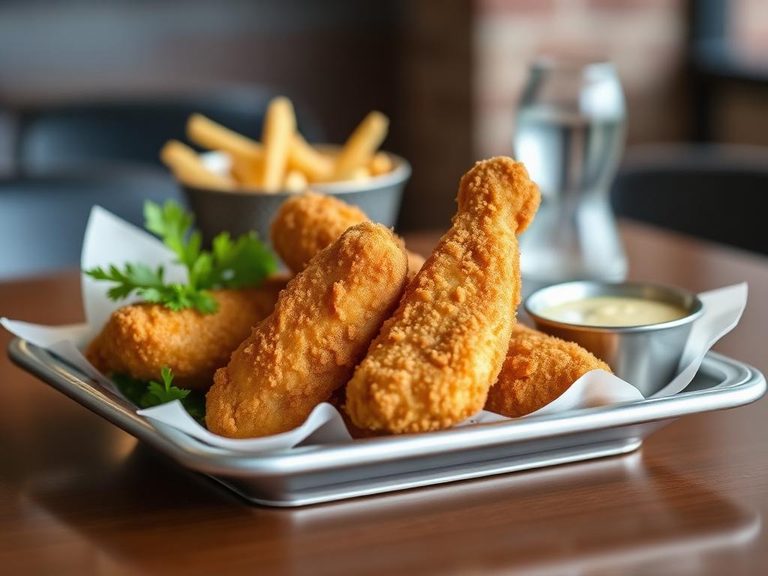

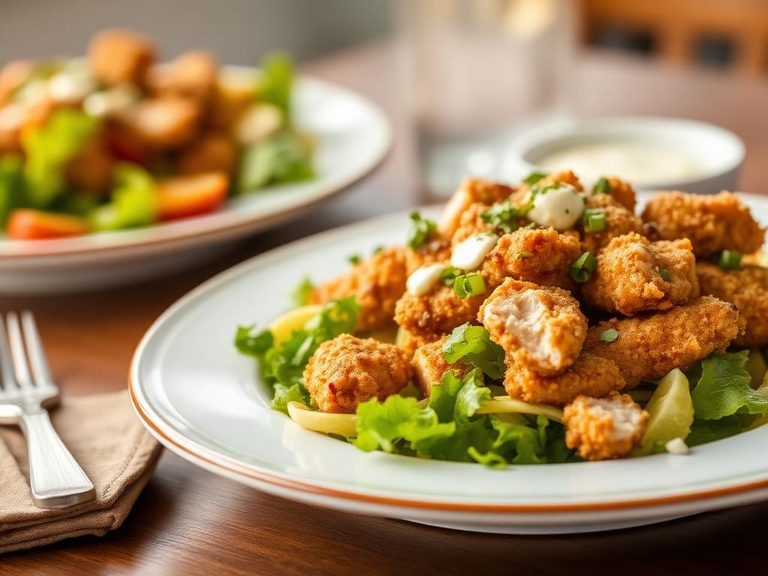
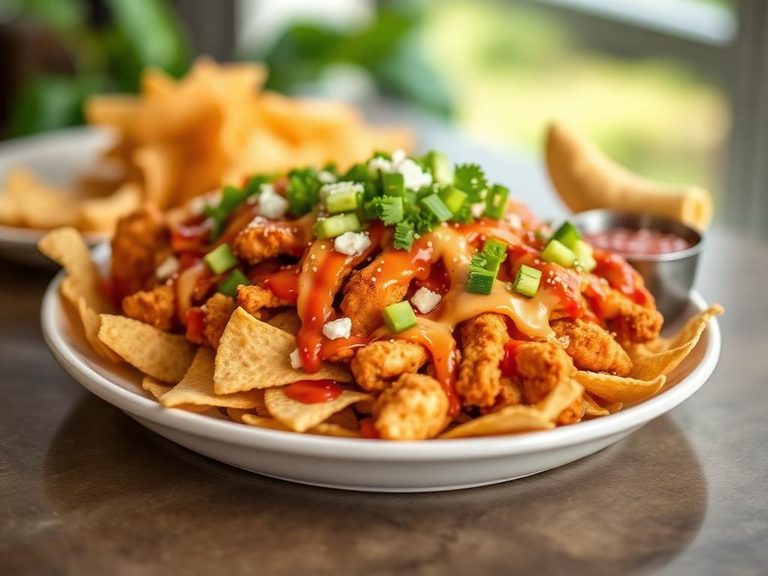
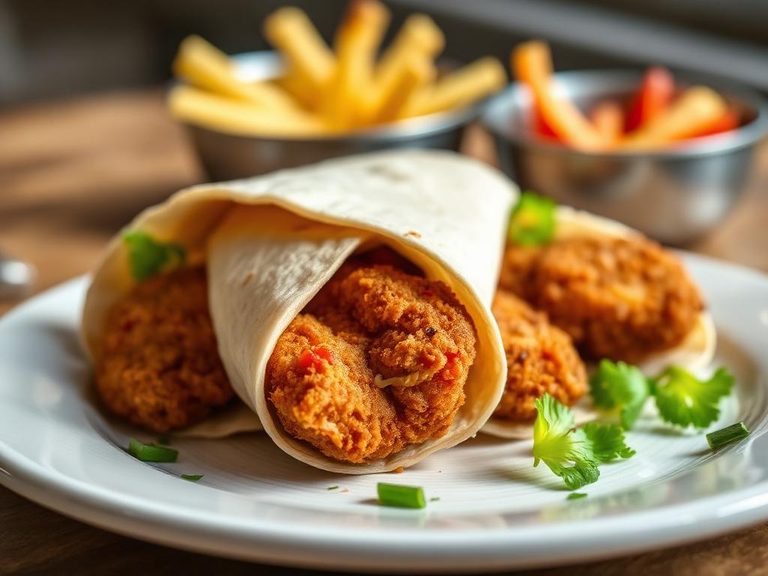
🌍 Where it's eaten
💡 Did you know?
The modern 'chicken finger' is often credited to the Puritan Backroom restaurant in Manchester, New Hampshire, which claims to have invented them in 1974.
Full nutrition (USDA data · scales with serving)
| Water | 41.3 g |
| Energy | 325 kcal |
| Energy | 1359 kj |
| Protein | 18.7 g |
| Total lipid (fat) | 20.3 g |
| Ash | 2.9 g |
| Carbohydrate, by difference | 16.8 g |
| Fiber, total dietary | 0.80 g |
| Total Sugars | 0.23 g |
| Sucrose | 0.00 g |
| Glucose | 0.23 g |
| Fructose | 0.00 g |
| Lactose | 0.00 g |
| Maltose | 0.00 g |
| Galactose | 0.00 g |
| Starch | 15.6 g |
| Calcium, Ca | 26.0 mg |
| Iron, Fe | 0.77 mg |
| Magnesium, Mg | 29.0 mg |
| Phosphorus, P | 350 mg |
| Potassium, K | 308 mg |
| Sodium, Na | 787 mg |
| Zinc, Zn | 0.65 mg |
| Copper, Cu | 0.07 mg |
| Manganese, Mn | 0.23 mg |
| Selenium, Se | 28.8 ug |
| Thiamin | 0.10 mg |
| Riboflavin | 0.18 mg |
| Niacin | 8.4 mg |
| Pantothenic acid | 1.6 mg |
| Vitamin B-6 | 0.46 mg |
| Vitamin B-12 | 0.12 ug |
| Vitamin A, RAE | 2.0 ug |
| Retinol | 2.0 ug |
| Carotene, beta | 1.0 ug |
| Carotene, alpha | 0.00 ug |
| Cryptoxanthin, beta | 1.0 ug |
| Vitamin A, IU | 10.0 iu |
| Lycopene | 0.00 ug |
| Lutein + zeaxanthin | 50.0 ug |
| Vitamin E (alpha-tocopherol) | 1.7 mg |
| Tocopherol, beta | 0.21 mg |
| Tocopherol, gamma | 9.6 mg |
| Tocopherol, delta | 4.2 mg |
| Tocotrienol, alpha | 0.00 mg |
| Tocotrienol, beta | 0.20 mg |
| Tocotrienol, gamma | 0.07 mg |
| Tocotrienol, delta | 0.00 mg |
Fat & fatty acid profile (per 100g)
| Fatty acids, total saturated | 3.9 g |
| SFA 4:0 | 0.00 g |
| SFA 6:0 | 0.00 g |
| SFA 8:0 | 0.01 g |
| SFA 10:0 | 0.01 g |
| SFA 12:0 | 0.00 g |
| SFA 14:0 | 0.03 g |
| SFA 15:0 | 0.01 g |
| SFA 16:0 | 2.3 g |
| SFA 17:0 | 0.02 g |
| SFA 18:0 | 1.3 g |
| SFA 20:0 | 0.07 g |
| SFA 22:0 | 0.07 g |
| SFA 24:0 | 0.02 g |
| Fatty acids, total monounsaturated | 4.9 g |
| MUFA 14:1 | 0.00 g |
| MUFA 15:1 | 0.00 g |
| MUFA 16:1 | 0.06 g |
| MUFA 16:1 c | 0.06 g |
| MUFA 17:1 | 0.01 g |
| MUFA 18:1 | 4.7 g |
| MUFA 18:1 c | 4.6 g |
| MUFA 20:1 | 0.14 g |
| MUFA 22:1 | 0.00 g |
| MUFA 22:1 c | 0.00 g |
| MUFA 24:1 c | 0.00 g |
| Fatty acids, total polyunsaturated | 10.6 g |
| PUFA 18:2 | 9.3 g |
| PUFA 18:2 n-6 c,c | 9.1 g |
| PUFA 18:2 CLAs | 0.03 g |
| PUFA 18:3 | 1.2 g |
| PUFA 18:3 n-3 c,c,c (ALA) | 1.1 g |
| PUFA 18:3 n-6 c,c,c | 0.09 g |
| PUFA 18:3i | 0.00 g |
| PUFA 18:4 | 0.00 g |
| PUFA 20:2 n-6 c,c | 0.01 g |
| PUFA 20:3 | 0.01 g |
| PUFA 20:3 n-3 | 0.00 g |
| PUFA 20:3 n-6 | 0.01 g |
| PUFA 20:4 | 0.04 g |
| PUFA 20:5 n-3 (EPA) | 0.00 g |
| PUFA 22:4 | 0.01 g |
| PUFA 22:5 n-3 (DPA) | 0.00 g |
| PUFA 22:6 n-3 (DHA) | 0.00 g |
| Fatty acids, total trans | 0.18 g |
| Fatty acids, total trans-monoenoic | 0.06 g |
| TFA 16:1 t | 0.00 g |
| TFA 18:1 t | 0.06 g |
| TFA 22:1 t | 0.00 g |
| TFA 18:2 t not further defined | 0.12 g |
| Fatty acids, total trans-polyenoic | 0.12 g |
| Cholesterol | 46.0 mg |
Amino acid profile (per 100g)
| Tryptophan | 0.19 g |
| Threonine | 0.56 g |
| Isoleucine | 0.88 g |
| Leucine | 1.4 g |
| Lysine | 1.5 g |
| Methionine | 0.47 g |
| Cystine | 0.22 g |
| Phenylalanine | 0.70 g |
| Tyrosine | 0.50 g |
| Valine | 0.96 g |
| Arginine | 1.1 g |
| Histidine | 0.63 g |
| Alanine | 0.97 g |
| Aspartic acid | 1.5 g |
| Glutamic acid | 3.0 g |
| Glycine | 0.75 g |
| Proline | 1.4 g |
| Serine | 0.58 g |
| Hydroxyproline | 0.01 g |
FAQ
Are chicken fingers made from whole chicken breast?
Typically, yes. They are strips cut from the pectoral muscle of the chicken, though some commercial versions may be formed from minced or restructured chicken.
How can I make them healthier at home?
Bake or air-fry them instead of deep-frying. Use a light coating of whole-grain breadcrumbs or crushed cornflakes, and season generously with herbs and spices to reduce the need for salt.
What is the best dipping sauce to balance the nutrition?
Opt for sauces based on yogurt, like a Greek yogurt ranch, or a simple mix of ketchup and mustard. These can add flavor with less fat than creamy, mayo-based sauces.
Nutrient density (calculated · NRF9.3)
Nutrient Rich Foods index: beneficial nutrients (protein, fiber, vitamins, minerals) minus saturated fat, added sugar & sodium, per 100 kcal.
NRF9.3 index — Fulgoni, Keast & Drewnowski, 2009. Computed from USDA nutrients.
Weight-loss friendliness (composite index)
Energy density 3.25 kcal/g · 23% calories from protein · 0.8 g fiber · 0.2 g sugar per 100 g.
Composite of energy density (Rolls et al., 1999), protein & fiber satiety, minus sugar. A calculated heuristic — ranks satiety-per-calorie, not a clinical measure.
Dietary load (calculated from USDA values)
Potential renal acid load. Positive = acid-forming, negative = alkaline-forming.
Sodium-to-potassium ratio: 2.56 (lower is better — aim for ≤ 1)
Sodium:potassium per WHO potassium guidance. Computed from USDA nutrients.