

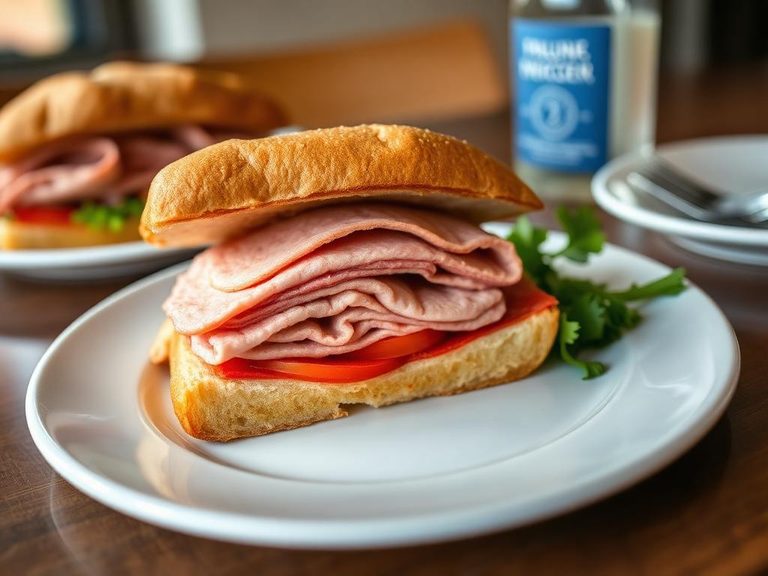
SUBWAY, turkey breast sub on white bread with lettuce and tomato
Whole food · Fast Foods

Photo: Wikipedia
A classic SUBWAY turkey breast sub on white bread is a light, protein-packed sandwich featuring lean, sliced turkey breast, crisp lettuce, and juicy tomato on soft, pillowy white bread. The texture is a satisfying contrast between the tender, mild turkey and the fresh, crunchy vegetables, all held together by the bread's subtle sweetness. Nutritionally, it's a lean option with a solid protein-to-calorie ratio, making it a popular choice for a quick, filling meal.
Calorie split: 25% protein · 61% carbs · 14% fat
↓ Full nutrition💚 Why it's loved
People love it for its clean, familiar flavors—the mild turkey lets the fresh veggies shine—and its versatility as a customizable, portable meal that fits easily into a busy day. It's a staple of casual American lunch culture, offering a perceived 'lighter' alternative to heavier sandwiches.
⚠️ Watch-outs & how to enjoy it better
The white bread can cause faster blood-sugar spikes compared to whole-grain options, and deli meats like turkey are often high in sodium. To counteract this, choose a whole-wheat or multigrain bread if available, add a side of healthy fats like avocado or a handful of nuts to slow digestion, and ensure the rest of your day's meals are lower in sodium.
Key benefits
- High-quality lean protein for muscle maintenance
- Low in total fat, especially saturated fat
- Provides quick energy from carbohydrates
- Contains fresh vegetables for added texture and micronutrients
- Convenient and customizable for on-the-go meals
🍽️ Popular dishes
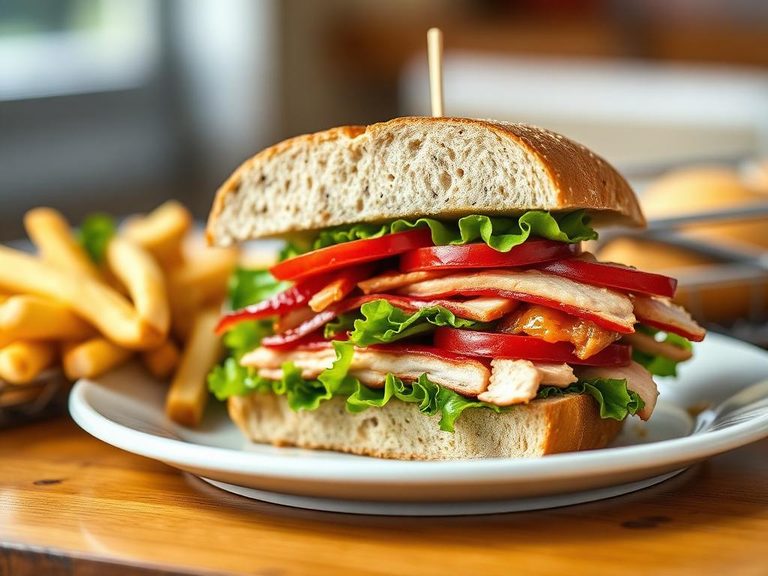

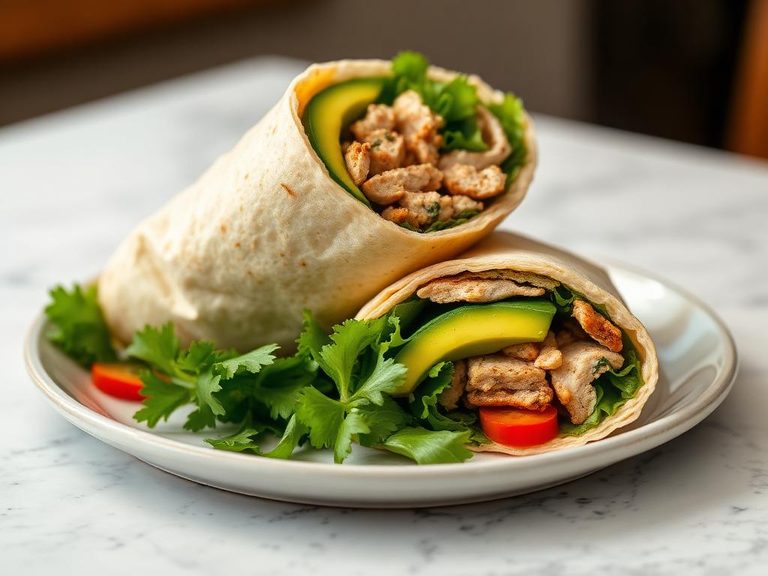
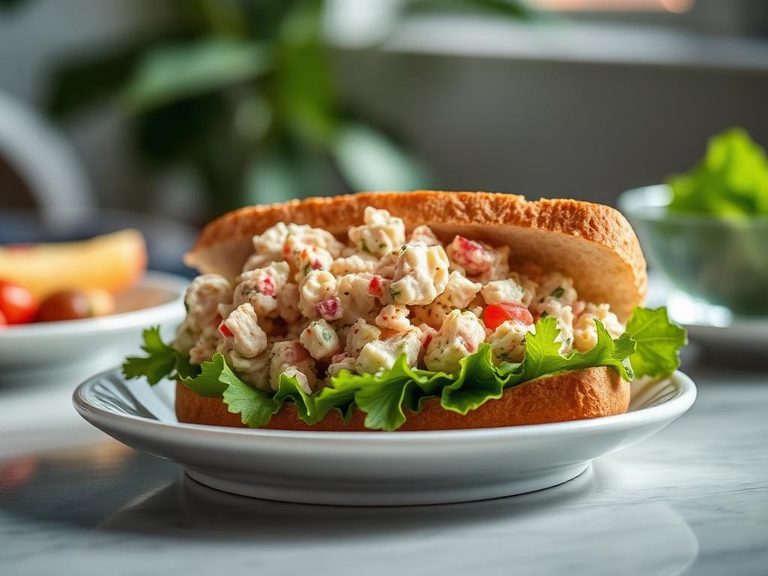
🌍 Where it's eaten
💡 Did you know?
The turkey breast sub was one of the original sandwiches offered when Subway (then 'Pete's Super Submarines') first started in 1965, helping to establish the chain's identity as a 'healthier' fast-food option.
Full nutrition (USDA data · scales with serving)
| Water | 64.3 g |
| Energy | 147 kcal |
| Energy | 615 kj |
| Protein | 9.1 g |
| Total lipid (fat) | 2.3 g |
| Ash | 1.8 g |
| Carbohydrate, by difference | 22.4 g |
| Fiber, total dietary | 1.3 g |
| Total Sugars | 3.1 g |
| Sucrose | 0.00 g |
| Glucose | 1.2 g |
| Fructose | 1.3 g |
| Lactose | 0.00 g |
| Maltose | 0.63 g |
| Galactose | 0.00 g |
| Starch | 16.7 g |
| Calcium, Ca | 169 mg |
| Iron, Fe | 1.8 mg |
| Magnesium, Mg | 23.0 mg |
| Phosphorus, P | 122 mg |
| Potassium, K | 253 mg |
| Sodium, Na | 317 mg |
| Zinc, Zn | 0.66 mg |
| Copper, Cu | 0.07 mg |
| Manganese, Mn | 0.30 mg |
| Selenium, Se | 17.0 ug |
| Vitamin C, total ascorbic acid | 1.2 mg |
| Thiamin | 0.27 mg |
| Riboflavin | 0.23 mg |
| Niacin | 4.6 mg |
| Pantothenic acid | 0.42 mg |
| Vitamin B-6 | 0.18 mg |
| Folate, total | 66.0 ug |
| Vitamin B-12 | 0.12 ug |
| Vitamin A, RAE | 2.0 ug |
| Retinol | 0.00 ug |
| Carotene, beta | 28.0 ug |
| Carotene, alpha | 0.00 ug |
| Cryptoxanthin, beta | 0.00 ug |
| Vitamin A, IU | 47.0 iu |
| Lycopene | 207 ug |
| Lutein + zeaxanthin | 72.0 ug |
| Vitamin E (alpha-tocopherol) | 0.28 mg |
| Tocopherol, beta | 0.07 mg |
| Tocopherol, gamma | 0.56 mg |
| Tocopherol, delta | 0.19 mg |
| Tocotrienol, alpha | 0.02 mg |
| Tocotrienol, beta | 0.37 mg |
| Tocotrienol, gamma | 0.00 mg |
| Tocotrienol, delta | 0.00 mg |
Fat & fatty acid profile (per 100g)
| Fatty acids, total saturated | 0.48 g |
| SFA 4:0 | 0.00 g |
| SFA 6:0 | 0.00 g |
| SFA 8:0 | 0.00 g |
| SFA 10:0 | 0.00 g |
| SFA 12:0 | 0.00 g |
| SFA 14:0 | 0.01 g |
| SFA 15:0 | 0.00 g |
| SFA 16:0 | 0.34 g |
| SFA 17:0 | 0.00 g |
| SFA 18:0 | 0.11 g |
| SFA 20:0 | 0.01 g |
| SFA 22:0 | 0.01 g |
| SFA 24:0 | 0.00 g |
| Fatty acids, total monounsaturated | 0.52 g |
| MUFA 14:1 | 0.00 g |
| MUFA 15:1 | 0.00 g |
| MUFA 16:1 | 0.02 g |
| MUFA 16:1 c | 0.02 g |
| MUFA 17:1 | 0.00 g |
| MUFA 18:1 | 0.49 g |
| MUFA 18:1 c | 0.48 g |
| MUFA 20:1 | 0.01 g |
| MUFA 22:1 | 0.00 g |
| MUFA 22:1 c | 0.00 g |
| MUFA 24:1 c | 0.00 g |
| Fatty acids, total polyunsaturated | 1.0 g |
| PUFA 18:2 | 0.92 g |
| PUFA 18:2 n-6 c,c | 0.91 g |
| PUFA 18:2 CLAs | 0.00 g |
| PUFA 18:3 | 0.09 g |
| PUFA 18:3 n-3 c,c,c (ALA) | 0.08 g |
| PUFA 18:3 n-6 c,c,c | 0.00 g |
| PUFA 18:3i | 0.00 g |
| PUFA 18:4 | 0.00 g |
| PUFA 20:2 n-6 c,c | 0.00 g |
| PUFA 20:3 | 0.00 g |
| PUFA 20:3 n-3 | 0.00 g |
| PUFA 20:3 n-6 | 0.00 g |
| PUFA 20:4 | 0.01 g |
| PUFA 20:5 n-3 (EPA) | 0.00 g |
| PUFA 22:4 | 0.01 g |
| PUFA 22:5 n-3 (DPA) | 0.00 g |
| PUFA 22:6 n-3 (DHA) | 0.00 g |
| Fatty acids, total trans | 0.02 g |
| Fatty acids, total trans-monoenoic | 0.01 g |
| TFA 16:1 t | 0.00 g |
| TFA 18:1 t | 0.01 g |
| TFA 22:1 t | 0.00 g |
| TFA 18:2 t not further defined | 0.01 g |
| Fatty acids, total trans-polyenoic | 0.01 g |
| Cholesterol | 10.0 mg |
Amino acid profile (per 100g)
Estimated from SUBWAY, cold cut sub on white bread with lettuce and tomato — USDA does not publish this profile for SUBWAY.
| Tryptophan | 0.10 g |
| Threonine | 0.33 g |
| Isoleucine | 0.43 g |
| Leucine | 0.75 g |
| Lysine | 0.49 g |
| Methionine | 0.21 g |
| Phenylalanine | 0.43 g |
| Tyrosine | 0.26 g |
| Valine | 0.50 g |
| Arginine | 0.50 g |
| Histidine | 0.30 g |
| Alanine | 0.48 g |
| Aspartic acid | 0.74 g |
| Glutamic acid | 2.5 g |
| Glycine | 0.45 g |
| Proline | 1.0 g |
| Serine | 0.41 g |
| Hydroxyproline | 0.07 g |
FAQ
Is a turkey breast sub a good post-workout meal?
Yes, it can be. The lean protein from the turkey supports muscle repair, and the carbohydrates from the white bread help replenish glycogen stores. Adding a source of healthy fat (like avocado) would make it more balanced.
How does the nutrition change if I add cheese or mayo?
Adding cheese or mayonnaise significantly increases the fat, calorie, and sodium content. A slice of provolone adds about 70 calories and 5g of fat, while a tablespoon of mayo adds nearly 100 calories and 11g of fat.
Why is the sodium content a concern in deli turkey?
Deli meats are cured and preserved with salt, leading to high sodium levels. Excessive sodium intake can contribute to high blood pressure. Rinsing the turkey briefly or choosing 'low-sodium' options when available can help reduce this.
Nutrient density (calculated · NRF9.3)
Nutrient Rich Foods index: beneficial nutrients (protein, fiber, vitamins, minerals) minus saturated fat, added sugar & sodium, per 100 kcal.
NRF9.3 index — Fulgoni, Keast & Drewnowski, 2009. Computed from USDA nutrients.
Weight-loss friendliness (composite index)
Energy density 1.47 kcal/g · 25% calories from protein · 1.3 g fiber · 3.1 g sugar per 100 g.
Composite of energy density (Rolls et al., 1999), protein & fiber satiety, minus sugar. A calculated heuristic — ranks satiety-per-calorie, not a clinical measure.
Dietary load (calculated from USDA values)
Potential renal acid load. Positive = acid-forming, negative = alkaline-forming.
Sodium-to-potassium ratio: 1.25 (lower is better — aim for ≤ 1)
Sodium:potassium per WHO potassium guidance. Computed from USDA nutrients.