

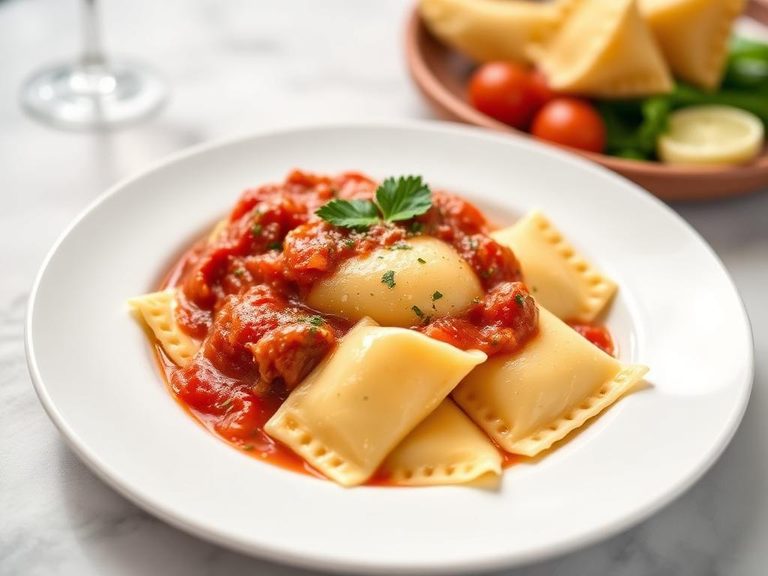
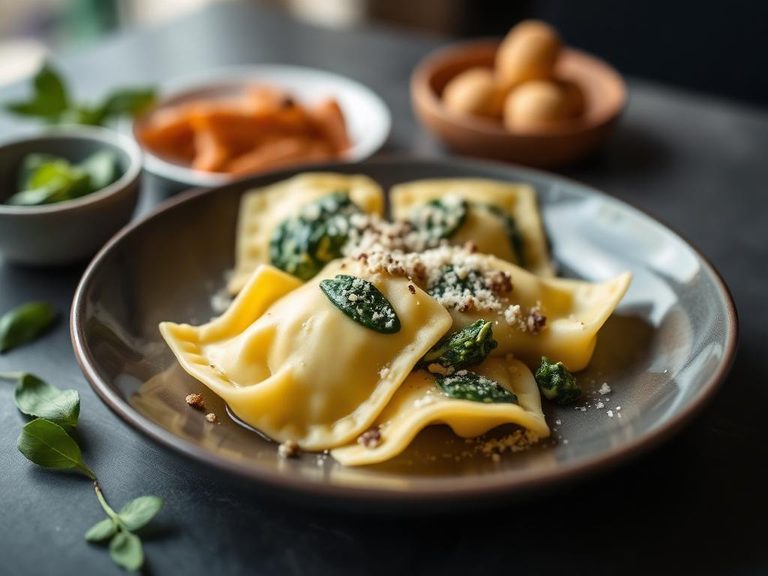
OLIVE GARDEN, cheese ravioli with marinara sauce
Whole food · Restaurant Foods

Photo: Wikipedia
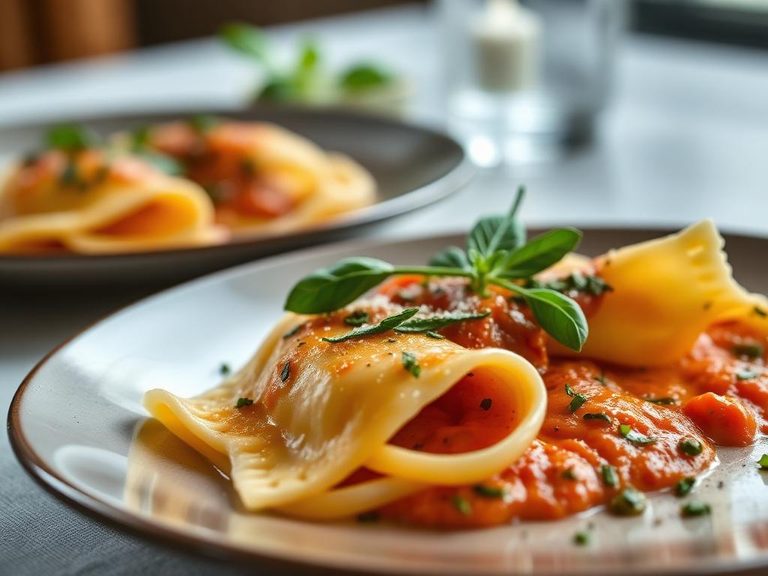
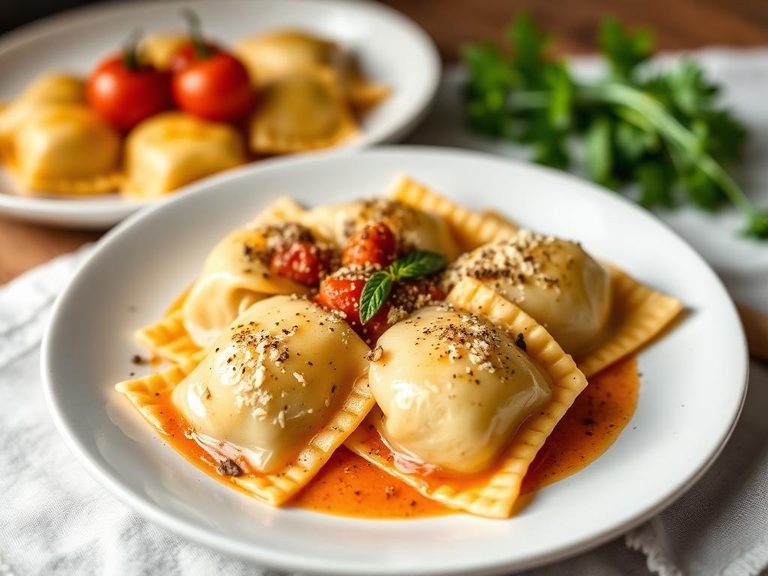
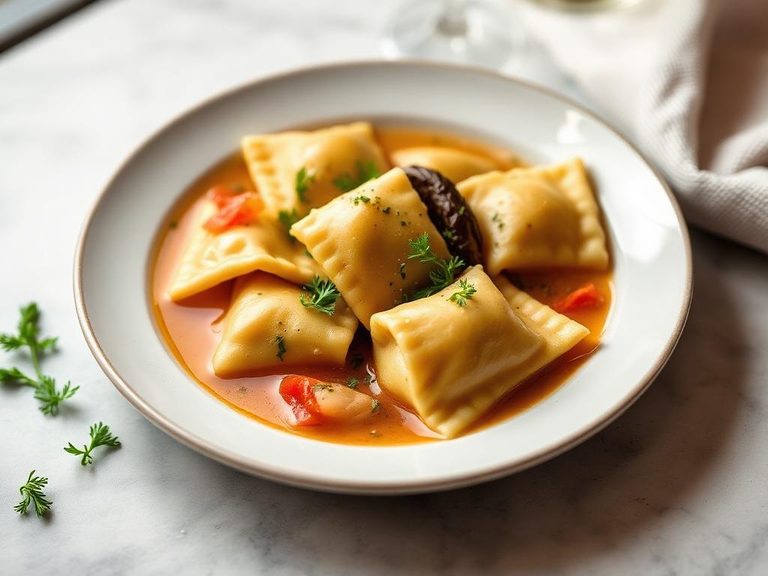
This is a classic Italian-American comfort dish featuring tender pasta pillows filled with a blend of cheeses, generously coated in a bright, herb-infused tomato marinara sauce. Each bite offers a satisfying contrast between the soft, yielding pasta and the savory, creamy filling, all balanced by the sauce's tangy sweetness. Nutritionally, it provides a moderate source of protein and carbohydrates, making it a hearty yet portion-conscious meal option.
Calorie split: 19% protein · 49% carbs · 32% fat
↓ Full nutrition💚 Why it's loved
People adore it for the nostalgic, comforting combination of rich, melted cheese encased in tender pasta and brightened by a familiar, savory tomato sauce. It's a versatile crowd-pleaser that works as a hearty main course or a satisfying part of a larger Italian-inspired meal.
⚠️ Watch-outs & how to enjoy it better
The dish can be high in sodium and refined carbohydrates, which may cause blood-sugar spikes or be a concern for those monitoring salt intake. To counteract this, pair it with a large side of non-starchy vegetables like roasted broccoli or a leafy green salad to add fiber and volume, and practice portion control by sticking to a single serving.
Key benefits
- Good source of protein from cheese filling
- Provides energy from carbohydrate-rich pasta
- Contains lycopene from tomato-based marinara sauce
- Offers calcium from the dairy component
- A satisfying, portion-controlled comfort food
🍽️ Popular dishes
🌍 Where it's eaten
💡 Did you know?
The word 'ravioli' likely derives from the Italian 'riavvolgere,' meaning 'to wrap,' and the dish has been documented in Italian cookbooks since the 14th century.
Full nutrition (USDA data · scales with serving)
| Water | 66.0 g |
| Energy | 159 kcal |
| Energy | 664 kj |
| Protein | 7.4 g |
| Total lipid (fat) | 5.6 g |
| Ash | 1.4 g |
| Carbohydrate, by difference | 19.6 g |
| Fiber, total dietary | 1.1 g |
| Total Sugars | 4.8 g |
| Sucrose | 0.00 g |
| Glucose | 0.86 g |
| Fructose | 0.74 g |
| Lactose | 2.8 g |
| Maltose | 0.47 g |
| Galactose | 0.00 g |
| Starch | 14.0 g |
| Calcium, Ca | 121 mg |
| Iron, Fe | 0.96 mg |
| Magnesium, Mg | 23.0 mg |
| Phosphorus, P | 129 mg |
| Potassium, K | 184 mg |
| Sodium, Na | 269 mg |
| Zinc, Zn | 0.75 mg |
| Copper, Cu | 0.08 mg |
| Manganese, Mn | 0.18 mg |
| Selenium, Se | 18.8 ug |
| Thiamin | 0.15 mg |
| Riboflavin | 0.24 mg |
| Niacin | 1.8 mg |
| Pantothenic acid | 0.46 mg |
| Vitamin B-6 | 0.09 mg |
| Folate, total | 44.0 ug |
| Vitamin B-12 | 0.32 ug |
| Vitamin A, RAE | 48.0 ug |
| Retinol | 38.0 ug |
| Carotene, beta | 123 ug |
| Carotene, alpha | 0.00 ug |
| Cryptoxanthin, beta | 0.00 ug |
| Vitamin A, IU | 330 iu |
| Lycopene | 1368 ug |
| Lutein + zeaxanthin | 111 ug |
| Vitamin E (alpha-tocopherol) | 0.45 mg |
| Tocopherol, beta | 0.00 mg |
| Tocopherol, gamma | 0.82 mg |
| Tocopherol, delta | 0.00 mg |
| Tocotrienol, alpha | 0.03 mg |
| Tocotrienol, beta | 0.15 mg |
| Tocotrienol, gamma | 0.00 mg |
| Tocotrienol, delta | 0.00 mg |
Fat & fatty acid profile (per 100g)
| Fatty acids, total saturated | 2.5 g |
| SFA 4:0 | 0.09 g |
| SFA 6:0 | 0.07 g |
| SFA 8:0 | 0.04 g |
| SFA 10:0 | 0.10 g |
| SFA 12:0 | 0.12 g |
| SFA 14:0 | 0.38 g |
| SFA 15:0 | 0.04 g |
| SFA 16:0 | 1.2 g |
| SFA 17:0 | 0.03 g |
| SFA 18:0 | 0.43 g |
| SFA 20:0 | 0.01 g |
| SFA 22:0 | 0.00 g |
| SFA 24:0 | 0.00 g |
| Fatty acids, total monounsaturated | 1.4 g |
| MUFA 14:1 | 0.04 g |
| MUFA 15:1 | 0.00 g |
| MUFA 16:1 | 0.07 g |
| MUFA 16:1 c | 0.06 g |
| MUFA 17:1 | 0.01 g |
| MUFA 18:1 | 1.3 g |
| MUFA 18:1 c | 1.2 g |
| MUFA 20:1 | 0.01 g |
| MUFA 22:1 | 0.00 g |
| MUFA 22:1 c | 0.00 g |
| MUFA 24:1 c | 0.00 g |
| Fatty acids, total polyunsaturated | 0.55 g |
| PUFA 18:2 | 0.46 g |
| PUFA 18:2 n-6 c,c | 0.42 g |
| PUFA 18:2 CLAs | 0.02 g |
| PUFA 18:3 | 0.07 g |
| PUFA 18:3 n-3 c,c,c (ALA) | 0.07 g |
| PUFA 18:3 n-6 c,c,c | 0.00 g |
| PUFA 18:3i | 0.00 g |
| PUFA 18:4 | 0.00 g |
| PUFA 20:2 n-6 c,c | 0.00 g |
| PUFA 20:3 | 0.01 g |
| PUFA 20:3 n-3 | 0.00 g |
| PUFA 20:3 n-6 | 0.01 g |
| PUFA 20:4 | 0.01 g |
| PUFA 20:5 n-3 (EPA) | 0.00 g |
| PUFA 22:4 | 0.00 g |
| PUFA 22:5 n-3 (DPA) | 0.00 g |
| PUFA 22:6 n-3 (DHA) | 0.00 g |
| Fatty acids, total trans | 0.12 g |
| Fatty acids, total trans-monoenoic | 0.10 g |
| TFA 16:1 t | 0.01 g |
| TFA 18:1 t | 0.08 g |
| TFA 22:1 t | 0.00 g |
| TFA 18:2 t not further defined | 0.03 g |
| Fatty acids, total trans-polyenoic | 0.03 g |
| Cholesterol | 23.0 mg |
Amino acid profile (per 100g)
| Tryptophan | 0.17 g |
| Threonine | 0.28 g |
| Isoleucine | 0.32 g |
| Leucine | 0.67 g |
| Lysine | 0.51 g |
| Methionine | 0.18 g |
| Cystine | 0.12 g |
| Phenylalanine | 0.36 g |
| Tyrosine | 0.26 g |
| Valine | 0.38 g |
| Arginine | 0.31 g |
| Histidine | 0.17 g |
| Alanine | 0.26 g |
| Aspartic acid | 0.54 g |
| Glutamic acid | 2.0 g |
| Glycine | 0.20 g |
| Proline | 1.0 g |
| Serine | 0.40 g |
| Hydroxyproline | 0.00 g |
FAQ
Is cheese ravioli with marinara sauce a good source of protein?
Yes, it provides a moderate amount of protein, primarily from the cheese filling, making it a more protein-rich pasta option than plain noodles.
Can I make this dish healthier?
Absolutely. You can boost nutrition by adding vegetables to the sauce (like spinach or mushrooms), using whole-wheat pasta, or pairing it with a large side salad to increase fiber and nutrient intake.
What is the main allergen in this dish?
The primary allergens are wheat (from the pasta) and dairy (from the cheese filling). It may also contain egg depending on the pasta recipe.
Nutrient density (calculated · NRF9.3)
Nutrient Rich Foods index: beneficial nutrients (protein, fiber, vitamins, minerals) minus saturated fat, added sugar & sodium, per 100 kcal.
NRF9.3 index — Fulgoni, Keast & Drewnowski, 2009. Computed from USDA nutrients.
Weight-loss friendliness (composite index)
Energy density 1.59 kcal/g · 19% calories from protein · 1.1 g fiber · 4.8 g sugar per 100 g.
Composite of energy density (Rolls et al., 1999), protein & fiber satiety, minus sugar. A calculated heuristic — ranks satiety-per-calorie, not a clinical measure.
Dietary load (calculated from USDA values)
Potential renal acid load. Positive = acid-forming, negative = alkaline-forming.
Sodium-to-potassium ratio: 1.46 (lower is better — aim for ≤ 1)
Sodium:potassium per WHO potassium guidance. Computed from USDA nutrients.