

Fast foods, fish sandwich, with tartar sauce and cheese
Whole food · Fast Foods
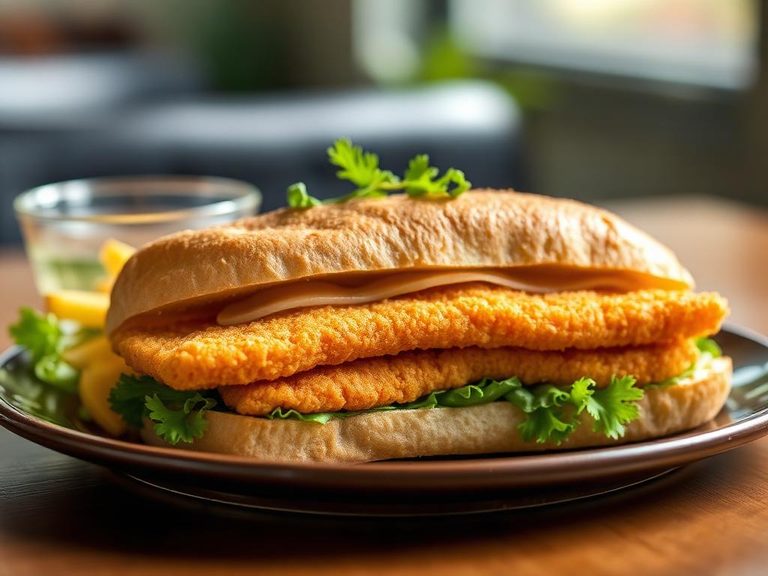
A classic fast-food staple, this sandwich features a crispy, golden-brown fish fillet nestled in a soft, pillowy bun, topped with creamy tartar sauce and a slice of melted American cheese. It delivers a satisfying contrast of textures—crunchy coating, flaky fish, and smooth sauce. Nutritionally, it's a calorie-dense meal with a moderate protein punch but a significant load from refined carbs and fats.
Calorie split: 16% protein · 37% carbs · 47% fat
↓ Full nutrition💚 Why it's loved
People adore the comforting, savory combination of salty, crispy fish with the cool, tangy creaminess of tartar sauce. It's a nostalgic, indulgent treat that hits a perfect balance of umami, fat, and a hint of sweetness from the bun and sauce.
⚠️ Watch-outs & how to enjoy it better
This sandwich is high in sodium, refined carbohydrates, and saturated fat, which can contribute to blood-sugar spikes and isn't ideal for heart-health-conscious diets. To counteract, pair it with a side salad or steamed vegetables for fiber, opt for a smaller portion, and drink water instead of sugary soda.
Key benefits
- Provides a quick source of energy from carbohydrates and fats.
- Offers a moderate amount of protein (11.26g per 100g) for muscle maintenance.
- The fish component can be a source of omega-3 fatty acids, depending on the type used.
- Convenient and widely available for a fast meal option.
🍽️ Popular dishes


🌍 Where it's eaten
💡 Did you know?
The Filet-O-Fish was the first new sandwich added to McDonald's original menu, created in 1962 to cater to Catholic customers in Cincinnati who abstained from meat on Fridays.
Full nutrition (USDA data · scales with serving)
| Water | 45.8 g |
| Energy | 279 kcal |
| Energy | 1168 kj |
| Protein | 11.3 g |
| Total lipid (fat) | 14.6 g |
| Ash | 1.9 g |
| Carbohydrate, by difference | 26.4 g |
| Fiber, total dietary | 0.80 g |
| Total Sugars | 3.7 g |
| Sucrose | 0.10 g |
| Glucose | 1.0 g |
| Fructose | 1.9 g |
| Lactose | 0.20 g |
| Maltose | 0.43 g |
| Galactose | 0.00 g |
| Calcium, Ca | 120 mg |
| Iron, Fe | 1.6 mg |
| Magnesium, Mg | 27.0 mg |
| Phosphorus, P | 137 mg |
| Potassium, K | 220 mg |
| Sodium, Na | 434 mg |
| Zinc, Zn | 0.58 mg |
| Copper, Cu | 0.07 mg |
| Manganese, Mn | 0.26 mg |
| Selenium, Se | 48.4 ug |
| Vitamin C, total ascorbic acid | 1.5 mg |
| Thiamin | 0.25 mg |
| Riboflavin | 0.23 mg |
| Niacin | 2.3 mg |
| Pantothenic acid | 0.24 mg |
| Vitamin B-6 | 0.06 mg |
| Folate, total | 44.0 ug |
| Folic acid | 31.0 ug |
| Folate, food | 12.0 ug |
| Folate, DFE | 65.0 ug |
| Choline, total | 32.6 mg |
| Betaine | 98.2 mg |
| Vitamin B-12 | 0.59 ug |
| Vitamin B-12, added | 0.00 ug |
| Vitamin A, RAE | 22.0 ug |
| Retinol | 20.0 ug |
| Carotene, beta | 17.0 ug |
| Carotene, alpha | 2.0 ug |
| Cryptoxanthin, beta | 6.0 ug |
| Vitamin A, IU | 101 iu |
| Lycopene | 0.00 ug |
| Lutein + zeaxanthin | 28.0 ug |
| Vitamin E (alpha-tocopherol) | 1.0 mg |
| Vitamin E, added | 0.00 mg |
| Vitamin D (D2 + D3), International Units | 37.0 iu |
| Vitamin D (D2 + D3) | 0.90 ug |
| Vitamin K (phylloquinone) | 7.9 ug |
| Alcohol, ethyl | 0.00 g |
| Caffeine | 0.00 mg |
| Theobromine | 0.00 mg |
Fat & fatty acid profile (per 100g)
| Fatty acids, total saturated | 2.8 g |
| SFA 4:0 | 0.03 g |
| SFA 6:0 | 0.02 g |
| SFA 8:0 | 0.02 g |
| SFA 10:0 | 0.04 g |
| SFA 12:0 | 0.05 g |
| SFA 14:0 | 0.16 g |
| SFA 15:0 | 0.02 g |
| SFA 16:0 | 1.6 g |
| SFA 17:0 | 0.02 g |
| SFA 18:0 | 0.75 g |
| SFA 20:0 | 0.05 g |
| SFA 22:0 | 0.04 g |
| SFA 24:0 | 0.02 g |
| Fatty acids, total monounsaturated | 4.0 g |
| MUFA 14:1 | 0.01 g |
| MUFA 15:1 | 0.00 g |
| MUFA 16:1 | 0.05 g |
| MUFA 16:1 c | 0.04 g |
| MUFA 17:1 | 0.01 g |
| MUFA 18:1 | 3.8 g |
| MUFA 18:1 c | 3.8 g |
| MUFA 20:1 | 0.07 g |
| MUFA 22:1 | 0.01 g |
| MUFA 22:1 c | 0.01 g |
| MUFA 24:1 c | 0.01 g |
| Fatty acids, total polyunsaturated | 6.0 g |
| PUFA 18:2 | 5.2 g |
| PUFA 18:2 n-6 c,c | 5.1 g |
| PUFA 18:2 CLAs | 0.02 g |
| PUFA 18:3 | 0.64 g |
| PUFA 18:3 n-3 c,c,c (ALA) | 0.61 g |
| PUFA 18:3 n-6 c,c,c | 0.02 g |
| PUFA 18:4 | 0.00 g |
| PUFA 20:2 n-6 c,c | 0.01 g |
| PUFA 20:3 | 0.01 g |
| PUFA 20:3 n-3 | 0.00 g |
| PUFA 20:3 n-6 | 0.01 g |
| PUFA 20:4 | 0.01 g |
| PUFA 20:5 n-3 (EPA) | 0.03 g |
| PUFA 22:4 | 0.01 g |
| PUFA 22:5 n-3 (DPA) | 0.01 g |
| PUFA 22:6 n-3 (DHA) | 0.06 g |
| Fatty acids, total trans | 0.13 g |
| Fatty acids, total trans-monoenoic | 0.07 g |
| TFA 16:1 t | 0.01 g |
| TFA 18:1 t | 0.06 g |
| TFA 22:1 t | 0.00 g |
| TFA 18:2 t not further defined | 0.06 g |
| Fatty acids, total trans-polyenoic | 0.06 g |
| Cholesterol | 37.0 mg |
Amino acid profile (per 100g)
Estimated from Fast foods, english muffin, with egg, cheese, and sausage — USDA does not publish this profile for Fast foods.
| Tryptophan | 0.16 g |
| Threonine | 0.52 g |
| Isoleucine | 0.54 g |
| Leucine | 0.98 g |
| Lysine | 0.75 g |
| Methionine | 0.29 g |
| Cystine | 0.20 g |
| Phenylalanine | 0.59 g |
| Tyrosine | 0.41 g |
| Valine | 0.65 g |
| Arginine | 0.65 g |
| Histidine | 0.33 g |
| Alanine | 0.60 g |
| Aspartic acid | 1.1 g |
| Glutamic acid | 2.5 g |
| Glycine | 0.54 g |
| Proline | 0.90 g |
| Serine | 0.70 g |
FAQ
What kind of fish is typically used in a fast-food fish sandwich?
Most commonly, it's made from mild, white fish like pollock, cod, or haddock, which are ground, formed into a patty, and breaded.
Is the fish in a fish sandwich healthy?
While fish itself is a good source of protein and omega-3s, the deep-frying process and high-sodium breading and sauces significantly reduce its health benefits, making it more of an occasional indulgence.
Why is tartar sauce so common on fish sandwiches?
Tartar sauce, a creamy mix of mayonnaise, pickles, capers, and herbs, provides a cool, tangy contrast that cuts through the richness of the fried fish, enhancing its flavor.
Nutrient density (calculated · NRF9.3)
Nutrient Rich Foods index: beneficial nutrients (protein, fiber, vitamins, minerals) minus saturated fat, added sugar & sodium, per 100 kcal.
NRF9.3 index — Fulgoni, Keast & Drewnowski, 2009. Computed from USDA nutrients.
Weight-loss friendliness (composite index)
Energy density 2.79 kcal/g · 16% calories from protein · 0.8 g fiber · 3.7 g sugar per 100 g.
Composite of energy density (Rolls et al., 1999), protein & fiber satiety, minus sugar. A calculated heuristic — ranks satiety-per-calorie, not a clinical measure.
Dietary load (calculated from USDA values)
Potential renal acid load. Positive = acid-forming, negative = alkaline-forming.
Sodium-to-potassium ratio: 1.97 (lower is better — aim for ≤ 1)
Sodium:potassium per WHO potassium guidance. Computed from USDA nutrients.