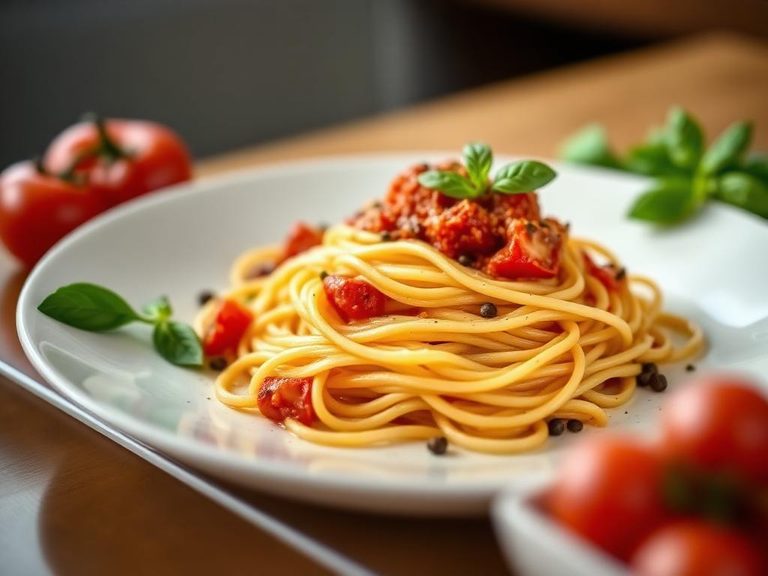
Restaurant, Italian, spaghetti with pomodoro sauce (no meat)
Whole food · Restaurant Foods
A simple, classic Italian pasta dish featuring al dente spaghetti coated in a vibrant, smooth tomato sauce. The flavor profile is bright and savory, with the natural sweetness and acidity of tomatoes balanced by garlic and herbs. Nutritionally, it's a light, low-fat, and low-calorie meal, primarily providing energy from carbohydrates.
💚 Why it's loved
People love it for its comforting, straightforward flavor that feels both rustic and satisfying. It's a beloved canvas for customization and a staple of home cooking, representing the Italian philosophy of simple, high-quality ingredients.
⚠️ Watch-outs & how to enjoy it better
The high carbohydrate content can cause rapid blood-sugar spikes, especially for those with insulin sensitivity. To counteract this, pair it with a source of protein (like a side of white beans or a sprinkle of Parmigiano-Reggiano) and healthy fat (like a drizzle of extra-virgin olive oil) to slow digestion. Also, watch portion sizes if managing calorie intake.
Key benefits
- Low in calories and fat
- Good source of quick energy from complex carbs
- Contains lycopene, an antioxidant from cooked tomatoes
- Provides dietary fiber for digestive health
- Naturally low in sodium if prepared without added salt
🍽️ Popular dishes
🌍 Where it's eaten
💡 Did you know?
The classic pomodoro sauce is traditionally made by simmering tomatoes for only 15-20 minutes to preserve their fresh, bright flavor—a stark contrast to the long-cooked ragùs of Northern Italy.
Full nutrition (scales with serving)
| Water | 75.6 g |
| Energy | 104 kcal |
| Energy | 434 kj |
| Protein | 3.9 g |
| Total lipid (fat) | 1.9 g |
| Ash | 0.89 g |
| Carbohydrate, by difference | 17.8 g |
| Fiber, total dietary | 1.7 g |
| Total Sugars | 1.8 g |
| Sucrose | 0.00 g |
| Glucose | 0.91 g |
| Fructose | 0.91 g |
| Lactose | 0.00 g |
| Maltose | 0.00 g |
| Galactose | 0.00 g |
| Starch | 12.1 g |
| Calcium, Ca | 15.0 mg |
| Iron, Fe | 0.90 mg |
| Magnesium, Mg | 16.0 mg |
| Phosphorus, P | 44.0 mg |
| Potassium, K | 140 mg |
| Sodium, Na | 191 mg |
| Zinc, Zn | 0.35 mg |
| Copper, Cu | 0.07 mg |
| Manganese, Mn | 0.21 mg |
| Selenium, Se | 10.1 ug |
| Vitamin C, total ascorbic acid | 1.1 mg |
| Thiamin | 0.07 mg |
| Riboflavin | 0.12 mg |
| Niacin | 1.2 mg |
| Pantothenic acid | 0.19 mg |
| Vitamin B-6 | 0.08 mg |
| Folate, total | 29.0 ug |
| Choline, total | 8.0 mg |
| Betaine | 472 mg |
| Vitamin A, RAE | 10.0 ug |
| Carotene, beta | 120 ug |
| Carotene, alpha | 0.00 ug |
| Cryptoxanthin, beta | 2.0 ug |
| Vitamin A, IU | 202 iu |
| Lycopene | 1872 ug |
| Lutein + zeaxanthin | 132 ug |
| Vitamin E (alpha-tocopherol) | 0.81 mg |
| Tocopherol, beta | 0.00 mg |
| Tocopherol, gamma | 0.33 mg |
| Tocopherol, delta | 0.02 mg |
| Tocotrienol, alpha | 0.02 mg |
| Tocotrienol, beta | 0.23 mg |
| Tocotrienol, gamma | 0.00 mg |
| Tocotrienol, delta | 0.00 mg |
| Vitamin K (phylloquinone) | 4.0 ug |
| Vitamin K (Dihydrophylloquinone) | 0.00 ug |
| Vitamin K (Menaquinone-4) | 0.00 ug |
Fat & fatty acid profile (per 100g)
| Fatty acids, total saturated | 0.37 g |
| SFA 4:0 | 0.00 g |
| SFA 6:0 | 0.00 g |
| SFA 8:0 | 0.00 g |
| SFA 10:0 | 0.00 g |
| SFA 12:0 | 0.00 g |
| SFA 14:0 | 0.01 g |
| SFA 15:0 | 0.00 g |
| SFA 16:0 | 0.26 g |
| SFA 17:0 | 0.00 g |
| SFA 18:0 | 0.07 g |
| SFA 20:0 | 0.01 g |
| SFA 22:0 | 0.00 g |
| SFA 24:0 | 0.00 g |
| Fatty acids, total monounsaturated | 0.93 g |
| MUFA 14:1 | 0.00 g |
| MUFA 15:1 | 0.00 g |
| MUFA 16:1 | 0.01 g |
| MUFA 16:1 c | 0.01 g |
| MUFA 17:1 | 0.00 g |
| MUFA 18:1 | 0.90 g |
| MUFA 18:1 c | 0.89 g |
| MUFA 20:1 | 0.01 g |
| MUFA 22:1 | 0.00 g |
| MUFA 22:1 c | 0.00 g |
| MUFA 24:1 c | 0.00 g |
| Fatty acids, total polyunsaturated | 0.53 g |
| PUFA 18:2 | 0.45 g |
| PUFA 18:2 n-6 c,c | 0.44 g |
| PUFA 18:2 CLAs | 0.00 g |
| PUFA 18:3 | 0.08 g |
| PUFA 18:3 n-3 c,c,c (ALA) | 0.07 g |
| PUFA 18:3 n-6 c,c,c | 0.00 g |
| PUFA 18:3i | 0.00 g |
| PUFA 18:4 | 0.00 g |
| PUFA 20:2 n-6 c,c | 0.00 g |
| PUFA 20:3 | 0.00 g |
| PUFA 20:3 n-3 | 0.00 g |
| PUFA 20:3 n-6 | 0.00 g |
| PUFA 20:4 | 0.00 g |
| PUFA 20:5 n-3 (EPA) | 0.00 g |
| PUFA 22:4 | 0.00 g |
| PUFA 22:5 n-3 (DPA) | 0.00 g |
| PUFA 22:6 n-3 (DHA) | 0.00 g |
| Fatty acids, total trans | 0.01 g |
| Fatty acids, total trans-monoenoic | 0.01 g |
| TFA 16:1 t | 0.00 g |
| TFA 18:1 t | 0.01 g |
| TFA 22:1 t | 0.00 g |
| TFA 18:2 t not further defined | 0.00 g |
| Fatty acids, total trans-polyenoic | 0.00 g |
| Cholesterol | 0.00 mg |
Amino acid profile (per 100g)
| Tryptophan | 0.04 g |
| Threonine | 0.10 g |
| Isoleucine | 0.12 g |
| Leucine | 0.23 g |
| Lysine | 0.08 g |
| Methionine | 0.06 g |
| Cystine | 0.07 g |
| Phenylalanine | 0.17 g |
| Tyrosine | 0.09 g |
| Valine | 0.14 g |
| Arginine | 0.15 g |
| Histidine | 0.07 g |
| Alanine | 0.12 g |
| Aspartic acid | 0.24 g |
| Glutamic acid | 1.3 g |
| Glycine | 0.10 g |
| Proline | 0.39 g |
| Serine | 0.17 g |
| Hydroxyproline | 0.00 g |
FAQ
What's the difference between pomodoro and marinara sauce?
Pomodoro sauce is a simpler, fresher tomato sauce often made with just tomatoes, garlic, and basil. Marinara is a similar base but is typically more seasoned with oregano, onion, and sometimes capers or olives, and is often cooked down further.
Is spaghetti with pomodoro sauce vegan?
The base dish is vegan. However, many restaurant or pre-made versions may contain butter, Parmesan cheese, or anchovies. Always check ingredients or ask when dining out.
How can I add more protein to this dish?
Toss in white beans (cannellini), chickpeas, or lentils. Top with grilled chicken, shrimp, or a poached egg. For a plant-based boost, use nutritional yeast or a vegan cheese alternative.