

Sauce, horseradish
Whole food · Soups, Sauces, and Gravies

Photo: Wikipedia
Horseradish sauce is a fiery, creamy condiment made from the grated root of the horseradish plant, often blended with vinegar, cream, or mayonnaise. Its texture is typically smooth or slightly coarse, delivering a sharp, pungent heat that clears the sinuses. Nutritionally, it's very low in protein and carbs but is a significant source of fat, primarily from its creamy base.
Calorie split: 1% protein · 8% carbs · 91% fat
↓ Full nutrition💚 Why it's loved
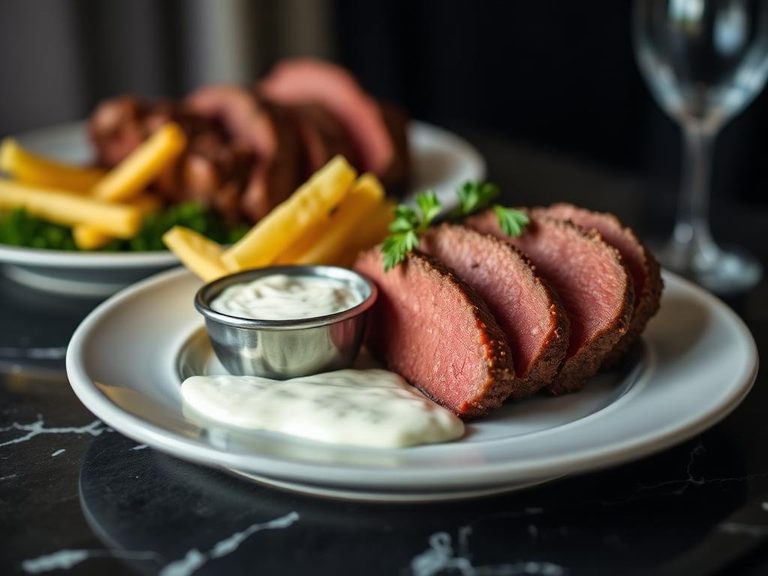
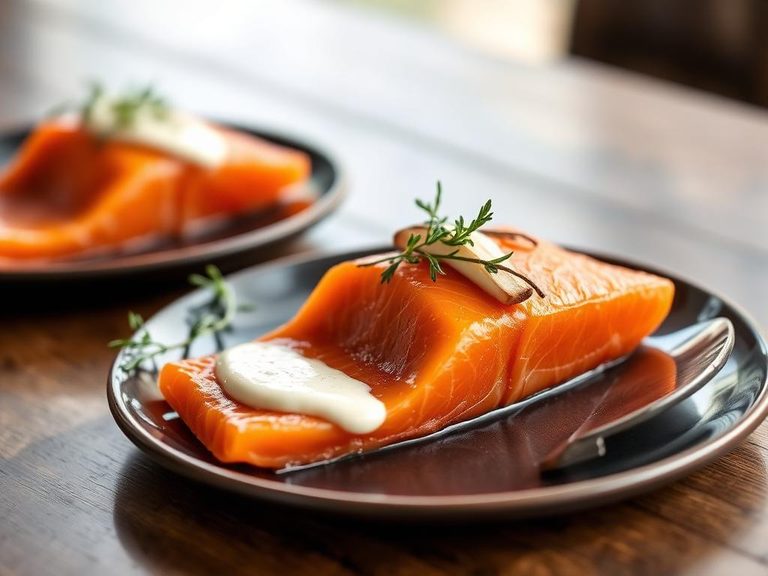
People love it for its unique, sinus-clearing kick that cuts through rich, fatty foods like roast beef or smoked fish. Its versatility as a flavor booster in sauces, dips, and dressings makes it a beloved pantry staple in many culinary traditions.
⚠️ Watch-outs & how to enjoy it better
The high fat content, often from mayonnaise or cream, makes it calorie-dense and a potential concern for those monitoring fat intake. Its intense pungency can be overwhelming for some palates. To counteract, use it sparingly as a condiment rather than a main sauce, or look for lighter versions blended with yogurt or sour cream to reduce fat.
Key benefits
- Contains compounds like glucosinolates, which are studied for potential antioxidant properties.
- Low in sugar and carbohydrates, making it suitable for low-carb diets.
- Adds intense flavor without needing large quantities, aiding in flavor enhancement.
- Traditionally used as a digestive aid in many cuisines.
🍽️ Popular dishes

🌍 Where it's eaten
💡 Did you know?
The heat in horseradish is released only when the root is grated or crushed, as an enzyme reaction requires contact with air.
Full nutrition (USDA data · scales with serving)
| Water | 35.8 g |
| Energy | 503 kcal |
| Energy | 2103 kj |
| Protein | 1.1 g |
| Total lipid (fat) | 50.9 g |
| Ash | 2.1 g |
| Carbohydrate, by difference | 10.1 g |
| Fiber, total dietary | 1.0 g |
| Total Sugars | 9.0 g |
| Sucrose | 0.88 g |
| Glucose | 4.1 g |
| Fructose | 4.0 g |
| Lactose | 0.00 g |
| Maltose | 0.00 g |
| Galactose | 0.00 g |
| Starch | 0.50 g |
| Calcium, Ca | 12.0 mg |
| Iron, Fe | 0.23 mg |
| Magnesium, Mg | 6.0 mg |
| Phosphorus, P | 19.0 mg |
| Potassium, K | 44.0 mg |
| Sodium, Na | 730 mg |
| Zinc, Zn | 0.17 mg |
| Copper, Cu | 0.02 mg |
| Manganese, Mn | 0.04 mg |
| Selenium, Se | 2.2 ug |
| Vitamin C, total ascorbic acid | 0.20 mg |
| Thiamin | 0.05 mg |
| Riboflavin | 0.04 mg |
| Niacin | 0.12 mg |
| Pantothenic acid | 0.00 mg |
| Vitamin B-6 | 0.04 mg |
| Folate, total | 1.0 ug |
| Folic acid | 0.00 ug |
| Folate, food | 1.0 ug |
| Folate, DFE | 1.0 ug |
| Choline, total | 38.4 mg |
| Vitamin B-12 | 0.09 ug |
| Vitamin B-12, added | 0.00 ug |
| Vitamin A, RAE | 17.0 ug |
| Retinol | 17.0 ug |
| Carotene, beta | 4.0 ug |
| Carotene, alpha | 2.0 ug |
| Cryptoxanthin, beta | 2.0 ug |
| Vitamin A, IU | 66.0 iu |
| Lycopene | 0.00 ug |
| Lutein + zeaxanthin | 51.0 ug |
| Vitamin E (alpha-tocopherol) | 4.2 mg |
| Vitamin E, added | 0.00 mg |
| Vitamin D (D2 + D3), International Units | 10.0 iu |
| Vitamin D (D2 + D3) | 0.20 ug |
| Vitamin K (phylloquinone) | 91.3 ug |
| Alcohol, ethyl | 0.00 g |
| Caffeine | 0.00 mg |
| Theobromine | 0.00 mg |
Fat & fatty acid profile (per 100g)
| Fatty acids, total saturated | 8.2 g |
| SFA 4:0 | 0.00 g |
| SFA 6:0 | 0.00 g |
| SFA 8:0 | 0.00 g |
| SFA 10:0 | 0.01 g |
| SFA 12:0 | 0.01 g |
| SFA 14:0 | 0.04 g |
| SFA 15:0 | 0.01 g |
| SFA 16:0 | 5.4 g |
| SFA 17:0 | 0.05 g |
| SFA 18:0 | 2.3 g |
| SFA 20:0 | 0.19 g |
| SFA 22:0 | 0.17 g |
| SFA 24:0 | 0.07 g |
| Fatty acids, total monounsaturated | 13.1 g |
| MUFA 14:1 | 0.00 g |
| MUFA 15:1 | 0.00 g |
| MUFA 16:1 | 0.06 g |
| MUFA 16:1 c | 0.06 g |
| MUFA 17:1 | 0.03 g |
| MUFA 18:1 | 12.5 g |
| MUFA 18:1 c | 12.5 g |
| MUFA 20:1 | 0.34 g |
| MUFA 22:1 | 0.13 g |
| MUFA 22:1 c | 0.12 g |
| MUFA 24:1 c | 0.01 g |
| Fatty acids, total polyunsaturated | 29.2 g |
| PUFA 18:2 | 25.5 g |
| PUFA 18:2 n-6 c,c | 25.3 g |
| PUFA 18:2 CLAs | 0.05 g |
| PUFA 18:3 | 3.6 g |
| PUFA 18:3 n-3 c,c,c (ALA) | 3.4 g |
| PUFA 18:3 n-6 c,c,c | 0.17 g |
| PUFA 18:3i | 0.00 g |
| PUFA 18:4 | 0.00 g |
| PUFA 20:2 n-6 c,c | 0.02 g |
| PUFA 20:3 | 0.01 g |
| PUFA 20:3 n-3 | 0.00 g |
| PUFA 20:3 n-6 | 0.00 g |
| PUFA 20:4 | 0.03 g |
| PUFA 20:5 n-3 (EPA) | 0.00 g |
| PUFA 22:4 | 0.00 g |
| PUFA 22:5 n-3 (DPA) | 0.00 g |
| PUFA 22:6 n-3 (DHA) | 0.00 g |
| Fatty acids, total trans | 0.18 g |
| Fatty acids, total trans-monoenoic | 0.03 g |
| TFA 16:1 t | 0.00 g |
| TFA 18:1 t | 0.02 g |
| TFA 22:1 t | 0.01 g |
| TFA 18:2 t not further defined | 0.15 g |
| Fatty acids, total trans-polyenoic | 0.15 g |
| Cholesterol | 50.0 mg |
Amino acid profile (per 100g)
Estimated from Sauce, homemade, white, medium — USDA does not publish this profile for Sauce.
| Tryptophan | 0.04 g |
| Threonine | 0.14 g |
| Isoleucine | 0.19 g |
| Leucine | 0.30 g |
| Lysine | 0.24 g |
| Methionine | 0.08 g |
| Cystine | 0.03 g |
| Phenylalanine | 0.15 g |
| Tyrosine | 0.15 g |
| Valine | 0.20 g |
| Arginine | 0.11 g |
| Histidine | 0.08 g |
| Alanine | 0.10 g |
| Aspartic acid | 0.23 g |
| Glutamic acid | 0.64 g |
| Glycine | 0.07 g |
| Proline | 0.30 g |
| Serine | 0.17 g |
FAQ
Is horseradish sauce the same as prepared horseradish?
Not exactly. Prepared horseradish is simply grated horseradish root preserved in vinegar. Horseradish sauce is a prepared condiment that typically mixes prepared horseradish with cream, mayonnaise, or sour cream, making it milder and richer.
How can I reduce the sharpness of horseradish sauce?
You can mellow its heat by mixing it with more of its creamy base (like sour cream or yogurt), adding a touch of sugar or honey, or letting it sit for a few minutes after mixing, as the pungency can mellow slightly over time.
Is the fat in horseradish sauce healthy?
The fat comes from its creamy base, which is typically saturated fat from dairy or mayonnaise. While it can be part of a balanced diet, it's best used in moderation, especially for those watching their saturated fat intake.
Nutrient density (calculated · NRF9.3)
Nutrient Rich Foods index: beneficial nutrients (protein, fiber, vitamins, minerals) minus saturated fat, added sugar & sodium, per 100 kcal.
NRF9.3 index — Fulgoni, Keast & Drewnowski, 2009. Computed from USDA nutrients.
Weight-loss friendliness (composite index)
Energy density 5.03 kcal/g · 1% calories from protein · 1.0 g fiber · 9.0 g sugar per 100 g.
Composite of energy density (Rolls et al., 1999), protein & fiber satiety, minus sugar. A calculated heuristic — ranks satiety-per-calorie, not a clinical measure.
Dietary load (calculated from USDA values)
Potential renal acid load. Positive = acid-forming, negative = alkaline-forming.
Sodium-to-potassium ratio: 16.59 (lower is better — aim for ≤ 1)
Sodium:potassium per WHO potassium guidance. Computed from USDA nutrients.