

Fast Food, Pizza Chain, 14" pizza, sausage topping, thick crust
Whole food · Fast Foods
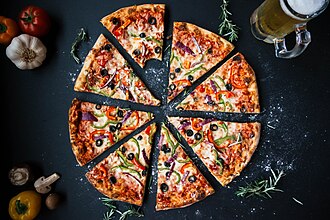
Photo: Wikipedia
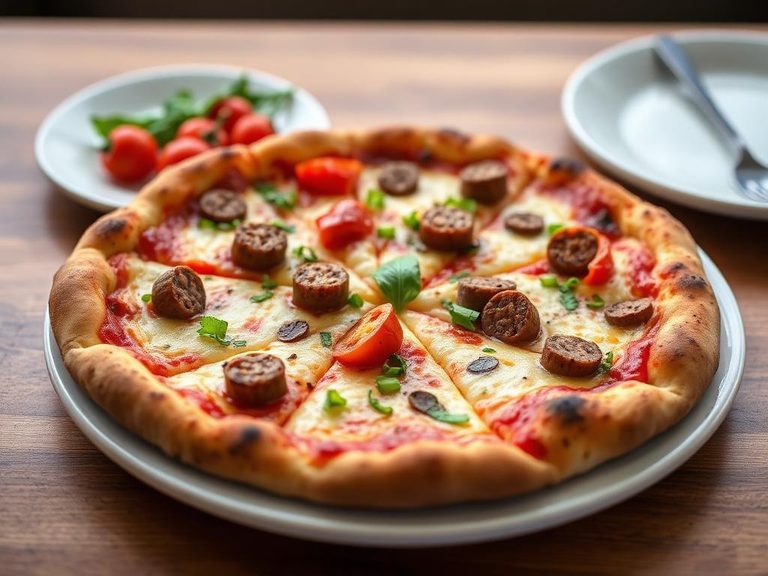
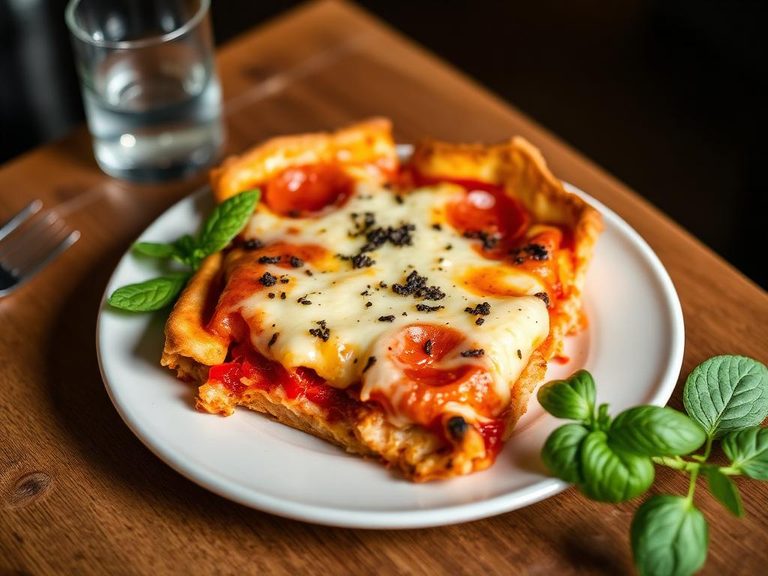
This is a hearty, indulgent slice of thick-crust pizza topped with savory sausage, a staple of American fast-food chains. The crust offers a bready, chewy foundation, while the sausage provides a salty, meaty punch against the melted cheese and tomato sauce. Nutritionally, it's a calorie-dense meal, with over half its calories coming from fat.
Calorie split: 16% protein · 43% carbs · 41% fat
↓ Full nutrition💚 Why it's loved
People love it for its satisfying, savory flavor combination and the comforting, filling texture of the thick crust. It's a social food, deeply tied to gatherings, game nights, and casual dining culture.
⚠️ Watch-outs & how to enjoy it better
The high fat, refined carbohydrate, and sodium content can contribute to blood sugar spikes and may not suit those monitoring heart health or blood pressure. To counteract, pair a smaller portion with a large, vinegar-dressed salad to increase fiber and slow digestion, and drink water instead of sugary soda.
Key benefits
- Provides a significant source of protein from sausage and cheese.
- Offers a quick and convenient source of energy from carbohydrates.
- Contains dietary fiber, primarily from the wheat-based crust.
- Can be a source of certain B vitamins and minerals like iron from the enriched flour and meat.
🍽️ Popular dishes


🌍 Where it's eaten
💡 Did you know?
The 'thick crust' style often associated with American fast-food chains is a distant cousin to the traditional Italian 'focaccia' bread, but engineered for a softer, chewier, and more uniform texture suitable for mass production and delivery.
Full nutrition (USDA data · scales with serving)
| Water | 43.2 g |
| Energy | 282 kcal |
| Energy | 1181 kj |
| Protein | 11.1 g |
| Total lipid (fat) | 12.9 g |
| Ash | 2.4 g |
| Carbohydrate, by difference | 30.4 g |
| Fiber, total dietary | 2.3 g |
| Total Sugars | 2.8 g |
| Sucrose | 0.15 g |
| Glucose | 0.42 g |
| Fructose | 0.60 g |
| Lactose | 0.50 g |
| Maltose | 1.1 g |
| Galactose | 0.08 g |
| Starch | 24.1 g |
| Calcium, Ca | 143 mg |
| Iron, Fe | 2.5 mg |
| Magnesium, Mg | 23.0 mg |
| Phosphorus, P | 193 mg |
| Potassium, K | 190 mg |
| Sodium, Na | 637 mg |
| Zinc, Zn | 1.3 mg |
| Copper, Cu | 0.11 mg |
| Manganese, Mn | 0.32 mg |
| Selenium, Se | 17.7 ug |
| Vitamin C, total ascorbic acid | 1.0 mg |
| Thiamin | 0.39 mg |
| Riboflavin | 0.19 mg |
| Niacin | 3.6 mg |
| Vitamin B-6 | 0.07 mg |
| Folate, total | 98.0 ug |
| Folic acid | 55.0 ug |
| Folate, food | 43.0 ug |
| Folate, DFE | 136 ug |
| Choline, total | 25.5 mg |
| Vitamin B-12 | 0.49 ug |
| Vitamin B-12, added | 0.00 ug |
| Vitamin A, RAE | 67.0 ug |
| Retinol | 60.0 ug |
| Carotene, beta | 91.0 ug |
| Carotene, alpha | 0.00 ug |
| Cryptoxanthin, beta | 0.00 ug |
| Vitamin A, IU | 351 iu |
| Lycopene | 1878 ug |
| Lutein + zeaxanthin | 22.0 ug |
| Vitamin E (alpha-tocopherol) | 0.90 mg |
| Vitamin E, added | 0.00 mg |
| Vitamin D (D2 + D3), International Units | 0.00 iu |
| Vitamin D (D2 + D3) | 0.00 ug |
| Vitamin K (phylloquinone) | 11.8 ug |
| Alcohol, ethyl | 0.00 g |
| Caffeine | 0.00 mg |
| Theobromine | 0.00 mg |
Fat & fatty acid profile (per 100g)
| Fatty acids, total saturated | 4.8 g |
| SFA 4:0 | 0.08 g |
| SFA 6:0 | 0.06 g |
| SFA 8:0 | 0.04 g |
| SFA 10:0 | 0.11 g |
| SFA 12:0 | 0.13 g |
| SFA 14:0 | 0.49 g |
| SFA 15:0 | 0.05 g |
| SFA 16:0 | 2.6 g |
| SFA 17:0 | 0.05 g |
| SFA 18:0 | 1.1 g |
| SFA 20:0 | 0.03 g |
| SFA 22:0 | 0.02 g |
| SFA 24:0 | 0.01 g |
| Fatty acids, total monounsaturated | 3.9 g |
| MUFA 14:1 | 0.04 g |
| MUFA 15:1 | 0.00 g |
| MUFA 16:1 | 0.18 g |
| MUFA 16:1 c | 0.17 g |
| MUFA 17:1 | 0.02 g |
| MUFA 18:1 | 3.6 g |
| MUFA 18:1 c | 3.5 g |
| MUFA 20:1 | 0.07 g |
| MUFA 22:1 | 0.00 g |
| MUFA 22:1 c | 0.00 g |
| MUFA 24:1 c | 0.00 g |
| Fatty acids, total polyunsaturated | 3.2 g |
| PUFA 18:2 | 2.8 g |
| PUFA 18:2 n-6 c,c | 2.7 g |
| PUFA 18:2 CLAs | 0.04 g |
| PUFA 18:3 | 0.30 g |
| PUFA 18:3 n-3 c,c,c (ALA) | 0.30 g |
| PUFA 18:3 n-6 c,c,c | 0.00 g |
| PUFA 18:4 | 0.00 g |
| PUFA 20:2 n-6 c,c | 0.03 g |
| PUFA 20:3 | 0.02 g |
| PUFA 20:3 n-3 | 0.01 g |
| PUFA 20:3 n-6 | 0.01 g |
| PUFA 20:4 | 0.03 g |
| PUFA 20:5 n-3 (EPA) | 0.00 g |
| PUFA 22:4 | 0.01 g |
| PUFA 22:5 n-3 (DPA) | 0.01 g |
| PUFA 22:6 n-3 (DHA) | 0.00 g |
| Fatty acids, total trans | 0.23 g |
| Fatty acids, total trans-monoenoic | 0.17 g |
| TFA 16:1 t | 0.02 g |
| TFA 18:1 t | 0.15 g |
| TFA 22:1 t | 0.00 g |
| TFA 18:2 t not further defined | 0.06 g |
| Fatty acids, total trans-polyenoic | 0.06 g |
| Cholesterol | 23.0 mg |
Amino acid profile (per 100g)
Estimated from Fast foods, nachos, with cheese — USDA does not publish this profile for Fast Food.
| Tryptophan | 0.04 g |
| Threonine | 0.16 g |
| Isoleucine | 0.19 g |
| Leucine | 0.52 g |
| Lysine | 0.16 g |
| Methionine | 0.09 g |
| Phenylalanine | 0.23 g |
| Tyrosine | 0.14 g |
| Valine | 0.25 g |
| Arginine | 0.21 g |
| Histidine | 0.14 g |
| Alanine | 0.29 g |
| Aspartic acid | 0.34 g |
| Glutamic acid | 0.92 g |
| Glycine | 0.15 g |
| Proline | 0.53 g |
| Serine | 0.22 g |
| Hydroxyproline | 0.00 g |
FAQ
How does the thick crust affect the nutrition compared to thin crust?
The thick crust significantly increases the carbohydrate and calorie content per slice. A thin-crust version would have less dough, meaning fewer carbs and calories, allowing the toppings to be more prominent.
Is the sausage topping typically pork or beef?
Most common fast-food pizza sausage is a seasoned blend of pork and beef, though some chains offer turkey or plant-based alternatives. The specific blend can vary by brand and region.
Can this be part of a balanced diet?
Yes, in moderation. Enjoying a single slice as part of a meal that includes vegetables and lean protein, and being mindful of overall daily intake, can fit into a balanced eating pattern.
Nutrient density (calculated · NRF9.3)
Nutrient Rich Foods index: beneficial nutrients (protein, fiber, vitamins, minerals) minus saturated fat, added sugar & sodium, per 100 kcal.
NRF9.3 index — Fulgoni, Keast & Drewnowski, 2009. Computed from USDA nutrients.
Weight-loss friendliness (composite index)
Energy density 2.82 kcal/g · 16% calories from protein · 2.3 g fiber · 2.8 g sugar per 100 g.
Composite of energy density (Rolls et al., 1999), protein & fiber satiety, minus sugar. A calculated heuristic — ranks satiety-per-calorie, not a clinical measure.
Dietary load (calculated from USDA values)
Potential renal acid load. Positive = acid-forming, negative = alkaline-forming.
Sodium-to-potassium ratio: 3.35 (lower is better — aim for ≤ 1)
Sodium:potassium per WHO potassium guidance. Computed from USDA nutrients.