

DENNY'S, chicken strips
Whole food · Restaurant Foods

Photo: Wikipedia
Denny's chicken strips are golden-brown, breaded, and deep-fried pieces of chicken breast, offering a satisfying crunch that gives way to tender, juicy white meat. They are a hearty, savory staple of American diner fare, often served with dipping sauces like honey mustard or ranch. Nutritionally, they provide a solid dose of protein but are also a significant source of fat and refined carbohydrates from the breading.
Calorie split: 26% protein · 30% carbs · 44% fat
↓ Full nutrition💚 Why it's loved
People love them for their classic, crowd-pleasing combination of crispy coating and savory chicken, making them a reliable comfort food. They are highly versatile, easily paired with fries, coleslaw, or a side salad, and are a staple in casual dining and family meals.
⚠️ Watch-outs & how to enjoy it better
The deep-fried preparation means they are high in fat and calories, and the breading can cause a rapid blood-sugar spike. To counteract this, pair them with a fiber-rich vegetable side (like steamed broccoli or a green salad) and use sauces sparingly to control sodium and added sugar intake.
Key benefits
- Good source of complete protein (19.17g per 100g)
- Provides quick energy from carbohydrates
- Convenient and familiar comfort food
- Often served with customizable dipping sauces
🍽️ Popular dishes


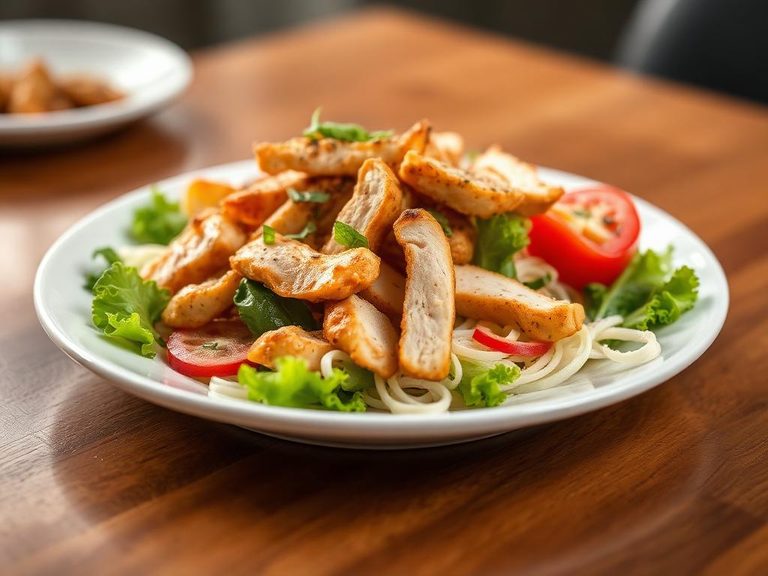
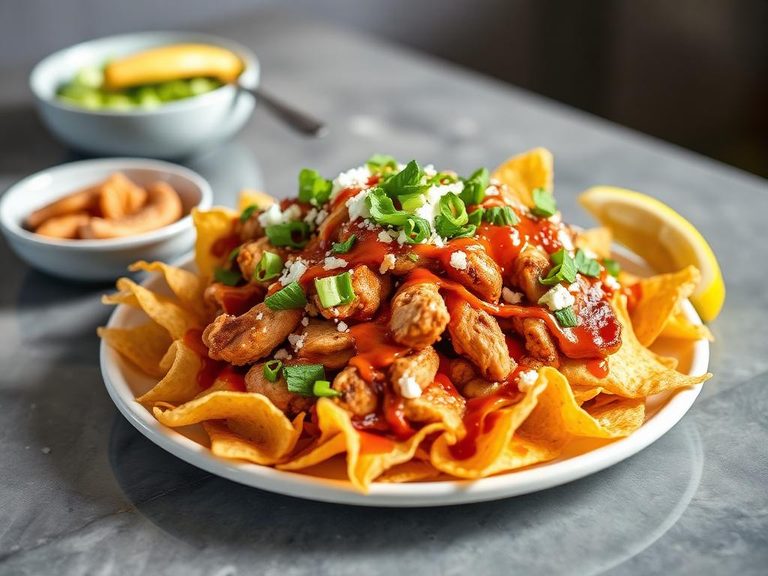
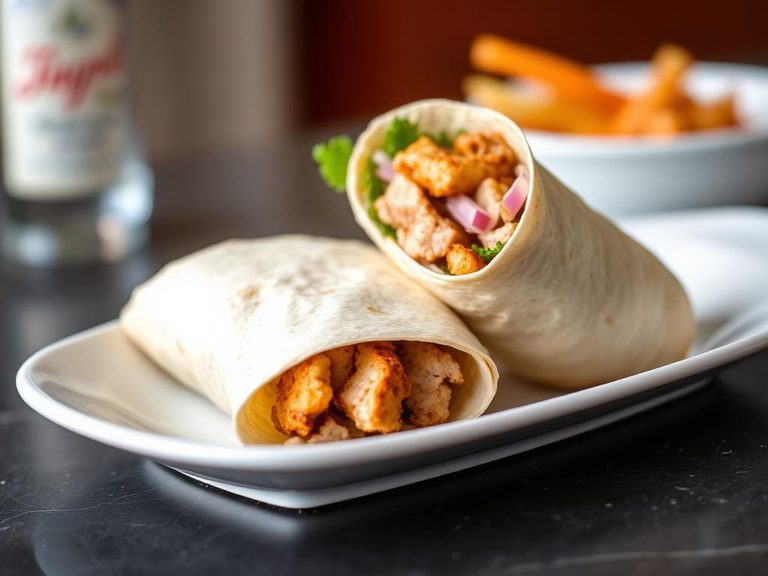
🌍 Where it's eaten
💡 Did you know?
The 'chicken finger' is said to have been invented in the 1970s at a restaurant in Massachusetts, where the owner cut chicken breasts into strips to make them easier for children to eat.
Full nutrition (USDA data · scales with serving)
| Water | 41.4 g |
| Energy | 295 kcal |
| Energy | 1236 kj |
| Protein | 19.2 g |
| Total lipid (fat) | 14.5 g |
| Ash | 2.9 g |
| Carbohydrate, by difference | 22.0 g |
| Fiber, total dietary | 1.1 g |
| Total Sugars | 0.29 g |
| Sucrose | 0.10 g |
| Glucose | 0.09 g |
| Fructose | 0.00 g |
| Lactose | 0.00 g |
| Maltose | 0.10 g |
| Galactose | 0.00 g |
| Starch | 19.7 g |
| Calcium, Ca | 11.0 mg |
| Iron, Fe | 0.72 mg |
| Magnesium, Mg | 30.0 mg |
| Phosphorus, P | 273 mg |
| Potassium, K | 334 mg |
| Sodium, Na | 798 mg |
| Zinc, Zn | 0.71 mg |
| Copper, Cu | 0.07 mg |
| Manganese, Mn | 0.23 mg |
| Selenium, Se | 17.0 ug |
| Thiamin | 0.09 mg |
| Riboflavin | 0.17 mg |
| Niacin | 8.1 mg |
| Pantothenic acid | 1.4 mg |
| Vitamin B-6 | 0.47 mg |
| Folate, total | 14.0 ug |
| Vitamin B-12 | 0.14 ug |
| Vitamin A, RAE | 14.0 ug |
| Retinol | 11.0 ug |
| Carotene, beta | 22.0 ug |
| Carotene, alpha | 0.00 ug |
| Cryptoxanthin, beta | 16.0 ug |
| Vitamin A, IU | 87.0 iu |
| Lycopene | 0.00 ug |
| Lutein + zeaxanthin | 102 ug |
| Vitamin E (alpha-tocopherol) | 1.2 mg |
| Tocopherol, beta | 0.11 mg |
| Tocopherol, gamma | 6.2 mg |
| Tocopherol, delta | 2.3 mg |
| Tocotrienol, alpha | 0.01 mg |
| Tocotrienol, beta | 0.04 mg |
| Tocotrienol, gamma | 0.07 mg |
| Tocotrienol, delta | 0.00 mg |
Fat & fatty acid profile (per 100g)
| Fatty acids, total saturated | 2.6 g |
| SFA 4:0 | 0.00 g |
| SFA 6:0 | 0.00 g |
| SFA 8:0 | 0.01 g |
| SFA 10:0 | 0.00 g |
| SFA 12:0 | 0.01 g |
| SFA 14:0 | 0.02 g |
| SFA 15:0 | 0.00 g |
| SFA 16:0 | 1.6 g |
| SFA 17:0 | 0.02 g |
| SFA 18:0 | 0.82 g |
| SFA 20:0 | 0.04 g |
| SFA 22:0 | 0.04 g |
| SFA 24:0 | 0.02 g |
| Fatty acids, total monounsaturated | 3.2 g |
| MUFA 14:1 | 0.00 g |
| MUFA 15:1 | 0.00 g |
| MUFA 16:1 | 0.04 g |
| MUFA 16:1 c | 0.04 g |
| MUFA 17:1 | 0.01 g |
| MUFA 18:1 | 3.1 g |
| MUFA 18:1 c | 3.1 g |
| MUFA 20:1 | 0.04 g |
| MUFA 22:1 | 0.00 g |
| MUFA 22:1 c | 0.00 g |
| MUFA 24:1 c | 0.00 g |
| Fatty acids, total polyunsaturated | 7.1 g |
| PUFA 18:2 | 6.2 g |
| PUFA 18:2 n-6 c,c | 6.1 g |
| PUFA 18:2 CLAs | 0.02 g |
| PUFA 18:3 | 0.83 g |
| PUFA 18:3 n-3 c,c,c (ALA) | 0.77 g |
| PUFA 18:3 n-6 c,c,c | 0.06 g |
| PUFA 18:3i | 0.00 g |
| PUFA 18:4 | 0.00 g |
| PUFA 20:2 n-6 c,c | 0.01 g |
| PUFA 20:3 | 0.01 g |
| PUFA 20:3 n-3 | 0.00 g |
| PUFA 20:3 n-6 | 0.01 g |
| PUFA 20:4 | 0.04 g |
| PUFA 20:5 n-3 (EPA) | 0.00 g |
| PUFA 22:4 | 0.01 g |
| PUFA 22:5 n-3 (DPA) | 0.00 g |
| PUFA 22:6 n-3 (DHA) | 0.00 g |
| Fatty acids, total trans | 0.13 g |
| Fatty acids, total trans-monoenoic | 0.04 g |
| TFA 16:1 t | 0.00 g |
| TFA 18:1 t | 0.04 g |
| TFA 22:1 t | 0.00 g |
| TFA 18:2 t not further defined | 0.08 g |
| Fatty acids, total trans-polyenoic | 0.08 g |
| Cholesterol | 44.0 mg |
Amino acid profile (per 100g)
| Tryptophan | 0.21 g |
| Threonine | 0.63 g |
| Isoleucine | 0.76 g |
| Leucine | 1.5 g |
| Lysine | 2.2 g |
| Methionine | 0.49 g |
| Cystine | 0.22 g |
| Phenylalanine | 0.70 g |
| Tyrosine | 0.53 g |
| Valine | 0.81 g |
| Arginine | 1.2 g |
| Histidine | 0.69 g |
| Alanine | 0.90 g |
| Aspartic acid | 1.3 g |
| Glutamic acid | 3.1 g |
| Glycine | 0.80 g |
| Proline | 1.1 g |
| Serine | 0.72 g |
FAQ
Are chicken strips the same as chicken nuggets?
Not exactly. Chicken strips (or tenders) are whole muscle pieces of chicken breast, while nuggets are typically made from ground and processed chicken formed into shapes.
How can I make them healthier at home?
Bake or air-fry them instead of deep-frying, use whole-grain breadcrumbs, and pair with a large portion of vegetables.
What is the best dipping sauce for chicken strips?
This is subjective! Popular choices include honey mustard, barbecue sauce, ranch dressing, and buffalo sauce. For a lighter option, try a yogurt-based dip.
Nutrient density (calculated · NRF9.3)
Nutrient Rich Foods index: beneficial nutrients (protein, fiber, vitamins, minerals) minus saturated fat, added sugar & sodium, per 100 kcal.
NRF9.3 index — Fulgoni, Keast & Drewnowski, 2009. Computed from USDA nutrients.
Weight-loss friendliness (composite index)
Energy density 2.95 kcal/g · 26% calories from protein · 1.1 g fiber · 0.3 g sugar per 100 g.
Composite of energy density (Rolls et al., 1999), protein & fiber satiety, minus sugar. A calculated heuristic — ranks satiety-per-calorie, not a clinical measure.
Dietary load (calculated from USDA values)
Potential renal acid load. Positive = acid-forming, negative = alkaline-forming.
Sodium-to-potassium ratio: 2.39 (lower is better — aim for ≤ 1)
Sodium:potassium per WHO potassium guidance. Computed from USDA nutrients.