

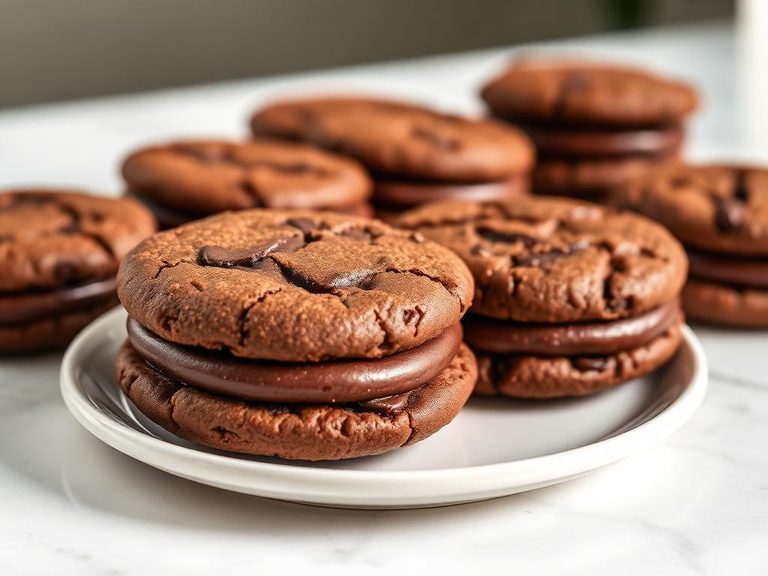
Cookies, gluten-free, chocolate sandwich, with creme filling
Whole food · Baked Products

Photo: Wikipedia
A crisp, gluten-free chocolate cookie sandwich hiding a sweet, creamy center. It delivers a satisfying snap followed by a smooth, sugary filling, offering a treat for those avoiding gluten without sacrificing the classic cookie experience. At 474 kcal per 100g, it's an energy-dense indulgence, primarily from carbohydrates and sugars.
Calorie split: 2% protein · 64% carbs · 34% fat
↓ Full nutrition💚 Why it's loved
People love it for the nostalgic pleasure of a sandwich cookie, now accessible to gluten-free eaters. The combination of chocolatey crunch and sweet creme is a universally appealing comfort food.
⚠️ Watch-outs & how to enjoy it better
The high sugar (49g/100g) and calorie content can cause blood-sugar spikes and isn't ideal for frequent snacking. It's also a common allergen risk, often containing soy, milk, and eggs. To counteract, practice strict portion control (stick to 1-2 cookies) and pair it with a source of protein or healthy fat, like a handful of nuts, to slow sugar absorption.
Key benefits
- Gluten-free formulation suitable for celiac or gluten-sensitive diets.
- Provides a quick energy boost from its high carbohydrate content.
- Offers a familiar, comforting treat in a specialized dietary format.
- The creme filling adds a contrasting texture and flavor.
🍽️ Popular dishes


🌍 Where it's eaten
💡 Did you know?
The iconic sandwich cookie design was patented in 1912, but gluten-free versions only became widely available and palatable in the 21st century due to advances in alternative flour blends.
Full nutrition (USDA data · scales with serving)
| Water | 2.8 g |
| Energy | 474 kcal |
| Energy | 1983 kj |
| Protein | 2.2 g |
| Total lipid (fat) | 17.9 g |
| Ash | 1.1 g |
| Carbohydrate, by difference | 76.0 g |
| Fiber, total dietary | 2.5 g |
| Total Sugars | 49.0 g |
| Sucrose | 47.6 g |
| Glucose | 1.0 g |
| Fructose | 0.00 g |
| Lactose | 0.00 g |
| Maltose | 0.42 g |
| Galactose | 0.00 g |
| Starch | 24.3 g |
| Calcium, Ca | 19.0 mg |
| Iron, Fe | 2.8 mg |
| Magnesium, Mg | 40.0 mg |
| Phosphorus, P | 70.0 mg |
| Potassium, K | 157 mg |
| Sodium, Na | 275 mg |
| Zinc, Zn | 0.66 mg |
| Copper, Cu | 0.26 mg |
| Manganese, Mn | 0.52 mg |
| Selenium, Se | 0.00 ug |
| Vitamin C, total ascorbic acid | 0.00 mg |
| Thiamin | 0.05 mg |
| Riboflavin | 0.08 mg |
| Niacin | 0.39 mg |
| Pantothenic acid | 0.15 mg |
| Vitamin B-6 | 0.00 mg |
| Folate, total | 0.00 ug |
| Folic acid | 0.00 ug |
| Folate, food | 0.00 ug |
| Folate, DFE | 0.00 ug |
| Choline, total | 19.6 mg |
| Vitamin B-12 | 0.00 ug |
| Vitamin B-12, added | 0.00 ug |
| Vitamin A, RAE | 0.00 ug |
| Retinol | 0.00 ug |
| Carotene, beta | 0.00 ug |
| Carotene, alpha | 0.00 ug |
| Cryptoxanthin, beta | 0.00 ug |
| Vitamin A, IU | 2.0 iu |
| Lycopene | 0.00 ug |
| Lutein + zeaxanthin | 3.0 ug |
| Vitamin E (alpha-tocopherol) | 2.3 mg |
| Vitamin E, added | 0.00 mg |
| Vitamin D (D2 + D3), International Units | 0.00 iu |
| Vitamin D (D2 + D3) | 0.00 ug |
| Vitamin K (phylloquinone) | 25.6 ug |
| Alcohol, ethyl | 0.00 g |
| Caffeine | 6.0 mg |
| Theobromine | 188 mg |
Fat & fatty acid profile (per 100g)
| Fatty acids, total saturated | 7.9 g |
| SFA 4:0 | 0.00 g |
| SFA 6:0 | 0.00 g |
| SFA 8:0 | 0.00 g |
| SFA 10:0 | 0.00 g |
| SFA 12:0 | 0.03 g |
| SFA 14:0 | 0.15 g |
| SFA 15:0 | 0.01 g |
| SFA 16:0 | 6.7 g |
| SFA 17:0 | 0.02 g |
| SFA 18:0 | 0.95 g |
| SFA 20:0 | 0.06 g |
| SFA 22:0 | 0.01 g |
| SFA 24:0 | 0.01 g |
| Fatty acids, total monounsaturated | 6.1 g |
| MUFA 14:1 | 0.00 g |
| MUFA 15:1 | 0.00 g |
| MUFA 16:1 | 0.03 g |
| MUFA 16:1 c | 0.03 g |
| MUFA 17:1 | 0.01 g |
| MUFA 18:1 | 6.1 g |
| MUFA 18:1 c | 6.0 g |
| MUFA 20:1 | 0.03 g |
| MUFA 22:1 | 0.00 g |
| MUFA 22:1 c | 0.00 g |
| MUFA 24:1 c | 0.00 g |
| Fatty acids, total polyunsaturated | 1.8 g |
| PUFA 18:2 | 1.7 g |
| PUFA 18:2 n-6 c,c | 1.7 g |
| PUFA 18:2 CLAs | 0.01 g |
| PUFA 18:3 | 0.06 g |
| PUFA 18:3 n-3 c,c,c (ALA) | 0.05 g |
| PUFA 18:3 n-6 c,c,c | 0.01 g |
| PUFA 18:3i | 0.00 g |
| PUFA 18:4 | 0.00 g |
| PUFA 20:2 n-6 c,c | 0.00 g |
| PUFA 20:3 | 0.00 g |
| PUFA 20:3 n-3 | 0.00 g |
| PUFA 20:3 n-6 | 0.00 g |
| PUFA 20:4 | 0.00 g |
| PUFA 20:5 n-3 (EPA) | 0.00 g |
| PUFA 22:4 | 0.00 g |
| PUFA 22:5 n-3 (DPA) | 0.00 g |
| PUFA 22:6 n-3 (DHA) | 0.00 g |
| Fatty acids, total trans | 0.10 g |
| Fatty acids, total trans-monoenoic | 0.06 g |
| TFA 16:1 t | 0.00 g |
| TFA 18:1 t | 0.06 g |
| TFA 22:1 t | 0.00 g |
| TFA 18:2 t not further defined | 0.04 g |
| Fatty acids, total trans-polyenoic | 0.04 g |
| Cholesterol | 0.00 mg |
Amino acid profile (per 100g)
Estimated from Cookies, animal crackers (includes arrowroot, tea biscuits) — USDA does not publish this profile for Cookies.
| Tryptophan | 0.10 g |
| Threonine | 0.19 g |
| Isoleucine | 0.26 g |
| Leucine | 0.47 g |
| Lysine | 0.24 g |
| Methionine | 0.12 g |
| Cystine | 0.15 g |
| Phenylalanine | 0.32 g |
| Tyrosine | 0.20 g |
| Valine | 0.30 g |
| Arginine | 0.26 g |
| Histidine | 0.14 g |
| Alanine | 0.21 g |
| Aspartic acid | 0.29 g |
| Glutamic acid | 2.3 g |
| Glycine | 0.23 g |
| Proline | 0.76 g |
| Serine | 0.36 g |
FAQ
Is this cookie safe for someone with celiac disease?
While formulated to be gluten-free, always check for a certified gluten-free label to ensure it was processed in a dedicated facility and isn't at risk of cross-contamination.
How does the nutrition compare to a regular chocolate sandwich cookie?
The calorie, fat, and sugar profiles are often very similar. The primary difference is the use of gluten-free flours (like rice or tapioca starch) instead of wheat flour, not a reduction in sugar or fat.
What's the best way to store these cookies?
Keep them in an airtight container at room temperature. The creme filling can dry out or the cookies can become stale if exposed to air. Freezing can extend their life for several months.
Nutrient density (calculated · NRF9.3)
Nutrient Rich Foods index: beneficial nutrients (protein, fiber, vitamins, minerals) minus saturated fat, added sugar & sodium, per 100 kcal.
NRF9.3 index — Fulgoni, Keast & Drewnowski, 2009. Computed from USDA nutrients.
Weight-loss friendliness (composite index)
Energy density 4.74 kcal/g · 2% calories from protein · 2.5 g fiber · 49.0 g sugar per 100 g.
Composite of energy density (Rolls et al., 1999), protein & fiber satiety, minus sugar. A calculated heuristic — ranks satiety-per-calorie, not a clinical measure.
Dietary load (calculated from USDA values)
Potential renal acid load. Positive = acid-forming, negative = alkaline-forming.
Sodium-to-potassium ratio: 1.75 (lower is better — aim for ≤ 1)
Sodium:potassium per WHO potassium guidance. Computed from USDA nutrients.